
The Dangers of Driving Your Own Car During Long-Distance Relocation
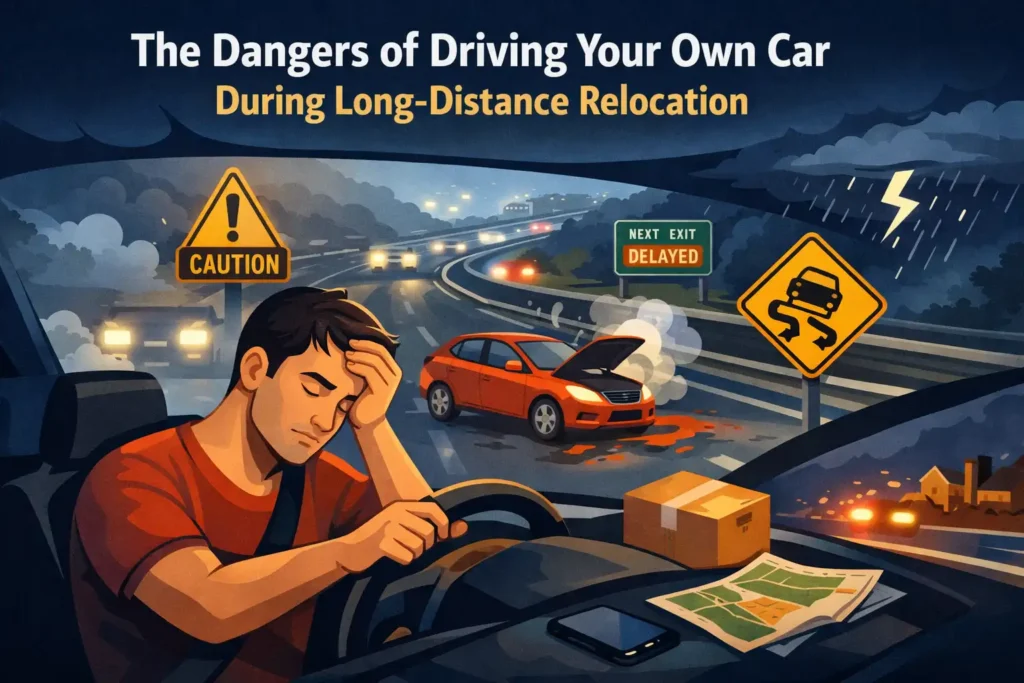
Long-distance relocation already places significant physical and mental demands on individuals, especially when coordinating packing, timelines, and logistics with professional Packers and Movers. When relocating across cities, relying on experienced packers and movers services ensures both household goods and vehicle transportation are handled safely and professionally. Adding long-distance self-driving into this equation introduces additional safety, health, and financial risks that are often underestimated. From fatigue-related accidents to unpredictable highway conditions, driving your own car across states during relocation can expose you to dangers that professional vehicle transportation is specifically designed to mitigate.
Physical Fatigue and Driver Exhaustion on Long Routes
Long-duration driving is directly associated with driver fatigue, reduced alertness, and impaired decision-making. Evidence shows that sleep deprivation and extended driving hours significantly increase the likelihood of road accidents, particularly during intercity and highway travel.
Fatigue affects drivers in subtle but dangerous ways—slower reaction times, poor hazard perception, and brief involuntary sleep episodes (microsleeps). These risks become more pronounced during relocation journeys, where drivers often attempt to cover long distances in limited timeframes.
Key fatigue-related risks during long-distance driving
- Extended driving hours without adequate rest reduce cognitive performance
- Night driving increases the probability of drowsiness-related errors
- Fatigue-related crashes are more likely to result in severe injuries or fatalities
- Drivers often underestimate their own level of exhaustion
Research examining road safety and driver alertness consistently shows that drowsy driving substantially increases crash risk, even when drivers believe they are still capable of continuing safely
Why relocation amplifies fatigue risk
During relocation, drivers are often:
- Managing pre-move stress and lack of sleep
- Driving unfamiliar routes for prolonged periods
- Coordinating calls, navigation, and schedules while on the road
These factors compound fatigue and distraction, making long-distance self-driving particularly hazardous in relocation scenarios.
National road safety data consistently links driver fatigue and night driving with a disproportionately high number of serious and fatal crashes during long-distance travel.
Higher Accident Risk During Intercity and Highway Travel
Driving across states or covering long intercity routes exposes drivers to a significantly higher accident risk compared to routine urban commuting. Long-distance highways involve higher speeds, extended driving hours, unfamiliar road conditions, and reduced margin for error—factors that collectively increase the severity and fatality rate of crashes.
National road accident data shows that a substantial proportion of fatal road accidents occur on highways and intercity roads, despite these routes carrying traffic for limited hours compared to city roads. High-speed corridors, while designed for faster travel, magnify the consequences of even minor driving errors.
Why highways are riskier during relocation driving
Unlike daily city driving, long-distance relocation trips often involve:
- Continuous high-speed driving over several hours
- Limited rest breaks due to time pressure
- Navigation through unfamiliar inter-state routes
- Reduced access to immediate emergency assistance
Road safety reports consistently indicate that accidents on highways are more likely to result in serious injury or fatalities compared to urban road accidents.
For long-distance moves, many people reduce this risk by opting for professional car transportation services instead of driving the vehicle themselves.
Increased dangers of night and early-morning highway driving
Relocation drives frequently extend into night or early morning hours to meet tight schedules. However, safety data highlights that night-time driving carries a disproportionate risk:
- Reduced visibility and depth perception
- Increased likelihood of fatigue and microsleep episodes
- Higher incidence of high-impact collisions
Despite lower traffic volumes at night, a higher percentage of fatal crashes occur after dark, indicating increased danger per kilometre driven.
Highway accident risk factors during long-distance moves
Risk Factor | How It Increases Accident Probability |
High cruising speeds | Reduced reaction and stopping time |
Unfamiliar routes | Delayed hazard recognition |
Long uninterrupted drives | Driver fatigue accumulation |
Night driving | Visibility loss and alertness decline |
Sparse emergency access | Delayed medical response |
Expert relocation insight
During relocation, drivers often attempt to “push through” long highway stretches to save time or cost. Accident trend analysis shows that this behavior directly correlates with increased crash severity, especially on intercity roads where recovery margins are minimal.
Hidden Financial Costs of Self-Driving During Relocation
At first glance, driving your own car during a long-distance move may appear cost-effective because there is no upfront transportation fee. However, documented cost analyses show that long-distance self-driving accumulates multiple indirect and often underestimated expenses that can equal or exceed professional car transport costs.
These costs are not limited to fuel alone; they extend to tolls, accommodation, food, vehicle depreciation, and unexpected repairs—all of which become unavoidable over intercity and inter-state journeys.
A detailed packers and movers cost breakdown helps compare these unpredictable self-driving expenses with fixed vehicle transport pricing.
Cost components most people overlook
During long-distance relocation, self-driving typically involves:
- Fuel expenses that increase with highway speeds and congestion
- Toll charges across multiple states and national highways
- Hotel stays or overnight halts on multi-day journeys
- Meals and incidental travel expenses
- Increased tyre wear, brake usage, and engine strain
Cost comparison studies show that when distance increases, per-kilometre self-driving costs rise steadily, while professional car transport remains a fixed, predictable expense.
Vehicle wear, depreciation, and maintenance impact
Extended highway driving accelerates vehicle wear, particularly on:
- Tyres (heat buildup and tread wear)
- Brake systems
- Suspension components
- Engine oil and cooling systems
Automotive breakdown data highlights that tyre- and battery-related failures are among the most common roadside incidents during long trips, frequently resulting in emergency repair costs.
Breakdown-related financial uncertainty
Unexpected breakdowns introduce both direct and indirect costs:
Cost Type | Financial Impact |
Emergency repairs | Unplanned service charges |
Towing | High intercity towing fees |
Delays | Additional lodging and food costs |
Missed timelines | Lost workdays and rescheduling |
Breakdown assistance reports show that long-distance travellers experience a higher frequency of roadside assistance calls compared to short-distance drivers.
Financial predictability vs uncertainty
Professional vehicle transportation services typically provide:
- Fixed pricing
- Defined delivery timelines
- Limited exposure to repair and breakdown costs
In contrast, self-driving shifts all financial risk—planned and unplanned—entirely onto the individual during an already expensive relocation process.
Mechanical Breakdown Risks Far From Home
Long-distance driving significantly increases the probability of mechanical issues, especially when vehicles are subjected to continuous high-speed operation, extended driving hours, and variable road and weather conditions. Breakdown data consistently shows that vehicles are more likely to experience failures during long journeys than during routine city use.
When a breakdown occurs far from home, the risks extend beyond inconvenience—drivers face limited repair options, higher service costs, and prolonged delays that directly disrupt relocation schedules.
Using a verified car transportation service through packers and movers eliminates owner-driven mileage and reduces the risk of roadside breakdowns during relocation.
Common mechanical failures during long-distance drives
Roadside assistance and vehicle safety analyses identify the following as the most frequent causes of breakdowns on highways:
- Tyre failures due to heat buildup, under-inflation, or worn tread
- Battery failure caused by prolonged electrical load and age
- Engine overheating linked to cooling system stress
- Brake wear and failure from extended downhill or high-speed driving
Tyre safety assessments show that tyre-related defects are a leading contributor to highway breakdowns and loss-of-control incidents during long trips.
Why breakdowns are more dangerous during relocation travel
During relocation journeys, breakdown risk is amplified because:
- Vehicles are often fully loaded, increasing mechanical strain
- Drivers may skip pre-trip inspections due to time pressure
- Breakdowns frequently occur in remote or unfamiliar areas
- Access to trusted mechanics and spare parts is limited
Breakdown service reports highlight that recovery times increase significantly in non-urban locations, especially on inter-state routes.
Practical impact of a mid-route breakdown
Breakdown Scenario | Relocation Impact |
Tyre burst on highway | Safety risk and towing cost |
Battery failure | Unexpected overnight halt |
Engine overheating | Delayed arrival by 1–2 days |
Brake issues | Immediate trip termination |
Even minor mechanical issues can cascade into major delays when repair facilities are not immediately available, affecting home possession dates, work schedules, and coordination with movers.
Why professional transport reduces breakdown exposure
Vehicle transportation services move cars without accumulating owner-driven mileage and manage mechanical risks within controlled logistics environments. This eliminates the individual’s exposure to roadside failures during relocation travel.
Stress and Distraction While Managing a Full Relocation
Long-distance relocation is not a single task—it is a combination of parallel responsibilities that demand constant attention. When individuals choose to drive their own car during a move, they combine two high-risk activities: long-duration driving and active relocation management. Safety research consistently shows that mental overload and distraction significantly impair driving performance, increasing accident probability.
Driver safety studies link cognitive distraction and fatigue with delayed reaction times, reduced situational awareness, and poor decision-making, even when drivers believe they are fully attentive.
Separating vehicle movement from personal travel allows individuals to focus on coordination with professional packers and movers rather than managing long-distance driving risks.
How relocation responsibilities create dangerous distractions
During a self-driven relocation journey, drivers commonly handle:
- Frequent phone calls from packers, landlords, or family members
- Navigation adjustments due to route changes or traffic updates
- Time pressure to meet move-in, unloading, or possession deadlines
- Ongoing stress related to household goods, documentation, and logistics
Road safety literature shows that cognitive distraction—such as planning, stress, or problem-solving while driving—can be as dangerous as physical distractions like mobile phone use.
Stress-induced driving errors during long trips
Stress affects driving behaviour in measurable ways:
- Increased likelihood of speeding to “make up time”
- Reduced patience and aggressive lane changes
- Missed road signs, exits, or hazard cues
- Delayed braking and poor gap judgment
Safety assessments consistently associate elevated stress levels with higher crash involvement, particularly during complex driving environments like highways and unfamiliar routes.
Compounding effect of fatigue and stress
Fatigue and stress do not act independently. When combined, their impact on driving safety intensifies:
Combined Factor | Effect on Driver Safety |
Mental stress | Reduced focus and judgment |
Physical fatigue | Slower reaction time |
Time pressure | Risk-taking behaviour |
Multitasking | Missed hazards |
Relocation journeys often involve all four factors simultaneously, placing self-driving movers in a high-risk category for avoidable road incidents.
Why professional handling reduces distraction risk
By separating vehicle transportation from personal travel, individuals reduce cognitive load and allow themselves to focus on coordination, rest, and safe arrival. Industry relocation comparisons show that delegating vehicle movement reduces stress-related driving risks during long-distance moves.
Safety Risks from Weather and Road Conditions
Weather variability and inconsistent road infrastructure significantly increase risk during long-distance self-driving, particularly on inter-state and rural highway stretches. Government accident datasets and road safety analyses show that adverse weather conditions—such as fog, heavy rain, and extreme heat—contribute directly to road accidents, delays, and vehicle failures.
Long-distance relocation often requires driving through multiple climate zones and road conditions in a single journey, increasing exposure to unpredictable and hazardous driving environments.
Professional vehicle transport minimizes exposure to adverse weather, which is often a key reason people avoid self-driving during long-distance relocation.
Weather-related hazards commonly faced during relocation drives
Documented accident data links the following conditions with higher crash incidence:
- Fog and mist reducing visibility and depth perception, especially during early mornings and winters
- Heavy rainfall and monsoons causing slippery surfaces, hydroplaning, and pothole exposure
- Extreme heat contributing to tyre blowouts and engine overheating
- Sudden weather changes across state borders without advance warning
Government-maintained accident records confirm that fog and poor visibility are direct contributing factors in a significant number of highway accidents annually.
Road infrastructure challenges on inter-state routes
Beyond weather, long-distance routes often present infrastructure-related risks:
- Uneven road surfaces and unmarked diversions
- Poorly lit highway stretches
- Inadequate signage in rural or developing corridors
- Limited availability of emergency lay-bys or service lanes
National road safety reports highlight the presence of accident-prone “black spots” on highways, where road design and maintenance issues increase collision probability.
Combined impact on driver safety and timelines
Risk Element | Practical Impact During Relocation |
Poor visibility | Delayed hazard detection |
Slippery roads | Longer braking distances |
Heat stress | Increased mechanical failures |
Road damage | Tyre and suspension damage |
Remote stretches | Slower emergency response |
Weather and road-related disruptions frequently cause unplanned halts, breakdowns, or rerouting—directly affecting relocation schedules and increasing fatigue and stress levels.
Why these risks matter during relocation
Unlike planned road trips, relocation drives are time-bound. Drivers may feel compelled to continue despite deteriorating weather or road conditions, increasing exposure to avoidable hazards. Professional vehicle transport eliminates this risk by removing personal driving exposure across adverse conditions.
Personal Security and Theft Concerns During Transit
Long-distance self-driving during relocation requires multiple stops for fuel, food, and overnight rest—often in unfamiliar locations. Travel safety guidance consistently highlights that unfamiliar environments increase exposure to personal security risks, including vehicle break-ins, theft of belongings, and unsafe encounters, particularly during night halts.
Relocation journeys frequently involve carrying important documents, valuables, and personal items inside the car, increasing both financial and personal risk during transit.
Vehicle transport handled by verified movers limits access to the car and aligns with safer relocation practices explained in our moving security and scam prevention guide.
Security risks associated with relocation driving
When driving across states, individuals commonly face:
- Parking in unfamiliar or poorly secured areas
- Overnight halts without access to guarded parking facilities
- Increased vulnerability during late-night fuel or food stops
- Limited local knowledge about safe neighbourhoods
Travel safety advisories emphasize that unattended vehicles and visible valuables significantly increase the likelihood of theft, especially during overnight stops.
Vehicle and personal theft exposure
Long-distance relocation amplifies theft risk due to:
- Prolonged exposure of the vehicle at multiple stops
- Carrying household items, electronics, or documents inside the car
- Fatigue-induced lapses in security awareness
Security guidance consistently advises minimizing overnight travel and avoiding isolated rest stops, as these conditions correlate with higher incident reports.
Practical consequences of security incidents
Incident Type | Impact During Relocation |
Vehicle break-in | Loss of valuables and documents |
Theft during halt | Trip delays and police reporting |
Personal safety incident | Physical and psychological harm |
Documentation loss | Legal and logistical complications |
Unlike controlled transport environments, self-driving places the responsibility for security entirely on the individual throughout the journey.
Risk reduction through professional transport
Vehicle transportation services reduce exposure to theft and personal security risks by limiting the number of stops, restricting access to the vehicle, and avoiding overnight roadside halts. This controlled handling environment significantly lowers the likelihood of transit-related security incidents during relocation
Why Professional Car Transportation Is a Safer Alternative
Professional car transportation is designed to eliminate the primary risks associated with long-distance self-driving during relocation. By removing personal driving exposure, this approach addresses safety, financial predictability, insurance clarity, and timeline reliability—key concerns identified throughout the relocation process.
Relocation planning comparisons consistently show that professional vehicle transport reduces fatigue-related risk, minimizes mechanical exposure, and provides structured handling under defined transit conditions.
How professional car transport reduces relocation risk
Unlike self-driving, professional transport offers:
- No long-hour driving or fatigue exposure
- No accumulation of relocation-related stress while driving
- Controlled handling by trained operators
- Reduced exposure to weather and road hazards
- Fixed pricing and predefined delivery windows
By separating vehicle movement from personal travel, individuals can prioritize rest, coordination, and safety during relocation.
Safety and risk comparison
Risk Area | Self-Driving During Relocation | Professional Car Transport |
Driver fatigue | High exposure | Eliminated |
Accident risk | Direct personal exposure | Indirect, managed |
Mechanical strain | High mileage accumulation | No owner-driven mileage |
Weather impact | Fully exposed | Managed through logistics |
Theft/security | Multiple transit stops | Limited access handling |
Vehicle transport services operate within logistics frameworks that limit unscheduled stops, reduce handling variability, and restrict vehicle access—factors that directly lower transit-related risks.
Insurance clarity and accountability
Professional car transport typically includes defined carrier liability or optional transit insurance, offering clearer accountability in case of damage during movement. This structure contrasts with self-driving scenarios, where insurance interpretation, documentation, and claim responsibility rest entirely with the individual.
Expert relocation perspective
Long-distance relocation already demands physical, financial, and emotional investment. Introducing extended self-driving into this process compounds risk without delivering proportional benefit. Professional car transportation aligns with a risk-managed relocation strategy—one that prioritizes safety, predictability, and overall move efficiency.
By delegating vehicle movement to professionals and coordinating relocation through experienced Packers and Movers, individuals significantly reduce avoidable hazards and support a smoother, more controlled transition into their new location.
Plan a Safer, Stress-Free Car Relocation With Experts
Long-distance relocation already involves enough complexity—packing, timelines, housing coordination, and family logistics. Driving your own car across states adds avoidable safety, financial, and insurance risks that can disrupt your entire move.
Instead of exposing yourself to fatigue, breakdowns, and unpredictable highway conditions, choose a safer, professionally managed car relocation solution handled by experienced Packers and Movers.
Why choose professional car transport through verified movers?
- Reduced accident and fatigue risk
- Fixed pricing with no hidden driving expenses
- Transit handling under defined insurance terms
- Predictable delivery timelines
- End-to-end coordination with your household move
Whether you are relocating for work, family, or business, professional vehicle transport helps you arrive rested, on schedule, and without unnecessary risk.
If you’re planning a long-distance move from Trivandrum, choosing verified packers and movers in Trivandrum ensures both your car and household goods are relocated safely.