
Moving to Amritsar: Cost of Living, Jobs, Best Areas & Relocation Guide
Moving to Amritsar
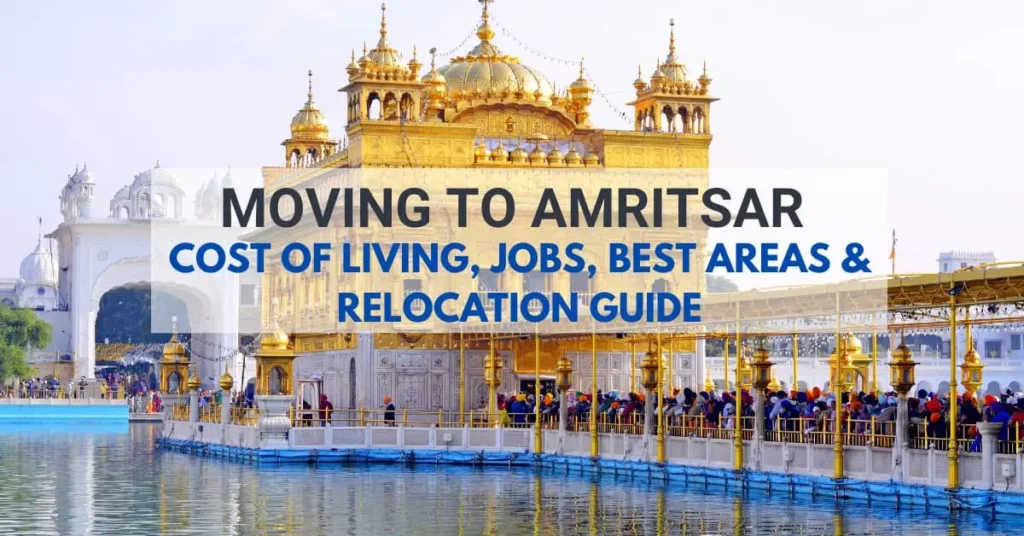
Few cities in India blend sacred serenity, lively street culture, and modern convenience quite like Amritsar, the cultural and spiritual heart of Punjab. Famous worldwide for the Golden Temple, this vibrant city welcomes millions of visitors every year, yet still retains its small-town warmth.
If you’re considering a move to northern India, Amritsar offers a rare mix of affordability, connectivity, and community — an ideal choice for families, professionals, and retirees seeking a balance between heritage and modern living.
Amritsar Overview
Introduction to the City and Its Significance
Founded by Guru Ram Das in 1574, Amritsar grew around the sacred Amrit Sarovar (“Pool of Nectar”) and quickly became the spiritual centre of Sikhism. Today, it’s not only home to the Harmandir Sahib (Golden Temple) but also a hub for trade, textiles, and tourism.
Geography and Demographics
Located in north-western Punjab, about 25 km east of the India–Pakistan border, Amritsar sits at an elevation of roughly 234 metres. As of 2025, its metropolitan population is estimated between 1.5 and 1.7 million people — making it one of Punjab’s largest urban centres.
Economy and Employment Sectors
Amritsar’s economy is a blend of tourism, small-scale manufacturing, trade, and services. Its hospitality sector thrives on year-round pilgrimage traffic, while nearby industrial zones host textile and light-manufacturing units.
Lifestyle and Culture Snapshot
Nicknamed the “Gateway to Punjab,” Amritsar pulses with Bhangra music, traditional bazaars, and unmatched street food. It’s also a symbol of resilience and pride — from the Jallianwala Bagh memorial to the daily Wagah Border ceremony.
Thinking of Moving to Amritsar
Who Should Consider Moving Here?
If you are looking for a city that blends cultural richness, moderate living costs, reasonable connectivity and a strong sense of community, Amritsar is worth considering. It suits families, professionals in tourism/hospitality, educators, small business owners and people looking for a second-tier city with growth potential rather than a megacity.
Relocating for Work, Education, or Family
Amritsar presents a good environment for families: established schools, lively neighborhoods, and comparatively affordable housing. For those relocating for work, sectors such as hospitality, retail, teaching and handicrafts are active. For educational purposes, the presence of institutions like Guru Nanak Dev University helps.
However, if you’re seeking high-end corporate/tech jobs like in Bangalore or Delhi, you may find fewer opportunities here.
What Makes Amritsar a Popular Choice
- Affordability: Compared with metros like Delhi or Mumbai, the cost of living is substantially lower. For instance, estimates show a family of four in Amritsar might spend approx ₹1,08,846 monthly, while a single person might spend ~₹38,325 (Dec 2024 data).
- Heritage & Culture: For people valuing culture, history, community living and food, Amritsar offers a distinctive lifestyle.
- Connectivity: With an international airport and good rail/road links, it is not isolated.
First Impressions and Common Myths
Some may think Amritsar is only about pilgrimage or old-world culture; but the city is modernizing: malls, movie theatres, IT-enabled services, and new localities are emerging. That said, it still retains a slower pace compared with mega-cities, which for some is a benefit, for others may feel limiting in terms of nightlife or ultra-modern urban infrastructure.
Thinking of Moving to Amritsar
Who Should Consider Moving Here?
If you are looking for a city that blends cultural richness, moderate living costs, reasonable connectivity and a strong sense of community, Amritsar is worth considering. It suits families, professionals in tourism/hospitality, educators, small business owners and people looking for a second-tier city with growth potential rather than a megacity.
Relocating for Work, Education, or Family
Amritsar presents a good environment for families: established schools, lively neighborhoods, and comparatively affordable housing. For those relocating for work, sectors such as hospitality, retail, teaching and handicrafts are active. For educational purposes, the presence of institutions like Guru Nanak Dev University helps.
However, if you’re seeking high-end corporate/tech jobs like in Bangalore or Delhi, you may find fewer opportunities here.
What Makes Amritsar a Popular Choice
- Affordability: Compared with metros like Delhi or Mumbai, the cost of living is substantially lower. For instance, estimates show a family of four in Amritsar might spend approx ₹1,08,846 monthly, while a single person might spend ~₹38,325 (Dec 2024 data).
- Heritage & Culture: For people valuing culture, history, community living and food, Amritsar offers a distinctive lifestyle.
- Connectivity: With an international airport and good rail/road links, it is not isolated.
First Impressions and Common Myths
Some may think Amritsar is only about pilgrimage or old-world culture; but the city is modernizing: malls, movie theatres, IT-enabled services, and new localities are emerging. That said, it still retains a slower pace compared with mega-cities, which for some is a benefit, for others may feel limiting in terms of nightlife or ultra-modern urban infrastructure.
What Is It Like to Live in Amritsar?
Local Lifestyle and Pace of Life
In Amritsar life flows with the rhythm of community and culture. Mornings might begin with visits or views of the Golden Temple, afternoons with market errands, evenings spent at local cafés. The pace is less frenetic than metros yet with enough vibrancy.
Reddit users have shared that for families it offers stability, though if you’re younger and crave high-energy urban nightlife you may find it quieter.
Community, Festivals, and Culture
The city pulses with festivals: e.g., the Golden Temple illuminated on Gurpurabs, the Wagah Border ceremony at sunset, food-fest trails in old markets. Community plays a big role: neighbourhoods are often close-knit, and Punjabi hospitality is visible everywhere.
Safety and Cleanliness
Amritsar is comparatively safe, especially in residential neighbourhoods. Civic infrastructure — like the municipal corporation’s services — is active though there are typical urban challenges such as traffic congestion and pollution. The city lies close to the international border, which sometimes contributes to security advisories.
Social Life and Entertainment Options
From the Heritage Street to modern shopping malls, from street food (Amritsari kulcha, lassi) to weekend trips (e.g., Wagah Border, Ram Bagh) — the city offers plenty. That said, entertainment options might be fewer than in metros; if you’re used to a robust nightlife/tourism scene you’ll need to adjust expectations.
The Cost of Living in Amritsar
Housing Costs (Rent vs Buy)
Rental and purchase costs in Amritsar are quite affordable compared with major cities. According to Numbeo: basic groceries like rice, onions, potatoes are inexpensive. For example, white rice (1 lb) is ~₹34.61 (April 2025).
Expatistan lists estimated monthly costs: for a family of four ~₹1,08,846; for a single person ~₹38,325 (Dec 2024).
Local rental data suggest 1-BHK in city centre ~₹4,000-₹12,000/month; 3-BHK in the centre ~₹10,000-₹20,000/month.
Purchase price averages around ₹6,727 per sq ft.
Food, Groceries, and Dining Out
As per Numbeo:
- Milk (1 litre) ~₹53.60
- Bread (1 lb) ~₹44.56
- Rice (1 lb) ~₹34.61
A basic meal at an inexpensive restaurant ~₹200; a three-course dinner for two ~₹875.
These figures reflect that day-to-day living costs are moderate.
Transportation and Utilities
Utilities such as electricity, water & gas typically cost less than in larger metros. While exact current averages are not always publicly listed, local sources suggest utilities in the range of ₹2,500-₹3,500/month for a small apartment.
Cost comparisons show transportation can cost more (per unit) in Amritsar than the Indian average (e.g., 30% more) though housing is much cheaper.
Healthcare and Education Expenses
Healthcare: Amritsar has a number of private hospitals (e.g., Fortis Escorts, Amandeep), and for general care, costs are lower than in metros. Schools: Fees vary widely; for many private schools you might expect between ₹2,000-₹6,000/month in reasonable institutions, though premium international schools will cost more.
Education comparisons show that childcare costs are about 50% lower in Amritsar than the Indian average.
Monthly Cost Comparison with Other Cities
A helpful benchmark: LivingCost.org lists Amritsar’s average living cost as ~$389 USD/month in global ranking (which puts it in the top ~3% of least expensive cities globally) for a single person.
Compared to major metros in India, Amritsar offers significant cost savings in housing and basic living expenses.
The Job Market in Amritsar
Key Employment Sectors
Job opportunities in Amritsar centre around:
- Tourism & Hospitality: Hotels, restaurants, travel services.
- Retail & Services: From local markets to mall shops.
- Education & Healthcare: Schools, colleges, hospitals.
- Manufacturing & Handicrafts: Textiles, artisan goods.
- For example, Internshala lists roles like hotel manager, tour guide, teacher/trainer among popular vacancies in Amritsar.
Average Salary and Living Standards
Indeed job listings show roles such as executive assistant offering ~₹22,000-₹30,000/month, data entry ~₹11,000-₹15,000/month.
Though salaries are lower than in metros, the cost of living is also lower, which means a reasonably comfortable life is achievable.
However, for senior corporate roles or tech jobs, opportunities are fewer than in tier-1 cities.
Job Opportunities for Expats and Locals
For locals and newcomers:
- Teaching and administrative roles in schools/colleges.
- Hotel/resort management and tourism operations.
- Retail management and service roles.
- Small business entrepreneurship (e.g., food outlets, craft exports).
There are fewer large-scale IT or corporate headquarters presence compared to large metros.
Freelance, Startup, and Business Options
Amritsar’s lower cost base makes it attractive for small startups — especially in tourism, food & beverages, handicrafts and e-commerce of local products.
The upcoming industrial corridor (ADKIC) could signal more manufacturing and logistics-related opportunities in the coming years.
Buying a Home in Amritsar
Real Estate Trends
Real estate in Amritsar is gaining momentum. For instance, a major developer recently announced a ₹1,000 crore investment to develop a township in Amritsar. Neighbourhoods like Ranjit Avenue, Green Avenue, New Amritsar Colony are increasingly popular.
Legal and Documentation Process
Before buying, you must check property registration, title deed, clearances from the municipal corporation, and property tax status. Amritsar’s municipal website provides online property tax payment and registration services.
An elevated road project (4.5 km long) shows the infrastructure improvements happening in the city.
Best Neighborhoods to Buy Property
- Ranjit Avenue: Upscale, near good schools and hospitals.
- Green Avenue: Quiet residential with newer developments.
- New Amritsar Colony / Majitha Road: Emerging zones with good value.
Average Property Prices by Locality
According to data, the average purchase price is around ₹6,727 per sq ft for general areas. Premium localities may exceed ₹10,000-₹12,000 per sq ft.
Given infrastructure improvements, early buyers may see good appreciation over time.
Top 10 Best Areas to Stay in Amritsar
Posh Areas in Amritsar
- Ranjit Avenue – premium, well-connected.
- Green Avenue – quieter, green surroundings.
- Mall Road area – central and historic.
Affordable Residential Zones
- Majitha Road – developing rapidly, good value.
- GT Road vicinity – older, established homes.
Family-Friendly Localities
- New Amritsar Colony – good for families; newer builds.
- Alpha International City – peaceful and developing.
- Dream City – emerging as a residential hub.
- Holy City – budget-friendly yet decent connectivity.
- Lawrence Road – mid-level price, close to markets and schools.
A Reddit user noted:
“Go for Alpha International City or Dream City… peaceful and not crowded.”
When choosing an area, consider commute time to work/school, access to hospitals, proximity to markets, and future development (roads, metrobus, green spaces).
Renting a Home in Amritsar
Average Rental Prices
- 1-BHK in Vijay Nagar: ~₹5,500/month.
- 2-BHK in Ranjit Avenue: up to ~₹16,000/month.
- 2-BHK city-average: ~₹14,749/month (Housing.com data).
These are significantly lower compared to large Indian metros.
Popular Areas for Tenants
Ranjit Avenue, Majitha Road, Green Avenue, and parts of Lawrence Road are often preferred because of proximity to schools, hospitals and retail.
Lease Terms and Legal Aspects
Standard lease terms are similar to other Indian cities: 11- or 12-month lease, security deposit (1–3 months’ rent), maintenance charges, and proper documentation is advised. Ensure the landlord’s title deed and property tax status are clear.
Tips for Finding a Good Rental Property
- Use verified portals like 99acres, MagicBricks.
- Visit the property in different time-zones (day/night) to check noise, environment.
- Check utilities—water, electricity, internet connectivity, parking.
- Prefer properties in gated societies if security and amenities are important.
- Negotiate rent if leasing for ≥12 months or pay upfront for a discount.
Schools Available in Amritsar
Education in Amritsar is well established, blending heritage institutions with modern academic facilities.
Top CBSE and ICSE Schools
- Spring Dale Senior School – Among the highest-rated in the region; focus on academics and extracurriculars.
- DAV International School – Strong CBSE results; good infrastructure.
- Holy Heart Presidency School – Popular for primary and secondary education.
- St. Francis School – English-medium, ICSE-affiliated.
International and Premium Schools
Amritsar has a small but growing number of international-curriculum institutions offering IGCSE or IB-inspired programs, often catering to NRI families returning from abroad.
Higher Education Institutions
Amritsar is home to some of Punjab’s most reputed colleges:
- Guru Nanak Dev University (GNDU) – NAAC “A++” accredited, major research hub.
- Khalsa College – Iconic 1892-era campus; offers undergraduate and postgraduate courses.
- Sri Guru Ram Das University of Health Sciences – Medical and dental programs.
- Global Institutes – Engineering, management, and IT studies.
School Admission Process
Most schools open admissions between November and February. Applicants must submit prior academic records, birth certificate, and address proof. Some top schools also conduct short interviews or entrance tests for higher grades.
Amritsar Connectivity
Amritsar’s strategic location makes it one of North India’s best-connected tier-2 cities.
Air Connectivity
Sri Guru Ram Das Ji International Airport (ATQ) is located about 11 km northwest of the city centre.
It offers direct flights to Delhi, Mumbai, Dubai, Sharjah, and Singapore, among others. The airport handled over 2 million passengers in 2024, making it the busiest in Punjab.
Rail and Road Connectivity
- Amritsar Junction (ASR) is a major railway hub with daily trains to Delhi, Kolkata, Mumbai, and Jammu.
- National Highways NH-3 and NH-54 link Amritsar to Jalandhar, Ludhiana, and Pathankot.
- Buses run by Punjab Roadways and private operators connect the city to Chandigarh and Delhi in under 6 hours.
Local Transport System
The city offers:
- Auto-rickshaws and e-rickshaws for short rides.
- City buses under the Amritsar Metrobus Service (BRTS) connecting major areas.
- App-based taxis (Ola, Uber) for comfortable commuting.
Distance from Major Indian Cities
City | Distance | Travel Time |
Chandigarh | 225 km | 4.5 hrs |
Delhi | 450 km | 6 hrs (train), 1 hr (flight) |
Jalandhar | 80 km | 1.5 hrs |
Ludhiana | 140 km | 3 hrs |
The Weather in Amritsar
Summer and Winter Climate
Amritsar experiences extreme seasons typical of northern India.
- Summers (Apr–Jun): Hot and dry, with temperatures reaching 44–46 °C.
- Winters (Nov–Feb): Cold, occasionally dipping to 2–3 °C at night.
Best Time to Visit or Relocate
The ideal months for relocation are October to March, when the weather is cool and pleasant — perfect for exploring neighborhoods and setting up a new home.
Monsoon Season and Air Quality
Monsoons arrive in July and last through September, bringing moderate rainfall (≈720 mm annually).
Air quality typically improves during this period, though winter months can see higher particulate levels due to crop burning across Punjab.
Things to Do in and Around Amritsar
Religious and Heritage Attractions
- The Golden Temple (Harmandir Sahib): Central, serene, and an icon.
- Jallianwala Bagh: Historic site of the 1919 massacre, reflective of India’s past.
- The Partition Museum: Located in Katra Ahluwalia, preserves eyewitness accounts of the 1947 Partition.
- Gobindgarh Fort, Heritage Street, Ram Bagh Palace all offer cultural experiences.
Shopping and Local Markets
Hall Bazaar, Lawrence Road, Mall Road area – vibrant markets selling handicrafts, textiles (Amritsari phulkari, carpets), metal-work, and street food stops.
Food and Street Eats
Amritsari kulcha, lassi, chole-bhature, jalebi, street-side tandoors are integral to local culture. The food culture adds a key lifestyle benefit for many relocating families and individuals.
Weekend Getaways from Amritsar
Short drives or local excursions: Wagah Border evening ceremony, the town of Durgiana, religious sites around, and trips to the country-side villages or heritage towns in Punjab.
Tips for Moving to Amritsar
Choosing the Right Movers and Packers
When relocating, select a packers & movers firm that has a valid GST number, transparent pricing, insurance for goods and good reviews. Local portals like 6 Packers And Movers list many verified providers.
Planning Your Relocation Budget
Budget should cover: moving costs, deposit for rent/buy, utilities connections, basic furnishing, initial groceries, registration fees and buffer for first 2–3 months. Given Amritsar’s moderate cost base, your buffer will be much lower than in metros.
Local Registration and Documents
If renting/buying: register your address with the municipal corporation; update your Aadhaar/pan change if the move is long-term; ensure utilities (electricity, water, internet) are transferred/connected.
Settling Down Smoothly
- Visit the chosen locality at different times (day/night) before finalising.
- Understand weekly market days, neighbourhood transport availability.
- Engage with local resident groups/social media (WhatsApp groups, Facebook) to integrate quickly.
- Learn basic Punjabi phrases—while many speak Hindi/English, borrowing local terms helps social integration.
Reasons to Relocate to Amritsar
Cultural Richness and Heritage
Amritsar offers a unique blend of faith, food, history and community, which is rare among Indian cities. For those who value culture, tradition and meaningful social life, this is a strong attraction.
Affordable Lifestyle
Lower rents, cheaper groceries and moderate utility bills make Amritsar financially attractive compared to metros. As noted earlier, a single person’s monthly cost is estimated about ₹38,000 (Dec 2024) in the city.
Business and Educational Opportunities
The heritage tourism sector, educational institutions and upcoming industrial corridors mean there are opportunities for entrepreneurs, educators and service-industry professionals. As the township investment shows (₹1,000 crore by Omaxe) — real-estate growth is underway.
Warm Community and Food Culture
The local warmth, strong community bonds, frequent festivals, and rich food culture (kulcha, lassi etc) make living here satisfying on more than just utilitarian levels.
Why Amritsar Works for Families
Family-Friendly Environment
Residential localities in Amritsar tend to be quieter neighbours, good for children, safer than many densely packed metros. Schools, community centres and parks are more accessible.
Good Schools and Healthcare
With established private schools and hospitals in the city, families can access quality education and healthcare without travelling far.
Safety and Community Bonding
Close-knit neighbourhoods, an emphasis on community values, frequent local festivals and the tradition of langar service create supportive social networks ideal for families.
Recreational Options for Kids
Visits to heritage sites, weekend outings, food walks, interactive crafts markets and green spaces mean children have enriching opportunities. While amusement-park style options may be fewer than metros, the richness is in culture, outdoors and history.
What Advice Would You Give to Someone Moving to Amritsar, India?
Local Insights from Residents
“We are a nuclear family planning to shift to Amritsar from Jaipur — rent looks similar, school-fees structure decent.”
— Reddit user on r/amritsar
This shows that for many families the transition to Amritsar is straightforward in terms of cost.
Do’s and Don’ts for Newcomers
Do:
- Visit the city in person, stay for a weekend in the locality you intend to move to.
- Check commuting time to work/school from the locality.
- Negotiate rent if you plan a long lease or can pay more upfront.
- Learn a few Punjabi words and cultural cues.
Don’t:
- Assume the job market will mirror Delhi or Bengaluru – adjust expectations.
- Ignore summer/winter climate extremes – pick accommodation accordingly.
- Overlook utility and maintenance costs – newer localities may have hidden infrastructure charges.
- Forget to check local noise, traffic and amenities – some developing areas may still be under construction.
Common Mistakes to Avoid
- Signing a long lease without checking landlord’s legal ownership/title deed.
- Ignoring commute time (even if locality looks nice, if it’s far from school or work it becomes burdensome).
- Under-planning budget: initial expenses including relocation, deposit, furnishings often push the first 2–3 months to be costlier than typical monthly budgets.
How to Blend into Local Culture
Engage in community langar services, attend local festivals, visit neighbour’s fairs, join social media groups for the locality. This will help you feel at home sooner.
Trying the local food (kulcha, lassi) and using Punjabi phrases helps also.
Why Did You Move to Amritsar? Are You Happy with Your Decision?
While I as writer don’t provide personal move testimony, many newcomers say:
- They moved for family-friendly lifestyle, affordable living and cultural richness.
- After settling, they often highlight contrast between high-stress metro life and more balanced pace in Amritsar.
- Some mention fewer job-escalation opportunities than bigger cities but note that the savings and community benefits offset that.
Ready to Move to Amritsar Punjab
Checklist Before You Move
- Confirm housing (rental or purchase) and sign the lease/title deed.
- Connect utilities: electricity, water, gas, internet, municipal registration.
- Choose and book a reliable packers & movers company.
- Register your address, update Aadhaar/PAN if required.
- Visit the neighbourhood at different times (day/night) to assess noise/traffic.
- Plan schooling/transport for family members.
- Budget for initial costs: deposit, furnishings, commute/transport, first two months expenses.
- Try to arrive maybe a week before children’s school or your job start to settle in.
Partnering with Professional Packers and Movers
Use companies that list their GST number, have reviews, provide item-wise insurance. Keep documentation of all goods moved, check household goods delivery and condition on arrival.
Research local companies (Amritsar-based) for cost advantage and better local experience.
Move with confidence! Compare Verified Packers and Movers Amritsar, get free quotes, and plan your relocation to Amritsar with trusted professionals today.
FAQs About Moving to Amritsar
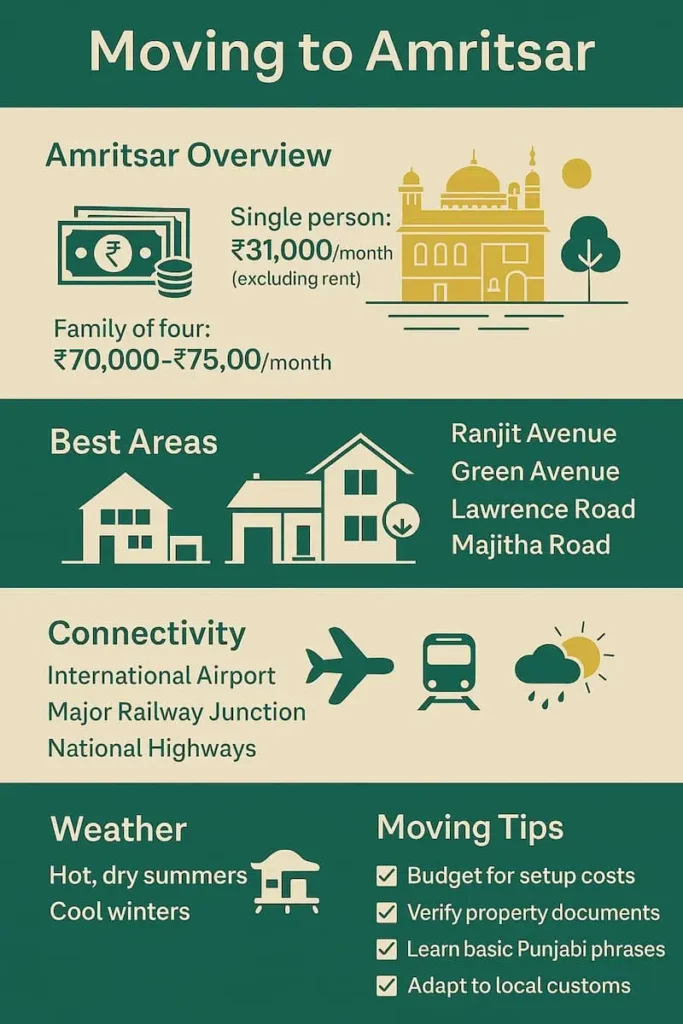
The average monthly cost of living in Amritsar for a single person is approximately ≈ ₹31,000 excluding rent, according to LivingCost.org. For a family of four, monthly expenses often range around ₹70,000–₹75,000, depending on lifestyle.
Amritsar’s connectivity is strong: the Sri Guru Ram Das Ji International Airport (ATQ) lies about 11 km from the city centre. The city also has a major railway junction and good road links via National Highways. This makes it convenient for domestic and international travel.
Some of the top areas in Amritsar include:
- Ranjit Avenue – upscale, premium apartments.
- Green Avenue – family-oriented, larger homes.
- Lawrence Road and Majitha Road – central/commercial and more affordable respectively.
These localities appear consistently in local real-estate listings and city-guides as favoured living zones.
Key points for buying a home in Amritsar:
- Stamp duty in Punjab is typically around 6 % (male buyer) / 5 % (female buyer) plus ~1 % registration fee.
- Average property prices (2025 estimates) vary by area — e.g., ~₹6,000-₹8,000 per sq ft in premium zones like Ranjit Avenue.
- Legal process includes sale deed registration, mutation in municipal records with the Amritsar Municipal Corporation and verifying the developer’s approvals.
Typical monthly rents in Amritsar (2025 data) are approximately:
- 1-BHK in central areas: ₹10,000-₹14,000
- 2-BHK: ₹15,000-₹22,000
- 3-BHK (premium): ₹25,000-₹30,000
Terms usually involve 1–3 months’ security deposit, and for leases over 11 months it’s advisable to register the agreement legally.
While Amritsar offers many advantages, some challenges include:
- Summer heat can reach up to ~45 °C, winters may drop to ~2-3 °C at night.
- Air-quality issues in winter months due to crop-burning in the region.
- Traffic congestion in some central corridors (GT Road, Lawrence Road).
- Fewer late-night social entertainment options compared with larger metros.