
Shared Truck vs. Dedicated Truck — Which Is Better for Household Shifting?
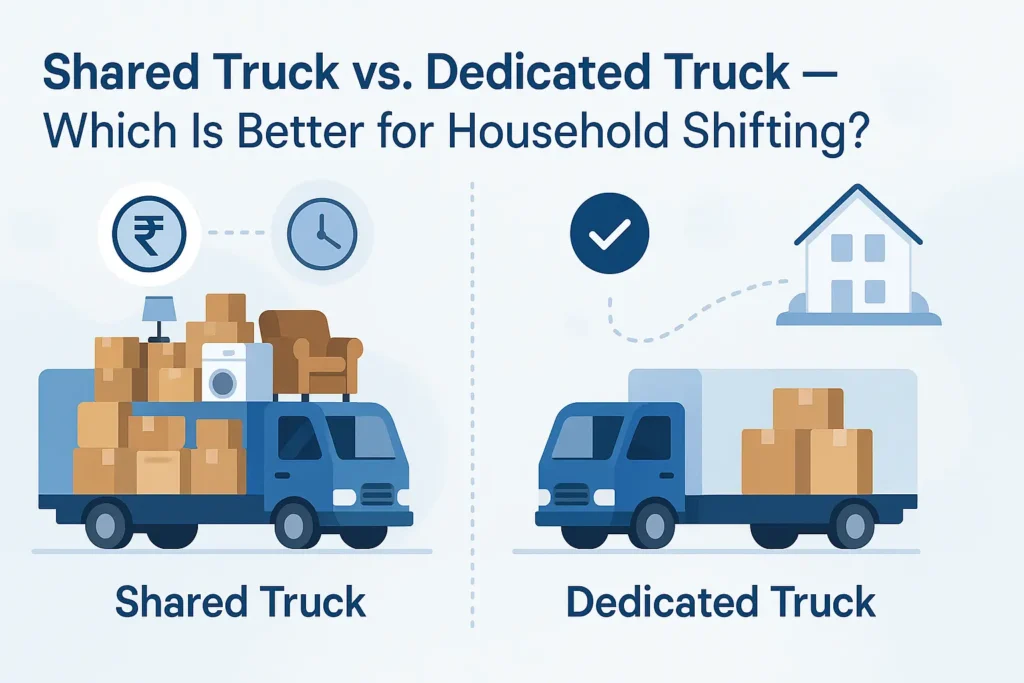
A shared truck is the cheapest option for small or flexible moves where you only pay for the space you use, but delivery may take longer. A dedicated truck offers faster, safer, direct transport with exclusive space—ideal for full-house or fragile-item moves. Choose shared for budget moves and dedicated for speed and safety.
Shifting your home can be stressful, especially when you’re trying to decide the safest and most cost-effective way to transport your household goods. One of the biggest choices people face is whether to use a shared truck or a dedicated truck for relocation. Both options come with their own advantages, limitations, cost differences, and safety implications. If you’re comparing these two methods for your next move, this guide breaks everything down in simple terms so you can make a confident decision. And if you need a trusted moving partner, you can always explore reliable Packers and Movers services to get professional help for your shifting needs.
What Is a Shared Truck in Household Shifting?
A shared truck—also known as a part-load or consolidated truck—is a transportation method where your household goods share space with shipments from other customers. This model reduces cost by splitting truck capacity while still ensuring goods are transported door-to-door. Below are the key aspects that define how shared trucking works and when it makes sense.
How Shared Truck Load-Sharing Works
In a shared truck model, the moving company consolidates goods from multiple customers who are shipping along the same route or toward nearby destinations.
Your belongings are allocated space based on volume or weight, and the transportation cost is proportionally divided. Because trucks make multiple pick-ups and deliveries along the route, goods may pass through hubs or transfer points before reaching the final destination.
Why Shared Trucks Are Popular for Budget Moves
Shared trucking is widely preferred by customers who want to minimize relocation expenses. Since you pay only for the space your goods occupy, it becomes significantly more affordable than renting an entire truck. This is ideal for smaller households, students, and individuals with limited furniture. Many moving companies recommend it as the most economical option for long-distance shifting when the load size is light.
For small relocations in cities like Bangalore, opting for shared transport through professional packers and movers in Mohali can significantly reduce overall moving costs.
Types of Moves Suitable for Shared Transportation
Shared trucks are generally recommended for:
- 1RK / 1BHK / studio apartments
- Students relocating between cities
- Shipping a few pieces of furniture or appliances
- Non-urgent moves with flexible delivery windows
If your goods do not fill an entire truck and you’re open to a wider delivery timeline, shared trucking gives excellent value for money.
What Is a Dedicated Truck in Household Shifting?
A dedicated truck—often called a full-load or exclusive-use truck—is a relocation service where the entire vehicle is reserved only for your household goods. Unlike shared trucking, your belongings are not mixed with other shipments, and the truck travels directly from your old home to your new one without additional pickups or deliveries along the way. This makes dedicated trucks the preferred choice for larger households, time-sensitive moves, and customers who prioritize safety and control.
Exclusive Space and Point-to-Point Delivery
When you choose a dedicated truck, you gain full control over the truck’s capacity and movement. Your goods are loaded once and unloaded only at the destination, eliminating the multiple handling stages common in shared transport. This point-to-point delivery significantly reduces the risk of damage, delays, or misplacement. Dedicated trucks also allow movers to arrange your goods more safely, using padding, straps, and space-optimized arrangements without worrying about other shipments being added or removed mid-route.
When Dedicated Trucks Become Essential for Safety
Dedicated trucking is strongly recommended when your move involves:
- Fragile items (glass furniture, mirrors, artefacts)
- High-value items (LED TVs, premium appliances, antiques, collectibles)
- Bulky or odd-shaped furniture
- Time-sensitive or same-day delivery needs
Since the goods are not mixed with other loads, movers can pack and place each item with specialized handling techniques. The reduced number of touchpoints (loading → direct transit → unloading) significantly lowers the risk of dents, scratches, moisture exposure, or accidental mishandling.
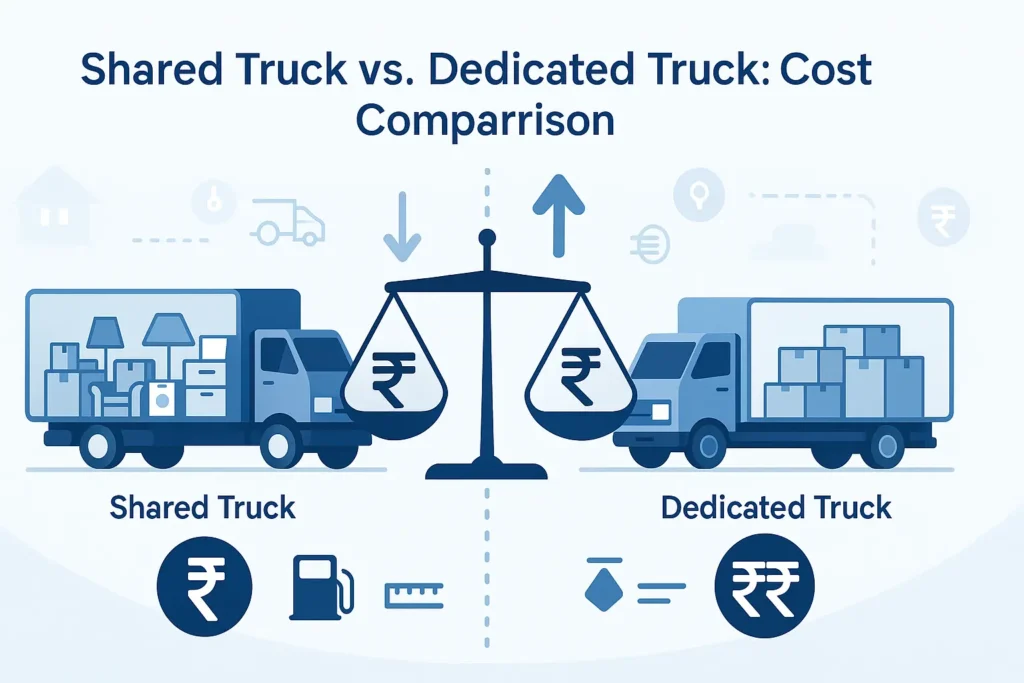
Shared Truck vs. Dedicated Truck: Cost Comparison
Cost is one of the biggest deciding factors for most households planning a relocation. While both shared and dedicated trucks follow transparent pricing principles, the total cost varies significantly based on how the truck’s space, route, and resources are utilized. Understanding how movers calculate charges—and what hidden costs you should watch for—helps you select the best value option for your shifting needs.
How Packers and Movers Calculate Shared Truck Charges
Shared truck pricing is designed around the concept of pay-as-per-space. Instead of paying for the entire truck, you only pay for the volume or weight of your goods. Packers and movers typically calculate shared-transport costs based on:
- Total volume (in cubic feet) your items occupy
- Distance between origin and destination
- Handling and consolidation requirements
- Route density (how many customers are shipping along the same route)
To understand how movers calculate transport charges in detail, you can refer to our packers and movers cost guide, which explains pricing based on distance, volume, and service type.
Because multiple customers split the cost of fuel, tolls, and vehicle operation, shared trucking becomes the most budget-friendly option for small to medium loads.
Factors That Increase the Cost of a Dedicated Truck
Dedicated truck pricing is higher because the entire truck is reserved solely for your move, even if your goods do not completely fill it. Key factors that influence dedicated-truck costs include:
- Full truck hire charges (you pay for the entire vehicle capacity)
- Fuel and tolls without cost-sharing
- Exclusive driver and labor allocation
- Faster routing and priority scheduling
- Type and size of the truck needed (14 ft, 17 ft, 19 ft, etc.)
Dedicated trucks also involve more precise planning and handling, which increases labor effort and operational cost.
Cost Efficiency for Long-Distance Moves
For long-distance relocations, the cost dynamics become interesting. Shared trucks are highly economical for small loads because customers jointly pay for the long-route fuel and logistics. However, dedicated trucks start becoming cost-efficient when:
- Your volume is large enough to justify a full load
- You want faster delivery
- You need minimal handling for safety
- You’re transporting fragile or premium items that can’t risk stacking or mixing
In many intercity moves, the price difference narrows when a household requires most of the truck space anyway, making dedicated transport a reasonable upgrade for better control and safety.
Hidden Costs to Watch Out For in Both Options
While both shared and dedicated truck services advertise base prices, customers may encounter additional charges depending on the situation. Some hidden or less-obvious costs include:
- Floor-based or stair-carry charges
- Long-carry charges (when trucks can’t park near the building)
- Packing material upgrades (for fragile items or premium packaging)
- Detour or waiting charges
- Insurance premiums based on declared value
- Revised pricing after pre-move survey
Being aware of these potential extras helps you compare quotes accurately and avoid unexpected expenses on moving day.
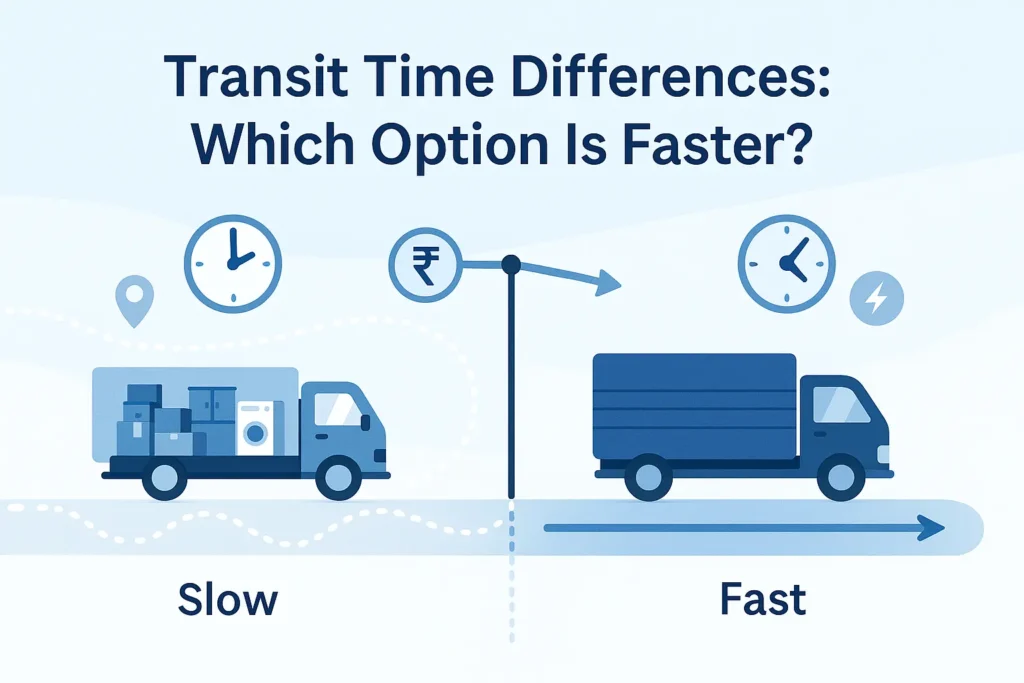
Transit Time Differences: Which Option Is Faster?
Transit time plays a crucial role in deciding how soon you can settle into your new home. The time taken to deliver your goods varies significantly between shared and dedicated trucks because of how each service is structured. Understanding these differences helps you choose an option that aligns with your schedule, urgency, and convenience.
Why Shared Trucks Take Longer in Most Cases
Shared trucks operate on a multi-stop, multi-customer route, which naturally increases the overall delivery timeline. Your goods may be loaded along with other shipments and routed through:
- Consolidation hubs
- Multiple pickup and drop-off points
- Scheduled dispatch slots (based on route demand)
This means the truck might not leave immediately after loading, and delivery can take longer due to route coordination and additional handling. Shared loads are also tied to the availability of customers going in the same direction, so dispatch may be delayed until the truck reaches optimum load capacity.
How Dedicated Trucks Reduce Transit Time
Dedicated truck services follow a direct, point-to-point route, making them significantly faster than shared alternatives. Since the truck is reserved exclusively for your household:
- It departs as soon as loading is complete
- There are no intermediate pickups or deliveries
- There is no waiting for consolidation or matching customers
- The route is planned solely around your destination
This makes dedicated trucks ideal for time-sensitive or urgent moves where predictable delivery times are essential.
Situations Where Shared Trucks May Still Be Time-Efficient
Even though shared trucking typically takes longer, there are certain scenarios where it can still be time-efficient:
- Popular intercity routes with high demand, allowing quicker consolidation
- Short-distance relocations where detours or hubs may not be involved
- Routes with frequent dispatch cycles maintained by large moving networks
- Flexible delivery windows, where the customer doesn’t need same-day or fixed-day delivery
In these cases, the difference in delivery time between shared and dedicated trucks may be minimal.
Safety & Damage Risks: Which Option Is More Secure?
Safety is one of the biggest concerns for anyone relocating their household. From fragile glass items to expensive appliances, every customer wants assurance that their belongings will reach their new home without scratches or damage. The safety levels of shared and dedicated trucks differ primarily because of handling frequency, load arrangement, and transit conditions.
Risks of Mixing Goods in Shared Loads
In a shared truck, your goods are transported alongside shipments from other customers. This increases the likelihood of items being:
- Stacked or rearranged to optimize space
- Handled multiple times during consolidation
- Loaded or unloaded at intermediate stops
- Exposed to varied packing quality (from different customers)
These additional touchpoints can raise the risk of dents, scratches, or damage—especially for fragile items like glassware, mirrors, and electronics. Uneven weight distribution from mixed goods can also affect the stability of delicate items.
Dedicated Truck Advantage for Fragile and High-Value Items
Dedicated trucks give movers complete control over how your goods are arranged, stacked, and secured. Because there are no external shipments, the team can:
- Create buffer zones for delicate items
- Use straps, blankets, and padding without space restrictions
- Prevent stacking that could crush fragile goods
- Maintain stable weight distribution
- Ensure minimal movement inside the truck
This dramatically reduces the likelihood of breakage. For items like LED TVs, chandeliers, artefacts, antiques, and premium appliances, dedicated transport offers a significantly safer environment.
Role of Packing Quality in Ensuring Safety
Regardless of whether you choose shared or dedicated transport, the quality of packing is the single largest factor influencing safety. Professional movers use specialized materials such as:
- Foam sheets and bubble wrap
- Corrugated corner guards
- Wooden crating for high-value items
- Thermocol cushioning
- Heavy-duty cardboard boxes
- Stretch wrap for moisture protection
Even in a dedicated truck, improper packing can lead to internal damage during transit. Similarly, high-quality packing can reduce risk even when using a shared truck.
Insurance Considerations for Both Options
Both shared and dedicated truck services offer the option of transit insurance, which protects your belongings in case of:
- Accidents
- Fire or natural disasters
- Theft during transit
- Major damage beyond packing protection
Insurance is especially important for long-distance or high-value moves. The premium is typically calculated on the declared value of goods, and customers should always take photos, maintain inventory lists, and carefully read policy terms.
Before choosing shared or dedicated transport, it’s important to understand what transit insurance covers during house shifting, especially for long-distance or high-value moves.
Ideal Use Cases: When to Choose Shared vs. Dedicated Trucks
Choosing between a shared truck and a dedicated truck becomes easier when you understand which option aligns with your move size, budget, timeline, and the nature of your goods. Each service fits different relocation scenarios, and selecting the right one can make your move smoother, safer, and more cost-effective.
When Shared Trucks Are the Right Choice
Shared trucks are the preferred option when your move is small, budget-focused, and flexible with timelines. You should choose a shared truck if:
- You’re shifting 1RK, 1BHK, or small apartments
- You have limited furniture or only a few cartons
- You’re a student or bachelor relocating between cities
- You want the lowest-cost long-distance option
- You don’t require same-day or fixed-time delivery
- Your items are non-fragile and easy to handle
- You’re comfortable with a slightly longer delivery window
Shared trucking allows you to save considerably because transport costs are divided among multiple customers. It’s a practical choice when safety concerns are minimal and urgent delivery isn’t required.
When Dedicated Trucks Are the Best Option
Dedicated trucks are ideal when your move involves large volumes, fragile goods, or strict delivery timelines. Choose a dedicated truck if:
- You are moving a 2BHK, 3BHK, or villa
- You have bulky furniture like sofas, beds, dining sets, or wardrobes
- You’re transporting expensive appliances or delicate items
- You require quick delivery or same-day transport
- You don’t want your goods mixed with other customers’ shipments
- You want complete control over loading, unloading, and routing
Dedicated trucking is also strongly recommended for premium moves where safety, speed, and privacy matter more than cost.
Choosing Based on Distance, Budget, and Volume
Here’s how to decide using practical parameters:
Distance:
- Short distances: Both options work, but shared trucks are fine if time is flexible.
- Long distances: Shared trucks are cheaper; dedicated trucks are faster and safer for big moves.
Budget:
- If budget is your priority → Go for shared.
- If safety & timing matter more → Choose dedicated.
Volume:
- Small loads → Shared
- Medium to large loads → Dedicated
This makes the selection simple: choose based on what matters most — affordability, space, or speed.
Choosing Based on Urgency and Delivery Control
Sometimes the biggest deciding factor is your timeline.
If your move requires:
- A fixed delivery date,
- Urgent shifting due to job relocation, school joinings, rental deadlines,
- Zero waiting time after packing,
then dedicated trucking is the only reliable option.
On the other hand, if you’re flexible with delivery and okay with a wider time window, shared trucking offers excellent value without compromising basic service quality.
Pros and Cons of Shared and Dedicated Trucks
Both shared and dedicated trucks offer distinct benefits depending on your moving requirements. Comparing their advantages and disadvantages side by side helps you make an informed decision that matches your budget, timeline, and safety priorities.
Pros of Shared Truck Services
Shared trucks are especially beneficial for customers who want to minimize costs while still receiving reliable door-to-door transportation. Key advantages include:
- Significant cost savings, since transport charges are divided among multiple customers
- Ideal for small-volume moves, where goods don’t fill an entire truck
- Eco-friendly option, as the truck’s capacity is optimized rather than running with partial loads
- Flexible availability on popular long-distance routes, making it easy to book consolidated transport
- Affordable choice for students, bachelors, or minimal-household relocations
Shared trucking offers the perfect balance between affordability and convenience for low-volume or non-urgent moves.
Cons of Shared Truck Services
While shared trucks are economical, they come with certain limitations you should be aware of:
- Longer transit times due to multiple pickups, deliveries, and consolidation
- Higher handling frequency, increasing the risk of minor damage or misplacement
- Fixed or semi-flexible delivery windows, which may not suit urgent relocations
- Mixed load environment, where goods from different customers are stacked together
- Less control over routing and scheduling, as the mover optimizes based on all customers
These factors make shared trucking less suitable for premium, fragile, or time-sensitive moves.
Pros of Dedicated Truck Services
Dedicated trucking is the premium choice for customers wanting full control, speed, and safety. Its advantages include:
- Fastest delivery time, as the truck travels directly to your destination
- Exclusive use of vehicle space, ensuring goods aren’t mixed or rearranged
- Minimal handling, reducing the chances of breakage or scratches
- Custom loading arrangement, ideal for fragile and high-value items
- Greater control over pickup and delivery timelines, enabling fixed-date or urgent relocations
- Improved security, since only your goods are inside the truck
This makes dedicated trucking the go-to solution for families with larger households or special moving requirements.
Cons of Dedicated Truck Services
Although highly secure and convenient, dedicated trucks tend to be more expensive and demand larger volumes to be cost-effective. Some of the drawbacks include:
- Higher overall cost, as you pay for the full truck—even if space isn’t fully used
- Less economical for small loads, where shared trucking offers better value
- Potential for higher toll, fuel, and driver charges, since costs aren’t shared
- Requires more planning, especially for choosing the correct truck size (14 ft, 17 ft, 19 ft, etc.)
Despite these drawbacks, the benefits usually outweigh the costs when handling full-household or fragile shipments.
Which Option Is Better for Your Move?
Both shared and dedicated truck services serve different types of customers and relocation needs. The right choice ultimately depends on your volume of goods, budget, flexibility, safety concerns, and delivery expectations. By understanding how each option functions, you can confidently decide what works best for your household.
Summary of Key Differences
Here is a quick breakdown:
- Shared Truck:
- Budget-friendly, space-efficient, best for small loads
- Longer transit times, more handling, mixed loads
- Ideal for non-fragile, flexible moves
- Dedicated Truck:
- Faster, safer, exclusive space, minimal handling
- Higher cost, best for medium to large moves
- Ideal for fragile, valuable, or urgent relocations
In essence, shared trucks prioritize cost savings, while dedicated trucks prioritize speed and safety.
Best Option for Budget-Focused Customers
If you’re looking for the most affordable moving service, the shared truck model is the clear winner. You only pay for the space your goods occupy, making it ideal for:
- Students
- Small families
- Minimal furniture
- Long-distance moves with flexible timelines
Shared transport allows you to reduce transport costs significantly without compromising basic reliability.
Best Option for Safety and Speed
If your priority is quick delivery, minimal handling, and maximum protection, a dedicated truck provides unmatched value. Choose this option when:
- You have fragile or high-value items
- You need a fixed delivery date or urgent move
- You’re shifting a full 2BHK/3BHK
- You want complete control over loading and unloading
For premium or sensitive relocations, dedicated trucks deliver the highest level of safety and professionalism.
Expert Recommendation Based on Your Specific Needs
- Choose a Shared Truck if:
Your load is small, your budget is tight, and you’re comfortable with flexible delivery timelines. - Choose a Dedicated Truck if:
You value safety, speed, and exclusivity—or if you’re moving a full household or transporting delicate items.
Before finalizing, always request a pre-move survey to assess volume, fragility, and special requirements. A professional evaluation ensures you choose the most cost-effective and secure option for your specific move.
Ready to Move? Choose Trusted Packers and Movers Today
Your household deserves a safe, stress-free relocation. Whether you prefer a shared truck for cost savings or a dedicated truck for premium safety and speed, our expert 6 Packers and Movers are here to handle everything—packing, loading, transport, and secure delivery. Get a free quote, compare options, and move with confidence. Let professionals make your shifting simple, fast, and reliable.