
Bike Transportation Charges – Complete Cost Guide in India
Bike transportation charges in India usually range between ₹3,000 and ₹15,000, depending on distance, bike engine capacity, packing quality, insurance, and transport mode. Road transport offers door-to-door convenience at a higher cost, while Indian Railways parcel service is cheaper but station-based. Charges increase for long distances, premium bikes, closed carriers, and additional services such as insurance or door delivery.
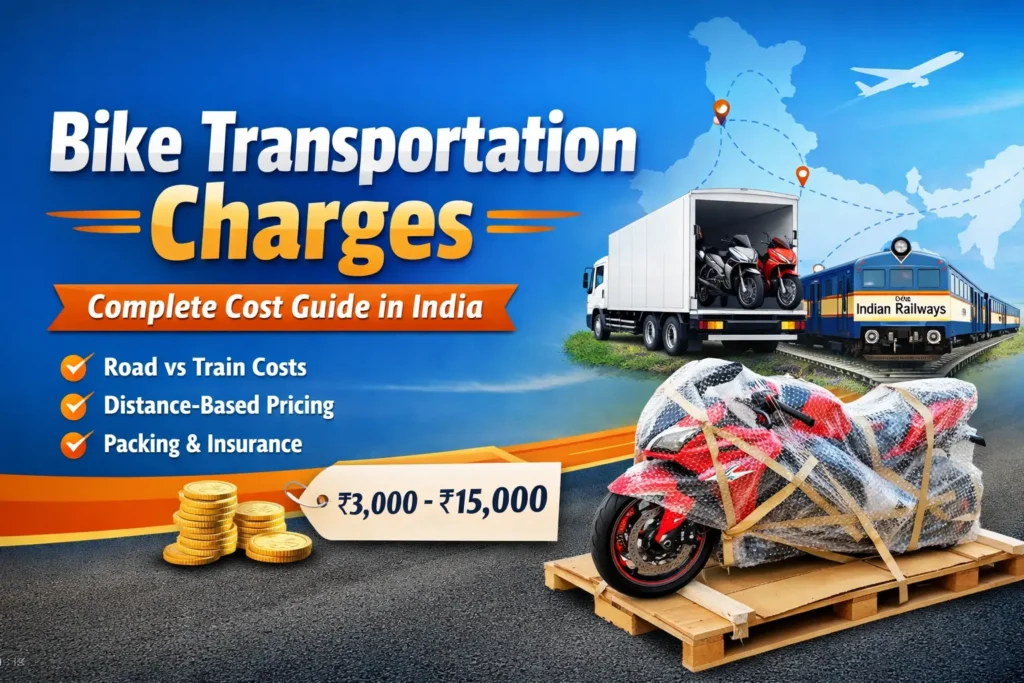
When relocating to another city, transporting a two-wheeler safely and at the right price becomes a major concern for bike owners. Bike transportation charges in India are not fixed; they vary based on distance, transport mode, packing quality, insurance, and route complexity. Unlike household shifting, bike transport is primarily an intercity service, commonly handled through road carriers or Indian Railways parcel services, each with its own cost structure and process.
what cost ranges to expect for different distances, and how factors like packing, insurance, and delivery method affect the final price. Whether you are moving a commuter bike or a premium motorcycle, knowing the pricing logic helps avoid overcharging and unexpected add-ons.
If you are planning a city-to-city relocation, following practical Moving Tips can help you avoid common mistakes and save time. To ensure a smooth experience, you can explore verified relocation options through Packers And Movers to compare services and make informed decisions.
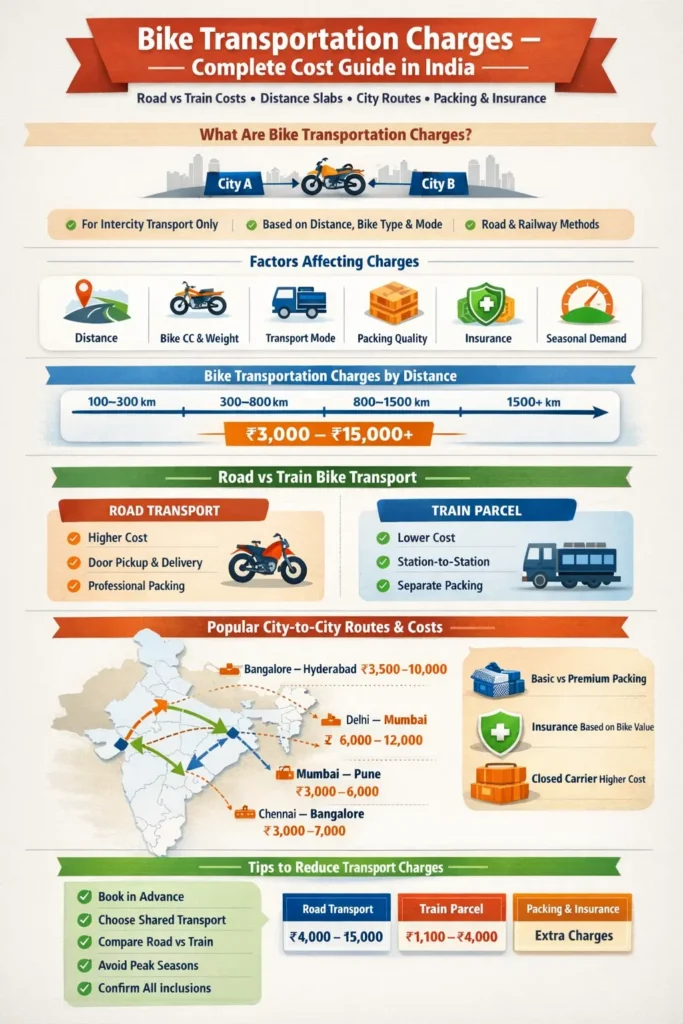
Factors That Affect Bike Transportation Charges
Bike transportation charges in India are not fixed and can vary significantly from one booking to another. Movers calculate the final cost after evaluating multiple practical factors related to distance, bike specifications, transport method, and service level. Understanding these factors helps you assess whether a quoted price is reasonable or inflated.
Distance Between Source and Destination Cities
Distance is the primary cost driver in bike transportation. Longer routes involve higher fuel consumption, toll charges, handling time, and transit risk.
- Short intercity routes usually fall under lower cost slabs
- Long-distance routes (800 km+) increase charges sharply
- Metro-to-metro routes are often cheaper due to frequent carrier availability
Bike Type, Model & Engine Capacity
The size and weight of the bike directly affect handling and loading costs.
- Scooters and small bikes cost less to transport
- Higher CC bikes require stronger packing and handling
- Premium motorcycles may attract higher insurance and safety charges
Heavier bikes also occupy more space in carriers, impacting shared transport pricing.
Mode of Transportation (Road vs Train)
The chosen transport method significantly impacts the total cost:
- Road transport offers door-to-door convenience but costs more
- Railway parcel transport is cheaper but station-based
- Transit handling differs between the two methods
Packing Quality & Safety Standards
Packing plays a crucial role in protecting the bike during transit and influences pricing.
- Basic packing is usually included
- Premium packing adds cost but reduces damage risk
- Extra materials may be required for long routes
Door Pickup vs Station Drop
Service level affects the quotation:
- Door pickup and delivery increase total charges
- Railway transport usually requires self drop and pickup
- Remote or non-accessible locations may attract extra fees
Insurance Coverage for Bike Transportation
Insurance is optional but impacts pricing when chosen.
- Declared bike value affects insurance premium
- Higher-value bikes attract higher coverage costs
- Some providers include limited coverage, others charge separately
To understand protection limits clearly, it’s important to know what transit insurance covers during house shifting, including two-wheelers.
Seasonal Demand & Relocation Rush Periods
Bike transport charges often rise during:
- Year-end and festive seasons
- Peak job relocation months
- Academic admission cycles
During these periods, carrier availability reduces and demand increases.
Bike Transportation Charges by Distance
Distance plays a decisive role in determining bike transportation charges in India. Movers generally classify routes into distance slabs, and pricing increases as the total kilometers increase. Longer distances involve higher fuel usage, toll expenses, transit handling, and risk exposure, which collectively impact the final quotation.
Rather than charging a strict per-kilometer rate, most service providers apply fixed price bands based on distance ranges.
Short-Distance Bike Transport Charges (100–300 km)
Short intercity routes are usually the most economical for bike transportation.
- Lower fuel and handling costs
- Faster delivery timelines
- Mostly handled through shared road carriers
This distance range is commonly used for relocations between nearby cities within the same state or neighboring states.
Medium-Distance Bike Transport Charges (300–800 km)
Medium-distance routes form the largest share of bike transport bookings in India.
- Increased fuel and toll expenses
- More transit handling points
- Suitable for both road and railway parcel options
Prices in this range vary depending on bike engine capacity and packing requirements.
Long-Distance Bike Transport Charges (800–1500+ km)
Long-distance bike transportation attracts higher charges due to:
- Extended transit duration
- Multiple handling stages
- Higher risk of damage during transit
Railway parcel services are often preferred in this category for cost savings, while road transport is chosen for convenience.
How Distance Impacts Per-KM Bike Transport Cost
As distance increases:
- Absolute cost increases
- Per-km cost may reduce slightly on long routes
- Fixed handling and packing costs get distributed over longer distances
This is why long routes sometimes appear cheaper per kilometer but higher in total value.
Estimated Intercity Bike Transportation Cost by Distance
Distance Range | Approximate Charges (₹) | Suitable Bike Category |
100 – 300 km | 3,000 – 5,000 | Scooters, small bikes |
300 – 800 km | 4,000 – 8,000 | 125cc – 200cc bikes |
800 – 1500 km | 6,000 – 12,000 | 200cc+ motorcycles |
1500+ km | 8,000 – 15,000+ | Premium / heavy bikes |
Key Takeaway for Distance-Based Pricing
- Short routes are economical but limited in availability
- Medium routes offer balanced cost and convenience
- Long routes benefit from early booking and rail options
Understanding these slabs helps you estimate realistic costs before requesting quotes.
Bike Transportation Charges by Mode (Road vs Train)
In India, bike transportation is primarily carried out through road carriers or Indian Railways parcel services. Each mode follows a different pricing structure, service level, and handling process. The choice between road and train transport directly impacts the total cost, delivery convenience, and transit responsibility.
Understanding how these two modes differ helps you select the most cost-effective and practical option based on distance, bike value, and urgency.
Bike Transportation Charges by Road
Road transport is the most commonly used method for intercity bike relocation, especially for customers seeking door-to-door service.
Key characteristics of road bike transport:
- Charges are higher than railway parcel services
- Door pickup and door delivery available
- Professional packing and handling included
- Suitable for premium, new, or heavy bikes
Road transport costs increase with distance, bike size, and service customization such as closed carriers or enhanced packing.
Bike Transportation Charges by Train (Indian Railways Parcel)
Indian Railways offers bike transportation through parcel or luggage booking, making it a budget-friendly option for long-distance relocation.
Key characteristics of train bike transport:
- Lower transportation cost compared to road
- Station-to-station movement only
- Packing and loading often arranged separately
- Fuel must be fully drained before booking
While cheaper, railway parcel services require the bike owner to handle documentation, drop-off, and pickup logistics.
Road vs Train Bike Transport – Cost & Service Comparison
Criteria | Road Transport | Train Parcel |
Average Cost | Higher | Lower |
Pickup & Delivery | Door-to-door | Station-based |
Packing Included | Yes | Usually separate |
Transit Responsibility | Transporter | Bike owner partially |
Suitable For | Premium & new bikes | Budget transport |
When Road Transport Is the Better Option
Road bike transport is preferable when:
- You want complete door-to-door convenience
- The bike is new, premium, or high-value
- You want professional packing and handling
- Destination is not close to a railway station
When Railway Parcel Is the Right Choice
Railway bike transport works best when:
- Budget is the primary concern
- Distance is long (800 km+)
- You can manage station drop and pickup
- Transit time flexibility is acceptable
Practical Insight
Many customers choose:
- Train transport for cost savings
- Road transport for peace of mind and convenience
The right choice depends on whether cost or service experience is your priority.
City-to-City Bike Transportation Charges
City-to-city routes form the core of bike transportation demand in India. Charges on these routes are influenced by distance, transport mode availability, route frequency, and demand between specific city pairs. Metro-to-metro routes generally cost less than metro-to-tier-2 or tier-2 to tier-2 routes due to better carrier availability.
Instead of a flat nationwide rate, bike transportation charges are usually quoted based on specific source–destination combinations.
Bike Transport Charges from Bangalore to Other Cities
Bangalore is one of the busiest relocation hubs, offering competitive pricing due to frequent carrier movement.
Destination City | Approximate Charges (₹) |
Bangalore → Hyderabad | 3,500 – 10,000 |
Bangalore → Chennai | 3,000 – 8,000 |
Bangalore → Mumbai | 4,000 – 10,000 |
Bangalore → Delhi | 8,000 – 15,000 |
Bike Transport Charges from Delhi to Other Cities
Delhi serves as a major north-India logistics hub with high demand for intercity bike transport.
Destination City | Approximate Charges (₹) |
Delhi → Mumbai | 6,000 – 12,000 |
Delhi → Bangalore | 8,000 – 15,000 |
Delhi → Pune | 6,000 – 11,000 |
Delhi → Jaipur | 3,000 – 6,000 |
Bike Transport Charges from Mumbai to Other Cities
Mumbai routes are influenced by traffic density and long-distance highway connectivity.
Destination City | Approximate Charges (₹) |
Mumbai → Pune | 3,000 – 6,000 |
Mumbai → Bangalore | 4,000 – 10,000 |
Mumbai → Hyderabad | 5,000 – 11,000 |
Mumbai → Delhi | 6,000 – 12,000 |
Bike Transport Charges from Chennai to Other Cities
Chennai routes are commonly served through both road carriers and railway parcel services.
Destination City | Approximate Charges (₹) |
Chennai → Bangalore | 3,000 – 7,000 |
Chennai → Hyderabad | 4,000 – 9,000 |
Chennai → Mumbai | 6,000 – 12,000 |
Chennai → Delhi | 8,000 – 15,000 |
Metro-to-Metro vs Metro-to-Tier-2 City Pricing
Route Type | Cost Impact |
Metro → Metro | Lower (high carrier availability) |
Metro → Tier-2 | Medium |
Tier-2 → Tier-2 | Higher (limited carriers) |
Metro routes benefit from shared carriers and frequent trips, while smaller cities may involve route deviation or additional handling costs.
Important Pricing Insight
- Prices are indicative, not fixed
- Bike CC, packing level, and insurance still influence final quotes
- Early booking helps secure lower metro-route pricing
If you’re relocating from Gujarat, choosing reliable packers and movers in Surat ensures safe handling and accurate pricing for bike transport.
Bike Packing, Insurance & Extra Charges
Packing and insurance play a critical role in determining the safety and final cost of bike transportation. While basic packing is often included in standard charges, higher-value bikes or long-distance routes may require enhanced protection, which increases the total price. Understanding these components helps you decide where additional spending is justified and where it can be avoided.
Packing Charges for Bike Transportation
Packing charges depend on the distance, bike type, and transport mode.
- Basic packing is usually included in road transport quotes
- Railway parcel services often charge packing separately
- Premium bikes require reinforced packing materials
Poor packing increases the risk of scratches, dents, and part damage during transit.
Packing Materials Used for Two-Wheeler Safety
Commonly used packing materials include:
- Bubble wrap for body panels and headlights
- Foam sheets for tank and side panels
- Corrugated sheets for overall coverage
- Stretch film and tapes for securing parts
The quality and quantity of materials directly affect packing charges and transit safety.
Open vs Closed Carrier Packing Differences
- Open carriers require stronger packing due to dust and weather exposure
- Closed carriers offer better protection but cost more
- Long-distance routes benefit from closed carrier usage
Closed carriers are often recommended for premium or new bikes.
Insurance Charges for Bike Transportation
Insurance is optional but strongly recommended for intercity transport.
- Insurance cost depends on declared bike value
- Higher value increases premium
- Covers damage or loss during transit
Some service providers offer limited coverage, while full insurance may be charged separately.
Many claims get rejected due to documentation or packing issues, which is why understanding why bike insurance claims get rejected is equally important.
Optional Charges You May Encounter
Additional charges may apply for:
- Door pickup or delivery in railway transport
- Special handling for heavy bikes
- Delayed delivery or storage
- Remote area accessibility
Clarifying these costs upfront prevents billing surprises.
Packing & Insurance Cost Overview Table
Cost Component | Approximate Charges (₹) |
Basic Packing | Included / 300 – 500 |
Premium Packing | 800 – 1,500 |
Insurance | As per bike value |
Closed Carrier | Higher than open carrier |
Door Delivery (Rail) | Extra |
Practical Tip
Spending slightly more on proper packing and insurance often reduces repair costs after delivery, especially on long-distance routes.
Planning to transport your bike safely to another city? 6 Packers And Movers helps you connect with trusted bike transportation professionals across India. Compare multiple quotes, understand exact pricing, and choose the right road or train transport option based on your budget and timeline. Avoid hidden charges, ensure proper packing, and get your bike delivered securely with verified movers.