
The Ultimate Guide for Address Change Before House Shifting
House shifting is not just about packing boxes and transporting furniture. One of the most critical yet overlooked tasks is updating your address across government records, financial institutions, utilities, and digital platforms. Failing to do this on time can lead to missed bills, service disruptions, rejected KYC, and legal complications. If you’re planning a relocation, coordinating your address updates alongside professional Packers And Movers helps ensure a smoother, disruption-free move. If you’re planning a relocation, coordinating your address updates alongside professional Packers And Movers helps ensure a smoother, disruption-free move.
Complete Checklist of Address Change Before Moving
Updating your address is not a single task—it’s a series of coordinated updates across multiple systems. Creating a structured checklist before house shifting helps ensure nothing critical is missed and reduces post-move complications such as service disruptions, failed verifications, or missed communications.
This checklist should ideally be prepared alongside your moving schedule, especially if you’re booking packers and movers for local or intercity shifting.
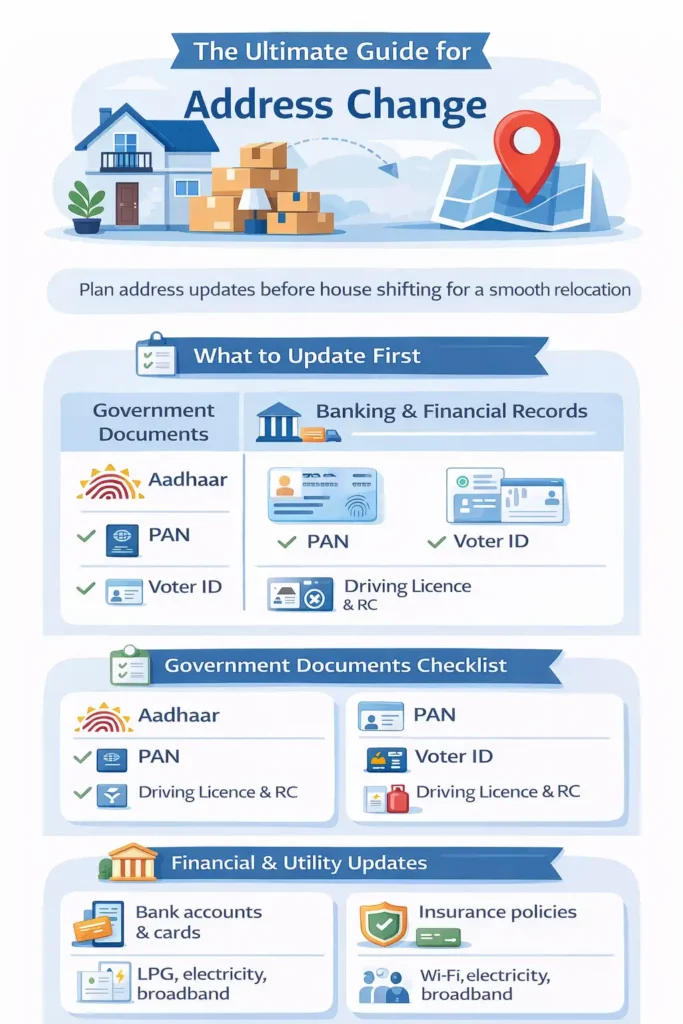
Government Documents to Update
Government-issued identity documents form the foundation of address verification in India. These records are commonly used for KYC, legal correspondence, and service eligibility. Updating them early helps keep all other linked records consistent.
Key documents that typically require an address update include:
- Aadhaar card
- PAN card
- Voter ID
- Driving licence and vehicle registration certificate
- Passport (through reissue, if applicable)
These updates usually require valid proof of the new address, such as utility bills, bank statements, or registered agreements.
Since many service providers rely on these documents, completing updates before hiring movers helps avoid delays during the shifting process.
Financial & Banking Records to Modify
Banks, lenders, and financial service providers rely on your registered address for compliance, communication, and delivery of financial instruments. Address updates are commonly allowed through online banking portals, mobile applications, or branch visits, subject to submission of address proof.
Accounts and services to review include:
- Savings and current bank accounts
- Credit cards and loan accounts
- Investment and pension-related accounts (such as NPS)
- Insurance policies
Ensuring your address is updated across all financial records helps avoid disruptions in transactions and official correspondence.
Utility & Household Services
Utility providers typically issue bills and service notifications to the registered address. Updating these records before shifting helps maintain continuity of essential services.
Services that usually require an address update or transfer include:
- Electricity and water connections
- LPG gas connection
- Broadband and DTH services
- Local subscriptions such as newspapers or milk delivery
Some services require advance notice or formal transfer requests, especially when moving to a different city.
Digital Platforms & Online Accounts
Many online platforms store your address for delivery, billing, or account recovery purposes. While often overlooked, updating these addresses helps avoid failed deliveries and account access issues after relocation.
This typically includes:
- E-commerce delivery addresses
- Food delivery and grocery apps
- Cab and mobility platforms
- Email and cloud account recovery details
Keeping these records current ensures uninterrupted access and accurate service delivery.
Personal & Professional Records
Beyond official systems, your address should also be updated wherever it’s used for communication or documentation.
Common areas include:
- Employer HR and payroll records
- School or college records
- Professional memberships and subscriptions
- Emergency contact information shared with close contacts
Updating these records ensures accurate communication and avoids confusion during and after the move.
Address Change for Government Documents
Government documents should be updated before house shifting because they act as primary address proof for most other services, including banks, insurance providers, and utilities. Keeping these records accurate helps avoid cascading verification issues later.
Aadhaar Card Address Change Process
The Aadhaar address can be updated either online through the myAadhaar portal or offline at authorised Aadhaar Seva Kendras and enrolment centres. The update requires valid Proof of Address documents such as utility bills, passport, voter ID, driving licence, or bank statements.
Online updates typically involve document upload and OTP-based authentication, while offline updates require physical document verification.
PAN Card Address Update Guidelines
PAN address updates are done using the PAN correction or update facility, which allows individuals to modify personal details, including address. The process can be completed online or offline by submitting the correction form along with supporting address proof and the applicable fee.
Updating PAN address helps maintain consistency across tax records and financial KYC systems.
Voter ID Address Change Steps
If you move to a new address, you can request a voter ID address update by submitting the prescribed form along with proof of the new residence. This ensures your name is correctly mapped to the electoral roll of the new constituency and prevents issues during elections.
Driving Licence Address Update
Driving licence address changes can be processed online via the Parivahan portal or offline at the local RTO. The update requires submission of address proof and relevant application forms.
Keeping your driving licence address updated is important for compliance, vehicle-related services, and official correspondence.
Vehicle RC Address Change After Shifting
When you shift residence, the address on your vehicle’s Registration Certificate should also be updated. This is usually handled through the Parivahan system or at the RTO, using address proof and the applicable forms. Accurate RC details are essential for traffic compliance, insurance, and ownership verification.
Passport Address Change – When Is It Required?
A passport address update is carried out through passport reissue, not simple correction. Applicants must apply online through the Passport Seva portal and submit valid address proof. Depending on the case, police verification may be required.
This update is recommended when the address change is long-term or needed for official documentation purposes.
Updating Address with Banks, Insurance & Financial Services
After government documents, financial records should be your next priority. Banks, insurers, and investment platforms rely on your registered address for compliance, communication, and delivery of critical documents. Address inconsistency across financial systems can lead to KYC issues and service delays.
Bank Account Address Change Procedure
Most banks in India allow customers to update their address through multiple channels, including:
- Net banking portals
- Mobile banking applications
- Visiting the nearest branch
- Submitting a written request with address proof
The update generally requires valid proof of the new address, such as Aadhaar, passport, driving licence, voter ID, or recent utility bills. Keeping bank address records updated ensures uninterrupted access to statements, cards, and official communication.
Credit Card & Loan Account Address Update
Credit card issuers and loan providers use the registered address for billing statements, legal notices, and card delivery. Address updates for these services are usually handled through:
- Customer service portals
- Mobile apps
- Branch visits or written requests
Failing to update your address may result in missed statements or delayed delivery of replacement cards and documents.
Insurance Policy Address Modification
Insurance providers require the policyholder’s current address for policy documents, renewal notices, and claim-related communication. Address updates are typically processed by submitting a signed request form along with valid address proof, either digitally or via courier/email, depending on the insurer.
Updating the address ensures accurate communication and avoids delays during claims or policy servicing.
Mutual Funds, Demat & Investment Accounts
Investment platforms generally require investors to keep their address details updated as part of compliance and record maintenance. Address changes are usually submitted through the investment portal or customer service channels, along with valid address proof.
Maintaining accurate address records helps prevent transaction issues and communication delays related to account statements or compliance notices.
Pension & NPS Address Updates
For National Pension System (NPS) accounts, address updates can be made by logging into the CRA system using PRAN credentials or through offline forms submitted to the relevant service provider. These updates help keep retirement records accurate confirm continuity in official communication.
Utility & Essential Service Address Change Before Shifting
Utility and essential services should be updated before moving to avoid service disruption, billing errors, or loss of connection at the new residence. Most providers require advance notice, especially when the move involves a city change or service transfer.
Electricity Connection Transfer or Address Update
Electricity service providers allow consumers to update or transfer the billing address by submitting a service request through the official provider portal or customer service centre. The process usually requires the consumer number, new address details, and valid address proof.
Since procedures vary by electricity distribution company, it is important to initiate the update well before the shifting date to avoid billing or service interruptions.
Water Supply Address Change
Water supply authorities typically require consumers to submit an address update request through their official service channels. This helps ensure accurate billing and communication regarding supply or maintenance. Early notification is recommended, particularly when relocating within the same city.
LPG / PNG Gas Connection Transfer
For LPG connections such as Indane, customers can request an address change or connection transfer through the official government services portal or by contacting the local distributor. When moving to a different city, the connection may need to be transferred using the portability or termination process, supported by valid address proof.
Broadband, Internet & DTH Services
Broadband and DTH providers usually process address updates through customer care, mobile apps, or official websites. Depending on network availability at the new location, the service may be transferred or reinstalled. Address proof may be required as part of the update process.
Newspaper, Milk & Local Vendor Subscriptions
Local service subscriptions often need direct communication with vendors to update delivery addresses or cancel services at the old location. Informing vendors in advance helps avoid missed deliveries and billing confusion during the transition period.
Digital, E-Commerce & Online Platform Address Updates
While digital platforms may not seem as critical as government or banking records, outdated addresses on online accounts can lead to failed deliveries, payment issues, and account recovery problems. Updating these platforms ensures continuity of services during and after house shifting.
E-Commerce Platforms Delivery Address Update
Most e-commerce platforms allow users to update delivery addresses directly from their account settings. This helps ensure that future orders are delivered to the correct location and prevents order cancellations or losses during relocation. Address updates can usually be made instantly before placing a new order.
Food Delivery & Grocery Apps
Food and grocery delivery apps rely on saved addresses for accurate service. Updating your location after shifting ensures uninterrupted access to deliveries and prevents incorrect routing. Address changes are typically done within the app by editing saved locations.
Cab, Travel & Mobility Apps
Cab and mobility apps store addresses for pickup points, saved locations, and billing. Updating your home address after relocation helps ensure accurate pickup locations and avoids confusion during ride bookings.
Email, Cloud Storage & Account Recovery Addresses
Email and cloud service providers often use a registered address or recovery contact information for account verification and security notifications. Keeping these details updated helps maintain account access and supports identity verification if recovery is required.
Subscription-Based Services
Subscription services such as OTT platforms, SaaS tools, or membership programs may use address details for billing or communication. Updating your address helps ensure uninterrupted service and accurate account records.
School, Workplace & Personal Network Address Updates
Address updates are not limited to official documents and services. Educational institutions, employers, and personal networks also rely on accurate address records for communication, records management, and emergency contact purposes.
School & College Records Update
Schools and colleges maintain student address records for administrative communication, identity verification, and emergency contact. Parents or students should notify the institution of the address change and submit supporting documents if required, ensuring academic records remain accurate.
Employer HR, Payroll & Tax Records
Employers use residential address details for payroll processing, tax documentation, and official correspondence. Address updates are typically handled through the organisation’s HR portal or by submitting a formal request to the HR department.
Keeping employer records updated helps ensure correct tax filings and uninterrupted communication.
Professional Licenses & Associations
Professionals associated with licensing bodies or membership organisations should update their address to maintain accurate records and receive timely communication. Address updates help avoid missed notices related to renewals or compliance.
Informing Friends, Relatives & Emergency Contacts
Sharing your updated address with close contacts ensures smooth communication and helps in emergencies. Informing key contacts before or shortly after shifting reduces confusion and ensures support systems remain accessible.
Address Change Made Simple Before House Shifting
Updating your address before house shifting is not just an administrative formality—it’s a critical step that protects your identity records, financial access, and essential services. From government documents and bank accounts to utilities and digital platforms, timely address updates help prevent service disruptions, verification issues, and missed communications.
By following a structured checklist and timeline, you can ensure that every important record reflects your new address accurately. Planning these updates alongside your relocation process allows you to focus on settling into your new home with confidence, knowing that your documentation and services are already in order.
Plan Your Move With Verified Packers And Movers
Address updates and house shifting go hand in hand. While you manage documentation and service transfers, working with reliable Packers And Movers helps ensure your belongings are moved safely, on schedule, and without unnecessary stress.
If you’re preparing for a local or intercity move, explore verified moving professionals who understand the logistics, timelines, and coordination required for a smooth relocation.