
How to Choose the Best Packers and Movers for Your Relocation
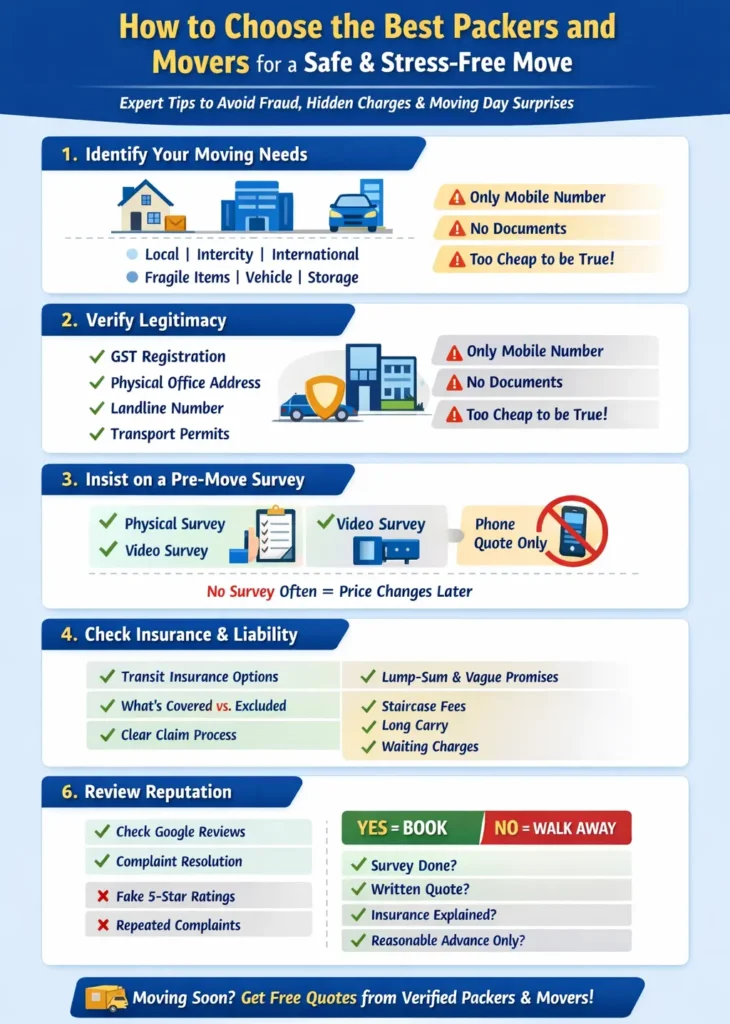
Choosing the right packers and movers requires more than comparing prices. Start by clearly defining your relocation needs, including the type of move, volume of goods, and any special handling requirements. Always verify the mover’s legitimacy by checking GST registration, physical office address, transport permits, and a functional landline number.
Insist on a pre-move survey to get an accurate, itemised quotation that clearly mentions packing, transportation, taxes, and insurance. Evaluate the mover’s experience, trained manpower, and quality of packing materials, as these directly impact safety and damage risk.
Never skip transit insurance—understand what is covered, what is excluded, and how claims are handled. Review customer feedback across multiple platforms and pay close attention to how complaints are resolved, not just star ratings. Finally, read the contract carefully, confirm delivery timelines, payment terms, and avoid movers demanding full advance payment.
A professional mover welcomes verification, provides written commitments, and maintains transparency throughout the relocation process.

Choosing the best packers and movers is one of the most critical decisions in the relocation process. A wrong choice can lead to damaged goods, hidden charges, delivery delays, or even financial loss, while a professional mover ensures safety, transparency, and peace of mind throughout the move. Hiring reliable packers and movers with verified credentials and transparent pricing is essential to avoid these risks. Despite this, many people select movers based only on price, without verifying credentials, service quality, or legal compliance—often resulting in avoidable disputes.
As an experienced relocation professional, it is evident that a successful move depends not on cheap quotes, but on verification, planning, and documented commitments. From understanding your relocation requirements and checking business legitimacy to comparing quotations correctly and securing proper insurance, every step plays a role in protecting your household goods and your finances.
Understand Your Relocation Requirements First
Choosing the best packers and movers begins long before you compare prices or read reviews. From an expert’s standpoint, the most common reason relocation goes wrong is unclear or incomplete requirement definition. When your needs are precisely mapped, you eliminate mismatched quotes, avoid service gaps, and reduce last-minute disputes.
Identify the Type of Move
Professional packers and movers structure their services based on the type of relocation, and each category involves a different operational scope.
- Local shifting (within the same city) generally involves smaller vehicles, same-day delivery, and minimal regulatory requirements.
- Intercity or interstate relocation requires route planning, longer transit timelines, interstate transport permits, toll management, and often vehicle tracking.
- International relocation involves customs documentation, export packing standards, and coordination with overseas agents.
- Office or commercial relocation requires asset tagging, IT equipment handling, phased movement, and downtime management.
Understanding your move type upfront ensures you shortlist movers who are operationally equipped for that category rather than general operators offering one-size-fits-all services.
For city-specific relocations, it is important to choose movers with proven local experience, such as professional packers and movers in Bangalore.
Estimate the Volume of Goods
From an expert perspective, volume estimation is the single biggest cost determinant in household relocation.
- The cubic volume of goods directly impacts:
- Vehicle size selection
- Number of packing staff required
- Packing material quantity
- Fuel and transit costs
- Inaccurate self-estimation often leads to:
- Quote revisions on moving day
- Additional vehicle deployment
- Unexpected loading or material charges
This is why professional movers insist on a pre-move survey (physical or video). Surveys allow accurate inventory mapping and realistic pricing, reducing disputes and post-loading price escalation. You can also review how movers calculate pricing in our detailed packers and movers cost guide to avoid last-minute revisions.
Define Special Handling Needs
Not all household goods can be treated the same during relocation. Certain categories require special packing methods, equipment, or permissions.
Common special-handling items include:
- Fragile items such as glassware, mirrors, and crockery
- Antiques, artwork, and high-value décor
- Large appliances that need dismantling and refitting
- Cars and bikes requiring dedicated carriers
- Items needing temporary storage or warehousing
Professional movers plan these requirements before packing begins, using customized materials like multi-layer cushioning, wooden crating, or vehicle-specific carriers. Failure to declare special items in advance is a frequent cause of damage claims being rejected.
Movers can only be held accountable for what is declared, surveyed, and documented. Clear requirement definition protects both the customer and the service provider.
Verify the Legitimacy and Credentials of Packers and Movers
From an expert standpoint, verification of credentials is the strongest defence against relocation fraud, hidden charges, and service failures. Many moving-related disputes originate from engaging unregistered or non-compliant operators who disappear once payment is made. Understanding documentation requirements also helps you avoid fraud, as explained in our guide on moving scams in the packers and movers industry.
Check Business Registration and Legal Documents
A legitimate packers and movers company must operate as a registered business entity and comply with taxation norms.
Key verifications include:
- GST registration (GSTIN): Professional movers issuing invoices are required to mention a valid GST number. GST applicability varies depending on whether the service includes only transportation or end-to-end relocation services.
- PAN and business registration: These confirm that the company is legally traceable and accountable.
Verifying GSTIN on official government portals helps customers confirm whether the company is active and compliant, which is critical for insurance claims and legal recourse.
Validate Physical Office Presence
One of the most overlooked but crucial checks is confirming whether the mover has a verifiable physical office.
Why this matters:
- Many fraudulent operators function only through temporary websites and call centres.
- A physical office indicates long-term operations, local accountability, and post-move support.
- Consumer grievance records consistently show higher complaint rates against movers without a fixed business address.
Customers should cross-check:
- Office address on Google Maps
- Consistency of address across website, invoice, and GST registration
A mismatch between these details is a strong warning sign.
Review Transport Permits and Vehicle Ownership
Household goods are transported using commercial vehicles, which must comply with motor vehicle laws.
Important checks include:
- Commercial vehicle registration (RC)
- Valid fitness certificate
- National or interstate permit for long-distance moves
Government transport systems such as VAHAN and Parivahan provide mechanisms to verify whether a vehicle is authorised for commercial goods transport. Using unpermitted vehicles can result in delays, fines, or goods being held at state borders.
Check for a Functional Landline Phone Number
From an expert and consumer-protection standpoint, the presence of a functional landline phone number is a strong credibility indicator for packers and movers.
Why a landline matters:
- A landline connection is issued only after address verification, which means the business has a traceable physical location.
- Fly-by-night or fraudulent movers typically rely only on mobile numbers, which can be easily changed or disconnected after collecting advance payments.
- Consumer grievance records show that companies with only mobile contact numbers are harder to track for dispute resolution.
Best practices for verification:
- Call the landline during business hours and confirm it is answered in the company’s registered name.
- Cross-check the landline number on the website, GST registration details, and official invoice.
- Be cautious if the company repeatedly avoids landline communication or redirects all calls to mobile numbers.
A legitimate relocation company usually maintains multiple communication channels—landline, official email ID, and physical office—demonstrating long-term operational intent.
A mover who avoids paperwork, delays document sharing, or discourages verification is not cutting costs — they are cutting compliance.
Evaluate Experience, Expertise, and Service Quality
From an expert relocation standpoint, service quality is determined more by operational capability than by pricing. Two movers may quote similar amounts, but the difference in experience, manpower training, and packing standards often decides whether a move is smooth or stressful.
Years of Experience in the Moving Industry
Experience in the packers and movers industry directly affects process reliability and risk management.
Why experience matters:
- Experienced movers follow established workflows for packing, loading, transit, and unloading.
- They are better equipped to handle unexpected issues such as route diversions, weather delays, or access restrictions at pickup and delivery points.
- Long-operating companies are more likely to have stable vendor networks, trained supervisors, and documented service procedures.
Consumer advisory resources consistently indicate that movers with a longer operational history show lower dispute frequency compared to newly formed or temporary operators.
Trained Packing and Handling Staff
The quality of a relocation largely depends on who handles your goods, not just what vehicle transports them.
Key expert observations:
- Professional movers deploy trained packing staff rather than unskilled daily-wage labor.
- Trained teams follow standardized lifting, wrapping, stacking, and securing methods to minimize transit damage.
- Improper handling is one of the leading causes of breakage, appliance damage, and post-move insurance claims.
Well-established moving guides and insurance documentation emphasize that staff training directly reduces claim ratios and damage incidents during relocation.
Packing Materials and Techniques Used
Packing materials are not interchangeable; the right material for the right item is a professional standard, not an upsell.
Industry-accepted packing practices include:
- Corrugated cartons of varying strengths for different load weights
- Bubble wrap and foam sheets for fragile items
- Stretch film and furniture blankets for sofas and wooden furniture
- Customized cartons for wardrobes, dishes, and electronics
- Proper labelling and inventory tagging for tracking
Professional relocation guides highlight that damage often occurs not due to transport distance, but due to inadequate or incorrect packing materials. Confirming packing standards in advance is therefore essential.
A mover’s real professionalism is visible before the truck arrives — in their survey accuracy, staff discipline, and packing preparation.
Compare Quotes the Right Way (Not Just the Price)
From an expert relocation perspective, most pricing disputes arise not because movers are expensive, but because quotations are incomplete or misunderstood. A low quote is meaningless if it excludes critical services or allows scope for later additions.
Importance of Pre-Move Survey
A pre-move survey—either physical or video-based—is a foundational step in professional relocation planning.
Why experts insist on surveys:
- Surveys allow movers to accurately assess the volume of goods, access conditions, and special packing needs.
- Physical constraints such as narrow staircases, lack of lifts, parking distance, or restricted entry times are identified in advance.
- Video surveys are now widely accepted as a practical alternative, offering similar accuracy when conducted properly.
Consumer advisory platforms consistently note that quotes issued without surveys are the most likely to change on moving day, leading to disputes and unplanned expenses.
What a Transparent Quotation Should Include
A professional quotation must clearly define what you are paying for.
Essential elements include:
- Itemised charges for packing, loading, transportation, unloading, and unpacking (if applicable)
- Packing material specifications
- Vehicle type and route scope
- Insurance option and premium
- Applicable taxes (GST) and statutory charges
- Pickup and delivery addresses with tentative timelines
Quotes that lack itemisation or use vague terms such as “all-inclusive” without explanation increase the risk of post-loading revisions.
Common Hidden Charges to Watch Out For
From documented consumer complaints and industry advisories, certain charges frequently appear when details are not clarified in advance.
Many of these add-ons are excluded unless discussed in advance, which is why you should review what is excluded from packers and movers charges.
Common examples include:
- Staircase or no-lift charges in multi-storey buildings
- Long-carry charges when trucks cannot park near the entrance
- Waiting charges due to access delays
- Additional packing material charges for undeclared items
- Storage or warehousing fees during transit delays
Experts recommend confirming all potential add-ons in writing before booking to prevent last-minute payment pressure.
The cheapest quote is often the most expensive move once hidden variables surface.
Check Insurance Coverage and Liability Protection
From an expert relocation standpoint, insurance is not an optional add-on—it is a risk management necessity. Many customers assume movers are automatically liable for damage, but in practice, liability depends on the type of insurance chosen and the terms of coverage.
Types of Moving Insurance Offered
Packers and movers in India typically facilitate insurance through licensed insurers rather than providing insurance themselves.
Common insurance options include:
- Carrier liability (basic cover): Limited statutory liability, often insufficient for high-value household goods.
- Transit insurance: Covers loss or damage during transportation due to specified risks.
- Comprehensive or all-risk insurance: Provides broader protection against accidental damage, theft, or loss during transit, subject to policy conditions.
Insurance regulators and insurers clarify that broader coverage generally requires a declared value of goods and payment of an insurance premium.
What Insurance Does and Does Not Cover
Understanding exclusions is as important as knowing what is covered.
Key coverage considerations:
- Damage caused by accidents, fire, or theft during transit may be covered depending on the policy.
- Items packed by the customer instead of the mover are often excluded.
- Wear and tear, inherent defects, or insufficient packing are commonly excluded risks.
- Compensation may be based on depreciated value unless “declared value” or “invoice value” is specified.
To avoid claim disputes, it is important to clearly understand what transit insurance covers during house shifting.
Insurance documentation consistently advises customers to read policy wording carefully before transit begins, as coverage cannot be altered once goods are in motion.
Claim Process and Documentation
From claim-settlement experience, delays and rejections usually result from incomplete documentation rather than claim validity.
Typically required documents include:
- Original invoice and insurance policy copy
- Inventory list signed at pickup and delivery
- Delivery receipt noting visible damage or shortages
- Photographic evidence of damaged items
- Claim intimation within the insurer’s specified time frame
Insurance authorities emphasize that timely reporting and proper documentation are essential for successful claim resolution.
Insurance protects against unforeseen risks — but only when coverage terms, valuation method, and documentation are handled correctly before the move.
Assess Reviews, Reputation, and Customer Feedback
From an expert consumer-advisory perspective, reputation analysis must go beyond star ratings. Reviews are valuable only when interpreted correctly and cross-verified across platforms.
Where to Check Authentic Reviews
Reliable feedback comes from multiple independent sources, not a single platform.
Recommended places to check:
- Google Business profiles for location-specific service feedback
- National Consumer Helpline and grievance portals for complaint history
- Public consumer forums and review platforms that archive unresolved disputes
Using more than one source helps identify patterns—such as repeated complaints about delays, damage, or pricing disputes—that may not be visible on promotional pages.
How to Spot Fake or Manipulated Reviews
Expert review analysis shows that not all online reviews are genuine.
Common red flags include:
- Multiple reviews posted within a short time span
- Repetitive or generic wording without service details
- Reviewer profiles with little or no review history
- Overly positive feedback that lacks specifics about the move
Digital consumer awareness studies explain that authentic reviews usually mention specific services, timelines, or issues, while fabricated ones tend to be vague.
Importance of Complaint Resolution History
Negative reviews are not always a deal-breaker; how a company responds matters more than the complaint itself.
What experts look for:
- Public responses acknowledging the issue
- Willingness to investigate and resolve complaints
- Absence of aggressive or dismissive replies
Consumer protection resources note that companies with a transparent and responsive complaint-handling approach are more accountable and service-oriented than those that ignore or delete negative feedback.
A mover’s reputation is revealed not by perfect ratings, but by how consistently and responsibly they handle problems.
Understand the Contract, Terms, and Service Commitments
From an expert relocation and consumer-rights perspective, the written contract is the only enforceable version of what the mover promises. Verbal assurances given by sales representatives carry little value once goods are loaded and in transit.
Reading the Fine Print Carefully
Every professional packers and movers engagement should be supported by a written quotation or service agreement.
Key elements experts advise customers to verify in writing:
- Scope of services included and excluded
- Liability limitations and insurance reference
- Conditions under which charges may change
- Cancellation or rescheduling terms
Consumer protection advisories consistently emphasize that disputes become difficult to resolve when services are agreed verbally and not documented. Written contracts protect both parties by clearly defining responsibility.
Delivery Timelines and Penalty Clauses
Delivery timelines are often misunderstood because movers may provide estimated delivery windows, not guaranteed dates.
Important expert considerations:
- Contracts should clearly state whether delivery timelines are estimated or guaranteed.
- For long-distance moves, transit time may vary due to weather, road conditions, or regulatory checks.
- Any compensation or penalty clauses for delays must be explicitly mentioned in the agreement.
Consumer law guidance indicates that vague delivery terms are a frequent cause of dissatisfaction, as expectations and contractual obligations do not always align.
Payment Terms and Advance Amount
Payment structure is a critical risk-management factor during relocation.
Best-practice observations include:
- Reputable movers usually request a reasonable advance, with the balance payable upon delivery.
- Full payment before loading or delivery increases the customer’s financial risk.
- Payment terms, including acceptable payment modes and milestones, should be documented in the quotation.
Consumer advisory platforms caution against movers who insist on 100% advance payment or demand cash-only transactions without proper receipts.
If a commitment is not written in the contract, it effectively does not exist in a dispute scenario.
Final Expert Checklist Before Booking Packers and Movers
From an expert relocation advisory standpoint, a structured final check prevents last-minute surprises and ensures accountability once the move is underway. This checklist consolidates the most critical verification points recommended by consumer protection resources and industry best practices.
Pre-Booking Verification Checklist
Before confirming any packers and movers, experts recommend verifying the following:
- Valid GST registration number (GSTIN) mentioned on the quotation
- Consistent company name, address, and contact details across invoice, website, and GST records
- Functional landline number and official email ID
- Completion of a pre-move survey (physical or video)
- Written, itemised quotation covering packing, transport, taxes, and insurance
- Availability of valid vehicle documents and transport permits for the route
Consumer advisories highlight that most relocation disputes originate from skipping one or more of these verification steps.
Questions You Must Ask Before Finalizing
Asking the right questions clarifies responsibility and prevents misunderstandings.
Essential questions include:
- Will the goods be transferred to another vehicle during transit?
- What is the exact process for reporting damage or loss?
- Are customer-packed items covered under insurance?
- Who will be the on-ground supervisor during pickup and delivery?
- What documents will be provided at pickup and delivery?
Experts recommend getting clear, written responses to these questions before making any payment.
When to Say No and Look for Another Mover
Certain warning signs indicate that it is safer to walk away, even if the quote appears attractive.
Red flags include:
- Quotes that are significantly lower than market averages
- Refusal to conduct a pre-move survey
- Absence of proper documentation or reluctance to share it
- Demand for full payment in advance or cash-only transactions
- Evasive answers regarding insurance or claims
Consumer complaint data consistently links these behaviours to higher instances of service failure and fraud.
A professional mover welcomes verification. Resistance to checks is often the clearest warning sign.
Planning Your Move? Choose Verified Experts
Don’t risk your relocation with unverified movers or hidden charges.
6 Packers And Movers connects you with verified, GST-registered, and experienced packers and movers in Bangalore who follow transparent pricing, proper documentation, and professional packing standards.
- Pre-verified movers
- Transparent quotations
- Insurance support
- Nationwide relocation coverage
Get Free Quotes from Trusted Packers and Movers Now
(Move smart. Move safe. Move stress-free.)