
What Is Usually Excluded from Moving Charges?
Packers and movers usually exclude hazardous items, perishable food, pets, valuables like cash and jewelry, post-move services, and certain packing methods such as wooden crating. Insurance exclusions apply to owner-packed items, mechanical failures, and natural calamities. Additional charges may apply for stair carry, long carry, shuttle service, or urgent moves. To avoid surprises, customers should request a written quotation, declare all items in advance, and confirm inclusions and exclusions before booking.

Moving is stressful enough — the last thing you need is a surprise charge or a denied claim on moving day. This guide explains, step-by-step, what packers & movers commonly exclude from standard moving charges, why those exclusions exist, and how you can avoid unexpected bills. If you’re planning a relocation with 6 Packers And Movers, start here to protect time, money and good will. Before booking, it also helps to understand how professional packers and movers services work and what is included in a standard relocation package.
Below you’ll find clear explanations, quick-check tables and action-oriented bullets that you can use on a landing page or long-form guide — all statements are drawn only from verifiable industry, government and insurer guidance.
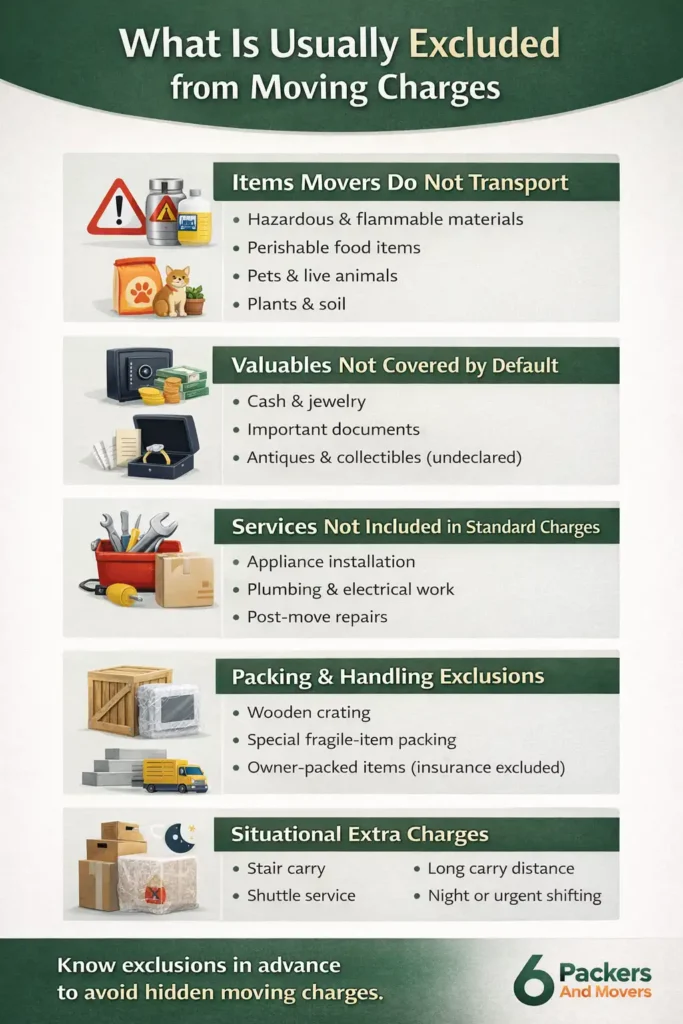
Items That Movers Commonly Refuse to Transport
Professional packers and movers are legally and operationally restricted from carrying certain items. These exclusions exist to protect safety, comply with transport laws, and avoid insurance violations. Even in full-service moves, these items are not accepted under standard moving charges and are usually refused outright.
Why These Items Are Excluded
- They pose fire, explosion, contamination, or health risks
- They may violate transport, excise, or safety regulations
- They are not covered by transit insurance
- They can endanger other household goods in the truck
These exclusions are standard across the industry and apply even when you hire packers and movers in Chandigarh or other major cities.
Commonly Refused Items (Always Excluded)
- Hazardous and flammable materials
Petrol, diesel, kerosene, paint thinner, chemicals, gas cylinders, firecrackers - Explosives and corrosive substances
Fireworks, acids, cleaning chemicals, industrial liquids - Perishable food items
Fresh vegetables, fruits, frozen food, dairy products, cooked food - Pets and live animals
Dogs, cats, birds, fish, livestock (require specialized animal transport) - Plants, soil, and organic matter
Potted plants, garden soil, compost (restricted due to pest and biosecurity risks)
Quick Reference
Item category | Transport status | Reason |
Flammable liquids | ❌ Refused | Fire and explosion risk |
Perishable food | ❌ Refused | Spoilage and hygiene issues |
Pets & animals | ❌ Refused | Legal and welfare concerns |
Plants & soil | ❌ Refused | Pest and biosecurity restrictions |
Chemicals & acids | ❌ Refused | Safety and insurance exclusions |
What You Should Do Instead
- Carry restricted and personal items yourself
- Dispose of or safely empty hazardous materials before packing day
- Arrange specialized transport for pets or plants if required
- Inform the movers in advance if you are unsure about any item
High-Value and Restricted Items Not Covered by Default
Even when you choose full-service packing and moving, certain high-value items are excluded from standard moving charges and liability. This is mainly because movers cannot assess their value accurately, and transit insurance places strict limits on such goods unless they are declared in advance.
Why Valuables Are Excluded by Default
- Their value is difficult to verify on-site
- Risk of theft or loss is higher
- Standard transit insurance does not cover undeclared valuables
- Movers cannot legally compensate without prior declaration
This is also why customers should clearly understand how packers and movers insurance works before assuming valuables are covered.
Items Typically Not Covered Under Standard Charges
- Cash and currency notes
Indian or foreign cash in any amount - Jewelry and precious items
Gold, silver, diamonds, gemstones, ornaments - Important personal documents
Passports, Aadhaar cards, PAN cards, property papers, certificates - Financial instruments
Bonds, share certificates, fixed deposit receipts, wills - Rare or collectible items
Antiques, paintings, coins, memorabilia (unless declared and approved)
Coverage Rules at a Glance
Item type | Included in moving charges | Insurance covered |
Cash & jewelry | No | No |
Personal documents | No | No |
Antiques (undeclared) | No | No |
Declared valuables | Conditional | Only with extra insurance |
What Movers Expect From Customers
- Carry valuables and documents personally
- Declare antiques or collectibles before the move
- Opt for additional insurance if high-value items must be transported
- Ensure declared values are recorded in writing
Common Mistake to Avoid
❌ Packing valuables inside cartons assuming “everything is insured”
Many claim rejections happen for this reason — learn why packers and movers insurance claims get rejected in India.
✔️ Declaring or self-carrying valuables to avoid claim rejection
Services That Are Excluded Unless Specifically Requested
Standard moving charges usually cover packing, loading, transportation, unloading, and placement of household goods. Certain services fall outside this scope and are excluded unless you request them in advance or opt for them as add-ons. These exclusions exist because they require specialized skills, tools, or additional time beyond a moving crew’s role.
What Is Included vs What Is Not
It’s important to separate moving services from technical or trade services. Movers focus on safe transportation — not post-move installations or repairs.
Services Commonly Excluded From Standard Charges
- Appliance installation after delivery
AC refitting, geyser installation, washing machine reconnection - Plumbing-related work
Tap fixing, pipe reconnections, leakage repairs - Advanced electrical work
Rewiring, switchboard modifications, heavy electrical fittings - Civil or carpentry modifications
Drilling, wall cutting, furniture alteration beyond dismantling
Important Clarification (Inclusion)
Dismantling and reassembly of complex furniture is included as part of professional moving services when required for safe transportation.
This covers wardrobes, beds, modular units, and large furniture that cannot be moved as a single piece.
Service Scope Comparison
Service type | Included in standard charges |
Furniture dismantling & reassembly | Yes |
Packing & loading | Yes |
Appliance installation | No |
Plumbing & electrical repairs | No |
Furniture modification | No |
How to Avoid Service-Related Confusion
- Ask for a written list of included services
- Confirm if any technical work is needed post-delivery
- Arrange electricians or plumbers separately if required
- Do not assume installation equals transportation
If you’re unsure what to expect, this detailed guide on what full-service movers actually include can help clarify service boundaries.
Situations Where Additional Charges May Apply
Even when items and services are included, certain site conditions and logistical challenges can increase moving costs. These are not hidden fees — they are situational charges that apply only when extra effort, manpower, or vehicles are required beyond standard assumptions.
Why These Charges Exist
- Increased labour time and physical effort
- Restricted vehicle access or parking limitations
- Use of additional vehicles or equipment
- Extended working hours or night operations
Common Situations That Trigger Extra Charges
- Staircase carry
When lifts are unavailable, under maintenance, or too small for items - Long carry distance
When the truck cannot be parked close to the building entrance - Shuttle service
Use of smaller vehicles when large trucks cannot enter narrow roads - Floor level variations
High-rise buildings with non-functional elevators - Night or urgent shifting
Same-day, late-night, or emergency relocation requests
These factors directly affect pricing, which is why it’s important to review how packers and movers charges are calculated in advance.
Additional Charges – Overview
Situation | Why extra cost applies |
Stair carry | More labour and time |
Long carry | Increased handling effort |
Shuttle service | Additional vehicle usage |
Night shifting | Overtime and safety costs |
Urgent moves | Resource reallocation |
What Customers Should Do in Advance
- Inform movers about floor number and lift availability
- Share parking restrictions at both locations
- Allow a pre-move survey to assess access issues
- Avoid last-minute changes on moving day
Packing Materials and Special Handling – Included vs Excluded
Packing is a core part of professional moving services, but not all packing materials or handling methods are included in standard moving charges. The difference usually depends on the type of item, fragility, weight, and declared requirements before the move.
What Is Typically Included in Standard Packing
- Corrugated cardboard boxes
- Bubble wrap and foam sheets
- Stretch film and packing tape
- Basic cushioning for household goods
These materials are sufficient for regular furniture, appliances, clothing, and kitchenware.
Packing and Handling Excluded Unless Opted Separately
- Wooden crating for fragile or high-value items
- Custom-built crates for glass, marble, or stone items
- Export-grade or long-distance specialty packing
- Artwork and antique-specific packing methods
Vehicle Packing – Important Inclusion Rule
Bike and car transport packing is included if the customer informs in advance.
Advance declaration allows movers to arrange correct packing material and insurance coverage.
If not informed beforehand, vehicle packing may be excluded or charged separately.
Packing Coverage Comparison
Packing type | Included by default |
Standard household packing | Yes |
Bike transport packing (declared) | Yes |
Car transport packing (declared) | Yes |
Wooden crating | No |
Artwork / marble crating | No |
How to Ensure Proper Packing Coverage
- Declare all fragile and special items during survey
- Inform in advance about bike or car transportation
- Ask for written confirmation of packing method used
- Opt for special packing when item value or fragility demands it
Insurance-Related Exclusions Movers Do Not Cover
Transit insurance protects household goods during movement, but it does not cover every type of loss or damage. Certain situations and item conditions are clearly excluded under standard insurance terms, which directly impacts what movers can compensate during a claim.
Why Insurance Has Exclusions
- Insurance covers accidental transit damage, not inherent defects
- Claims are paid only when packing and handling meet approved standards
- Events beyond human control fall under force majeure
Common Insurance Exclusions You Should Know
- Owner-packed items
Goods packed by the customer are excluded due to unverifiable packing quality - Mechanical or electrical failure
Internal appliance issues are not treated as transit damage - Pre-existing damage
Scratches, dents, or wear noted before packing are not compensable - Force majeure events
Natural disasters such as floods, earthquakes, or severe weather
Insurance Coverage – Quick
Scenario | Insurance claim valid |
Mover-packed item damaged | Yes |
Customer-packed item damaged | No |
Appliance not working after move | No |
Damage from natural calamity | No |
How to Reduce Claim Rejections
- Allow movers to pack items covered under insurance
- Disclose existing damage during the survey
- Opt for insurance based on declared value, not assumptions
- Review exclusions before signing the agreement
Key Takeaway
Insurance does not mean “everything is covered.”
Coverage applies only within defined conditions — understanding these exclusions prevents disputes later.
Items Excluded Due to Legal or Regulatory Restrictions
Certain items are excluded from moving charges not because movers refuse service, but because laws and regulations restrict their transportation. In these cases, movers are legally obligated to deny or conditionally accept such items only when proper permits and documentation are provided.
Why Legal Restrictions Apply
- Transport laws regulate public safety and security
- Some goods require special permits or licenses
- Non-compliance can lead to seizure, penalties, or legal action
- Movers are liable if restricted goods are carried without approval
Common Legally Restricted Items
- Alcohol and liquor
Inter-state movement is regulated by state excise laws and may require permits - Firearms and ammunition
Transport requires valid licenses and compliance with arms regulations - Restricted or banned goods
Items prohibited under central or state laws - Goods without ownership proof
Items lacking invoices, bills, or legal possession documents
Legal Exclusions – Overview
Item | Transport status | Requirement |
Alcohol | Conditional | State excise permit |
Firearms | Conditional | Valid license & approval |
Banned goods | Prohibited | Not allowed |
No-proof items | Refused | Ownership documents needed |
What Customers Should Do
- Ask in advance if an item is legally movable
- Arrange permits where applicable before packing
- Carry personal licenses and documents yourself
- Never hide restricted items inside cartons
Important Warning
Transporting restricted goods without compliance can result in confiscation, fines, or criminal liability, and movers will not be responsible for such outcomes.
Cleaning, Debris Removal, and Post-Move Services
Standard moving charges focus on safely transporting household goods from one location to another. Post-move services are usually excluded unless they are clearly mentioned in the quotation. Many customers assume these are included, which often leads to confusion after delivery.
Why These Services Are Not Included
- They fall outside the core scope of packing and transportation
- They require separate manpower, tools, and time
- They are treated as optional add-on services
Services Commonly Excluded From Moving Charges
- Disposal of packing debris
Used cartons, plastic wrap, and cushioning materials - Deep cleaning services
Cleaning of old or new premises after unloading - Furniture alignment or décor setup
Rearranging interiors beyond basic placement - Extended storage services
Storage beyond the agreed free or transit period
Post-Move Services – Inclusion
Service | Included by default |
Packing waste removal | No |
Deep cleaning | No |
Furniture décor setup | No |
Short-term transit storage | Limited |
Long-term storage | No |
How to Plan for These Exclusions
- Ask for written clarity on post-move services
- Arrange cleaning separately if required
- Confirm storage duration and charges in advance
- Do not assume waste removal is automatic
Key Reminder
Movers deliver and place items — they do not restore or set up the home unless contracted separately.
Common Misunderstandings About “All-Inclusive” Moving Charges
Many relocation disputes happen not because of poor service, but due to misunderstanding what “all-inclusive” actually means. In moving contracts, this term usually refers to a defined scope — not unlimited services or zero conditions.
What “All-Inclusive” Usually Covers
- Packing of declared household items
- Loading, transportation, and unloading
- Placement of items inside the new home
- Basic dismantling and reassembly of furniture
What “All-Inclusive” Does NOT Mean
- No extra charges in unusual access conditions
- Coverage for undeclared items
- Insurance for all types of damage
- Inclusion of technical or post-move services
Common Customer Assumptions vs Reality
Assumption | Reality |
Quote price is final | Quotes are estimates based on survey |
Everything is insured | Insurance has exclusions |
Verbal promises apply | Only written terms are valid |
Extra items won’t matter | Inventory changes affect cost |
Why Quotes Change After Booking
- Additional items added on moving day
- Incorrect or incomplete pre-move information
- Access issues not disclosed earlier
- Special packing or handling required
How to Avoid These Misunderstandings
- Insist on a written quotation with inclusions and exclusions
- Share complete and accurate inventory details
- Read insurance clauses before confirmation
- Avoid relying on verbal assurances
Key Insight
“All-inclusive” applies only to what is written and agreed — not to assumptions.
Planning a move? Avoid hidden charges and last-minute surprises.
Get a clear, written quotation with transparent inclusions and exclusions from experienced professionals.
o avoid exclusions, disputes, or last-minute charges, follow this expert checklist on how to choose the best packers and movers before confirming your booking.
Get Free Moving Quote from 6 Packers And Movers