
Moving Cost Calculation Factors: How Packers and Movers Calculate Charges
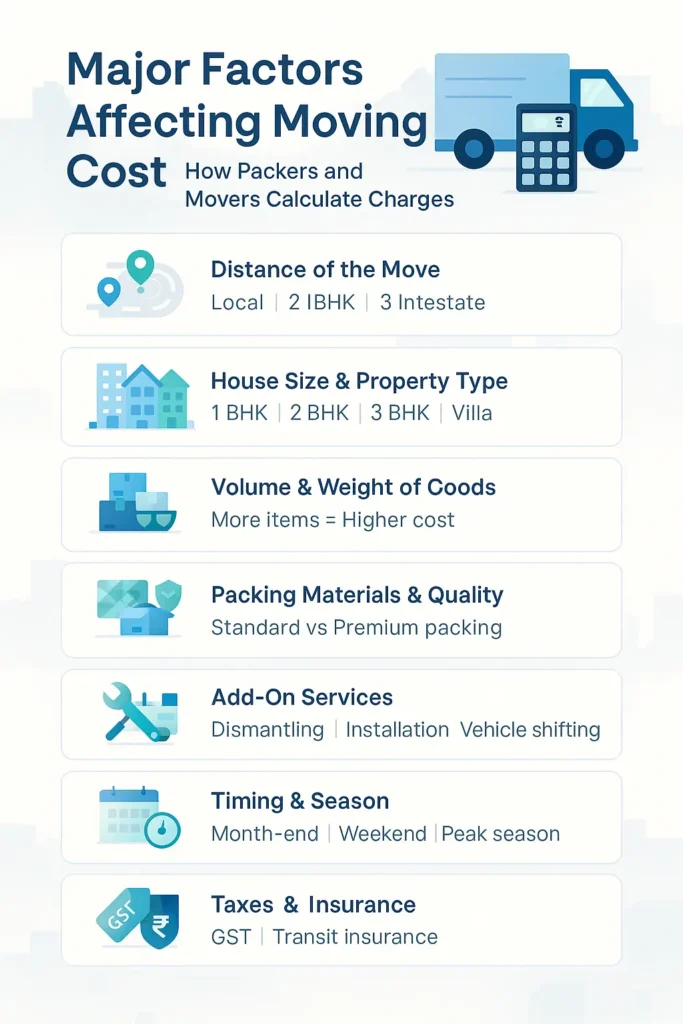
Packers and movers calculate shifting charges based on several factors, including distance of the move, house size, volume and weight of goods, floor level and lift availability, packing materials used, add-on services, and moving time. Additional costs such as taxes, insurance, and access-related charges may also apply. Understanding these factors helps you compare quotations accurately and plan your relocation budget without hidden surprises.

When planning a house relocation, understanding how moving costs are calculated can help you avoid hidden charges and unrealistic quotations. Professional Packers And Movers do not decide prices randomly — moving charges are calculated based on multiple practical factors such as distance, house size, volume of goods, floor access, packing materials, and additional services requested. Each of these elements directly impacts manpower, vehicle requirements, fuel consumption, time, and risk involved in the move. To get a complete cost overview, you can also refer to our detailed packers and movers cost guide, which explains standard price ranges and common inclusions.
we break down all major factors affecting moving cost calculation, explaining how packers and movers arrive at their final quotation. Whether you are planning a local shift, intercity relocation, or full household move, this guide will help you understand what you are paying for and why, so you can compare quotes confidently and plan your relocation budget accurately.
Distance of the Move
Distance is one of the most important components in packers and movers charges calculation. The longer the distance between the pickup and delivery location, the higher the transportation-related expenses involved in the move.
How Distance Impacts Moving Cost
- Fuel consumption increases with distance
- Toll charges and state entry permits may apply
- Driver allowance and transit time increase
- Vehicle wear and operational costs go up
Because of this, movers calculate transportation charges differently for local, intercity, and interstate relocations.
Local vs Intercity vs Interstate Charges
Type of Move | Distance Range | Cost Impact |
Local Move | Within the same city | Lower transport cost |
Intercity Move | Between cities in same state | Moderate cost increase |
Interstate Move | Across states | Highest transport-related charges |
Local moves may be charged as a flat rate or based on labor and vehicle size, while intercity and interstate moves depend heavily on kilometers traveled and vehicle type used.
If you are planning a local move, it’s helpful to check city-specific pricing, such as packers and movers charges in Ludhiana.
Per-Kilometer & Vehicle-Based Pricing
For long-distance relocation, movers often calculate costs based on:
- Total distance (in km)
- Type of transport vehicle (shared or dedicated)
- Load size and volume
Dedicated trucks cost more than shared vehicles because they move directly to the destination without combining consignments.
Additional Distance-Related Costs
- Toll taxes and road charges
- Border or entry permits in some states
- Remote or difficult route accessibility
These charges are usually added to the final quote after distance estimation.
House Size & Property Type
House size plays a critical role in packers and movers charges calculation because it directly reflects the quantity of household items, packing effort, manpower requirement, and vehicle size needed for transportation. Movers commonly use house configuration as a starting benchmark to estimate relocation costs.
How House Size Affects Moving Cost
Larger homes generally contain:
- More furniture and appliances
- Higher packing material consumption
- Increased loading and unloading time
- Bigger or multiple transport vehicles
Because of this, packers and movers usually categorize moves by BHK size or property type to estimate costs accurately.
Cost Difference by House Configuration
House Type | Typical Cost Impact | Reason |
1 BHK | Lower | Fewer items, smaller vehicle |
2 BHK | Moderate | Balanced volume & manpower |
3 BHK | High | More furniture & appliances |
4 BHK / Villa | Highest | Large volume, premium packing |
Movers often use these categories to prepare approximate price slabs before conducting a physical or virtual survey.
For a clearer idea of pricing by home size, refer to our packers and movers charges by house size guide covering 1 BHK, 2 BHK, and 3 BHK relocations.
Furnished vs Semi-Furnished vs Unfurnished Homes
The level of furnishing also influences the final cost:
- Fully furnished homes include beds, sofas, wardrobes, appliances, and décor items
- Semi-furnished homes have limited furniture and appliances
- Unfurnished homes require minimal packing and labor
More furnishings mean more packing material, handling time, and risk coverage — all of which increase the relocation cost.
Apartment vs Independent House Shifting
Property type further affects pricing:
- Apartments may involve lift dependency, parking restrictions, and society rules
- Independent houses may require longer carrying distances from door to vehicle
Both scenarios can impact labor hours and loading strategy.
Commercial & Office Space Cost Considerations
For office or commercial moves, movers consider:
- Number of workstations and files
- IT equipment handling
- Structured packing and labeling needs
These factors generally place commercial shifting in a higher cost bracket compared to residential moves of similar size.
Volume & Weight of Household Goods
The total volume and weight of household items is a core factor in moving cost calculation. Packers and movers rely on this assessment to determine packing requirements, vehicle size, manpower strength, and fuel consumption. Even if two homes are of the same size, their moving cost can vary significantly based on the quantity and heaviness of goods.
How Movers Estimate Volume of Goods
Professional movers estimate volume using:
- Number of items
- Size of furniture and appliances
- Carton count after packing
- Cubic feet or cubic meter calculation
This volume estimation helps movers decide whether a small pickup, medium truck, or large container is required for transportation.
Volume-Based vs Weight-Based Pricing
Pricing Method | Used For | Cost Impact |
Volume-based | Household goods | Depends on space occupied |
Weight-based | Heavy consignments | Depends on total weight |
Household shifting is generally priced based on volume, while unusually heavy items or consolidated consignments may also consider weight as a factor.
Impact of Heavy & Bulky Items
Certain items increase moving charges due to special handling needs:
- Refrigerators and washing machines
- Wardrobes and solid wood furniture
- Treadmills, safes, or gym equipment
These items require additional manpower, stronger packing, and sometimes mechanical assistance, increasing overall cost.
Effect of Decluttering on Moving Cost
Reducing item count before shifting can:
- Lower packing material usage
- Reduce labor hours
- Allow use of a smaller vehicle
Decluttering unwanted or unused items before relocation directly helps in reducing moving charges.
Why Accurate Survey Matters
A physical or virtual survey helps movers:
- Assess actual volume correctly
- Avoid underestimation or last-minute price revisions
- Provide a more transparent quotation
Inaccurate volume assessment is one of the most common reasons for cost mismatch during relocation.
Understanding how professional movers assess inventory can help avoid disputes — see how inventory lists protect you from missing or damaged items.
Floor Level & Lift Availability Charges
Floor level and lift availability directly affect the labor effort, time, and safety risks involved in loading and unloading household goods. When access is difficult, packers and movers apply additional charges to compensate for extra manpower and handling complexity.
Ground Floor vs Upper Floor Loading Costs
- Ground floor properties usually have lower loading charges
- Upper floors increase manual carrying effort
- Cost rises with each additional floor if no lift is available
Movers factor in the number of floors at both the pickup and delivery locations when calculating total shifting charges.
Lift Available vs No Lift Charges
Access Condition | Cost Impact | Reason |
Lift available | Lower | Faster & safer movement |
No lift | Higher | Manual stair carrying required |
Even when lifts are available, movers may avoid using them for very heavy items due to safety or society restrictions.
Narrow Staircases & Long Carry Distance
Additional cost factors include:
- Narrow staircases or tight turns
- Long distance from home to parking area
- Basement or podium parking limitations
These conditions increase loading time and manpower needs, leading to extra charges.
Such access challenges are common in apartment relocations and directly affect manpower planning and pricing.
Extra Manpower Requirement
For higher floors or restricted access:
- Additional helpers may be deployed
- Loading and unloading time increases
- Risk of item damage rises
These operational challenges are reflected in the final quotation.
Packing Materials & Packing Quality
Packing materials and packing quality significantly influence packers and movers charges calculation. The type, quantity, and grade of materials used determine the level of protection for household goods and directly affect the overall moving cost.
Standard vs Premium Packing Materials
- Standard packing uses basic cartons, wrapping paper, and tapes
- Premium packing includes bubble wrap, foam sheets, corrugated rolls, and multi-layer protection
Premium packing increases cost but reduces the risk of damage during transit, especially for long-distance moves.
Common Packing Materials Used by Movers
Packing Material | Purpose | Cost Impact |
Corrugated boxes | General packing | Moderate |
Bubble wrap | Fragile item protection | Higher |
Thermocol sheets | Shock absorption | Higher |
Stretch film & tapes | Securing items | Low |
Waterproof covers | Moisture protection | Additional |
Choosing the right packing materials also impacts safety — learn the difference between bubble wrap and foam sheets for packing fragile items.
The more fragile or high-value items you have, the greater the packing material requirement.
Waterproof & Weather-Proof Packing Charges
For monsoon or long-distance relocations:
- Waterproof sheets may be used for furniture
- Moisture-resistant packing helps prevent damage
These protective measures add to packing costs but are often recommended to safeguard goods.
Custom Crating for Fragile & High-Value Items
Items such as:
- Glass tops and artwork
- Large LED TVs
- Antique or delicate furniture
may require custom wooden crating, which involves additional material and labor costs.
Why Packing Quality Affects Final Cost
Higher packing standards:
- Increase material usage
- Require skilled labor
- Take more time
As a result, better packing quality reflects directly in the total moving charges.
Add-On Services That Increase Moving Cost
Add-on services are optional but commonly requested during relocation. These services are not always included in the base quotation and can significantly increase the total moving cost depending on the complexity and scope of work involved.
Furniture Dismantling & Reinstallation Charges
Large furniture items such as:
- Beds
- Wardrobes
- Modular furniture
often require dismantling before transport and reinstallation at the destination. This service involves skilled labor and tools, which adds to the overall shifting charges.
Appliance Uninstallation & Installation Services
Packers and movers may charge separately for:
- Air conditioner uninstallation and refitting
- Geyser removal and installation
- Wall-mounted TV dismantling and reinstallation
These tasks require technical handling and are usually billed as add-on services.
Vehicle Transportation Charges
If you are relocating a:
- Car
- Bike or scooter
additional charges apply based on:
- Distance of transport
- Type of carrier used
- Vehicle size and weight
Vehicle shifting costs are calculated independently from household goods transportation.
Vehicle relocation costs vary based on transport method — this vehicle transportation guide for bike and car shifting explains the pricing factors in detail.
Storage & Warehousing Services
Temporary storage may be required when:
- Move-in dates do not match
- Renovation work is pending
Warehousing charges depend on:
- Storage duration
- Space occupied
- Security and handling requirements
Transit Insurance & Risk Coverage
Transit insurance is optional but recommended for long-distance moves. The cost depends on:
- Declared value of goods
- Type of insurance coverage chosen
Insurance charges are added separately to the final quotation.
Timing, Season & Operational Factors
The timing of your move and operational conditions on moving day can influence packers and movers charges significantly. Demand fluctuations, scheduling constraints, and urgency all affect how relocation costs are calculated.
Peak Season vs Off-Season Moving Rates
- Moving demand is usually higher during month-ends and weekends
- Higher demand often leads to increased service charges
- Off-season or mid-month moves are generally more cost-efficient
Packers and movers adjust pricing based on workload and vehicle availability during peak periods.
“Seasonal demand plays a major role in pricing — here’s a comparison of best season for moving: monsoon vs summer vs winter.
Weekend, Month-End & Festival Surcharges
Timing Factor | Cost Impact | Reason |
Month-end | Higher | Maximum relocation demand |
Weekends | Higher | Limited availability |
Weekdays | Lower | Better scheduling flexibility |
Festival seasons and public holidays may also affect manpower availability, influencing charges.
Same-Day vs Flexible Delivery Pricing
Urgent relocations that require:
- Same-day loading and delivery
- Tight delivery schedules
often cost more due to:
- Dedicated vehicle requirement
- Overtime labor
- Priority handling
Flexible delivery timelines allow movers to optimize logistics, reducing overall cost.
Last-Minute Booking Charges
Bookings made close to the moving date may incur additional charges because:
- Planning time is limited
- Vehicle and labor allocation becomes urgent
- Backup resources may be required
Advance booking helps secure better pricing and availability.
Taxes, Insurance & Hidden Cost Components
Apart from basic packing, labor, and transportation charges, certain statutory and operational components are added to the final relocation bill. Understanding these costs helps avoid confusion and last-minute surprises.
GST & Applicable Taxes on Moving Services
Packers and movers services attract Goods and Services Tax (GST), which is calculated on the total service value. GST is generally applied after adding packing, labor, and transportation charges, and is shown separately in most quotations.
Transit Insurance Cost Calculation
Transit insurance is an optional service that protects household goods against damage or loss during transportation. Insurance charges depend on:
- Declared value of household items
- Type of coverage selected
Higher declared value leads to higher insurance premiums.
Parking, Entry & Permit Charges
Certain locations may involve additional costs such as:
- Paid parking near apartments or societies
- Entry or municipal permits in some cities
- Restricted-area access charges
These expenses are usually added separately if applicable.
What Is Included vs Excluded in the Final Quote
Included Components | Common Exclusions |
Packing labor | Appliance installation |
Basic packing material | Premium crating |
Transportation | Storage services |
Loading & unloading | Insurance |
Clarifying inclusions and exclusions in advance helps avoid billing disputes later.
Always review exclusions carefully — some services may not be covered in the base quote.
Importance of Written Quotation
A detailed written quotation helps:
- Track cost components clearly
- Avoid hidden charges
- Ensure accountability
Always request a breakup of charges before confirming the move.
Planning a move and want clear, transparent pricing? 6 Packers And Movers helps you understand every cost component before you book. From accurate volume assessment to packing quality and add-on services, we ensure fair estimates with no last-minute surprises. Whether you’re shifting locally or long-distance, our structured approach helps you plan your relocation budget confidently and move stress-free with professional support at every step.