
Apartment Shifting vs. Villa Shifting — What Changes? (Logistics, Manpower, Loading Complexity)
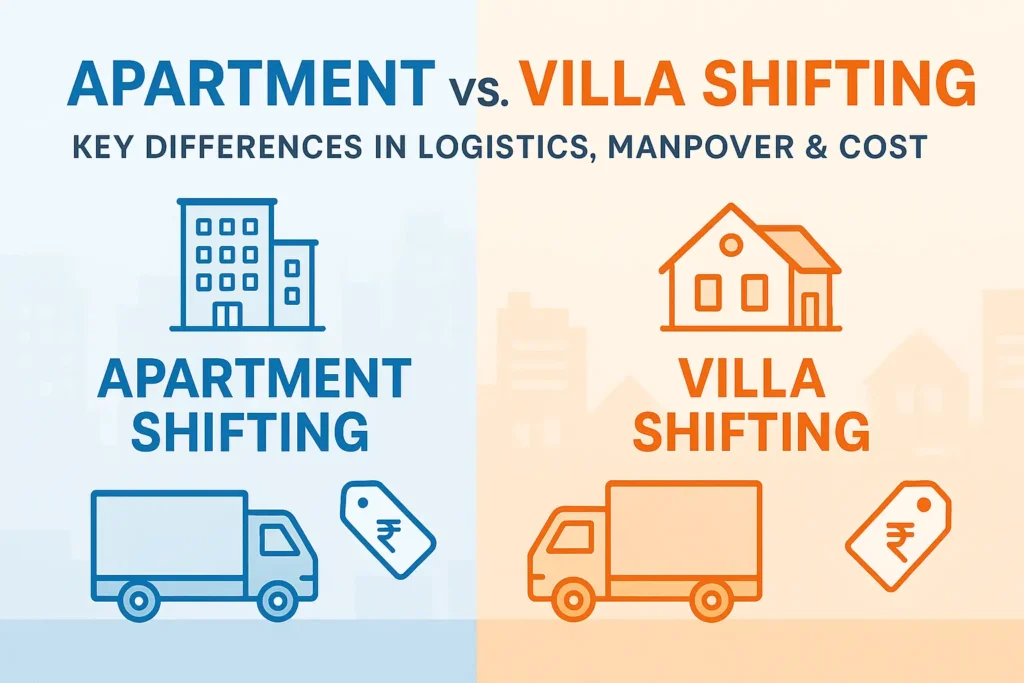
Apartment shifting involves lift restrictions, society rules and narrow access paths, making loading slower. Villa shifting demands more manpower, larger trucks and extensive packing due to higher inventory and heavy outdoor items. This guide compares logistics, cost, manpower and time to help you choose the right moving strategy.
Shifting a home—whether it’s an apartment or a villa—may look similar on the surface, but the ground reality is very different. Each type of property has its own challenges related to access, layout, packing needs, manpower, loading pathways, vehicle movement, and society rules. Understanding these differences helps you plan better, avoid delays, reduce damage risks, and choose the right Packers and Movers service for a smooth relocation.
In India, apartments come with lift booking rules, security restrictions, narrow corridors, and limited parking, while villas require handling of larger volume, heavy wooden furniture, garden items, terrace materials, and outdoor equipment. These elements directly impact the time required, the number of labourers, packing materials used, and ultimately, the final shifting cost.
Below is a detailed comparison that breaks down every element of apartment vs. villa shifting — from logistics to manpower to loading complexity — to help you make the right choice and plan efficiently. For a smoother relocation experience, consider reviewing practical Moving Tips for a stress-free move before finalizing your shifting strategy.
Space Layout & Accessibility Differences
When comparing apartment shifting with villa shifting, the biggest visible difference comes from the layout and accessibility. Apartments in India usually have tight corridors, limited lift sizes, strict movement timings, and restricted truck parking, making loading and unloading more time-consuming. Villas, on the other hand, provide wider access, open driveways, and direct entry, but involve more rooms, heavier furniture, and outdoor items that increase overall handling effort.
Key Differences
- Apartments
- Narrow pathways, staircases, and small service lifts
- Long carry distance if trucks can’t enter the premises
- Mandatory lift booking and fixed shifting hours
- Tighter turns requiring dismantling of large furniture
- Villas
- Easy truck access from the main gate or driveway
- Wider rooms and larger furniture to handle
- Additional terrace, balcony, garden, and backyard items
- Multiple floors inside duplex/triplex villas
This difference in movement pathways plays a crucial role in deciding the manpower, packing effort, and total time needed for both types of relocations.
Logistics & Vehicle Planning for Both Moves
Logistics planning changes significantly depending on whether you’re shifting from an apartment or a villa. Apartments usually require smaller vehicles or multiple rounds because of parking restrictions, society entry rules, and narrow internal roads. Villas, due to their bigger inventory, often need larger trucks, multiple loading zones, and more organised sequencing—especially when handling garden items, heavy furniture, or equipment from multiple floors.
Proper logistics planning also includes pre-move surveys, route planning, estimating packing material, and arranging the right number of labourers. A trusted mover from your city, such as packers and movers in Bangalore, can ensure efficient vehicle allocation and proper logistics planning.
Key Logistics Differences
- Apartments
- May require smaller trucks (14–17 ft) due to narrow societies
- Parking often away from the lift → longer carry distance
- Strict entry/exit windows can delay scheduling
- Lift availability affects loading sequence
- Villas
- Ideal for larger 19–22 ft trucks
- Direct loading access lowers carry time
- More items need structured packing and inventorying
- Outdoor, terrace, and garden material increases truck space needs
Comparison
Logistics Factor | Apartment Move | Villa Move |
Truck Size | Smaller / multiple trips | Larger trucks |
Parking Access | Restricted | Easy & open |
Volume of Goods | Moderate | High |
Time Required | Depends on society rules | Depends on number of rooms |
Pre-Move Survey | Essential | Mandatory |
Manpower Requirement & On-Ground Coordination
Manpower needs differ sharply between apartment relocation and villa shifting due to the layout, number of rooms, accessibility, and carrying distance involved. Apartments often require additional manpower for manual carrying, especially when lifts are small, busy, or unavailable. Villas, however, need larger teams because of the higher furniture volume, multiple floors, and large items like garden furniture, swing sets, heavy wooden wardrobes, and outdoor appliances.
On-ground coordination becomes crucial in both cases. For apartments, movers must align with the society office, security desk, lift operator, and manage timed entry gates. In villas, the challenge lies in managing multiple pickup points, distributing manpower efficiently, and ensuring larger items are dismantled before loading.
Hiring professional teams through verified platforms such as Packers and Movers ensures better supervision, team coordination, and safe handling.
Manpower Differences
- Apartments
- Extra handlers needed for stairs or long-carry scenarios
- Lift coordination requires time and supervision
- Often 4–6 labourers for 1–2 BHK moves
- Villas
- More labourers to handle large items & large inventories
- Team split for indoor + outdoor packing
- Often 6–10 labourers for duplex or large villas
Comparison
Factor | Apartment Shifting | Villa Shifting |
Labour Count | 4–6 (avg.) | 6–10 (avg.) |
Handling Difficulty | Lift/stair constraints | Heavy/bulky items |
Coordination Needs | Society rules & timing | Multiple floors/areas |
Supervision | Medium | High |
Packing & Loading Complexity: Volume, Fragility & Heavy Items
Packing and loading complexity varies significantly between apartment moves and villa moves due to differences in space, furniture size, and the volume of belongings. Apartments typically require tight-space navigation, meaning movers must dismantle bulky wardrobes, bed frames, or appliances to fit through narrow lifts and corridors. Villas, on the other hand, come with larger inventories, including garden equipment, terrace furniture, outdoor décor, and heavy wooden pieces that need special protection. This increases the need for high-quality packing materials, careful labeling, and additional loading time. Understanding what transit insurance covers during house shifting is especially important when handling heavy furniture and outdoor items.
Professional packers and movers use materials like bubble wrap, corrugated sheets, foam, crates, and stretch film based on fragility and size. Villas often require custom wooden crates for delicate or antique items.
Packing & Loading Differences
- Apartments
- Difficult turns in corridors and lift entry points
- Frequent dismantling of large furniture
- Higher risk of wall/door scratches → more padding needed
- Moderate total volume, but complex movement
- Villas
- High volume: extra rooms, balconies, store rooms, garden items
- Need for special packing (plants, swing sets, heavy furniture)
- Large loading space allows faster truck preparation
- Multi-point packing across floors and outdoor spaces
Comparison
Factor | Apartment Shifting | Villa Shifting |
Packing Volume | Moderate | High |
Fragile Items | Standard | More décor & antiques |
Special Packing | Medium | High |
Loading Difficulty | Due to tight spaces | Due to heavy & large items |
Dismantling Required | Often | Frequent for bulky items |
Cost Comparison — What Makes Shifting Cheaper or Expensive?
The cost difference between apartment shifting and villa shifting is influenced by factors such as access, number of rooms, labour effort, packing materials, and loading difficulty. Apartment moves may appear smaller but can become expensive due to floor charges, lift unavailability, extended carrying distance, and strict society timing, which increases total labour hours. Villa shifting generally costs more overall because of higher inventory volume, multiple floors inside the house, and special packing requirements for outdoor and heavy items.
The total price bracket usually depends on:
You can refer to our detailed packers and movers cost guide to understand how pricing is calculated for apartment and villa moves.
- BHK size and total number of items
- Accessibility factors (lift, stairs, basement parking)
- Packing material usage (bubble wrap, foam, crates)
- Number of labourers and total hours needed
- Type of vehicle(s) required
- Distance between origin and destination
Using verified local movers such as those listed on Packers and Movers ensures transparent pricing and proper pre-move surveys.
Cost Drivers
- Apartments
- Lift charges & floor-based labour fees
- Longer carry distance from basement parking
- Timing restrictions → delayed workflow
- Dismantling for tight spaces
- Villas
- High packing material usage
- More labourers required
- Large truck requirement (19–22 ft)
- Handling of heavy outdoor items
Comparison
Cost Factor | Apartment Shifting | Villa Shifting |
Overall Cost | Moderate | High |
Labour Effort | Medium–High | High |
Packing Cost | Medium | High |
Vehicle Size | Small/Medium | Large |
Extra Charges | Lift/floor charges | Outdoor item handling |
Time Required & Overall Difficulty Level
The time required for apartment shifting versus villa shifting varies due to differences in access, loading pathways, and total inventory volume. Apartment moves often take longer than expected because of lift sharing, society movement restrictions, and long carry distances from basements or parking areas. A typical 1–2 BHK move may take 4–8 hours, while 3 BHK+ can stretch to 8–12 hours depending on lift availability and coordination. Villas, although more spacious and easier to access, require more time due to multiple rooms, outdoor items, and heavier furniture, often extending the process to a full day.
Difficulty level also changes based on manpower and sequencing. Apartments are difficult because of tight movement paths, while villas are difficult because of volume and weight. Using reliable packers and movers ensures proper supervision and time-efficient workflows.
Time & Difficulty Factors
- Apartments
- Lift wait time increases loading duration
- Society timing restrictions can cause delays
- Tight corners require slower handling
- Moderate inventory but complex navigation
- Villas
- Larger inventory + outdoor areas
- Heavy furniture slows dismantling & loading
- Multi-floor packing adds time
- Easier access, but more total work
Comparison
Factor | Apartment Shifting | Villa Shifting |
Time Required | 4–12 hours | 6–14+ hours |
Difficulty Level | High (access issues) | High (volume/weight) |
Delays Due To | Lift, society rules | Heavy/extra items |
Workload | Medium | High |
Apartment vs. Villa Shifting at a Glance
Apartment shifting and villa shifting may share the same goal—moving your belongings safely—but the challenges, planning, effort, and cost involved can be completely different. Apartments pose access-related difficulties, while villas bring volume and heavy-item challenges. Understanding these differences helps you plan manpower, schedule, truck size, and packing material in advance. Before hiring professionals, Before hiring professionals, read our guide on how to choose the best packers and movers and always request a pre-move survey. through Packers and Movers, ensure you request a pre-move survey so teams can estimate accurate time and cost.
Quick Highlights
- Apartments = Space constraints, lift rules, long carry distance
- Villas = Higher inventory, heavier items, outdoor areas
- Apartments take longer due to society restrictions; villas take longer due to packing volume
- Total cost is influenced by truck size, labour hours, and packing material consumption
Master Comparison
Factor | Apartment Shifting | Villa Shifting |
Accessibility | Limited, lift/stairs | Easy, open driveway |
Inventory Volume | Moderate | High |
Heavy Items | Less | More (garden, outdoor, wooden) |
Labour Requirement | 4–6 | 6–10 |
Packing Material Needed | Medium | High |
Loading Difficulty | Tight turns, limited space | Bulky & large items |
Vehicle Type | Small/medium trucks | Large trucks |
Time Required | 4–12 hours | 6–14+ hours |
Cost Impact | Floor/lift charges | Heavy items & extra material |
Society Rules | Strict & time-bound | Usually flexible |
This side-by-side comparison offers a clear overview of what to expect and how to prepare for each type of move—helping you make faster, smarter shifting decisions.