
Bubble Wrap vs. Foam Sheets: When to Use Which
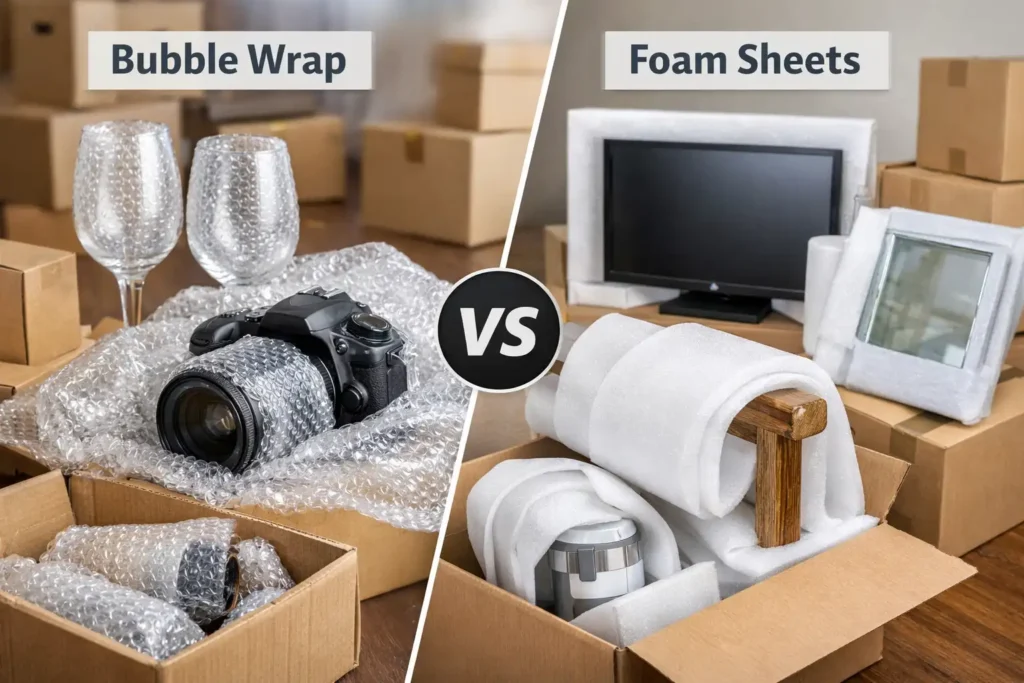
Bubble wrap is best for impact protection and irregular-shaped fragile items, while foam sheets are ideal for scratch prevention and surface protection. For maximum safety during moving, professionals often use foam sheets as the first layer to protect surfaces and bubble wrap as a secondary layer to absorb shocks and vibrations.
Choosing the right packing material plays a critical role in preventing damage during relocation, storage, or transportation. Following practical Moving Tips can help you select the most suitable materials for different items and reduce the risk of damage. Professional packers and movers rely heavily on materials like bubble wrap and foam sheets because each serves a distinct protective purpose. Understanding when to use bubble wrap versus foam sheets helps reduce breakage, surface damage, and insurance claims—especially during home and office shifting handled by Experienced Packers and Movers. This report presents a factual, side-by-side evaluation of both materials based on protection capability, use cases, cost, and professional packing practices.
Bubble Wrap vs Foam Sheets – Quick Comparison Table
Bubble wrap and foam sheets are both widely used by professional packers, but they differ significantly in how they protect items during relocation and transport. The comparison below highlights their functional differences based on protection type, handling efficiency, and practical usage in packing scenarios.
Key Differences at a Glance
Comparison Factor | Bubble Wrap | Foam Sheets |
Primary Protection Type | Impact and shock absorption | Surface and abrasion protection |
Cushioning Mechanism | Air-filled bubbles compress under force | Closed-cell foam distributes pressure evenly |
Best For | Fragile, breakable, and irregular-shaped items | Polished, flat, or surface-sensitive items |
Surface Protection | Moderate (air pockets may imprint on finishes) | High (non-abrasive contact layer) |
Flexibility | Highly flexible and conforms to shapes | Flexible but requires cutting for fit |
Space Efficiency | Bulky due to air pockets | Compact and stackable |
Reusability | Limited once bubbles deflate | High due to shape retention |
Moisture Resistance | Basic resistance | Higher resistance due to closed cells |
Weight Impact | Very lightweight | Slightly heavier per unit area |
Performance Overview
- Bubble wrap absorbs vibration and minor drops effectively, making it suitable for long-distance or high-handling moves.
- Foam sheets provide consistent protection against scratches and pressure marks, especially when items are tightly packed or stacked.
- Professional packers often use both materials together, applying foam sheets as a first layer and bubble wrap as a secondary cushioning layer for maximum protection.
This comparison helps determine which material to use based on the item’s fragility, surface sensitivity, and transport conditions.
How Professional Packers Choose Between Bubble Wrap and Foam Sheets
Professional packers do not rely on a single packing material. For example, professional packers and movers in Rajkot commonly use this layered method to minimise damage during household and office relocation. Material selection is based on handling risk, transport distance, and surface sensitivity. The standard workflow used during home and office shifting follows a layered approach:
First-contact layer: Foam sheets are used directly on polished, painted, or glass surfaces to prevent scratches and pressure marks
Secondary cushioning layer: Bubble wrap is added to absorb shocks, vibration, and minor drops
Structural support: Corrugated sheets or cartons provide rigidity
Void filling: Empty spaces are filled to prevent internal movement
This method ensures both surface protection and impact resistance, reducing damage during loading, unloading, and transit.
When to Use Bubble Wrap (Best Use Cases)
Bubble wrap is most effective when the primary risk during transportation is impact, vibration, or sudden movement. Its air-filled cushioning structure makes it suitable for protecting items that are fragile, uneven in shape, or likely to experience frequent handling during a move.
Best Situations to Use Bubble Wrap
- Packing fragile household items such as glassware, crockery, showpieces, and ceramic décor
- Wrapping irregular-shaped items that cannot be fully protected by flat materials
- Protecting items during long-distance or interstate moves, where vibration and handling are higher
- Separating multiple items packed within the same carton to prevent collision damage
Common Items Packed Using Bubble Wrap
- Glass bottles and kitchenware
- Decorative items and collectibles
- Electronic components and accessories
- Light fixtures and lamps
Why Professionals Prefer Bubble Wrap in These Cases
- Easily wraps around corners and contours
- Absorbs shock during bumps, drops, and stacking
- Lightweight, adding minimal load to cartons
- Works well as a secondary cushioning layer inside boxes
Limitations to Keep in Mind
- Provides limited scratch protection on polished surfaces
- Loses effectiveness once air bubbles deflate or burst
- Occupies more carton space compared to foam sheets
Improper packing is also one of the key reasons why insurance claims get rejected during house shifting.
Because of these limitations, professional packers often combine bubble wrap with foam sheets or corrugated padding when dealing with high-value or surface-sensitive items.
When to Use Foam Sheets
Foam sheets are most effective when the primary risk is surface damage rather than impact. Professional packers use foam sheets to protect items with finished, polished, or delicate surfaces that can be scratched, scuffed, or marked due to friction during movement or storage.
Best Situations to Use Foam Sheets
- Protecting polished wooden furniture, cabinets, and modular units
- Wrapping glass tabletops, mirrors, and panels to prevent surface abrasion
- Packing home appliances and electronic screens where finish protection is critical
- Short-distance moves and warehouse storage where handling impact is lower
Common Items Packed Using Foam Sheets
- Wardrobes, beds, and dining tables
- Refrigerators, washing machines, and TVs
- Doors, panels, and laminated boards
- Artwork, framed pictures, and décor pieces
Why Professionals Prefer Foam Sheets in These Cases
- Non-abrasive contact layer prevents scratches
- Uniform thickness ensures even protection
- Thin and space-efficient, allowing tighter carton packing
- Retains cushioning properties after repeated use
Limitations to Consider
- Does not absorb heavy shocks as effectively as bubble wrap
- Requires additional cushioning for long-distance or high-impact transport
- Less suitable as a standalone solution for highly fragile items
For maximum protection, foam sheets are often used as a primary wrapping layer, followed by bubble wrap or corrugated sheets depending on transport distance and item fragility.
Packing Material Choice Based on Move Distance
Packing strategy changes based on how far items are transported:
Short-distance or local moves:
Foam sheets are prioritised to prevent surface damage caused by friction and stacking.Long-distance or interstate moves:
Bubble wrap is used more extensively to absorb vibration, road shocks, and repeated handling.Storage or warehousing:
Foam sheets are preferred for long-term surface protection and reusability.
Using the wrong material for the distance involved increases the risk of breakage or surface damage.
Bubble Wrap vs Foam Sheets for Fragile Items
When packing fragile items, the choice between bubble wrap and foam sheets depends on the type of fragility involved—whether the risk is breakage from impact or surface damage from friction. Professional packers select materials based on how an item reacts to movement, pressure, and handling during transit.
Bubble Wrap for Fragile Items
Bubble wrap is commonly used for fragile items that are prone to cracking or breaking when subjected to shocks or vibrations.
Best suited for:
- Glassware, ceramic items, and porcelain
- Decorative pieces and collectibles
- Lightweight electronic components
- Items with irregular or curved shapes
Why bubble wrap works well:
- Conforms closely to item contours
- Absorbs vibration and sudden impact
- Provides cushioning between multiple packed items
- Can be layered to increase protection
Foam Sheets for Fragile Items
Foam sheets are preferred when fragile items also have sensitive or finished surfaces that require scratch-free protection.
Best suited for:
- Glass tabletops and mirrors
- Flat electronic screens and panels
- Polished wooden or painted items
- Artwork and framed décor
Why foam sheets are effective:
- Non-abrasive surface prevents marks and scuffs
- Uniform cushioning distributes pressure evenly
- Maintains protection even after repeated handling
- Can be cut and layered for controlled immobilisation
Recommended Professional Approach
- Use foam sheets as the first layer to protect the surface
- Add bubble wrap as a secondary layer for shock absorption
- Fill empty spaces in cartons to prevent internal movement
This combined method reduces both impact damage and surface abrasion, making it the preferred strategy for high-value and fragile household or office items.
Which Packing Material to Use for Common Household Items
| Item Type | Best Material | Why It Works | Recommended Layering |
|---|---|---|---|
| TV / Monitor | Foam sheets + Bubble wrap | Protects screen surface and absorbs shock | Foam contact + bubble outer |
| Glassware / Crockery | Bubble wrap | Cushions impact and vibration | Multiple bubble layers + void fill |
| Mirrors / Glass panels | Foam sheets | Prevents scratches and pressure marks | Foam contact + rigid outer board |
| Wooden furniture | Foam sheets | Non-abrasive surface protection | Foam sheets + stretch wrap |
| Decorative items | Bubble wrap | Conforms to irregular shapes | Bubble wrap + box cushioning |
| Appliances | Foam sheets | Protects finish and corners | Foam + corner protection |
Cost, Reusability & Environmental Impact
Beyond protection, professional packers also consider cost efficiency, reuse potential, and environmental impact when selecting packing materials. Bubble wrap and foam sheets differ significantly across these practical dimensions.
Cost Comparison
Factor | Bubble Wrap | Foam Sheets |
Initial Cost | Generally lower | Higher than bubble wrap |
Bulk Availability | Widely available in rolls | Available in sheets and rolls |
Cost Justification | Suitable for high-volume, low-value items | Justified for high-value or surface-sensitive goods |
Bubble wrap is often chosen when budget constraints exist or when packing large volumes of items. Foam sheets, while more expensive initially, are frequently used for items where surface damage could lead to higher replacement or repair costs.
Understanding what transit insurance covers during house shifting becomes especially important when transporting high-value or fragile items.
Reusability & Durability
- Bubble wrap loses cushioning ability once air bubbles deflate or burst, which limits repeated reuse.
- Foam sheets retain their structure and protective properties under repeated compression, allowing multiple reuse cycles.
- Professional movers reuse foam sheets more frequently in storage and returnable packing systems due to their durability.
Environmental Impact
- Both materials are plastic-based and not biodegradable under natural conditions.
- Bubble wrap is made from low-density polyethylene (LDPE), which can be recycled in facilities that accept soft plastics, though access is limited.
- Foam sheets (such as EPE foam) are recyclable in specialised facilities, but recycling availability varies by region.
- Due to lightweight composition, both materials pose recycling challenges related to collection and processing efficiency.
Sustainability Considerations
- Reusable foam sheets can reduce overall material consumption when used across multiple moves.
- Biodegradable and paper-based alternatives are increasingly used where environmental impact is a priority, though protection levels differ.
Recycling and Disposal Considerations
Bubble wrap is made from LDPE plastic and may be recyclable in facilities that accept soft plastics, though availability varies.
Foam sheets (such as EPE foam) are recyclable in specialised facilities but are not universally accepted due to processing challenges.
Reusing foam sheets across multiple moves can reduce overall material consumption.
Proper disposal depends on local recycling infrastructure and material condition.
Expert Packing Tips for Maximum Protection
Professional packers focus on layered protection, correct material sequencing, and proper immobilisation to minimise damage during relocation. Using bubble wrap or foam sheets alone is rarely sufficient; the way these materials are applied plays an equally important role.
Use Layered Packing Instead of a Single Material
- Apply foam sheets as the first layer to protect item surfaces from scratches and scuffs.
- Add bubble wrap as a secondary layer to absorb shock and vibration.
- Combine with corrugated sheets or cartons for structural strength.
Protect the Surface First
- Items with polished, painted, or laminated finishes should never be wrapped directly in bubble wrap.
- A non-abrasive foam sheet layer helps prevent pressure marks and surface impressions during transit.
Eliminate Empty Spaces Inside Boxes
- Fill all voids using cushioning materials to prevent movement inside cartons.
- Even well-wrapped items can break if allowed to shift during transport.
Use Multiple Thin Layers Instead of One Thick Layer
- Several layers of foam sheets and bubble wrap offer better protection than relying on a single heavy layer.
- Layering improves energy absorption and distributes pressure more evenly.
Ensure Snug, Not Compressed, Wrapping
- Wrapping should be firm enough to prevent movement but not so tight that cushioning materials lose their protective properties.
- Over-compression reduces the shock-absorbing effectiveness of both foam and bubble wrap.
Match Packing Material to Transport Distance
- Long-distance and interstate moves require higher shock protection using bubble wrap and multi-layered packing.
- Short-distance moves and storage benefit more from foam sheets focused on surface protection.
Avoid Common Packing Mistakes
- Using damaged or deflated bubble wrap
- Skipping surface protection for polished items
- Relying on foam sheets alone for high-impact transport
- Leaving unfilled gaps inside cartons
Applying these professional packing principles significantly reduces breakage, surface damage, and post-move complaints.
Mistakes Professional Packers Avoid
Wrapping polished or painted surfaces directly with bubble wrap
Reusing bubble wrap with deflated or burst bubbles
Using foam sheets alone for high-impact or long-distance transport
Leaving empty gaps inside cartons
Over-tight wrapping that compresses cushioning materials
Avoiding these mistakes significantly reduces damage complaints and post-move claims.
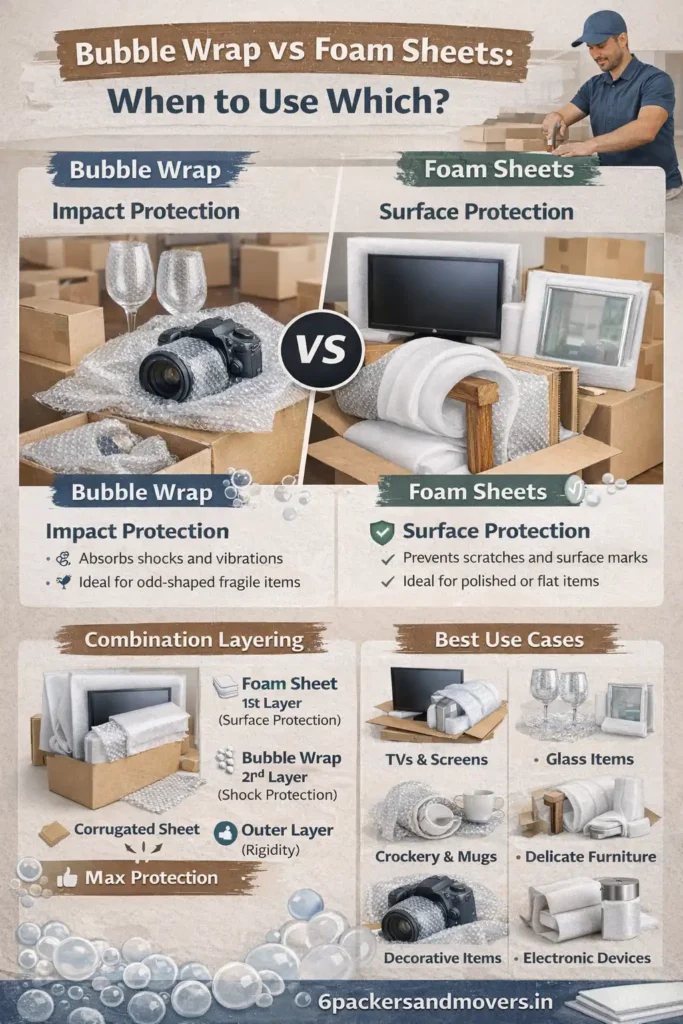
Bubble wrap is better for absorbing shocks and vibrations, especially for fragile and uneven items. Foam sheets are better for protecting polished or painted surfaces from scratches. Professional packers usually combine both materials for optimal protection.
Foam sheets cannot fully replace bubble wrap in high-impact or long-distance transportation. While foam sheets protect surfaces well, bubble wrap provides superior shock absorption needed for fragile items.
Glass items are best protected using a combination of foam sheets and bubble wrap. Foam sheets prevent surface scratches, while bubble wrap absorbs shocks and reduces the risk of breakage.
Yes, foam sheets are more reusable than bubble wrap because they retain their structure and cushioning even after repeated use, unlike bubble wrap which loses effectiveness once bubbles deflate.
Traditional bubble wrap is plastic-based and not biodegradable. While it can be recycled in facilities that accept soft plastics, recycling availability is limited. Reusable foam sheets or alternative materials can reduce environmental impact.
Yes, professional packers typically use foam sheets as the first protective layer and bubble wrap as a secondary cushioning layer to handle both surface protection and impact resistance.
Bubble wrap and foam sheets serve different but equally important roles in professional packing. Bubble wrap excels at absorbing impact and vibration, making it essential for fragile and irregular items. Foam sheets provide reliable surface protection, preventing scratches and scuffs on polished or delicate finishes. Choosing the right material—or combining both—depends on the item type, transport distance, and handling conditions.
When packing is done correctly using the appropriate materials and layering techniques, the risk of damage during relocation drops significantly.
For safe, damage-free relocation, trust experienced professionals and follow a reliable hiring checklist to avoid damage and packing mistakes.
Get expert help from Verified packers and movers to ensure your belongings are packed with the right protection for every move.