
How Inventory Lists Protect You from Missing or Damaged Items
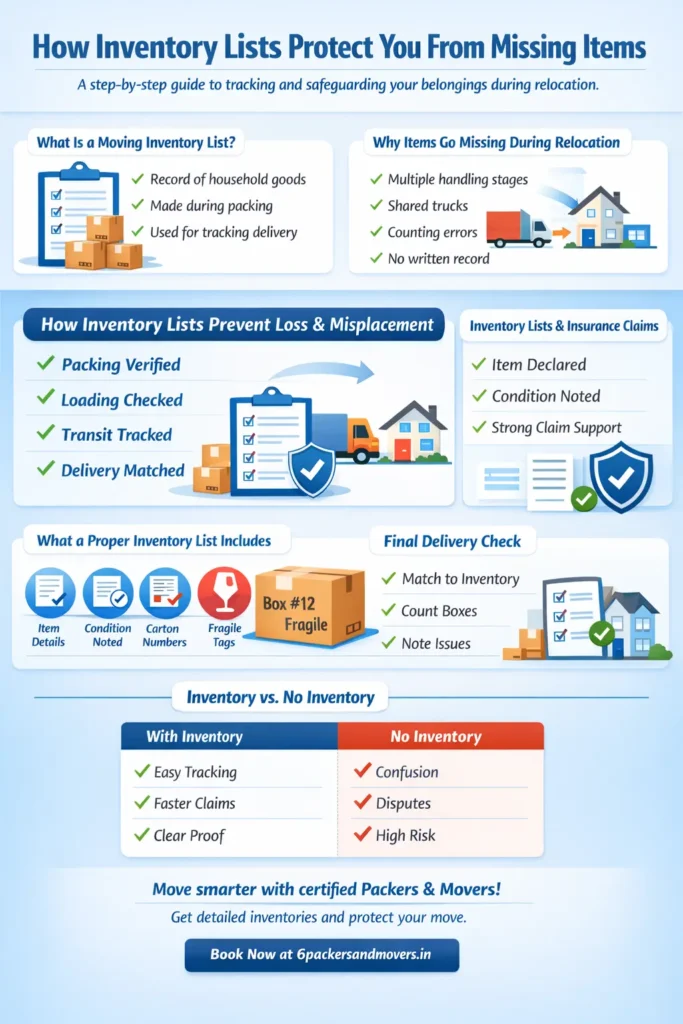
An inventory list protects you from missing items during relocation by creating a documented record of everything packed, loaded, and delivered. It allows movers and customers to cross-verify items at multiple stages, detect missing or misplaced goods immediately, and establish accountability. Inventory lists also serve as essential proof during damage or insurance claims, helping confirm item condition and ownership. Without an inventory list, it becomes difficult to track belongings, resolve disputes, or prove losses after a move.

Relocation involves multiple stages—packing, loading, transportation, unloading, and unpacking—each of which introduces the risk of items being misplaced, mixed up, or completely lost. Whether you are moving locally or across cities, household goods often change hands several times during the process. Without proper documentation, it becomes difficult for customers and service providers to track what was packed, what was loaded, and what was finally delivered. This is where inventory lists play a critical role in safeguarding your belongings during relocation.
When you hire professional Packers And Movers, an inventory list acts as an official record of every item being transported. It documents what is included in the move, the quantity of items, and often their condition at the time of packing. This systematic listing helps create transparency between customers and movers and reduces disputes related to missing or misplaced goods.
Industry moving guidelines explain that inventory lists are used to track belongings throughout the relocation journey, helping both parties verify items during loading and delivery. By cross-checking items at different stages, inventory lists make it easier to identify discrepancies immediately instead of discovering losses days or weeks after the move.
In addition to tracking items, inventory lists also serve as supporting documentation in case of damage or insurance claims. Insurers rely on inventory records to confirm whether an item was declared, its condition before transit, and whether it was delivered in the same state. Without such documentation, customers may face difficulties proving ownership or condition, leading to claim rejections or delays.
What Is an Inventory List in Packing and Moving?
An inventory list in packing and moving is a detailed, item-by-item record of all household goods that are scheduled to be relocated from the origin to the destination. It is created before or during packing and is used as a reference document throughout the moving process—right from loading to final delivery. The primary purpose of this list is to ensure that every item handed over to the movers is accounted for until it reaches the new location.
Moving guidelines explain that an inventory list helps both customers and movers track belongings at multiple stages, reducing confusion and disputes. Each time goods are handled—during packing, loading, unloading, or unpacking—the inventory list serves as a checklist to verify that nothing is missing or misplaced.
From an accountability perspective, inventory lists act as a mutual agreement document. Once signed, it confirms what items the movers have taken responsibility for and what the customer should expect at delivery. This documentation becomes especially important during long-distance or shared-truck relocations, where goods may pass through multiple checkpoints.
Definition of a Moving Inventory List
A moving inventory list is a written or digital document that records:
- The name or description of each item
- The quantity of items
- Sometimes the condition of items at the time of packing
Industry relocation practices describe it as a tracking tool used to confirm that all belongings loaded onto the moving vehicle are delivered safely and in the same count at the destination.
Who Prepares the Inventory List During Relocation
In professional moves, the inventory list is usually prepared by the packing supervisor or moving crew leader at the time of packing or loading. However, customers are encouraged to actively participate by:
- Reviewing item descriptions
- Verifying quantities
- Asking for corrections before signing
For example, customers hiring packers and movers in Jalandhar should always verify the inventory list before signing to avoid post-move disputes.
Relocation best practices state that customer involvement during inventory preparation improves accuracy and reduces post-move disputes related to missing items.
Types of Inventory Lists Used by Packers and Movers
Different stages of relocation require different inventory checks. Commonly used inventory lists include:
Pre-Move Inventory
- Prepared before packing begins
- Lists items planned for relocation
- Helps estimate volume and plan resources
Loading Inventory
- Prepared during packing/loading
- Records actual items loaded onto the vehicle
- Acts as the primary accountability document
Delivery Inventory
- Used at destination
- Items are cross-checked against the loading inventory
- Helps immediately identify missing or short-delivered goods
Relocation documentation guidelines highlight that using inventories at multiple stages improves tracking accuracy and ensures discrepancies are caught early rather than after completion of the move.
How Inventory Lists Prevent Loss, Theft, and Misplacement
Inventory lists play a preventive role in relocation by creating a clear chain of accountability from the moment packing begins until the final box is delivered. Instead of relying on memory or verbal confirmations, movers and customers use a written or digital record to track every item through each stage of the move. This systematic tracking significantly reduces the chances of loss, theft, or accidental misplacement.
Relocation documentation practices explain that inventory lists allow items to be checked, counted, and verified repeatedly, which helps identify discrepancies immediately rather than after the move is completed. When inventory is reviewed at multiple checkpoints, missing items are detected early, making corrective action possible.
Item-Level Tracking From Pickup to Delivery
Inventory lists enable movers to track belongings at the item or carton level rather than as a bulk shipment. Each box or item listed becomes traceable throughout the relocation journey.
Key tracking benefits include:
- Confirmation that every packed item is loaded onto the truck
- Verification that all loaded items are unloaded at destination
- Reduced chances of cartons being overlooked or forgotten
Moving process explanations show that item-level tracking improves shipment control and reduces uncertainty during unloading and unpacking.
Cross-Verification at Loading and Unloading Stages
One of the strongest protections inventory lists provide is cross-verification. Movers check items against the inventory:
- Once during loading
- Again during unloading
This comparison helps immediately identify shortages or mismatches. Relocation best practices state that verifying items at both ends of the move is one of the most effective ways to prevent permanent loss, as discrepancies can be addressed while the moving vehicle and crew are still present.
Accountability for Packers, Loaders, and Drivers
Inventory lists assign responsibility clearly:
- Packers are accountable for what they pack
- Loaders are accountable for what goes into the truck
- Drivers are accountable for transporting listed items safely
- Unloaders are accountable for delivering the same count
Relocation guidelines explain that when each team works from the same inventory document, accountability is shared and disputes are minimized.
Immediate Detection of Missing or Swapped Items
Without an inventory list, customers often realize items are missing only after unpacking is complete. Inventory-based verification changes this by enabling:
- Immediate identification of missing cartons
- Early detection of swapped or misdelivered boxes
- On-the-spot remarks before signing delivery receipts
Moving documentation guidance highlights that early detection improves recovery chances and strengthens the customer’s position in follow-ups or claims.
How Inventory Lists Reduce Loss Risks at Each Stage
Relocation Stage | Risk Without Inventory | Protection With Inventory |
Packing | Items forgotten or packed loosely | Items listed and counted |
Loading | Boxes miscounted | Count verified against list |
Transit | Mixed shipments | Shipment identified by inventory |
Unloading | Boxes left in truck | Cross-check before sign-off |
Relocation best practices emphasize that repeating inventory checks at every stage dramatically lowers the chances of missing items going unnoticed.
Role of Inventory Lists in Damage Claims and Insurance
Inventory lists are not only used for tracking items during relocation but also serve as critical supporting documents in damage and insurance claims. When household goods are damaged or go missing, insurers and moving companies rely on inventory records to determine whether an item was officially declared, its condition before transit, and whether it was delivered in the same state. Without an inventory list, proving loss or damage becomes significantly more difficult.
Understanding what transit insurance covers during house shifting helps customers see why inventory documentation is critical for successful claims.
Relocation and insurance guidelines explain that inventory lists help establish a documented trail of responsibility, making it easier to assess claims objectively. They clarify what was handed over to the movers and create a reference point for evaluating post-move issues.
Inventory Lists as Legal Proof of Item Condition
Inventory lists often include notes about an item’s condition at the time of packing, such as scratches, dents, or pre-existing damage. These condition remarks help distinguish between:
- Damage that existed before the move
- Damage that occurred during packing or transit
Insurance and moving documentation explain that such records act as written evidence when evaluating claims, reducing ambiguity and disputes over responsibility.
How Insurers Use Inventory Records During Claims
When a claim is raised, insurers typically verify:
- Whether the item appears on the inventory list
- Whether its condition was recorded before transit
- Whether the item was delivered or reported missing
Insurance support guidelines indicate that claims are assessed based on declared items and documented conditions, making inventory lists a key reference document during claim evaluation.
Difference Between Declared Items vs Undeclared Items
Items that appear on the inventory list are considered declared, while those not listed are treated as undeclared. This distinction directly impacts claim eligibility.
Key differences include:
- Declared items can be verified against inventory records
- Undeclared items are difficult to prove ownership or condition
- Claims for undeclared items may be rejected or delayed
Relocation documentation guidance explains that accurate item declaration through inventory lists improves transparency and protects customer interests in case of disputes.
Why Claims Get Rejected Without Inventory Documentation
Claims are commonly rejected when:
- The damaged or missing item is not listed
- No pre-move condition is documented
- There is no delivery-stage verification
Insurance and relocation guidelines highlight that the absence of inventory documentation makes it challenging to confirm whether the item was ever in the mover’s custody, weakening the claim.
Many disputes arise due to poor documentation, which is why insurance claims often get rejected when inventory records are incomplete or missing.
Inventory Lists and Claim Success – Practical Impact
Scenario | With Inventory List | Without Inventory List |
Item declaration | Clearly documented | Uncertain |
Pre-move condition | Recorded | Not verifiable |
Claim assessment | Faster and clearer | Delayed or disputed |
Approval chances | Higher | Lower |
Relocation documentation practices emphasize that well-maintained inventory lists improve clarity, reduce disputes, and support smoother claim resolution.
What a Proper Inventory List Should Include
A proper inventory list is effective only when it is detailed, accurate, and clearly documented. Generic or incomplete inventories reduce traceability and weaken protection against missing items. Moving documentation guidelines explain that well-structured inventory lists improve tracking, verification, and claim support by clearly identifying what is being transported and in what condition.
A complete inventory list ensures that both the customer and the movers have a shared, written understanding of the shipment contents, reducing ambiguity at every stage of relocation.
Item Name, Quantity, and Category
Every inventory list should clearly specify:
- Item name (e.g., “Double bed,” “Microwave oven”)
- Quantity (number of items or cartons)
- Category (furniture, electronics, kitchenware, etc.)
Relocation inventory guidelines explain that categorizing and quantifying items makes verification faster and reduces the risk of cartons being overlooked during loading or unloading.
Condition Notes (Scratches, Dents, Fragility)
Recording item condition at the time of packing is a critical component of a proper inventory list. Condition notes may include:
- Visible scratches or dents
- Functional issues
- Fragile status
Moving documentation guidance explains that condition notes help differentiate pre-existing damage from transit-related damage, which is essential for dispute resolution and insurance evaluation.
Carton Numbers and Box Labels
Numbering cartons and matching them to the inventory list improves traceability. Best practices include:
- Assigning unique carton numbers
- Labeling boxes clearly
- Mentioning carton ranges in the inventory
Relocation process explanations highlight that carton numbering allows movers and customers to quickly verify whether all boxes have arrived, especially during large or long-distance moves.
High-Value and Fragile Item Declarations
High-value items such as electronics, appliances, or valuables should be explicitly declared in the inventory. This includes:
- Clear item descriptions
- Separate identification from regular household goods
- Fragile handling notes
Moving inventory guidance explains that declaring high-value items improves handling care and strengthens documentation in case of damage or loss
Customer and Company Signatures
A proper inventory list is not complete without acknowledgment. Both parties should:
- Review the inventory carefully
- Confirm accuracy
- Sign the document
Relocation documentation practices state that signed inventories act as confirmation of responsibility and help prevent disputes related to missing or misreported items.
Essential Elements of a Proper Inventory List
Inventory Element | Why It Matters |
Item descriptions | Identifies what is being moved |
Quantity counts | Prevents missing cartons |
Condition notes | Supports damage claims |
Carton numbers | Enables quick verification |
Signatures | Confirms accountability |
Relocation guidelines emphasize that inventories containing these elements provide stronger protection against loss, confusion, and disputes.
Inventory Verification at Delivery – Your Final Protection
Inventory verification at the time of delivery is the last and most critical checkpoint in the relocation process. Even when packing and transportation are done carefully, items can still be overlooked during unloading if verification is skipped. Delivery-stage inventory checks help confirm that everything listed during loading has arrived at the destination before the move is officially closed.
Relocation process guidelines explain that inventory verification during unloading allows customers to identify missing or short-delivered items immediately, while the moving crew and vehicle are still present. This significantly improves the chances of quick resolution compared to reporting losses after unpacking is completed.
Matching Delivered Items With the Original Inventory
At delivery, each carton and item should be checked against the original loading inventory. This process ensures:
- All listed cartons are accounted for
- No items are left behind in the vehicle
- No cartons are missing or misdelivered
Moving documentation guidance explains that matching delivered items with the original inventory helps maintain continuity and prevents disputes about whether an item was transported at all.
How to Check Boxes Before Signing Delivery Receipt
Before signing the delivery receipt, customers should:
- Count cartons and match numbers with the inventory
- Check labels and item descriptions
- Confirm fragile or high-value items have arrived
Relocation best practices stress that signing delivery acknowledgment without verification may limit the customer’s ability to report missing items later, as the signature confirms receipt of goods.
What to Do If an Item Is Missing at Delivery
If any item or carton is missing:
- Immediately notify the crew supervisor
- Cross-check the inventory list again
- Record the shortage on the delivery receipt
Moving documentation guidelines explain that noting discrepancies at the time of delivery creates a written record that strengthens follow-ups and claim processes.
Importance of Writing Remarks Before Final Acknowledgement
Remarks written on the delivery receipt act as official documentation. These remarks should clearly mention:
- Missing cartons
- Damaged items
- Items delivered in open or tampered condition
Relocation process explanations highlight that written remarks are more effective than verbal complaints and help establish accountability in post-move communications.
Delivery Verification Checklist
Verification Step | Purpose |
Carton count | Ensures all boxes arrived |
Inventory matching | Confirms no missing items |
Visual inspection | Identifies visible damage |
Written remarks | Documents discrepancies |
Final signature | Confirms delivery status |
Relocation best practices emphasize that completing this checklist before signing off provides the strongest protection against unresolved missing item issues.
Common Mistakes Customers Make With Inventory Lists
Even when an inventory list is provided, its effectiveness depends largely on how carefully it is reviewed and used by the customer. Relocation guidance explains that many missing-item disputes arise not because an inventory was absent, but because it was incomplete, unchecked, or misunderstood. Avoiding these common mistakes significantly improves protection during a move.
Not Reading the Inventory Before Signing
One of the most frequent mistakes is signing the inventory without reviewing it. Customers may assume the list is accurate, but:
- Item descriptions may be vague
- Quantities may be incorrect
- Certain items may be missing entirely
Moving documentation guidance explains that once signed, the inventory becomes an acknowledgment of what was handed over, making later corrections difficult.
Ignoring Open or Vague Item Descriptions
Descriptions such as “miscellaneous items” or “general boxes” reduce clarity. These vague entries:
- Make verification difficult at delivery
- Weaken proof during disputes or claims
- Allow room for misinterpretation
Relocation best practices stress that detailed descriptions improve traceability and reduce confusion, especially for large or mixed-category shipments.
Accepting Handwritten or Incomplete Lists
Handwritten or rushed inventories may:
- Omit carton numbers
- Skip condition notes
- Contain unreadable descriptions
Moving process explanations indicate that incomplete inventories reduce the ability to track items accurately and make reconciliation at delivery more time-consuming and error-prone.
Losing Copies of the Inventory Document
Another common issue is failing to retain a copy of the inventory list. Without access to the document:
- Customers cannot cross-check at delivery
- Follow-ups become harder
- Claims lack supporting references
Relocation documentation guidance emphasizes that customers should keep physical or digital copies of inventories until the move and any post-move issues are fully resolved.
Customer Mistakes and Their Impact
Mistake | Result |
Signing without review | Disputes become harder to resolve |
Vague descriptions | Missing items harder to prove |
Incomplete lists | Weak tracking |
Lost inventory copy | No reference for claims |
Relocation guidelines highlight that avoiding these mistakes helps customers fully benefit from inventory-based protection during relocation.
Inventory Lists vs No Inventory – Real Impact Comparison
The difference between moving with an inventory list and moving without one becomes most evident after the relocation is complete. Inventory lists provide a structured way to verify items, resolve disputes, and establish accountability, while the absence of an inventory often leads to confusion, delays, and unresolved complaints. Relocation guidance explains that documented inventories help maintain order and clarity throughout the moving process, especially during verification and follow-up stages.
When no inventory is used, customers and movers rely on memory or assumptions, which increases the likelihood of disagreements if something goes missing. Inventory-based moves, on the other hand, create a shared reference point that both parties can rely on.
Risk of Loss and Disputes
Without an inventory list:
- There is no written proof of what was packed
- Missing items are difficult to trace
- Disputes often turn into word-against-word situations
Relocation documentation guidance explains that inventories help confirm whether an item was actually handed over, reducing disputes related to missing cartons or belongings.
Claim Approval Chances
Inventory lists directly affect the outcome of damage or loss claims:
- Listed items can be verified and evaluated
- Unlisted items are difficult to prove
- Condition notes help assess responsibility
Moving and insurance guidance explains that claims supported by inventory documentation are clearer and easier to process compared to claims without any item records.
Transparency and Accountability
Inventory lists improve transparency by:
- Clearly defining what movers are responsible for
- Aligning expectations between customers and service providers
- Reducing misunderstandings at delivery
Relocation best practices highlight that shared documentation improves accountability across packing, loading, and delivery teams.
Stress and Post-Move Follow-ups
Moves without inventory lists often result in:
- Extended follow-up calls
- Unresolved missing-item complaints
- Increased stress after relocation
Documentation guidance explains that organized inventories help customers stay in control and reduce post-move uncertainty by providing clear records for verification.
Inventory vs No Inventory – Practical Comparison
Aspect | With Inventory List | Without Inventory |
Item verification | Structured and reliable | Uncertain |
Missing item detection | Immediate | Delayed |
Dispute resolution | Clear reference available | Difficult |
Claim support | Strong | Weak |
Post-move stress | Lower | Higher |
Relocation guidance emphasizes that maintaining an inventory list throughout the move significantly improves clarity, accountability, and customer confidence.
How to Ensure Your Packers and Movers Follow Proper Inventory Practices
Ensuring that packers and movers follow proper inventory practices is essential for protecting your belongings throughout the relocation process. Inventory-related issues usually arise when documentation is rushed, incomplete, or not shared transparently with the customer. Relocation guidance explains that customers who actively engage in the inventory process experience fewer disputes and better accountability during and after the move.
By setting clear expectations and verifying inventory procedures in advance, customers can reduce the risk of missing items and post-move complications.
Questions to Ask Before Hiring Movers
Before finalizing a moving company, customers should ask inventory-related questions such as:
- Will a detailed inventory be prepared during packing or loading?
- Will carton numbers and item descriptions be mentioned?
- Will I receive a copy of the inventory list?
Relocation best practices explain that asking these questions helps establish documentation standards upfront and ensures that inventory tracking is part of the service process.
Before booking, customers should review a complete hiring checklist for packers and movers to ensure inventory practices are clearly discussed.
Red Flags That Indicate Poor Inventory Practices
Certain signs may indicate weak inventory controls, including:
- Refusal to provide an inventory copy
- Use of vague descriptions like “household goods”
- Skipping condition notes for furniture or electronics
- Rushing customers to sign without review
Moving process guidance highlights that such practices increase the risk of missing items and weaken accountability in case of disputes.
Importance of Digital or Itemized Inventory Formats
Digital or itemized inventories improve clarity and traceability by:
- Providing legible, structured records
- Making it easier to match carton numbers
- Allowing customers to store copies securely
Relocation documentation guidance explains that itemized inventories help reduce errors and simplify verification at delivery compared to loosely written or generic lists.
Customer Rights Regarding Inventory Copies
Customers are entitled to:
- Review the inventory before signing
- Request corrections if descriptions or counts are inaccurate
- Receive a signed copy for reference
Relocation guidelines explain that keeping an inventory copy allows customers to verify delivery accurately and provides documentation for follow-ups, if required.
Checklist to Ensure Proper Inventory Practices
Step | What to Check |
Before packing | Ask about inventory format |
During packing | Verify item descriptions |
During loading | Confirm carton counts |
At delivery | Match items with inventory |
After delivery | Retain inventory copy |
Relocation guidance emphasizes that following this checklist helps customers stay involved and ensures inventory lists serve their intended purpose of protecting against missing items.
Planning a move and worried about missing items or post-move disputes? 6 Packers And Movers follow strict inventory-based relocation practices to ensure every item is documented, tracked, and verified from pickup to delivery. Our professional teams prepare detailed inventories, cross-check cartons at every stage, and provide proper documentation to protect your belongings and support claims if needed.
Choose a moving partner that values transparency and accountability. Get verified movers, accurate inventories, and stress-free shifting today.