
Benefits of Storage Warehouse Facilities for Household and Office Goods
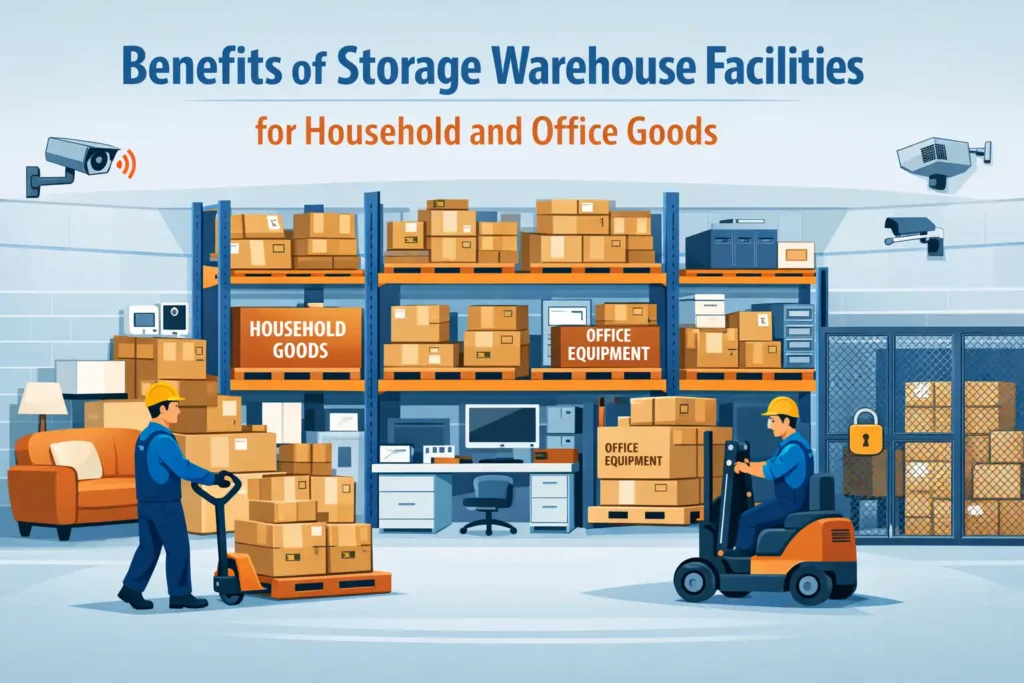
Relocation is rarely a single-day activity. Delays in possession, phased office moves, renovations, and long-distance transitions often create a gap between moving out and settling in. This is where professional storage warehouse facilities play a critical role. From a moving company’s operational perspective, storage is not an add-on service but an extension of safe, controlled, and accountable relocation. Following expert Moving Tips can help you better plan such situations and avoid unnecessary stress. When integrated with professional moving services like Packers and Movers, warehouse storage significantly improves safety, flexibility, and overall moving outcomes.
1. Enhanced Safety and Protection of Goods
One of the most significant benefits of storage warehouse facilities is the enhanced protection they provide for household and office goods. Unlike temporary on-site storage or unmanaged spaces, professional warehouses are designed specifically to safeguard items over short and long durations.
Storage facilities protect goods from common relocation risks such as physical damage, environmental exposure, pest infestation, and theft. Items like wooden furniture, electronics, documents, and appliances are especially vulnerable when stored in unsuitable conditions. Purpose-built warehouses mitigate these risks through controlled environments and structured storage practices.
From a moving company’s perspective, warehouse storage allows goods to remain under supervised conditions rather than being repeatedly loaded, unloaded, or left in unsecured locations. This continuity of care reduces handling-related damage and preserves the condition of items until final delivery.
Understanding what transit insurance covers during house shifting is especially important when goods are stored for extended periods.
Key safety-related benefits include:
- Protection from rain, heat, dust, and humidity that can damage furniture and electronics
- Reduced exposure to pests and rodents through regular pest-control measures
- Lower risk of breakage due to professional stacking and racking systems
- Secure handling of fragile and high-value items during extended storage periods
By placing goods in a controlled warehouse environment, movers can maintain consistent safety standards from packing to final delivery, which directly improves reliability and customer trust.
2. Secure Storage with Professional Monitoring
Security is a core advantage of professional storage warehouse facilities, particularly when household or office goods need to remain in storage for extended periods. Unlike informal storage spaces or residential premises, warehouses operated by moving companies are designed with controlled access and continuous monitoring to reduce the risk of unauthorized handling or theft.
From an operational standpoint, moving companies rely on structured security systems to maintain accountability for stored goods. Warehouses typically restrict entry to authorized personnel only, ensuring that items remain untouched until scheduled retrieval or delivery. This level of control is critical for both household goods and office assets such as documents, IT equipment, and furniture.
Professional monitoring also allows movers to track goods throughout the storage lifecycle. When storage is integrated with relocation services, responsibility remains centralized, minimizing disputes related to loss or mishandling.
Security and monitoring benefits include:
- Controlled entry and exit points to prevent unauthorized access
- Continuous surveillance to deter theft and monitor activity
- Supervised handling during storage, inspection, and retrieval
- Greater accountability when goods remain under one service provider
This centralized responsibility works best when storage is handled by verified professional packers and movers services instead of multiple vendors.
For customers, this translates into confidence that their belongings are protected even when they are not immediately accessible. For moving companies, secure warehousing reduces operational risk and reinforces trust during complex or delayed relocations.
3. Flexibility During Relocation, Renovation, or Transition Periods
One of the most practical benefits of storage warehouse facilities is the flexibility they offer during uncertain or transitional phases of relocation. In real-world moving scenarios, timelines often do not align perfectly. Possession delays, renovation overruns, phased office moves, or temporary relocations can create a gap where goods cannot be delivered immediately.
From a moving company’s perspective, warehouse storage acts as a buffer that absorbs these timing mismatches. Instead of rushing deliveries or forcing customers to arrange temporary storage independently, goods can be securely held until the destination is ready. This flexibility improves planning efficiency and reduces last-minute logistical pressure.
For households, storage is especially useful during home renovations or short-term relocations. For offices, it supports phased shifting, departmental moves, or restructuring without disrupting ongoing operations.
Flexibility-related benefits include:
- Safe holding of goods between move-out and move-in dates
- Support for delayed possession or incomplete renovations
- Easier management of phased or partial relocations
- Reduced urgency that often leads to rushed or error-prone handling
Storage is commonly used during home shifting services and phased office relocations where timelines do not align.
By offering flexible storage durations, moving companies can adapt to changing schedules while maintaining safety and control over goods. This adaptability is a key reason storage warehousing has become an essential component of modern relocation services.
4. Organized Inventory Management and Easy Retrieval
Another major benefit of storage warehouse facilities is the ability to maintain a structured and traceable inventory of stored goods. During relocation, especially when storage is involved, the risk of misplacement increases if items are not catalogued properly. Professional warehouses address this risk through systematic inventory management.
From a moving company’s operational perspective, every item entering storage is recorded, labeled, and tracked. This ensures visibility over what has been stored, in what condition, and where it is placed within the warehouse. Such organization is particularly valuable for office relocations, where documents, workstations, and equipment must be retrieved in a planned sequence.
Organized inventory systems also simplify retrieval. Whether customers require partial delivery of items or complete retrieval at a later stage, goods can be located and dispatched without unnecessary handling or delays.
Inventory and retrieval benefits include:
- Systematic labeling and cataloguing of household and office goods
- Reduced chances of loss, misplacement, or mix-ups
- Easier identification of stored items during long-term storage
- Efficient retrieval without disturbing other stored goods
By maintaining structured inventory records, moving companies ensure accountability and transparency throughout the storage period. This level of organization supports smoother transitions and minimizes disruption during final delivery.
5. Cost Efficiency Compared to Alternative Storage Options
Storage warehouse facilities can be more cost-efficient than arranging separate or informal storage solutions, particularly when storage is required as part of a relocation. From a moving company’s perspective, integrated warehousing reduces duplicated handling, transportation, and coordination costs that often arise when customers manage storage independently.
When storage is bundled with packing and moving services, goods are moved directly into the warehouse without repeated loading and unloading. This minimizes labor hours, vehicle usage, and the risk of damage-related expenses. Over time, these operational efficiencies translate into lower overall costs compared to short-term rentals, makeshift storage spaces, or repeated transportation.
For a detailed breakdown, refer to our packers and movers cost guide, which explains how storage impacts overall moving charges.
For both households and offices, warehouse storage also prevents indirect costs such as repair or replacement of damaged items, which are more common in unmanaged storage environments.
Cost-related benefits include:
- Reduced handling and transportation expenses through centralized storage
- Lower risk of damage-related financial losses
- More economical than renting and managing independent storage units
- Predictable costs when storage is part of a single relocation plan
By streamlining logistics under one service framework, storage warehouse facilities help optimize relocation budgets while maintaining safety and control over goods.
6. Stress Reduction and Convenience for Customers
Relocation is often associated with uncertainty, tight timelines, and logistical pressure. Storage warehouse facilities significantly reduce this stress by providing a controlled and dependable place for goods when immediate delivery is not possible. From a moving company’s standpoint, storage simplifies coordination and removes the burden of last-minute decision-making for customers.
When goods are stored professionally, customers do not need to search for temporary spaces, manage multiple vendors, or worry about the condition of their belongings. The moving company retains responsibility for handling, storage, and protection, creating a smoother and more predictable relocation experience.
This convenience is especially valuable during complex moves involving long distances, overlapping timelines, or office transitions where operational continuity is critical.
Convenience-related benefits include:
- Elimination of the need to arrange independent temporary storage
- Reduced coordination between multiple service providers
- Centralized responsibility for packing, storage, and handling
- Greater peace of mind during uncertain relocation phases
By absorbing logistical complexity, storage warehouse facilities allow customers to focus on settlement, renovation, or business continuity rather than managing stored goods.
7. Space Optimization for Homes and Offices
Storage warehouse facilities play an important role in helping households and businesses optimize available space during transitions. When relocation, renovation, or restructuring is underway, retaining all goods on-site can create congestion and reduce usability of the space. Professional storage offers a practical solution by relocating non-essential items to a secure off-site facility.
From a moving company’s perspective, warehouse storage enables better space planning for customers. Households can temporarily store excess furniture, seasonal items, or bulky appliances, while offices can move surplus workstations, files, and equipment out of active areas. This allows the remaining space to be used efficiently without permanent disposal of assets.
Space optimization is particularly beneficial during phased relocations, office expansions, or downsizing exercises where goods are needed later but not immediately.
Space-related benefits include:
- Reduced clutter during home renovation or relocation phases
- Better utilization of office space during restructuring or expansion
- Temporary storage of surplus or seasonal items without discarding them
- Improved safety and accessibility within active living or working areas
By moving excess goods into organized storage, warehouse facilities help maintain functionality and order in both residential and commercial environments.
8. Business Continuity Benefits for Offices and Enterprises
For offices and enterprises, relocation is not only about moving assets but also about maintaining operational continuity. Storage warehouse facilities support this requirement by allowing businesses to relocate in phases without disrupting daily activities. From a moving company’s operational perspective, warehousing enables better coordination between asset movement and business timelines.
Office furniture, documents, archives, and equipment can be securely stored while essential departments continue functioning. This staged approach reduces downtime and allows businesses to resume operations gradually instead of facing a complete shutdown during relocation.
Warehouse storage also helps organizations manage surplus assets during expansion, downsizing, or restructuring, ensuring that valuable resources remain protected and accessible when required.
Business continuity benefits include:
- Secure storage of office assets during phased relocations
- Reduced downtime by allowing department-wise or scheduled moves
- Safe holding of documents and equipment until deployment
- Better control over assets during organizational changes
By integrating storage warehousing into office relocation planning, moving companies help enterprises maintain stability, reduce disruption, and execute transitions more efficiently.
If you are relocating in Pondicherry, choosing experienced packers and movers in Pondicherry with warehouse facilities ensures better coordination and safety.
Need Secure Storage for Your Household or Office Goods?
Whether you are facing delayed possession, renovation, phased office relocation, or a long-distance move, professional storage warehouse facilities can simplify your relocation while keeping your goods safe and organized.
By choosing a moving company that offers integrated packing, storage, and delivery, you eliminate coordination hassles and reduce the risk of damage, delays, and unnecessary costs.
Why opt for professional movers with storage facilities?
- Secure warehouse storage for household and office goods
- Flexible short-term and long-term storage options
- Single-point responsibility for packing, storage, and delivery
- Reduced stress during complex or delayed relocations
Plan your move with secure storage support today.
Explore trusted Packers and Movers services and get professional assistance tailored to your relocation needs.