
Ultimate Moving Checklist: 8 Weeks Before Your Move
Start your move preparation 8 weeks in advance to stay organized and avoid last-minute stress. Key tasks include creating a moving plan, setting a budget, decluttering, researching packers and movers, organizing documents, planning utility transfers, and preparing an inventory list. Early planning ensures cost control, smoother coordination, and a hassle-free relocation experience.

Planning a home relocation without a clear timeline often leads to last-minute stress, budget overruns, and avoidable mistakes. Starting your move preparation 8 weeks in advance gives you enough time to plan each step methodically—right from budgeting and decluttering to selecting Reliable Packers And Movers and arranging utilities. This early window allows you to spread tasks over manageable weeks instead of rushing everything closer to moving day. A structured checklist also helps reduce risks like missed paperwork, delayed service connections, or incorrect moving quotations. This guide breaks down exactly what you should do 8 weeks before your move, beginning with the most critical foundation: creating a master moving plan.
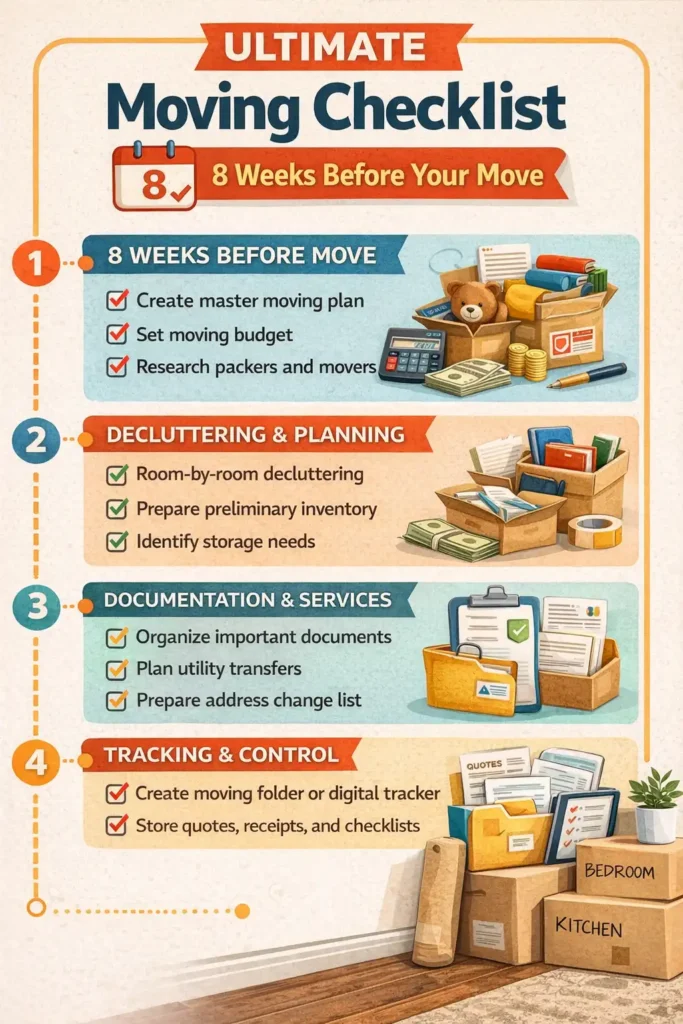
1. Create a Master Moving Plan
A master moving plan acts as the backbone of your entire relocation process. At the 8-week mark, your focus should be on setting a clear direction, defining timelines, and organizing responsibilities. Without a central plan, moving tasks often overlap, get delayed, or are forgotten altogether.
Why a Master Moving Plan Is Essential
- Helps break down a complex move into weekly, actionable steps
- Reduces last-minute decisions that can increase moving costs
- Keeps documentation, bookings, and schedules aligned
- Allows better coordination with packers, movers, and service providers
Key Actions to Take at This Stage
- Finalize your tentative moving date
- Decide whether the move will be local or intercity
- Identify whether professional packing and transportation services will be required
- Create a single checklist covering all upcoming tasks
Recommended 8-Week Planning Framework
Timeline | Planning Focus | Outcome |
8 Weeks Before | Create master plan & checklist | Clear roadmap for entire move |
6 Weeks Before | Decluttering & mover research | Reduced inventory and better quotes |
4 Weeks Before | Booking & documentation | Confirmed logistics |
2 Weeks Before | Packing preparation | Faster, safer packing |
1 Week Before | Final checks | Smooth move day execution |
Best Practice for Organizing Your Plan
- Maintain one moving folder (physical or digital)
- Store quotations, timelines, inventories, and receipts together
- Keep backup copies of important documents in cloud storage
- Update your plan weekly as tasks are completed
A well-structured master plan created at this stage ensures every future step—budgeting, packing, utility transfers, and address updates—flows smoothly without confusion or delays.
2. Set a Moving Budget Early
Creating a moving budget at least 8 weeks before your move helps you stay financially prepared and avoid last-minute expenses that often arise during relocation. Many moving costs are not paid on a single day; instead, they are spread across planning, packing, transportation, utilities, and post-move setup. Budgeting early allows you to track these expenses in advance and make informed decisions without pressure.
Why Early Budget Planning Matters
- Prevents overspending due to rushed bookings
- Helps compare mover quotations realistically
- Allows allocation for hidden or variable costs
- Reduces dependency on emergency funds closer to moving day
Common Expense Categories to Include
When setting your moving budget, account for all possible cost heads instead of focusing only on transportation charges.
- Packing and loading services
- Transportation and unloading charges
- Packing materials (boxes, tapes, protective wraps)
- Insurance or risk coverage (if applicable)
- Temporary storage (if required)
- Utility disconnection or connection fees
- Travel and accommodation costs (for long-distance moves)
- Contingency buffer for unforeseen expenses
Sample Moving Budget Structure
Expense Category | Purpose | Planning Benefit |
Movers & Packing | Core relocation services | Prevents under-quoting |
Packing Materials | Boxes & protective supplies | Avoids last-minute purchases |
Utilities | Transfer or disconnection fees | Prevents service disruption |
Storage | Short-term holding (if needed) | Supports flexible timelines |
Contingency Fund | Unexpected expenses | Financial safety net |
Best Practices for Budget Control
- Start tracking expenses from the 8-week mark onward
- Keep all quotations and receipts in one folder
- Compare written estimates instead of verbal promises
- Reserve a small buffer amount to handle unplanned costs
Setting a clear budget at this early stage ensures better control over your relocation spending and allows smoother coordination with service providers as your moving date approaches.
3. Research and Shortlist Packers and Movers
At the 8-week mark, researching and shortlisting packers and movers is a critical step that directly impacts cost accuracy, service quality, and overall moving safety. Booking movers too late often limits choices and increases the risk of unclear pricing or service gaps. Starting early gives you enough time to compare options properly and understand what services are actually included.
Why Early Research Is Important
- Allows comparison of multiple service providers
- Reduces chances of last-minute booking pressure
- Helps identify realistic timelines and service scope
- Improves accuracy of moving quotations
Importance of Pre-Move Survey
A pre-move survey is a standard practice used to assess the actual volume and handling requirements of your household goods. This step helps movers provide quotations based on real inventory instead of assumptions.
- Measures item volume and weight
- Identifies fragile or special-handling items
- Evaluates access conditions like stairs, lifts, and parking
- Reduces billing disputes after the move
What to Compare While Shortlisting Movers
When reviewing different options, comparisons should be based on service details rather than just the quoted price.
- Packing and unpacking scope
- Type of packing materials used
- Transportation method and delivery timeline
- Insurance or risk coverage options
- Written quotation and payment terms
Sample Comparison Checklist
Comparison Factor | Why It Matters | What to Check |
Pre-Move Survey | Accurate quotation | Physical or virtual inspection |
Written Estimate | Cost transparency | Inclusions & exclusions |
Service Scope | Avoids confusion | Packing, loading, unloading |
Timeline | Delivery planning | Estimated pickup & drop |
Documentation | Accountability | Receipts and paperwork |
Best Practices While Finalizing Movers
- Always request written quotations after a survey
- Avoid committing based on verbal estimates
- Keep all communication records and documents
- Do not finalize immediately; allow time for comparison
Shortlisting movers at this stage creates a strong foundation for the rest of your relocation process and ensures smoother coordination as packing and logistics planning begins.
4. Declutter Your Home Room by Room
Decluttering your home around 8 weeks before moving helps reduce the number of items that need to be packed, transported, and managed during relocation. This step directly impacts moving efficiency, packing time, and overall costs. Handling decluttering early gives you enough time to make thoughtful decisions instead of rushing through them just before packing begins.
Why Decluttering Should Start Early
- Fewer items reduce packing and transportation requirements
- Lower volume can result in more accurate mover quotations
- Saves time during packing and unpacking
- Makes it easier to organize your new home
Recommended Room-by-Room Decluttering Approach
Instead of sorting everything at once, breaking the process room by room makes the task more manageable and systematic.
- Start with storage areas like store rooms, attics, and cupboards
- Move on to bedrooms, living areas, and kitchen spaces
- Leave daily-use items for the final weeks
- Clearly separate items into keep, donate, sell, or discard categories
Common Item Categories to Review
- Old furniture or unused appliances
- Extra kitchenware and expired items
- Clothes and footwear not used regularly
- Paper files, magazines, and outdated documents
Decluttering Impact on Moving Costs
Decluttering Action | Effect on Move | Practical Benefit |
Removing unused items | Reduced volume | Lower packing effort |
Selling large items | Fewer heavy loads | Easier transport |
Donating usable goods | Cleaner inventory | Faster packing |
Discarding waste | No unnecessary boxes | Efficient unpacking |
Best Practices for Effective Decluttering
- Complete decluttering before final mover survey, if possible
- Do not pack items you are unsure about keeping
- Label discarded items clearly to avoid accidental packing
- Keep donation or sale timelines realistic
Decluttering at this stage ensures that only necessary and valuable items move with you, making the remaining relocation steps simpler and more cost-effective.
5. Start Organizing Important Documents
Organizing important documents at least 8 weeks before your move helps prevent last-minute delays, misplaced paperwork, and unnecessary stress. During relocation, documents are often required at multiple stages—for mover coordination, utility services, address updates, and post-move formalities. Keeping everything organized early ensures smooth access whenever needed.
Why Document Organization Is Critical Before Moving
- Prevents loss or damage of essential paperwork
- Reduces delays in utility transfers and address updates
- Helps during mover coordination and payment verification
- Ensures quick access to records during emergencies
Documents to Organize at This Stage
Create a dedicated folder (physical and digital) and start gathering commonly required documents.
- Identity and address proofs
- Rental agreement, sale deed, or ownership papers
- Moving quotations, invoices, and receipts
- Insurance-related documents
- Employment or school-related records
- Medical records and prescriptions
Recommended Document Storage Method
Document Type | Storage Method | Purpose |
Original Documents | Physical folder | Legal and official use |
Scanned Copies | Cloud storage | Backup access |
Moving Papers | Dedicated sub-folder | Easy mover coordination |
Utility Records | Digital + print | Service transfers |
Best Practices for Document Safety
- Keep originals in a waterproof, easy-to-carry folder
- Do not pack important documents with household goods
- Maintain both digital and physical copies
- Carry essential documents personally on moving day
Organizing documents early creates a reliable reference system that supports every remaining step of your moving checklist, from service coordination to settling into your new home.
6. Create a Preliminary Inventory List
Creating a preliminary inventory list around 8 weeks before your move helps you understand what you are relocating and supports better planning with packers and movers. An inventory prepared early is not meant to be final; instead, it acts as a working document that can be refined later during surveys and packing. This step improves transparency, accountability, and overall move coordination.
Why an Inventory List Is Important
- Helps estimate packing materials and vehicle size
- Supports accurate mover quotations
- Assists in tracking items during packing and unloading
- Becomes useful for insurance or loss-related follow-ups
How to Prepare a Preliminary Inventory
At this stage, the inventory should be simple and room-wise rather than highly detailed.
- List items room by room (bedroom, kitchen, living room, storage)
- Group similar items together instead of listing every small object
- Mark fragile, high-value, or special-handling items
- Note large furniture and appliances separately
Items That Should Be Clearly Identified
- Fragile items such as glassware and electronics
- High-value belongings like jewelry or artwork
- Appliances requiring special packing or dismantling
- Furniture that may need disassembly
Sample Preliminary Inventory Format
Room | Item Category | Special Handling Required |
Bedroom | Bed, wardrobe, mattress | Dismantling |
Living Room | Sofa, TV unit, television | Fragile packing |
Kitchen | Utensils, appliances | Extra cushioning |
Storage | Boxes, suitcases | Standard packing |
Best Practices for Inventory Management
- Update the inventory after decluttering is completed
- Share the preliminary list during mover surveys
- Keep a copy of the inventory in your moving folder
- Do not rely on memory alone during final packing
Preparing an inventory early creates clarity for both you and your movers, reducing confusion and helping ensure that all items are accounted for throughout the relocation process.
7. Plan for Utilities and Service Transfers
Planning utility and service transfers 8 weeks before your move helps avoid service interruptions at both your current and new home. Many utility providers require advance notice for disconnections, transfers, or new installations. Delaying this step can result in paying for unused services or moving into a home without essential utilities.
Why Early Utility Planning Is Important
- Prevents last-minute service disruptions
- Allows coordination between disconnection and activation dates
- Helps avoid overlapping bills at old and new addresses
- Ensures essential services are available immediately after moving
Utilities and Services to List at This Stage
Create a complete list of services connected to your current address so none are overlooked later.
- Electricity supply
- Cooking gas connection
- Water supply
- Internet and broadband
- DTH or cable TV
- Landline or fixed telephone services
What to Do at the 8-Week Mark
At this stage, focus on preparation rather than immediate disconnection.
- Note down customer IDs and service numbers
- Check provider policies for transfer or closure
- Understand documentation requirements
- Identify installation timelines at the new address
Utility Transfer Planning Overview
Service Type | Action Required | Planning Benefit |
Electricity | Transfer or new connection | Avoids power outage |
Gas | Transfer or reinstallation | Ensures cooking access |
Internet | Relocation request | Prevents connectivity gap |
Water | Update consumer details | Continuous supply |
DTH/Cable | Address update | Entertainment continuity |
Best Practices for Utility Coordination
- Do not disconnect services immediately at this stage
- Schedule disconnections closer to moving day
- Keep confirmation messages or emails safely stored
- Carry essential service documents during the move
Early planning of utilities and services ensures a smoother transition into your new home without unnecessary inconvenience or delays.
8. Evaluate Storage Needs (If Required)
Evaluating storage requirements 8 weeks before your move helps you plan for situations where all belongings may not be moved directly into the new home. Storage may be required due to staggered possession dates, renovation work at the new location, downsizing, or temporary accommodation arrangements. Identifying this early prevents last-minute scrambling for space.
When Storage May Be Required
Storage is not needed for every move, but certain situations make it necessary.
- Delay between vacating the old home and occupying the new one
- Ongoing repairs, painting, or renovation at the new house
- Temporary relocation or short-term accommodation
- Excess furniture or items not immediately required
Types of Storage to Consider
Understanding storage options helps align them with your moving timeline.
- Short-term storage for a few weeks
- Long-term storage for extended periods
- Storage as part of packers and movers services
- Independent warehouse or storage facilities
Key Factors to Check Before Finalizing Storage
Factor | Why It Matters | What to Verify |
Security | Protects belongings | Surveillance, access control |
Insurance | Risk coverage | Liability and coverage terms |
Accessibility | Item retrieval | Access hours and process |
Environment | Item safety | Ventilation, moisture control |
Best Practices for Storage Planning
- Decide storage needs before final mover booking
- Store only items not required immediately
- Label stored items clearly for easy retrieval
- Keep a separate inventory for stored goods
Evaluating storage needs early ensures flexibility in your moving schedule and protects your belongings until you are ready to move them into your new home.
9. Start Address Change Planning
Starting address change planning 8 weeks before your move ensures that important communications, services, and official records are updated smoothly after relocation. Address updates often involve multiple institutions and can take time to process. Preparing a structured list early helps prevent missed notifications, delayed deliveries, or service disruptions.
Why Address Change Planning Should Begin Early
- Avoids loss of important mail or documents
- Prevents delays in banking, insurance, or service-related communication
- Makes post-move formalities easier to manage
- Reduces the risk of missed bills or notices
Institutions and Services to Include in Your Plan
At this stage, focus on preparing a checklist rather than executing changes immediately.
- Banks and financial institutions
- Insurance providers
- Employer or business contacts
- Schools or educational institutions
- Subscription and membership services
- E-commerce and courier accounts
Address Update Planning Checklist
Category | Examples | Planning Benefit |
Financial | Banks, credit cards | Prevents transaction issues |
Insurance | Health, vehicle, home | Policy continuity |
Work & Education | Employer, schools | Record accuracy |
Subscriptions | Newspapers, services | Uninterrupted delivery |
Online Accounts | Shopping, couriers | Delivery accuracy |
Best Practices for Address Change Preparation
- Maintain a single master list of all institutions
- Keep old and new address details documented
- Track update status once changes are initiated
- Retain confirmation messages or receipts
Preparing your address change plan in advance allows you to execute updates efficiently closer to your moving date, ensuring continuity across services and official records.
10. Prepare a Moving Folder or Digital Tracker
Preparing a moving folder or digital tracker 8 weeks before your move helps centralize all relocation-related information in one place. As moving involves multiple service providers, documents, timelines, and payments, having a single reference system reduces confusion and prevents important details from being overlooked during the process.
Why a Centralized Moving Tracker Is Important
- Keeps all moving-related information organized
- Prevents loss of quotations, receipts, and documents
- Helps track progress against your moving timeline
- Improves coordination with packers, movers, and service providers
What to Include in Your Moving Folder
Your moving folder can be physical, digital, or a combination of both. At this stage, focus on setting up the structure.
- Moving checklist and timeline
- Packers and movers quotations and invoices
- Inventory lists and storage details
- Utility and service provider information
- Address change planning list
- Important documents and scanned copies
Suggested Folder Structure
Folder Section | Contents | Purpose |
Planning | Checklist, timeline | Track moving progress |
Movers | Quotations, receipts | Service coordination |
Inventory | Item lists, notes | Tracking belongings |
Utilities | Service details | Transfer management |
Documents | IDs, agreements | Easy reference |
Best Practices for Using a Moving Tracker
- Update the tracker weekly as tasks are completed
- Keep cloud backups of important files
- Carry essential information separately on moving day
- Retain the folder until all post-move tasks are finished
Setting up a moving folder at this early stage ensures clarity, accountability, and smoother execution throughout the remaining weeks of your relocation.
Planning your move 8 weeks in advance?
Make it stress-free by connecting with professional, verified Packers and Movers who understand timelines, safety, and transparent pricing.
Get Free Moving Quotes from 6 Packers And Movers
- Compare multiple movers in one place
- Accurate estimates based on pre-move planning
- No last-minute surprises
Book Your Free Pre-Move Survey Now