
How to Transport Goods by Train in India: Services, Charges and Required Documents
Goods can be transported by train in India through parcel or luggage services offered by Indian Railways. The process involves selecting the correct service type, packing goods securely, filling a forwarding note, submitting goods for inspection and weighment at the parcel office, paying charges based on official rate scales, and collecting a Railway Receipt. Charges depend on distance, weight, and train category, while delivery is made at the destination station against the original Railway Receipt. Certain items are restricted or prohibited, and claims for loss or damage must be filed within prescribed timelines using official railway procedures.
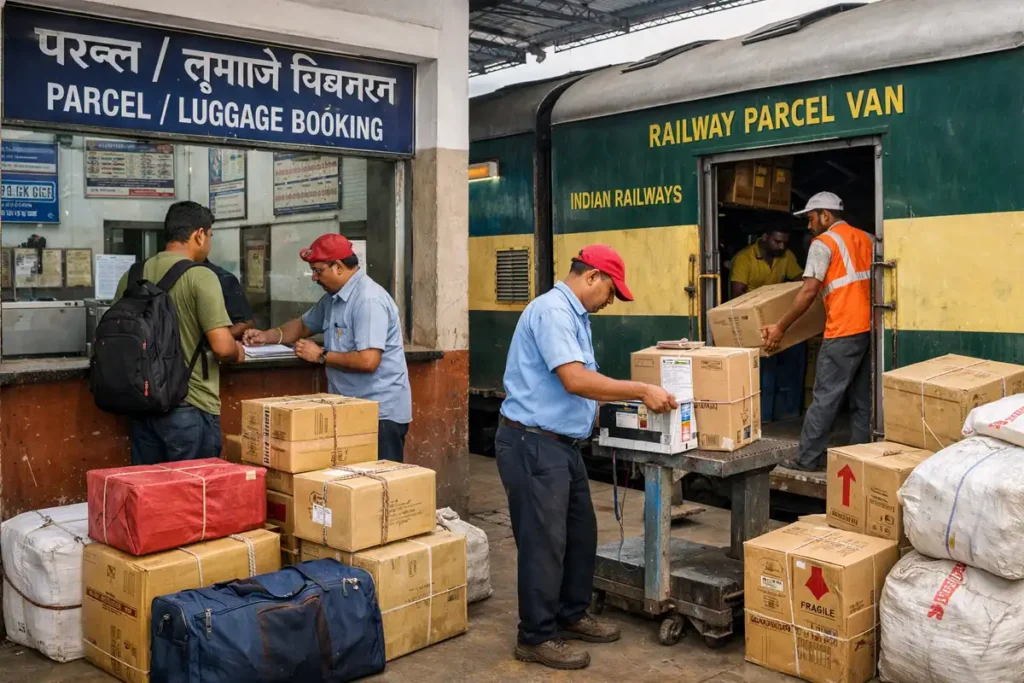
Transporting goods by train in India is a cost-effective option for moving household items, vehicles, and small consignments over long distances. Operated through parcel and luggage services, train-based transport follows a station-to-station process with fixed rules for booking, charges, documentation, and delivery. While it differs from door-to-door services offered by professional packers and movers, understanding how train goods transport works helps you choose the right method based on cost, convenience, and risk.
Types of Goods Transport Services by Train in India
Indian Railways offers multiple structured options for transporting goods by train, designed to handle everything from small household consignments to bulk commercial cargo. These services are station-to-station in nature and are governed by predefined booking procedures, rate scales, and safety rules. Choosing the correct service type is critical, as eligibility, charges, documentation, and liability conditions differ for each option. The services are operated under the parcel and luggage framework of Indian Railways and are available at notified parcel booking stations across India.
1. Parcel Service
Parcel service is used when goods are sent without the sender travelling on the same train. This is the most commonly used option for transporting household items, commercial goods, and vehicles between two railway stations.
Key characteristics:
- Suitable for household goods, cartons, boxes, appliances, and two-wheelers
- Booking is done at the parcel office of the originating station
- Goods are examined, weighed, and accepted after submission of a forwarding note
- Delivery is made at the destination parcel office against the original Railway Receipt
Best suited for:
- Long-distance household shifting on a budget
- Sending goods to another city without personal travel
- Commercial consignments that do not require door pickup
2. Luggage Transport
Luggage transport applies when the sender is travelling on the same train and wants to send goods that exceed the free luggage allowance permitted with a passenger ticket.
Key characteristics:
- Booking requires a confirmed passenger ticket
- Goods are booked as “luggage” before train departure
- Charges are calculated under the luggage rate scale
- Delivery is made at the destination station’s luggage office
Important points:
- Luggage must be booked in advance; carrying excess luggage without booking may attract penalties
- This option is generally used for personal belongings rather than bulk shipments
3. Two-Wheeler Transport by Train
Indian Railways allows motorcycles and scooters to be transported as parcels or luggage, depending on whether the owner is travelling.
Key characteristics:
- Vehicles are booked through the parcel office
- Details such as vehicle make and registration number are filled in the forwarding note
- Fuel must be drained as per safety instructions before acceptance
- Delivery is station-to-station
Common use cases:
- Relocation to another city
- Sending a two-wheeler to family members
- Cost-effective alternative to road vehicle carriers
4. Parcel Van / VP
For larger consignments, Indian Railways provides the option to lease a Parcel Van (VP) or a dedicated luggage compartment attached to passenger trains.
Key characteristics:
- Used for bulk or commercial shipments
- Requires advance booking and approvals
- Entire space is reserved for a single consignor
- Commonly used by traders and logistics operators
Best suited for:
- High-volume shipments
- Time-sensitive commercial goods
- Regular transport requirements between fixed routes
5. Goods Trains
Goods trains are primarily meant for large-scale commercial and industrial freight rather than household shifting.
Key characteristics:
- Operated through freight terminals instead of parcel offices
- Used for raw materials, industrial goods, and bulk cargo
- Booking follows freight rules and agreements
- Not typically suitable for small household consignments
Train Goods Transport Service Types
Service Type | Travel Required | Suitable For | Delivery Type |
Parcel Service | ❌ No | Household goods, cartons, bikes | Station to station |
Luggage Transport | ✅ Yes | Personal belongings | Station to station |
Two-Wheeler Parcel | Optional | Bikes & scooters | Station to station |
Parcel Van (VP) | ❌ No | Bulk/commercial goods | Station to station |
Goods Train | ❌ No | Industrial freight | Freight terminal |
Step-by-Step Process to Book Goods Transport by Train
Booking goods transport by train in India follows a structured process defined under railway parcel and luggage rules. Whether goods are sent as parcels or booked as luggage, the sender must complete mandatory formalities at the originating station. Following each step correctly is important to ensure acceptance of goods, accurate charge calculation, and smooth delivery at the destination station.
Where to Book Train Parcel Services (Online vs Parcel Office)
Train parcel services can be initiated both online and offline, but physical submission of goods is mandatory at the parcel office. Online booking allows users to register, check service availability, and generate booking details in advance. However, goods must still be produced at the originating station’s parcel office for inspection, weighment, and acceptance. Offline booking involves directly visiting the parcel office, filling the forwarding note, and completing the booking at the counter. Availability of online booking may vary by station and service type.
Step 1: Identify the Correct Service Type
Before visiting the railway station, the sender must decide whether the goods will be booked as:
- Parcel (sender not travelling), or
- Luggage (sender travelling on the same train)
This decision affects:
- Applicable rate scale
- Booking counters
- Documentation requirements
Incorrect service selection can result in rebooking or penalties.
Step 2: Pack Goods as Per Railway Guidelines
All goods must be securely packed before submission at theளம் parcel office. Railway authorities inspect packages to ensure:
- Goods are safe for handling and transit
- Packing matches the description mentioned in the forwarding note
- Prohibited or hazardous items are not included
Poor packing can lead to refusal of booking or damage during transit.
Step 3: Obtain and Fill the Forwarding Note
The Forwarding Note is a mandatory declaration form and can be obtained free of cost from:
- Parcel office
- Station Master’s office
Details required in the forwarding note include:
- Sender and receiver name, address, and contact details
- Origin and destination station
- Description of goods
- Declared weight and value
- Vehicle details (for two-wheelers)
Providing incorrect or incomplete information may affect claims eligibility later.
Step 4: Submit Goods for Examination and Weighment
After submitting the forwarding note:
- Goods are physically examined by parcel staff
- Actual weight is measured using railway weighment facilities
- Charges are calculated based on applicable rate scale, distance slab, and weight slab
The final payable amount is determined only after this step.
Step 5: Pay Charges and Collect Railway Receipt (RR)
Once charges are calculated:
- Payment is made at the parcel booking counter
- A Railway Receipt (RR) is issued
The Railway Receipt is a crucial document and is required for:
- Tracking the consignment
- Taking delivery at the destination
- Filing claims for loss or damage
Loss of the RR may delay delivery and require additional formalities.
Step 6: Dispatch and Transit of Goods
After booking:
- Goods are loaded onto the notified train
- Transit time depends on train type, route, and operational factors
- Parcels move through intermediate stations until they reach the destination
Railway parcels do not guarantee time-bound delivery unless booked under specific premium services.
Step 7: Delivery at Destination Station
At the destination:
- Receiver visits the parcel or luggage office
- Original Railway Receipt is submitted
- Identity verification may be done before release
Goods are delivered only after verification of documents and receipt.
Parcel Booking Timings and Cut-Off Rules
Parcel booking is subject to station working hours and train-specific cut-off timings. Goods must be booked sufficiently before the scheduled departure of the selected train to allow inspection, documentation, and loading. Same-day or last-minute bookings may not be accepted if the cut-off time has passed. Booking timings can vary by station based on operational workload, so senders are advised to reach the parcel office early, especially during peak seasons.
Goods Transport Charges by Train
Goods transport charges by train in India are calculated using a structured pricing system defined under railway parcel and luggage rules. Unlike road-based movers, Indian Railways does not follow flat or negotiated pricing. Instead, the final freight amount is determined after physical inspection and weighment of goods at the parcel office, using officially notified rate scales and slab-based tables. This ensures uniform pricing across stations but also means exact costs can only be confirmed at the time of booking.
Unlike railway parcel charges, packers and movers costs include packing, loading, transportation, and doorstep delivery, which may be more suitable for complete household moves.
How Goods Transport Charges Are Calculated
Railway parcel and luggage charges are calculated based on rate scales, each of which contains predefined slabs combining distance (in kilometres) and weight (in kilograms). The applicable rate scale depends on the service type selected and the category of train used for transport.
In simple terms, charges are calculated by:
- Identifying the correct rate scale
- Selecting the applicable distance slab
- Applying the corresponding weight slab
- Calculating the final freight based on the table values
Charges are determined strictly as per these tables and are not estimated manually.
Key Factors That Affect Train Goods Transport Charges
The following factors directly influence the final cost:
- Type of booking: Parcel or luggage
- Applicable rate scale: Standard or premium parcel scale
- Distance between stations: As per kilometre slab
- Actual weight of goods: Measured at the parcel office
- Train category: Premium trains may attract higher scales
Each of these components is mandatory for freight calculation.
Rate Scales Used for Goods Transport by Train
Indian Railways uses different rate scales for different services:
- Scale-L (Luggage Scale): Used when goods are booked as accompanied luggage
- Scale-R: Applied for parcel services on notified premium trains
- Scale-S / Standard Parcel Scale: Used for regular parcel bookings when premium scales are not applicable
If a train is not notified under a premium scale, charges are automatically applied under the standard parcel scale.
Goods Transport Charges – Cost Factors
Cost Component | Impact on Charges |
Rate Scale | Determines the base pricing table used |
Distance Slab | Longer distances fall under higher slabs |
Weight Slab | Heavier consignments attract higher charges |
Booking Type | Parcel and luggage bookings follow different scales |
Train Category | Premium trains may apply higher parcel scales |
Example Goods Transport Charges by Train
While Indian Railways does not publish fixed prices, illustrative examples based on officially available rate-scale explanations help in understanding approximate costs. Final charges always depend on exact slabs applied at booking.
Example 1: Household Goods Parcel
- Weight: ~50 kg
- Distance: ~1,000–1,100 km
- Booking Type: Parcel (unaccompanied)
Approximate parcel charges in such cases have been illustrated at ₹300–₹350, depending on the applicable distance and weight slab.
Example 2: Larger Household Consignment
- Weight: ~100 kg
- Distance: ~1,000–1,100 km
- Service Type: Parcel
Indicative charges for this weight range have been shown at ₹500–₹600, subject to the final slab applied.
Example 3: Two-Wheeler Transport by Train
- Vehicle: Motorcycle or scooter
- Distance: Route dependent
Two-wheeler parcel charges typically fall within ₹300 to ₹3,000, depending on vehicle weight, distance slab, and parcel scale applied.
Indicative Charges Summary
Item Type | Approx. Weight | Approx. Distance | Indicative Charge Range |
Household parcel | ~50 kg | ~1,000 km | ₹300 – ₹350 |
Household parcel | ~100 kg | ~1,000 km | ₹500 – ₹600 |
Two-wheeler | Model dependent | Route dependent | ₹300 – ₹3,000 |
Important Notes on Train Goods Transport Charges
- Charges are based on actual weighment, not estimated weight
- Parcels may be charged on weight or volume, whichever is higher, where applicable
- Final freight is calculated only at the parcel booking counter
- Rates may change as per railway notifications
Additional Charges and Situations That May Increase Cost
Apart from base freight charges, additional costs may apply in certain situations. These include repacking charges if packing is found inadequate, handling or loading charges where applicable, and demurrage or storage charges if goods are not collected promptly at the destination station. Charges may also increase if volume-based calculation is applied instead of actual weight. Being aware of these situations helps avoid unexpected expenses.
Required Documents for Transporting Goods by Train
Transporting goods by train in India requires submission of specific documents at the time of booking and delivery. These documents serve as legal declarations, proof of ownership, and evidence of booking under railway rules. Missing or incorrectly filled documents can result in booking rejection, delivery delays, or difficulties while filing claims in case of loss or damage. All parcel and luggage bookings follow documentation procedures prescribed by Indian Railways.
1. Forwarding Note (Mandatory Document)
The Forwarding Note is the most important document for booking goods transport by train. It is a declaration form filled and signed by the sender at the parcel booking station.
Key details captured in the forwarding note include:
- Sender’s name, address, and contact number
- Receiver’s name, address, and contact number
- Origin and destination railway stations
- Description of goods
- Declared weight and value of goods
- Vehicle details (in case of two-wheeler transport)
The forwarding note is provided free of cost at the parcel office or Station Master’s office and must be filled accurately. Any incorrect declaration may affect liability or claim eligibility.
Where to Get the Forwarding Note and How to Fill It Correctly
The forwarding note is available free of cost at the parcel office or Station Master’s office. It must be filled clearly with accurate sender and receiver details, station names, item description, declared value, and weight. For vehicles, registration details must be mentioned. Any mismatch between the forwarding note and the actual goods may lead to booking refusal or claim complications later, making accuracy critical.
2. Railway Receipt (RR)
The Railway Receipt (RR) is issued by the parcel office after payment of charges and acceptance of goods.
Importance of the Railway Receipt:
- Acts as proof of booking
- Required for tracking the consignment
- Mandatory for taking delivery at the destination station
- Essential document for filing compensation or refund claims
Goods are released at the destination only after submission of the original Railway Receipt.
3. Identity Proof of the Sender
The sender is required to provide a valid identity proof at the time of booking for verification purposes.
Commonly accepted ID proofs:
- Aadhaar card
- Driving licence
- Voter ID
- Passport
Identity verification helps prevent fraudulent bookings and ensures traceability of consignments.
4. Passenger Ticket (For Luggage Booking Only)
When goods are booked as luggage, the sender must present a valid and confirmed passenger ticket for the same train.
Important points:
- Luggage booking is allowed only if the sender is travelling
- Excess luggage without booking may attract penalties
- Charges are calculated under luggage rate scale
This document is not required for unaccompanied parcel bookings.
5. Vehicle Documents (For Two-Wheeler Transport)
For transporting motorcycles or scooters by train, additional vehicle-related details are required.
Details generally recorded include:
- Vehicle registration number
- Make and model of the vehicle
- Declared weight of the vehicle
These details are entered in the forwarding note during booking.
Documents Required at the Delivery Station
At the destination station, delivery of goods is made only after submission of the original Railway Receipt. The receiver may also be asked to provide identity proof for verification. If the Railway Receipt is lost, delivery may be delayed and additional indemnity formalities may be required. Collecting goods promptly helps avoid storage charges and handling issues.
What Items Are Allowed & Restricted for Train Transport
Indian Railways permits the transport of a wide range of goods through its parcel and luggage services. However, acceptance of items is governed by safety regulations, operational feasibility, and legal provisions. Certain categories of goods are freely accepted, while others are restricted or completely prohibited due to the risks they pose during handling and transit. Understanding these rules in advance helps avoid booking rejection, penalties, or confiscation at the parcel office.
Items Generally Allowed for Train Transport
The following items are commonly accepted for transport by train, subject to proper packing, declaration, and inspection:
- Household goods such as clothes, books, utensils, bedding, and cartons
- Packed appliances and non-fragile household items
- Motorcycles and scooters (with fuel drained and details declared)
- Commercial goods that are non-hazardous and properly documented
These items are accepted either as parcels or as luggage, depending on whether the sender is travelling.
Items Allowed With Conditions
Some goods may be accepted only if specific conditions are met:
- Electronics and fragile items: Must be securely packed to withstand handling and stacking
- Commercial consignments: May require value declaration and proper description in the forwarding note
- Two-wheelers: Fuel must be removed, and vehicle details must be clearly mentioned
Acceptance of such items is subject to inspection at the parcel office.
Restricted and Prohibited Items
Certain items are not accepted for transport by train due to safety and legal reasons. These items are either restricted or completely prohibited under parcel and luggage rules enforced by Indian Railways.
Commonly prohibited items include:
- Flammable substances such as petrol, diesel, kerosene, and gas cylinders
- Explosives, fireworks, and hazardous chemicals
- Corrosive materials and compressed gases
- Any item that may endanger passengers, railway property, or other consignments
Such items are refused at the time of booking and may attract penalties if concealed.
Legal Basis for Restrictions
The carriage of dangerous, offensive, or hazardous goods is regulated under railway rules and statutory provisions. Railways reserve the right to:
- Inspect parcels before acceptance
- Refuse booking of unsafe or undeclared items
- Take action if prohibited goods are detected during transit
These rules are enforced to ensure safety across the railway network.
Can Fragile and High-Value Items Be Sent by Train?
Fragile and high-value items may be accepted for train transport if they are properly packed and declared. Acceptance depends on inspection at the parcel office. Packing responsibility rests with the sender, and inadequate protection can increase the risk of damage. Liability for such items is limited under railway rules, so senders should assess risk carefully before choosing train transport for delicate or expensive goods.
Safety, Insurance & Damage Liability in Train Goods Transport
Safety and liability in train-based goods transport are governed by railway rules and statutory provisions. Unlike door-to-door moving services, train transport follows a station-to-station responsibility framework, where liability depends on how goods are booked, declared, and packed. Understanding these rules is essential, especially when transporting valuable household items or commercial consignments.
Safety Measures Followed During Train Transport
Before accepting any consignment, railway authorities carry out mandatory safety checks to reduce transit risks.
Key safety measures include:
- Physical inspection of goods at the parcel office
- Verification of packing quality and labeling
- Refusal of prohibited or hazardous items
- Mandatory weighment before booking
Goods that do not meet safety or packing requirements may be rejected at the booking stage.
Packing Responsibility and Its Impact on Liability
Packing quality plays a crucial role in determining liability in case of damage.
- Packing is primarily the sender’s responsibility
- Goods must be packed to withstand handling, stacking, and transit
- Improper or weak packing can limit compensation eligibility
Railways may note packing conditions during acceptance, which can later influence claim assessment.
Risk Rates and Railway Liability
Goods transported by train are generally booked under specific risk conditions:
- Owner’s Risk Rate: Railway liability is limited unless negligence or misconduct is established
- Railway responsibility is assessed based on booking details, packing condition, and inspection records
Liability does not extend to loss or damage caused by:
- Improper packing
- Undeclared or prohibited items
- Natural or operational risks covered under railway rules
Insurance Coverage for Train Transport
Indian Railways does not automatically provide comprehensive insurance for goods transported as parcels or luggage.
Important points regarding insurance:
- No default transit insurance is included in parcel charges
- Compensation, if any, is governed by railway liability rules
- Senders transporting high-value goods may consider arranging separate insurance
Insurance decisions should be taken before booking, especially for valuable or fragile items.
To understand how transit insurance works for door-to-door household shifting, read what transit insurance covers during house shifting.
Claims for Loss, Damage, or Non-Delivery
If goods are lost, damaged, or not delivered, the sender or consignee can file a compensation claim.
Key claim-related requirements include:
- Original Railway Receipt (RR)
- Proof of booking and declared details
- Filing claims within the prescribed time limit
- Submission of required documents during claim registration
Claims must be filed through the official railway claims system and are assessed based on documentation and inspection records.
Who Is Responsible at Each Stage of Transport?
Responsibility during train goods transport is divided across stages. The sender is responsible for correct packing and accurate declaration. Railways handle loading, transit, and unloading as per prescribed procedures. The receiver is responsible for timely collection and verification at the destination station. Liability is assessed based on compliance with rules at each stage, especially packing and documentation accuracy.
What to Do If Goods Are Damaged at Delivery
If damage is noticed at the time of delivery, the receiver should immediately inform parcel office staff and request assessment before taking delivery. Documentation related to the condition of goods at delivery plays an important role during claim filing. Preserving the Railway Receipt and following prescribed procedures is essential for initiating compensation claims within the allowed timeframe.
Train Transport vs Packers and Movers – Cost, Safety & Convenience Comparison
When planning to move household goods or personal belongings, people often compare train-based goods transport with door-to-door services offered by professional packers and movers. Both options serve different needs and operate under different responsibility frameworks. Understanding these differences helps in choosing the right mode based on budget, convenience, risk tolerance, and delivery expectations.
For example, people relocating long-distance from cities like Pondicherry often choose packers and movers in Pondicherry for safer handling and door-to-door convenience.
Train transport operates under station-to-station parcel and luggage rules governed by Indian Railways, whereas packers and movers generally provide end-to-end services that include packing, pickup, transportation, and delivery.
Cost Comparison
- Train transport:
Charges are calculated using predefined rate scales based on distance and weight slabs. This often makes train transport a lower-cost option for long-distance movement of goods, especially when door pickup and delivery are not required. - Packers and movers:
Pricing is typically higher as it includes packing materials, labor, vehicle transport, loading, unloading, and doorstep delivery. Costs may vary based on service level and distance.
Train transport is usually preferred when budget is a primary concern.
Safety & Handling Comparison
- Train transport:
Goods are handled at parcel offices and during loading/unloading at stations. Packing responsibility lies mainly with the sender, and liability is governed by railway rules and risk conditions. - Packers and movers:
Packing and handling are done by trained staff using professional materials. Damage risk is generally reduced due to controlled handling, though it depends on service quality and insurance opted.
Convenience & Delivery Scope
- Train transport:
Operates strictly on a station-to-station basis. Sender and receiver must arrange transport to and from railway stations. Transit time depends on train schedules and operational factors. - Packers and movers:
Offer door-to-door convenience, including pickup from home and delivery to the destination address, reducing the need for additional local transport.
Claims & Liability Framework
- Train transport:
Claims for loss or damage must be filed through the railway claims system within prescribed timelines, supported by documents such as the Railway Receipt and forwarding note. - Packers and movers:
Claims are generally processed under transit insurance policies or contractual terms agreed at the time of booking.
When Train Transport Is a Better Choice Than Movers
Train transport is suitable when budget is a priority, goods are non-fragile, and station-to-station delivery is acceptable. It works well for long-distance relocation where door-to-door convenience is not essential. Users who can manage packing and local transport independently often find train transport more economical.
When Packers and Movers Are the Safer Option
Packers and movers are a better choice when goods are fragile, high-value, or when door-to-door convenience is required. Professional packing, controlled handling, and bundled services reduce effort and risk, making this option suitable for complete household relocations or time-sensitive moves.
Who Should Use Train Goods Transport in India?
Train goods transport is commonly used by students, renters relocating between cities, small traders sending consignments, and individuals looking for cost-effective long-distance movement of goods. It is most suitable when flexibility in delivery time and station pickup is acceptable, and when goods do not require specialized handling.
FAQs: Transporting Goods by Train in India
Yes, household goods such as clothes, books, utensils, bedding, and packed appliances can be sent by train through parcel services. Goods must be properly packed, declared in the forwarding note, and submitted for inspection and weighment at the parcel office before booking.
No, travelling is not mandatory. Goods can be sent as unaccompanied parcels without the sender travelling. Travelling is required only when goods are booked as luggage, which is a separate service category.
Train parcel charges are calculated using officially notified rate scales that combine distance slabs and weight slabs. Charges are finalized only after physical weighment and application of the correct rate scale at the parcel booking counter.
No, standard train goods transport operates on a station-to-station basis. Senders and receivers must arrange local transport to and from railway stations unless a separate third-party service is used.
The primary documents required are:
- Forwarding Note
- Railway Receipt (issued after booking)
- Valid ID proof of the sender
- Passenger ticket (only for luggage booking)
Additional details may be required for vehicles or commercial consignments.
Electronics and fragile items may be accepted if they are securely packed and properly declared. Acceptance depends on inspection at the parcel office, and improper packing may affect liability in case of damage.
Items such as flammable substances, gas cylinders, explosives, hazardous chemicals, and other dangerous goods are prohibited and not accepted for transport under parcel or luggage services.
No, insurance is not automatically included in train parcel charges. Compensation for loss or damage is governed by railway liability rules, and additional insurance arrangements must be made separately if required.
Goods are delivered at the destination parcel or luggage office upon submission of the original Railway Receipt. Identity verification may also be carried out before release.
Claims for loss, damage, or non-delivery must be filed within the legally prescribed time limit under railway rules. Claims are submitted through the official railway claims system along with supporting documents.
Train transport is a cost-effective solution for station-to-station movement of goods when time flexibility and self-managed logistics are acceptable. However, for complete peace of mind, professional handling, and doorstep convenience, many people prefer using verified moving services.
If you’re planning a household move and want expert support for packing, loading, transportation, and delivery, explore Reliable Packers and Movers services to compare options and choose what fits your relocation needs best.