
Why GST Invoice Is Important in Packers and Movers Services
A GST invoice is important in packers and movers services because it acts as legal proof of a genuine, registered relocation company, ensures transparent billing, and protects customers during insurance claims, reimbursements, and disputes. It clearly shows the service value, applicable GST (CGST, SGST, or IGST), and confirms that the mover complies with Indian tax laws.
For interstate shifting, a GST invoice is often required during transit verification and for generating e-way bills. Employers, insurance providers, and government departments usually accept only GST-compliant invoices, making them mandatory for relocation reimbursements and claims. Hiring packers and movers without a GST invoice increases the risk of hidden charges, rejected claims, and lack of legal protection.
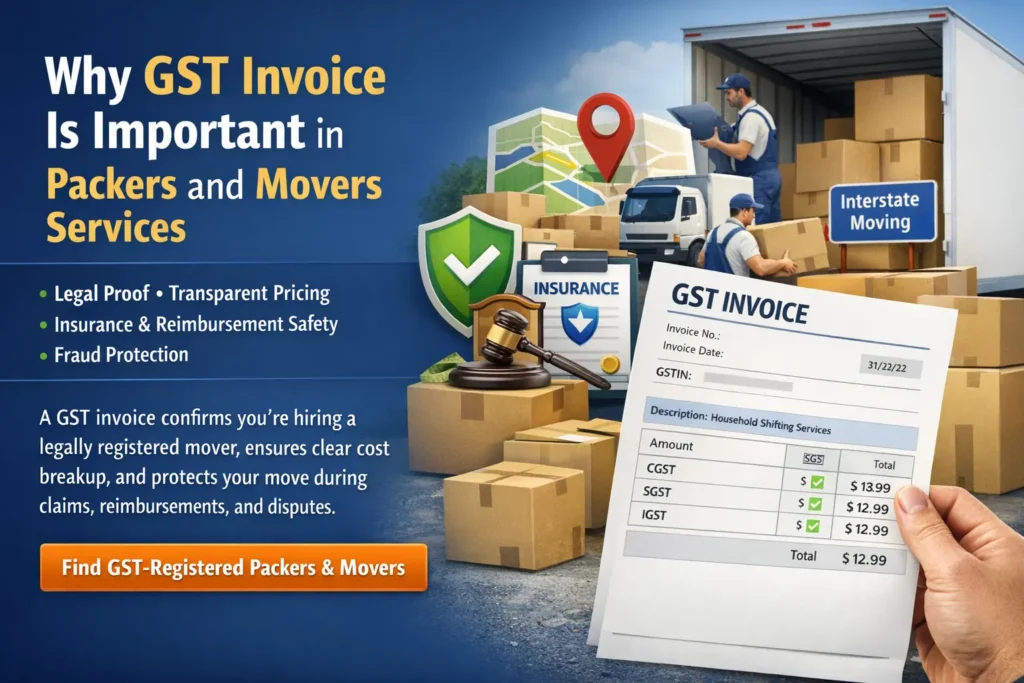
When hiring professional packers and movers, many customers focus only on packing quality, transport safety, and delivery timelines. However, one of the most critical yet often ignored aspects of relocation is the GST invoice. A GST invoice is not just a bill—it is a legal document that confirms the authenticity of the movers, ensures tax compliance, and protects you financially during and after the move. Whether you are planning a local house shift or an interstate relocation, insisting on a proper GST invoice from your service provider is essential for transparency, insurance claims, reimbursements, and dispute resolution. If you are searching for reliable and compliant moving companies, you can explore verified options through professional Packers And Movers services that follow proper billing and documentation practices.
From a customer’s perspective, a GST invoice acts as proof that the packers and movers company is legally registered under Indian tax laws and is accountable for the services it provides. It clearly breaks down service charges and applicable taxes, helping customers understand exactly what they are paying for—without hidden costs or last-minute surprises. For salaried professionals, corporate employees, and government staff, a GST invoice is often mandatory for relocation reimbursements and official claims. In the case of transit damage or loss, insurance providers usually require a valid GST invoice to process claims, making it a crucial safeguard for your household goods. To better understand how charges and taxes are calculated, customers should also review a detailed packers and movers cost guide before finalizing their move.
In today’s relocation market, where unregistered operators and fake billing practices still exist, understanding why a GST invoice is important in packers and movers services empowers you to make safer decisions.
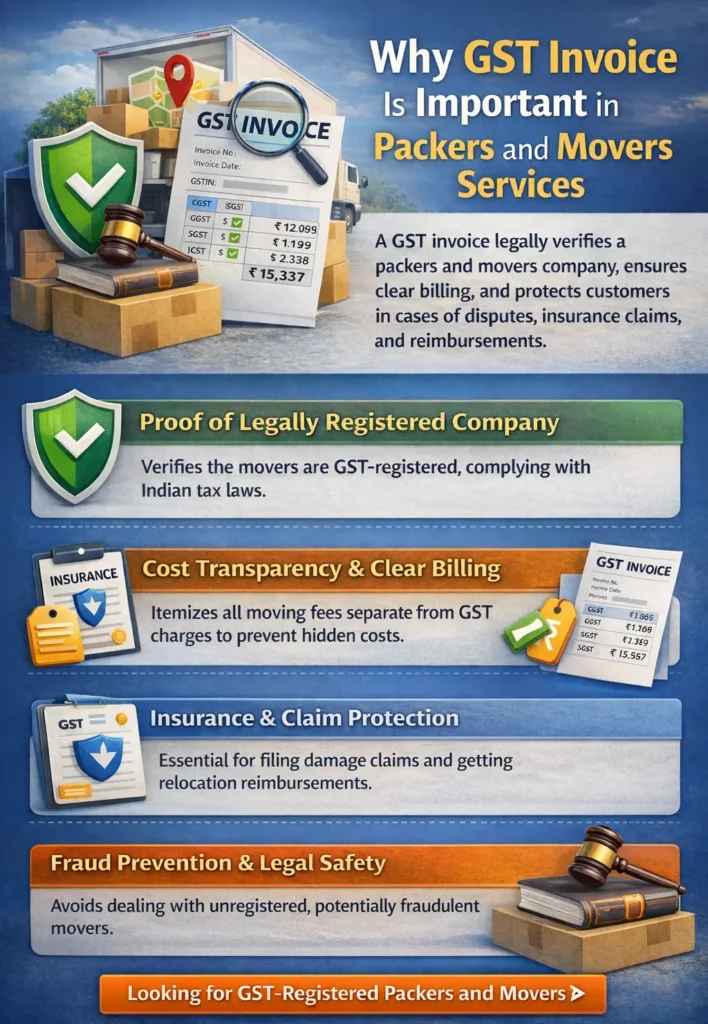
GST Invoice in Packers and Movers Services
A GST invoice in packers and movers services is a tax-compliant document issued by a GST-registered relocation company for the services it provides, such as packing, loading, transportation, unloading, and related handling. This invoice is governed by GST law and serves as legal proof of the transaction, confirming that tax has been correctly charged and will be deposited with the government. For customers, a GST invoice establishes accountability, transparency, and traceability—especially important during high-value household or office relocations.
Meaning of GST Invoice in the Relocation Industry
In the relocation industry, a GST invoice specifically refers to a tax invoice issued for moving-related services provided by a registered packers and movers company. These services are categorized under taxable supply, which means GST is applicable and must be invoiced as per prescribed rules.
Key points for customers to understand:
- A GST invoice confirms the mover is registered under GST.
- It reflects the actual service value and tax charged.
- It creates an official record for future verification or claims.
This distinction is especially important in the movers and packers sector, where informal billing or cash receipts can leave customers without legal protection.
Difference Between a GST Invoice and a Normal Bill
Many customers confuse a GST invoice with a simple bill or cash receipt. However, there are clear legal and practical differences between the two, particularly in packers and movers services.
Aspect | GST Invoice | Normal Bill |
Legal validity | Recognized under GST law | No legal tax standing |
GSTIN mentioned | Mandatory | Not required |
Tax breakup | CGST/SGST or IGST shown | Usually missing |
Accepted for claims | Yes | Often rejected |
Proof of registration | Confirms GST registration | Does not confirm legality |
This is why it’s important to follow a proper hiring checklist for packers and movers instead of choosing service providers based only on low prices.
A normal bill may indicate payment, but it does not confirm tax compliance or the legitimacy of the service provider. This is why many insurance companies, employers, and authorities insist on GST invoices only.
Mandatory Details Included in a Packers and Movers GST Invoice
GST rules specify a set of mandatory fields that must appear on every valid tax invoice. When hiring packers and movers, customers should always check for these details before making the final payment.
Mandatory details include:
- Name and address of the service provider
- GSTIN of the packers and movers company
- Unique invoice number and invoice date
- Description of moving services provided
- Taxable value of the service
- Applicable GST breakup (CGST & SGST or IGST)
- Place of supply (important for interstate moves)
- Total amount payable
If any of these elements are missing, the invoice may be considered incomplete or invalid, which can cause problems during reimbursements, insurance claims, or legal disputes.
Legal Importance of GST Invoice for Customers
A GST invoice plays a crucial legal role for customers hiring packers and movers. It is not merely a payment receipt but a statutory document recognized under Indian tax law, establishing a formal relationship between the customer and the service provider. In the event of service issues, disputes, or claims, the GST invoice acts as documentary evidence of the transaction, service scope, and amount paid. Without a valid GST invoice, customers may find it difficult to prove the authenticity of the mover or the legality of the service rendered.
From a compliance perspective, a GST invoice confirms that the packers and movers company is operating within the legal framework. This significantly reduces the risk of dealing with unregistered operators, who often disappear once payment is made, leaving customers without any recourse.
Proof of a Legally Registered Packers and Movers Company
One of the strongest legal advantages of a GST invoice is that it verifies the legal registration of the packers and movers company. Only businesses registered under GST are permitted to issue GST invoices with a valid GSTIN.
Why this matters to customers:
- Confirms the mover is registered under Indian tax law
- Ensures the company has a traceable business identity
- Reduces the risk of fraud and fly-by-night operators
For customers, checking the GSTIN on the invoice provides immediate confidence that the service provider is accountable to statutory authorities.
How GST Invoice Protects Customers From Fraud
Fraudulent packers and movers often operate without proper registration and issue handwritten bills or informal receipts. A GST invoice helps customers avoid such risks by creating a verifiable transaction trail.
Customer protection benefits include:
- Traceability of the service provider through GSTIN
- Clear identification of service value and tax paid
- Reduced chances of invoice manipulation or overcharging
If a mover refuses to issue a GST invoice, it can be a strong warning sign that the business is not compliant or may not be operating legally.
Role of GST Invoice in Dispute Resolution and Claims
In case of disputes related to damaged goods, delayed delivery, or service deficiencies, a GST invoice acts as formal proof of service engagement. It establishes:
- Who provided the service
- What service was agreed upon
- How much was charged
Consumer grievance mechanisms and insurance providers typically rely on invoices to verify claims. A valid GST invoice strengthens the customer’s position during negotiations or formal complaints.
GST Invoice as Valid Documentation for Legal Complaints
When customers approach consumer forums or legal authorities regarding packers and movers issues, documentation is critical. A GST invoice is considered acceptable evidence because it includes the registered identity of the service provider and the transaction details.
Legal advantages include:
- Recognized proof of payment
- Confirmation of service provider identity
- Support for written complaints and claims
Without a GST invoice, customers may struggle to establish responsibility, making legal resolution more complex.
GST Invoice and Its Role in Cost Transparency
One of the biggest advantages of receiving a GST invoice from packers and movers is complete cost transparency. Relocation services often involve multiple components—packing materials, labor, loading, transportation, unloading, and handling charges. A GST invoice ensures that all these elements are clearly documented, leaving no room for ambiguity or last-minute cost manipulation. For customers, this transparency helps in budgeting, comparison, and financial planning before and after the move.
Unlike informal bills, a GST invoice is issued under statutory rules that require the service provider to declare the taxable value and applicable tax separately. This protects customers from hidden charges and ensures that the amount paid aligns with what was originally agreed upon during the quotation stage.
Clear Breakup of Moving Charges and Taxes
GST law mandates that invoices must show a clear breakup of service value and tax components. For packers and movers services, this means customers can easily distinguish between the actual moving cost and the tax charged on it.
What customers can clearly see on a GST invoice:
- Base service charges for relocation
- Applicable GST rate
- Separate tax amounts (CGST & SGST or IGST)
- Final payable amount
This level of clarity allows customers to understand exactly where their money is going, which is especially important for high-value or long-distance moves.
How GST Invoice Prevents Hidden or Inflated Costs
Hidden charges are a common complaint in the relocation industry. A GST invoice helps prevent this by requiring packers and movers to declare the full taxable value of the service at the time of billing.
How this protects customers:
- Final amount must match the declared taxable value
- Any additional charge must be reflected on the invoice
- Overcharging outside the invoice violates GST provisions
If a mover demands extra payment that is not reflected in the GST invoice, customers have clear grounds to question or refuse such charges.
Difference Between Quoted Price and Final GST Invoice Amount
Customers often receive an initial quotation before booking packers and movers. The GST invoice helps bridge the gap between the quote and the final amount by documenting the actual billed value.
Common reasons for variation include:
- Change in volume or number of items
- Additional services requested
- Interstate tax applicability
A GST invoice ensures that any change in cost is formally recorded and justified, rather than added verbally or informally.
Why Verbal Estimates Without GST Invoice Are Risky
Relying solely on verbal estimates or non-GST bills can expose customers to financial and legal risks. Without a GST invoice:
- There is no official record of the transaction
- Charges cannot be verified or audited
- Claims, reimbursements, and complaints become difficult
For this reason, customers are always advised to finalize payments only after receiving a proper GST invoice, ensuring transparency and accountability throughout the relocation process.
GST Invoice Benefits for Insurance, Claims, and Reimbursements
A GST invoice is a critical document when it comes to insurance coverage, damage claims, and relocation reimbursements in packers and movers services. While packing quality and transport safety reduce risk, unforeseen issues such as transit damage, loss, or delays can still occur. In such situations, a GST invoice becomes essential proof that the relocation service was officially booked, paid for, and legally documented. Customers should also understand exactly what transit insurance covers during house shifting to ensure their invoice and insurance documents align.
For salaried professionals, corporate employees, and government staff, a GST invoice is often mandatory for reimbursement approval. Similarly, insurance providers rely on GST invoices to validate the declared value of goods and the legitimacy of the service provider before processing claims.
Importance of GST Invoice for Transit Insurance Claims
Transit insurance protects household goods against risks during transportation. To file an insurance claim, insurers typically require documentary evidence of the service and declared value, which is provided through a GST invoice.
Why GST invoice matters for insurance claims:
- Confirms the identity of the service provider
- Establishes the value of relocation services
- Acts as proof of payment and service engagement
Without a valid GST invoice, insurance claims may face delays or rejection due to insufficient documentation.
GST Invoice Requirement for Employer Relocation Reimbursement
Many employers reimburse relocation expenses as part of transfer or joining benefits. However, finance departments usually accept only GST-compliant invoices for such reimbursements.
Common reasons employers insist on GST invoices:
- Compliance with tax and audit requirements
- Verification of service provider legitimacy
- Clear breakup of service charges and taxes
Employees who submit non-GST bills or informal receipts often face rejection or partial reimbursement of their relocation expenses.
GST Invoice for Government and PSU Employee Claims
Government departments and public sector units follow strict financial rules for reimbursements. In most cases, only GST invoices issued by registered service providers are accepted for relocation claims.
Why GST invoice is mandatory in such cases:
- Aligns with official accounting and audit norms
- Provides traceable and verifiable transaction details
- Ensures tax compliance in government expenditure
This makes it essential for government and PSU employees to choose packers and movers who issue proper GST invoices.
Why Non-GST Bills Are Often Rejected in Claims
Non-GST bills or handwritten receipts lack statutory recognition. As a result, they are often rejected for:
- Insurance claims
- Corporate reimbursements
- Government expense settlements
Since these documents do not confirm tax compliance or business registration, authorities and insurers consider them insufficient proof of a legitimate transaction.
GST Invoice in Interstate and Long-Distance Relocation
In interstate and long-distance relocation, the importance of a GST invoice becomes even more critical. When household goods move from one state to another, the transaction falls under interstate supply, which is governed by specific GST provisions. A valid GST invoice ensures that the relocation complies with tax regulations during transit and helps customers avoid delays, penalties, or documentation issues while their goods are on the move.
For long-distance moves, it is safer to work with experienced intercity packers and movers who understand GST, e-way bills, and interstate compliance.
For customers planning long-distance shifting, a GST invoice also acts as official proof of lawful transportation, especially during inspections at checkpoints or verification during transit. Without proper invoicing, goods may be detained or questioned, causing unnecessary stress and delays.
GST Rules Applicable to Interstate Packers and Movers Services
When packers and movers provide services across state boundaries, GST law treats the transaction as an interstate supply. In such cases, Integrated GST (IGST) is applicable instead of CGST and SGST.
Key points customers should know:
- Interstate relocation attracts IGST
- Place of supply determines the type of tax
- GST invoice must clearly mention interstate service details
This classification ensures uniform taxation across states and prevents tax evasion during long-distance transportation.
IGST vs CGST & SGST in Moving Services
The type of GST charged depends on whether the relocation is within the same state or across states. A GST invoice helps customers clearly identify which tax applies to their move.
Type of Move | Applicable GST |
Within the same state | CGST + SGST |
Between two states | IGST |
This distinction is important for customers reviewing their invoice and for those claiming reimbursements, as incorrect tax application can lead to invoice rejection.
GST Invoice Requirement at Checkposts and During Transit
During interstate movement, goods may be subject to verification by authorities. A GST invoice is often required to:
- Establish the legality of transportation
- Support e-way bill generation
- Confirm the service provider’s registration
In many cases, the e-way bill details are directly linked to the GST invoice, making the invoice a key transit document for long-distance relocation.
Risks of Interstate Shifting Without a GST Invoice
Transporting household goods across state borders without a GST invoice can expose customers to several risks:
- Detention of goods during inspection
- Delays due to documentation issues
- Difficulty in proving ownership or service legitimacy
For this reason, customers planning interstate relocation should always insist on a proper GST invoice before their goods are dispatched.
How to Verify a Genuine GST Invoice From Packers and Movers
Receiving a GST invoice is important, but verifying its authenticity is equally critical. In the packers and movers industry, some unregistered operators issue fake or incomplete GST invoices to appear legitimate. Customers who fail to verify these details may face problems later during reimbursements, insurance claims, or legal disputes. Knowing how to check a GST invoice helps ensure that you are dealing with a legally compliant and accountable service provider.
A genuine GST invoice allows customers to independently confirm the mover’s registration status and validate the transaction details. This verification process is simple and can be done using publicly available government tools.
How to Check GSTIN on the Invoice
Every valid GST invoice must contain the GST Identification Number (GSTIN) of the packers and movers company. Customers can verify this number through the official GST portal.
Steps customers can follow:
- Locate the GSTIN printed on the invoice
- Enter the GSTIN on the GST search portal
- Check the registered business name and status
If the company name on the portal matches the invoice details, it confirms that the mover is registered under GST.
Matching Company Name With GST Registration
A common red flag in fake invoices is a mismatch between the company name on the invoice and the name registered under GST. Customers should always compare:
- Legal business name
- Trade name (if mentioned)
- Registered state
Even small spelling differences or incorrect state details can indicate an invalid or misleading invoice.
Common Red Flags in Fake or Invalid GST Invoices
Customers should be cautious if they notice any of the following issues on a packers and movers GST invoice:
- Missing or incorrect GSTIN
- No tax breakup (CGST/SGST or IGST not shown)
- Invoice number or date missing
- Handwritten or editable invoices without proper format
- Company refusing to share GST details for verification
These signs often indicate non-compliance and increase the risk of future disputes.
What to Do If a Mover Refuses to Provide a GST Invoice
If a packers and movers company refuses to issue a GST invoice, customers should treat it as a serious warning sign. Since registered service providers are legally required to issue tax invoices, refusal may indicate non-registration or intent to avoid compliance.
Recommended customer actions:
- Avoid making full payment without a GST invoice
- Ask for written confirmation of GST billing
- Consider choosing a compliant service provider
Insisting on proper invoicing helps customers protect their financial and legal interests throughout the relocation process.
Looking for GST-Compliant Packers and Movers You Can Trust?
Avoid fake bills, hidden charges, and rejected claims.
Choose professionally verified packers and movers who provide proper GST invoices, transparent pricing, and legally compliant relocation services. If you are planning a move in Bangalore, choose verified packers and movers in Bangalore who provide proper GST invoices and legal documentation.
- Compare GST-registered Packers and Movers near you
- Get written estimates with tax breakup
- Move safely with invoice-backed protection
Check Trusted Packers And Movers Now-