
Understanding Different Types of Moving Services Available
Moving services include local moving for same-city relocation, domestic intercity moving for shifting between cities, international moving for overseas relocation, office and commercial moving for businesses, vehicle transportation for cars and bikes, storage and warehousing for temporary or long-term storage, and full-service or partial moving options based on customer needs.
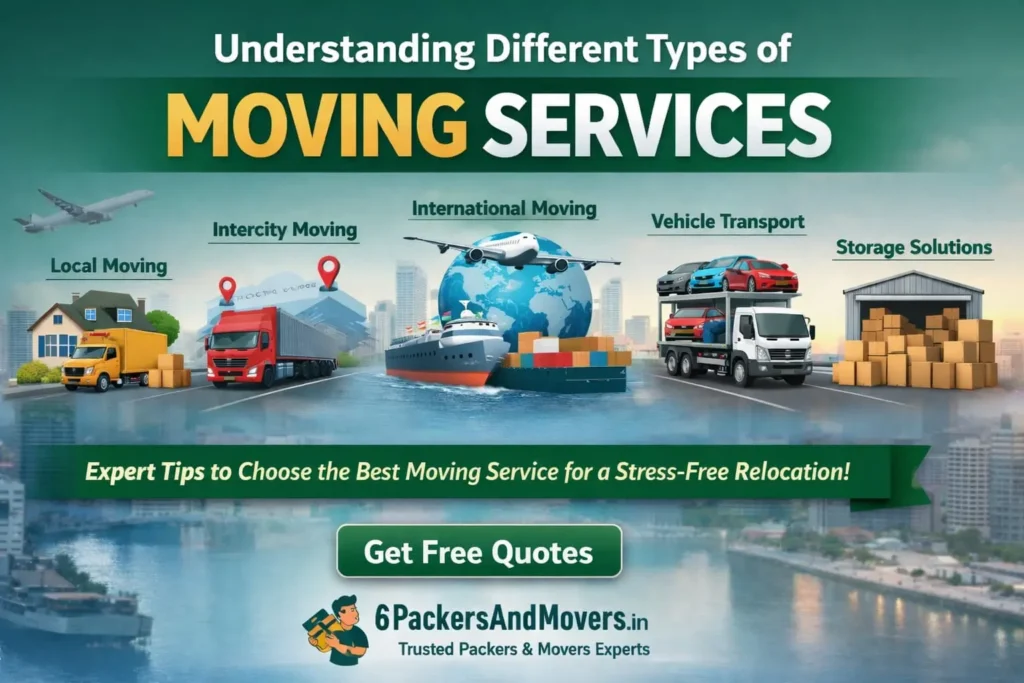
Relocation today is no longer limited to simply loading household goods onto a truck and unloading them at a new address. Modern moving services are structured solutions designed to handle different relocation needs—whether it is a short-distance home shift, an intercity household move, an international relocation, office shifting, vehicle transportation, or temporary storage. Choosing the right type of service plays a critical role in protecting belongings, managing costs, and avoiding operational or legal issues during transit.
For individuals and businesses planning a move, understanding the difference between local, domestic, international, commercial, and specialized moving services helps prevent common mistakes such as overpaying, booking the wrong transport type, or facing delays due to documentation or handling issues. Each moving service follows a distinct process, involves different cost factors, and carries varying levels of risk depending on distance, volume, and the nature of goods being moved.
Professional relocation providers like Packers And Movers offer structured services that combine packing, loading, transportation, unloading, insurance support, and optional storage. These structured solutions are delivered through professional packers and movers services, which help individuals and businesses relocate safely across cities and regions. However, not every move requires a full-service package. Some relocations are better handled through partial services, shared transport, or specialized handling—making it essential to understand which moving option aligns with your specific requirements.
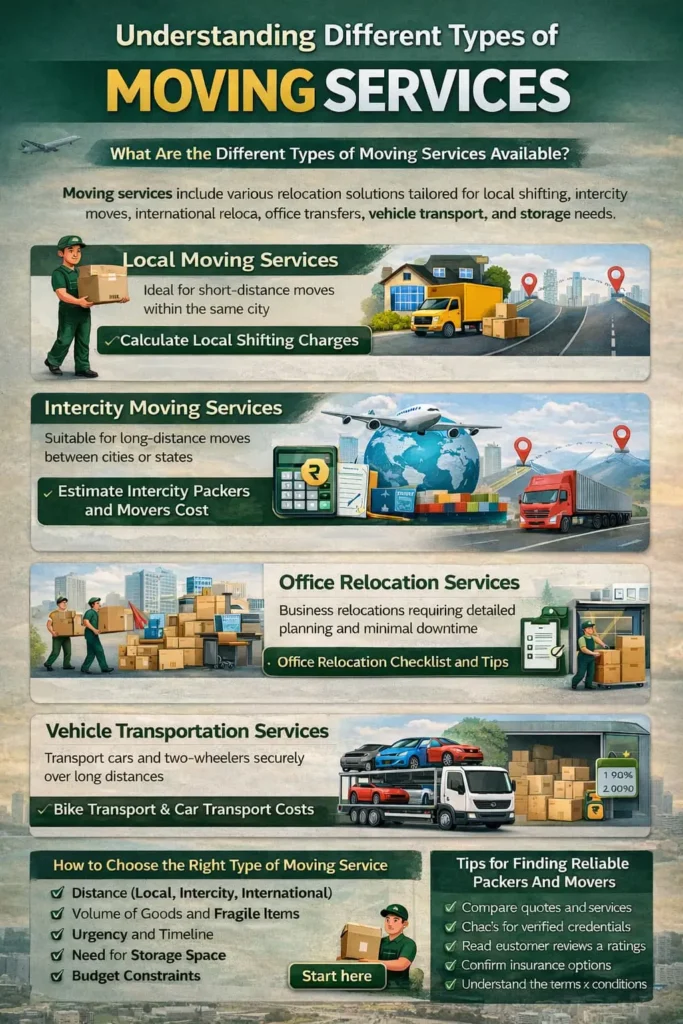
Why Choosing the Right Type Matters
Moving services refer to professional relocation solutions that manage one or more stages of a move, including packing, loading, transportation, unloading, unpacking, insurance coordination, and in some cases storage or documentation support. These services are designed to reduce physical effort, minimize damage risk, and ensure goods are moved in compliance with transport and regulatory requirements—especially for long-distance and international relocations.
Not all relocations require the same level of service. A short-distance home shift within the same city involves very different logistics compared to an intercity household move, an office relocation, or an overseas transfer. Choosing the wrong type of moving service can result in unnecessary expenses, delays, damaged goods, or compliance issues during transit. This is why understanding how moving services differ is essential before booking a relocation provider.
What Professional Moving Services Typically Include
Professional movers may offer services either as a bundled package or as individual components, depending on the type of move and customer preference.
Core services generally include:
- Packing household or office goods using appropriate materials
- Loading and unloading with trained manpower
- Transportation using suitable vehicles
- Basic handling of fragile or bulky items
Additional or optional services may include:
- Unpacking and rearrangement
- Transit insurance coordination
- Temporary storage or warehousing
- Documentation support for intercity or international moves
Understanding these service differences also helps when comparing relocation providers in different cities.
Why the Right Moving Service Type Matters
Each relocation scenario involves different risks, costs, and operational challenges. Selecting a suitable service ensures that:
- Goods are transported using the correct vehicle type
- Packing standards match the distance and fragility of items
- Transit timelines align with delivery expectations
- Legal and procedural requirements are addressed in advance
Failure to align the service type with the move often leads to cost overruns, repeated handling, or last-minute changes that increase risk.
Impact of Choosing the Wrong Moving Service
Scenario | Incorrect Choice | Possible Outcome |
Local move treated as intercity | Overpaying for transport | Higher cost with no added benefit |
Intercity move using shared truck unintentionally | Poor coordination | Delays and repeated handling |
International move without documentation support | Clearance issues | Shipment delays or penalties |
Business disruption | Downtime and data handling risks |
Understanding moving services at a foundational level allows individuals and businesses to match their relocation needs with the correct solution—balancing cost, safety, and convenience effectively.
Local Moving Services (Within the Same City)
Local moving services are designed for relocations that take place within the same city or nearby urban limits. These moves usually involve shorter travel distances, quicker turnaround times, and simpler logistics compared to intercity or international relocations. Because of this, local shifting services are often more flexible and cost-efficient when planned correctly.
Local movers focus on efficient execution rather than long-haul transport planning. In most cases, the entire move—from packing to unloading—can be completed within the same day. However, even short-distance moves require proper handling, especially for fragile items, furniture, and appliances.
For same-city relocations, hiring experienced packers and movers in Lucknow ensures faster execution, proper handling of household goods, and same-day delivery when required.
How Local Moving Services Typically Work
Local relocation services usually follow a streamlined process:
- Pre-move assessment of goods volume and access conditions
- Packing using cartons, bubble wrap, and basic protective materials
- Loading goods onto a suitable local transport vehicle
- Short-distance transportation
- Unloading at the destination and basic placement of items
Since the transit time is short, advanced documentation or permits are usually not required, but access issues such as staircases, elevators, parking availability, and traffic restrictions can affect execution.
Who Should Choose Local Moving Services
Local moving services are suitable for:
- Shifting within the same city or nearby locality
- Studio apartments, 1–3 BHK homes, or small offices
- Tenants moving between rental properties
- Situations requiring same-day delivery
They are especially useful when relocation timelines are tight and storage is not required.
Cost Structure for Local Moves
Local shifting charges are generally calculated based on a combination of factors rather than distance alone.
Common cost factors include:
- Volume of household or office goods
- Number of packers and loaders required
- Type and size of transport vehicle
- Floor level and lift availability
- Packing materials used
Cost Factor | Impact on Final Price |
Goods volume | Higher volume increases labour and vehicle size |
Floor access | No lift increases handling time |
Packing requirement | Fragile items raise packing costs |
Vehicle size | Larger vehicles increase base charges |
While local moves are comparatively simpler, choosing a service that matches the actual volume and handling needs helps avoid overpaying or last-minute adjustments.
Domestic Long-Distance Moving Services (Intercity Moves)
Domestic long-distance moving services are meant for relocations between two different cities or states within the country. These moves involve extended travel distances, longer transit times, and more complex logistics compared to local shifting. Because goods remain in transit for multiple days, intercity moves require stronger packing standards, better route planning, and clearer coordination between pickup and delivery schedules.
Unlike local moves, intercity relocations demand careful selection of transport mode, loading strategy, and service scope to reduce damage risk and avoid delays. The choice between dedicated and shared transportation plays a major role in cost, safety, and delivery timelines.
Choosing the correct transport type becomes easier when you understand how local and intercity moving costs differ.
How Intercity Moving Services Operate
Domestic long-distance moving generally follows a structured process:
- Pre-move survey to assess volume, packing needs, and route
- Multi-layer packing suitable for long-haul transit
- Loading into long-distance trucks or containers
- Scheduled transit with planned halts
- Unloading and placement at the destination city
Because goods are transported over highways and across state borders, route conditions, weather, and traffic regulations can influence delivery timelines.
Dedicated Truck vs Shared Truck Services
Intercity movers typically offer two transportation options based on shipment size and budget.
Transport Type | Description | Best For |
Dedicated Truck | Entire vehicle reserved for one customer’s goods | Large households, faster delivery |
Shared / Part-Load Truck | Multiple shipments consolidated in one truck | Smaller moves, lower cost |
Dedicated trucks reduce handling and usually ensure quicker delivery, while shared trucks are cost-effective but may involve additional loading and unloading during transit.
Transit Time, Tracking, and Safety
Intercity moves take longer than local shifts, with delivery timelines depending on:
- Distance between cities
- Route conditions and regulations
- Transport type selected
- Handling requirements
To protect goods during extended transit, movers generally use reinforced packing, proper weight distribution inside vehicles, and systematic unloading at the destination.
Choosing the correct intercity moving service helps balance affordability, safety, and delivery certainty—especially when relocating entire households or offices across cities.
International Moving Services
International moving services are designed for relocations that involve crossing national borders. These moves are more complex than domestic relocations because they require compliance with international shipping regulations, customs procedures, and documentation requirements. In addition to packing and transportation, international movers coordinate shipping modes, customs clearance, and delivery logistics in the destination country.
Because household goods remain in transit for longer durations and pass through multiple handling points, international moves demand specialized packing standards and precise documentation. Choosing the correct international moving service helps avoid customs delays, unexpected charges, or shipment holds.
What International Moving Services Typically Cover
International relocation services generally include:
- Export-grade packing suitable for long transit durations
- Transportation via sea freight or air freight
- Preparation of shipping and customs-related documents
- Coordination with overseas agents or delivery partners
- Destination delivery based on the selected service model
The scope of services varies depending on whether the move is door-to-door or port-to-port.
Sea Freight vs Air Freight Moving
International movers usually offer two primary shipping methods, each suited for different needs.
Shipping Mode | Characteristics | Suitable For |
Sea Freight | Cost-effective, longer transit time | Full household moves, large volumes |
Air Freight | Faster delivery, higher cost | Limited items, urgent relocation |
Sea freight is commonly used for complete household relocations, while air freight is preferred when speed is critical and shipment size is smaller.
Door-to-Door vs Port-to-Port Services
International moves can also be categorized based on delivery responsibility:
- Door-to-door services include packing, international shipping, customs clearance, and final delivery at the destination address.
- Port-to-port services cover transportation only between ports, requiring the customer to manage customs clearance and local delivery.
Selecting the right service type depends on familiarity with customs procedures, budget considerations, and the level of convenience required.
International moving services reduce the complexity of overseas relocation by managing regulatory, logistical, and handling challenges—provided the service scope is clearly defined before booking.
Office and Commercial Moving Services
Office and commercial moving services are structured to relocate workplaces, retail units, warehouses, and institutional setups with minimal disruption to daily operations. Unlike residential moves, commercial relocations involve coordinated handling of furniture, IT equipment, documents, and operational assets that must be moved safely and efficiently within a defined timeline.
Because business continuity is critical, office moves require careful planning, labeling, and scheduling. Professional movers use structured relocation plans to ensure that departments, systems, and workstations are reassembled correctly at the new location.
How Office Relocation Differs from Household Moving
Commercial moving services differ from residential shifting in several ways:
- Detailed inventory and asset tagging
- Specialized handling of computers, servers, and electronics
- Secure movement of files and sensitive documents
- Planned execution during non-working hours
These elements help reduce downtime and prevent loss or damage to critical business assets.
Handling of IT Equipment and Office Assets
Office movers typically follow systematic procedures:
- Anti-static and shock-resistant packing for electronics
- Labeling of desks, chairs, and workstations by department
- Controlled loading to avoid cable, screen, or hardware damage
- Structured unloading and placement based on layout plans
This organized approach ensures quicker resumption of business operations after relocation.
Planned Moves to Minimize Business Downtime
To limit operational impact, office relocations are often scheduled:
- Over weekends or holidays
- During off-peak business hours
- In phases for large organizations
Proper planning allows businesses to restart operations with minimal interruption while maintaining data and asset safety.
Vehicle Transportation Services
Vehicle transportation services are designed to move personal or commercial vehicles—such as cars and two-wheelers—from one location to another without adding mileage or wear and tear. These services are commonly used during intercity relocations, transfers, or long-distance moves where self-driving the vehicle is impractical, time-consuming, or costly.
Professional vehicle transport focuses on secure loading, controlled transit, and safe delivery. The choice of transport method directly affects protection level, transit time, and overall cost.
Types of Vehicle Transportation Services
Vehicle movers generally offer two primary transport options:
Transport Method | Description | Suitable For |
Open Carrier Transport | Vehicles transported on open trailers | Standard cars, cost-sensitive moves |
Enclosed Carrier Transport | Vehicles moved inside covered carriers | Luxury, vintage, or high-value vehicles |
Open carriers are more commonly used due to availability and lower cost, while enclosed carriers provide added protection from weather and road debris.
Bike and Two-Wheeler Transportation
Two-wheeler transportation involves:
- Partial dismantling (mirrors, accessories if required)
- Protective wrapping and crating
- Secure positioning inside the carrier
This service is commonly chosen when relocating long distances, especially when household goods are being moved simultaneously.
Safety, Insurance, and Delivery Timelines
Key considerations in vehicle transport include:
- Proper loading ramps and securing mechanisms
- Inspection reports before pickup and after delivery
- Transit insurance coverage for damage during movement
- Delivery timelines based on route, carrier type, and distance
Choosing a vehicle transportation service that matches the vehicle’s value and relocation distance helps ensure safety without unnecessary expense.
Storage and Warehousing Services
Storage and warehousing services support relocations where goods cannot be moved directly from the old location to the new one. These services are commonly used during delayed possession, phased moves, temporary travel, renovations, or downsizing. Professional storage solutions provide secure facilities to protect household or commercial goods for short or extended durations.
Unlike simple storage rooms, professional warehouses are designed for systematic stacking, controlled access, and safe handling during both storage and retrieval.
Types of Storage Solutions Available
Storage services are generally categorized based on duration and usage:
Storage Type | Description | Suitable For |
Short-Term Storage | Storage for days or weeks | Temporary relocation gaps |
Long-Term Storage | Storage for months or longer | Overseas travel, delayed possession |
Some warehouses also offer specialized zones for fragile items, documents, or climate-sensitive goods.
When Storage Services Are Required
Storage becomes necessary in situations such as:
- New home or office not ready for possession
- Staggered relocation schedules
- Renovation or remodeling work
- Temporary job transfers or overseas assignments
Using professional storage reduces the risk of damage compared to keeping goods in unsecured or unsuitable spaces.
Security, Access, and Insurance
Professional warehousing services typically include:
- Secured premises with controlled access
- Organized stacking and inventory records
- Protection against dust, moisture, and pests
- Insurance options covering stored goods
Clear terms on access and retrieval ensure that stored items can be collected safely and systematically when required.
Specialized and Value-Added Moving Services
Specialized and value-added moving services are designed for items or situations that require handling beyond standard household or office relocation. These services focus on safety, precision, and customization, especially when goods are fragile, bulky, high-value, or require special care during packing and transportation.
Such services are commonly used in premium relocations, sensitive moves, or when standard packing and loading methods are insufficient.
Fragile and High-Value Item Handling
Fragile and valuable items require enhanced protection during relocation. This typically includes:
- Multi-layer protective packing
- Customized cartons or wooden crating
- Shock-absorbent cushioning
- Careful placement inside the transport vehicle
Items such as glassware, antiques, artworks, and delicate electronics often fall under this category.
Heavy and Bulky Item Moving
Certain household or commercial items require specialized equipment and trained manpower due to their size or weight. These include:
- Pianos, safes, and large appliances
- Industrial machines and heavy furniture
- Oversized fixtures and installations
Movers may use lifting tools, trolleys, ramps, or cranes depending on access conditions and item weight.
Additional Value-Added Services
Beyond physical movement, some movers also provide:
- Dismantling and reassembly of furniture
- Appliance installation support
- Handyman services for fixtures and fittings
These value-added services simplify post-move setup and reduce the effort required after relocation.
Specialized moving services help ensure that complex or sensitive relocations are executed safely, without relying on improvised handling methods.
Full-Service Moving vs Partial Moving Services
Full-service and partial moving services differ mainly in the scope of responsibility handled by the mover. Understanding this difference helps customers choose a service model that balances cost, convenience, and control during relocation. Not every move requires end-to-end handling, and selecting the right option can significantly impact both budget and effort.
What Full-Service Moving Includes
Full-service moving is an end-to-end relocation solution where the mover manages almost every stage of the move.
Typically included services are:
- Packing of all household or office goods
- Supply of packing materials
- Loading, transportation, and unloading
- Unpacking and basic placement
- Optional insurance coordination and storage
This option is commonly chosen for long-distance, international, large households, or time-sensitive relocations where convenience and risk reduction are priorities.
What Partial Moving Services Cover
Partial moving services allow customers to select only specific components of the relocation process.
Common partial services include:
- Transportation only
- Loading and unloading without packing
- Packing of fragile items only
- Vehicle transport without household shifting
Partial services are suitable for short-distance moves, small households, or situations where customers want to manage some tasks themselves.
Cost vs Convenience Comparison
Aspect | Full-Service Moving | Partial Moving |
Cost | Higher | Lower |
Customer effort | Minimal | Moderate to high |
Risk management | Lower | Depends on self-handling |
Time requirement | Less | More |
Which Option Is Right for You
Full-service moving is ideal when time, safety, and convenience are critical. Partial moving works better when budget control is a priority and the move is relatively simple. Evaluating the distance, volume of goods, and personal availability helps determine the most suitable option.
For a detailed breakdown of charges across different relocation types, refer to this complete packers and movers cost guide.
Selecting the Best Moving Service for a Stress-Free Relocation
Relocation becomes significantly smoother when the moving service is aligned with the actual requirements of the move. Local shifts, intercity relocations, international moves, office transfers, vehicle transportation, and storage needs all involve different processes, costs, and risk levels. Understanding these differences helps in selecting a service that offers the right balance between safety, convenience, and budget.
Choosing a suitable moving service starts with evaluating key factors such as distance, volume of goods, timeline, and the nature of items being moved. Full-service options are ideal for complex or time-sensitive relocations, while partial services work well for simpler moves where some tasks can be managed independently. Specialized services further support relocations involving fragile, bulky, or high-value items that require extra care.
A well-informed decision reduces common relocation challenges such as unexpected costs, transit delays, or damage to belongings. By clearly defining your needs, confirming service scope in advance, and selecting the appropriate type of moving service, you can ensure a safer, more organized, and stress-free relocation experience.
FAQ Schema – Understanding Different Types of Moving Services Available
Moving services are professional relocation solutions that help individuals and businesses move household or commercial goods safely from one location to another. These services may include packing, loading, transportation, unloading, unpacking, vehicle transport, storage, and insurance support depending on the type of move.
Local moving services are used for relocations within the same city and usually involve same-day or short-duration delivery. Intercity moving services are meant for relocations between different cities or states and involve long-distance transport, stronger packing, longer transit time, and dedicated or shared trucks.
Full-service moving includes end-to-end relocation support such as packing all items, loading, transportation, unloading, unpacking, and sometimes storage or insurance coordination. This option is ideal for long-distance, international, or time-sensitive relocations.
Yes, vehicle transportation services are often booked separately from household shifting. Cars and two-wheelers are moved using open or enclosed carriers to avoid wear and tear, making this service ideal for long-distance or intercity relocations.
Storage and warehousing services are required when there is a gap between moving out and moving in, during home renovations, delayed possession, or temporary relocations. These services provide secure short-term or long-term storage for household or commercial goods.
The right moving service depends on factors such as relocation distance, volume of goods, type of items, budget, timeline, and whether storage or specialized handling is required. Evaluating these factors helps ensure a safe, cost-effective, and stress-free move.
Planning a Move? Choose the Right Moving Service with Experts
Not sure whether you need local shifting, intercity relocation, vehicle transport, or full-service moving?
6 Packers And Movers helps you compare options, avoid hidden costs, and connect with reliable professionals for a safe and hassle-free move.
Get verified movers, transparent quotes, and expert relocation support
Regardless of the relocation type, working with verified packers and movers helps reduce risks, manage costs, and ensure smooth execution from start to finish.