
How Do I Plan an Office Move?
To plan an office move effectively, start by setting a clear relocation timeline, creating a detailed office moving checklist, and allocating a realistic budget. Choose experienced office packers and movers, plan IT infrastructure and data security in advance, communicate clearly with employees and stakeholders, and conduct post-move system testing to ensure smooth business continuity.
Planning an office move is a complex business decision that involves timelines, budgets, people, assets, and technology. A poorly planned office relocation can lead to operational downtime, employee confusion, data risks, and unexpected expenses. On the other hand, a structured office move plan helps businesses relocate smoothly while maintaining continuity. Whether you are moving a small startup or a large corporate office, understanding each phase of office shifting is essential. Businesses often rely on professional packers and movers services to handle logistics, especially for structured office relocation services that involve furniture, IT assets, and time-bound execution. This guide explains how to plan an office move step by step, covering timelines, checklists, budgeting, mover selection, IT coordination, and execution to ensure a controlled and disruption-free transition.
Start Office Move Planning Early
Early planning is consistently highlighted as one of the most important factors in a successful office relocation. Office move planning should begin months in advance to coordinate leases, vendors, employees, and IT systems without rushing critical decisions.
Decide the Ideal Office Relocation Timeline
The recommended planning timeline depends on the size and complexity of the office move. Larger offices require longer preparation due to the number of employees, workstations, and IT assets involved.
Key facts:
- Office relocation planning is commonly started 3–12 months before the moving date.
- Large offices benefit from a 6–12 month planning window to avoid operational disruption.
- Early planning allows time for vendor comparison, space planning, and risk mitigation.
Set a Fixed Office Moving Date
Fixing the office moving date early helps align internal teams and external vendors. Businesses often prefer dates that minimize work disruption.
Common considerations when selecting a moving date:
- Weekends or non-working days reduce productivity loss
- Lease end and new lease start alignment
- Availability of movers and IT vendors
- Time required for packing and setup
Appoint an Internal Office Move Coordinator
An internal coordinator acts as the central decision-maker throughout the relocation process. This role improves communication and reduces confusion during planning and execution.
Responsibilities of the move coordinator include:
- Coordinating with packers and movers
- Managing internal timelines and checklists
- Communicating move instructions to employees
- Supervising packing and moving day activities
Working with experienced office packers and movers helps the internal coordinator manage timelines, manpower, and execution more efficiently.
Office Move Planning Timeline
Office Size | Recommended Planning Time | Key Focus Areas |
Small office (10–25 staff) | 2–4 months | Inventory, movers, basic IT |
Medium office (25–75 staff) | 4–6 months | Department planning, budgeting |
Large office (75+ staff) | 6–12 months | IT migration, risk control |
Why Early Planning Matters
- Reduces last-minute costs
- Prevents business downtime
- Improves coordination between departments
- Allows structured IT and data migration
Create a Detailed Office Moving Checklist
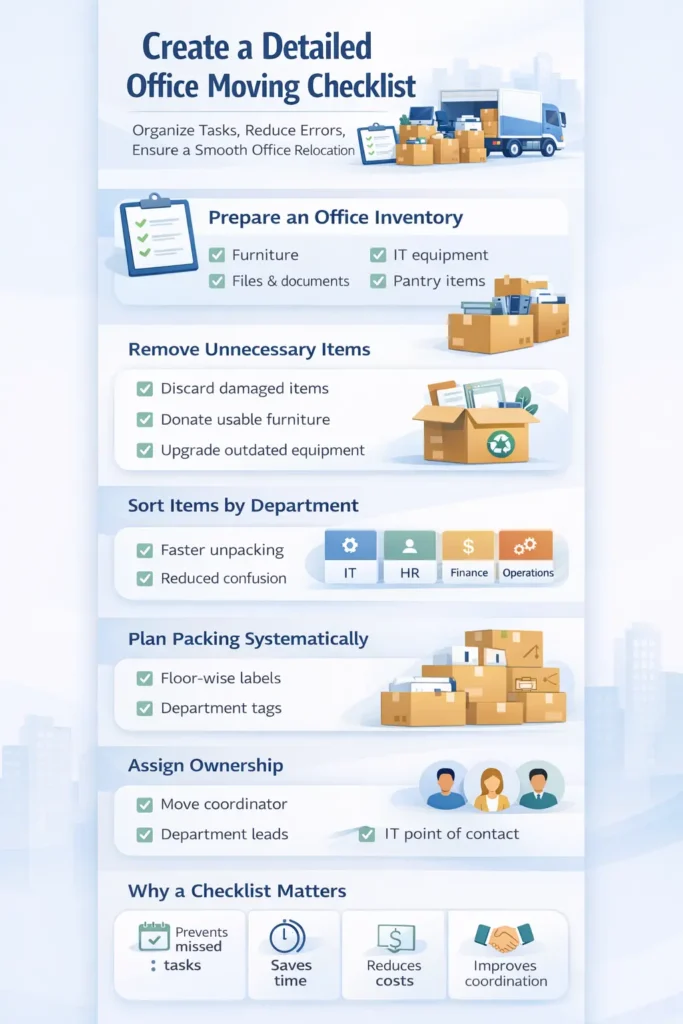
A structured office moving checklist is essential to keep the relocation process organized and prevent critical tasks from being overlooked. Office relocation involves multiple departments, assets, and timelines, and a checklist helps break down the move into manageable actions. Businesses that use a detailed checklist are better able to track responsibilities, coordinate packing, and ensure nothing is missed during the transition.
Prepare an Inventory of Office Assets
Creating a complete inventory of office assets is one of the first checklist tasks in office move planning. An inventory helps determine packing needs, transport requirements, insurance coverage, and setup priorities at the new location.
Office assets commonly included in an inventory:
- Office furniture (desks, chairs, cabinets)
- Computers, monitors, printers, servers
- Files, documents, and storage units
- Pantry equipment and supplies
- Miscellaneous equipment and supplies
An updated inventory also helps movers plan vehicle size and packing materials accurately.
Identify Items to Discard, Donate, or Upgrade
Office relocation is an opportunity to declutter and remove items that are no longer required. Reducing unnecessary items lowers moving costs and simplifies unpacking at the new office.
Common actions during this stage:
- Dispose of broken or outdated furniture
- Recycle old electronics according to regulations
- Donate usable furniture or equipment
- Replace worn-out items instead of moving them
Decluttering before packing improves efficiency and reduces transportation expenses.
Categorize Department-Wise Assets
Sorting office items by department helps streamline packing, labeling, and unpacking. Department-wise categorization ensures assets reach the correct work areas at the new office location.
Departments often categorized separately:
- IT and server equipment
- HR and administrative files
- Finance and confidential documents
- Operations and general workstations
Clear categorization reduces confusion and speeds up post-move setup.
Office Moving Checklist – Core Tasks Table
Checklist Task | Purpose |
Asset inventory preparation | Identify items to be moved |
Decluttering and disposal | Reduce moving volume |
Department-wise labeling | Faster unpacking |
Packing material planning | Avoid shortages |
Responsibility assignment | Clear accountability |
Benefits of a Detailed Office Moving Checklist
- Improves task visibility and accountability
- Prevents missed steps during relocation
- Helps coordinate movers and internal teams
- Reduces delays on moving day
Set a Realistic Office Relocation Budget
Setting a clear and realistic office relocation budget is a critical part of planning an office move. Office shifting costs are not limited to transportation alone and often include packing, IT handling, insurance, downtime, and post-move setup expenses. A structured budget helps businesses control spending, compare service options, and avoid unexpected financial strain during relocation.
Office relocation costs vary based on asset volume, distance, and service scope. Reviewing a detailed office moving cost guide helps businesses estimate expenses accurately and avoid budget overruns.
Estimate Office Shifting Costs
Office moving costs vary depending on office size, distance, services required, and asset volume. Estimating costs early helps businesses allocate funds appropriately and avoid last-minute compromises.
Typical cost components in an office move:
- Packing materials and packing labor
- Loading and unloading charges
- Transportation cost
- Furniture dismantling and reinstallation
- IT equipment handling
- Transit insurance
Accurate estimation allows businesses to plan cash flow and vendor selection efficiently.
Account for Hidden Office Moving Expenses
Many office relocations exceed budget due to overlooked indirect expenses. Identifying these early helps prevent cost overruns.
Common hidden or indirect costs include:
- Business downtime during relocation
- Temporary storage requirements
- Internet and utility setup charges
- Cleaning costs for old and new offices
- Address change updates and signage
Including these costs in the budget provides a more realistic financial picture.
Understanding what is excluded from moving charges helps businesses plan realistic office relocation budgets.
Plan a Contingency Budget
Unexpected changes are common during office moves. Industry guides recommend setting aside a contingency fund to handle unforeseen expenses without disrupting the relocation process.
Situations that may require contingency funds:
- Last-minute asset additions
- Extended packing time
- Extra manpower requirements
- Delays in office readiness
A contingency buffer helps businesses respond quickly without compromising service quality.
Office Relocation Budget Breakdown
Cost Category | Purpose |
Packing & materials | Protect office assets |
Transportation | Move goods safely |
IT handling | Secure electronics |
Insurance | Risk protection |
Downtime costs | Business continuity |
Contingency fund | Unexpected expenses |
Why Budget Planning Is Critical for Office Moves
- Prevents cost overruns
- Improves vendor comparison
- Supports uninterrupted operations
- Helps prioritize essential services
Choose the Right Office Packers and Movers
Selecting experienced office packers and movers plays a major role in the success of an office relocation. Office moves involve handling furniture, sensitive documents, and expensive IT equipment, which requires specialized expertise. Comparing service scope, safety measures, and insurance coverage helps businesses avoid delays, damage, and coordination issues during relocation.
Verify Office Relocation Experience
Not all movers specialize in office relocations. Guides on commercial moving emphasize choosing movers with proven experience in handling corporate and office shifting requirements.
What to verify before finalizing movers:
- Experience with commercial or office relocations
- Handling of workstations and modular furniture
- Familiarity with IT and electronic equipment
- Ability to manage time-bound relocations
Experienced movers help reduce downtime and ensure organized execution.
Compare Office Moving Quotes Properly
Comparing multiple office moving quotes helps businesses understand cost differences and service coverage. Quotes should be reviewed carefully to avoid misunderstandings later.
Key elements to compare in quotes:
- Packing services included or excluded
- Quality and type of packing materials
- Loading, unloading, and reinstallation services
- Insurance coverage and claim process
- Additional or conditional charges
Clear comparison helps businesses choose services that match their requirements and budget.
Businesses should also review a structured guide on how to compare packers and movers quotes to evaluate pricing, service coverage, and risk protection accurately.
Check Safety, Insurance, and Compliance
Office relocation involves risk to valuable assets. Moving guides recommend confirming insurance coverage and safety practices before finalizing movers.
Important checks before hiring movers:
- Transit insurance availability
- Protection methods for electronics and files
- Secure handling of confidential documents
- Compliance with building and society rules
Insurance coverage provides financial protection against loss or damage during transit.
Office moves involve high-value equipment and documents. Understanding what transit insurance covers during relocation helps businesses reduce financial risk in case of damage or loss.
Office Packers and Movers Evaluation
Evaluation Criteria | Why It Matters |
Office move experience | Reduces errors |
Quote transparency | Prevents disputes |
Packing standards | Asset safety |
Insurance coverage | Risk management |
Coordination ability | Timely execution |
Benefits of Choosing the Right Office Movers
- Minimizes business disruption
- Protects office assets
- Ensures faster setup at the new location
- Reduces coordination stress for internal teams
Plan IT Infrastructure & Data Security Carefully
IT infrastructure is one of the most sensitive components of an office move. Computers, servers, networking devices, and business data require careful handling to avoid data loss, downtime, or operational disruption. Office relocation planning guides consistently highlight the importance of integrating IT planning into the overall move strategy to ensure business continuity before, during, and after relocation.
Coordinate IT Equipment Shutdown & Packing
Proper shutdown, disconnection, and packing of IT equipment are essential to protect hardware and maintain system integrity. IT assets should be handled separately from general office items and packed using appropriate protective materials.
IT equipment that requires special handling:
- Desktop computers and monitors
- Servers and networking devices
- Printers, scanners, and peripherals
- Cables, routers, and switches
Clear coordination between internal IT teams and movers reduces the risk of damage and setup delays.
Backup Business Data Before Moving
Backing up business data before relocation is a widely recommended precaution during office moves. Data backups help safeguard critical information in case of equipment damage or loss during transit.
Common data backup practices during office relocation:
- Cloud-based data backups
- External hard drive backups
- Server data duplication
- Verification of backup integrity before shutdown
Having reliable backups ensures business operations can resume quickly after the move.
Schedule IT Setup at the New Office
IT setup should be planned before the moving date to minimize downtime. Preparing the new office space for IT installation allows systems to become operational as soon as assets arrive.
Key IT setup tasks include:
- Internet and network readiness
- Power supply and cabling checks
- Server room preparation
- Testing systems before full operations resume
Advance planning helps reduce delays and ensures employees can return to work smoothly.
IT Relocation Planning Checklist
IT Task | Purpose |
Equipment audit | Identify IT assets |
Data backup | Prevent data loss |
Secure packing | Protect hardware |
Network readiness | Faster setup |
System testing | Business continuity |
Why IT Planning Is Critical in Office Relocation
- Prevents data loss
- Reduces operational downtime
- Protects expensive IT assets
- Ensures faster resumption of work
Many businesses rely on specialized IT equipment moving services to handle servers, networking hardware, and sensitive electronics securely.
Communicate & Execute the Office Move Smoothly
Clear communication and structured execution are essential during an office move. Office relocation guides emphasize that timely communication with employees, clients, and service providers helps reduce confusion and ensures everyone understands their role in the relocation process. Proper execution on moving day further ensures that assets are handled correctly and business disruption is minimized.
Inform Employees, Clients, and Vendors
Early and consistent communication helps stakeholders prepare for the transition. Employees should receive clear instructions on packing responsibilities, timelines, and post-move expectations.
Key groups to notify before the office move:
- Employees and department heads
- Clients and business partners
- Vendors and service providers
- Banks, courier services, and utilities
Advance communication ensures operational continuity and reduces last-minute confusion.
Supervise Office Packing & Loading Day
Active supervision on packing and moving day is recommended to ensure that procedures are followed correctly. Supervision helps confirm that items are packed as planned and loaded securely.
Important supervision tasks include:
- Monitoring department-wise packing
- Verifying labeling and inventory lists
- Coordinating loading order
- Addressing issues in real time
On-site supervision reduces errors and ensures accountability.
Post-Move Setup and Final Inspection
After relocation, a structured setup process helps businesses resume operations efficiently. Final inspection ensures that all items have arrived and systems are functional.
Post-move checks typically include:
- Verifying asset delivery against inventory
- Inspecting furniture and equipment condition
- Confirming workstation allocation
- Reporting missing or damaged items
Final inspection helps close the relocation process systematically.
Office Move Execution Checklist
Execution Stage | Key Actions |
Pre-move communication | Inform stakeholders |
Packing day supervision | Monitor handling |
Moving day coordination | Ensure smooth transport |
Post-move inspection | Verify assets |
Setup completion | Resume operations |
Benefits of Proper Communication & Execution
- Reduces confusion and downtime
- Improves coordination between teams
- Ensures asset safety
- Enables faster return to normal operations
Post-Move Optimization & Business Continuity
Post-move optimization is a critical phase of office relocation that ensures the business resumes operations smoothly after shifting. Office relocation checklists emphasize that the move does not end with transportation alone. Testing systems, stabilizing workflows, and reviewing the relocation process help businesses minimize extended downtime and address unresolved issues quickly.
Test All Office Systems & Utilities
After the move, all essential systems and utilities should be tested before full operations resume. Early testing helps identify technical or infrastructure issues that may affect productivity.
Systems and utilities to verify post-move:
- Internet connectivity and network stability
- Power supply and backup systems
- Computers, servers, and printers
- Access control and security systems
Testing systems in advance allows issues to be resolved without impacting daily operations.
Resume Operations with Minimal Downtime
Business continuity planning helps reduce the impact of relocation on daily operations. Some organizations adopt phased or staggered work resumption to maintain productivity.
Common business continuity practices after relocation:
- Phased employee return to the office
- Temporary remote work arrangements
- Priority setup for critical departments
- Gradual onboarding at the new workspace
These measures help stabilize operations while the new office environment settles.
Collect Feedback & Close the Move Project
Once operations stabilize, reviewing the relocation process helps identify gaps and improve future planning. Feedback collection is a recommended step in office move completion.
Post-move review activities include:
- Employee feedback on workspace setup
- Review of mover performance
- Documentation of challenges faced
- Closure of pending vendor payments
Closing the move project formally ensures accountability and process improvement.
Post-Move Optimization Checklist
Post-Move Task | Objective |
System testing | Ensure functionality |
Utility verification | Prevent disruptions |
Phased operations | Reduce downtime |
Feedback collection | Improve processes |
Project closure | Formal completion |
Why Post-Move Optimization Matters
- Ensures stable business operations
- Identifies unresolved relocation issues
- Improves employee productivity
- Strengthens future relocation planning
Plan Your Office Move with 6 Packers And Movers
Planning an office relocation requires experience, coordination, and reliable execution. From structured packing and safe transportation to IT equipment handling and time-bound delivery, working with professional office movers helps reduce downtime and operational risk.
6 Packers And Movers connects you with trusted office packers and movers who understand the complexity of business relocation and provide end-to-end support for smooth office shifting.
Why Businesses Choose Professional Office Movers
- Organized packing and labeling
- Safe handling of office furniture and IT equipment
- Time-efficient relocation planning
- Reduced operational disruption
- Support for local and intercity office moves
Get started with verified office packers and movers