
Local vs Intercity Moving Cost Comparison
Local shifting costs are lower because pricing is based on labour, time, and vehicle size within the city. Intercity moving costs are higher as charges depend on distance, volume of goods, transport type, packing quality, and insurance. Transport and packing form the largest cost components in intercity relocation, while labour dominates local shifting costs.
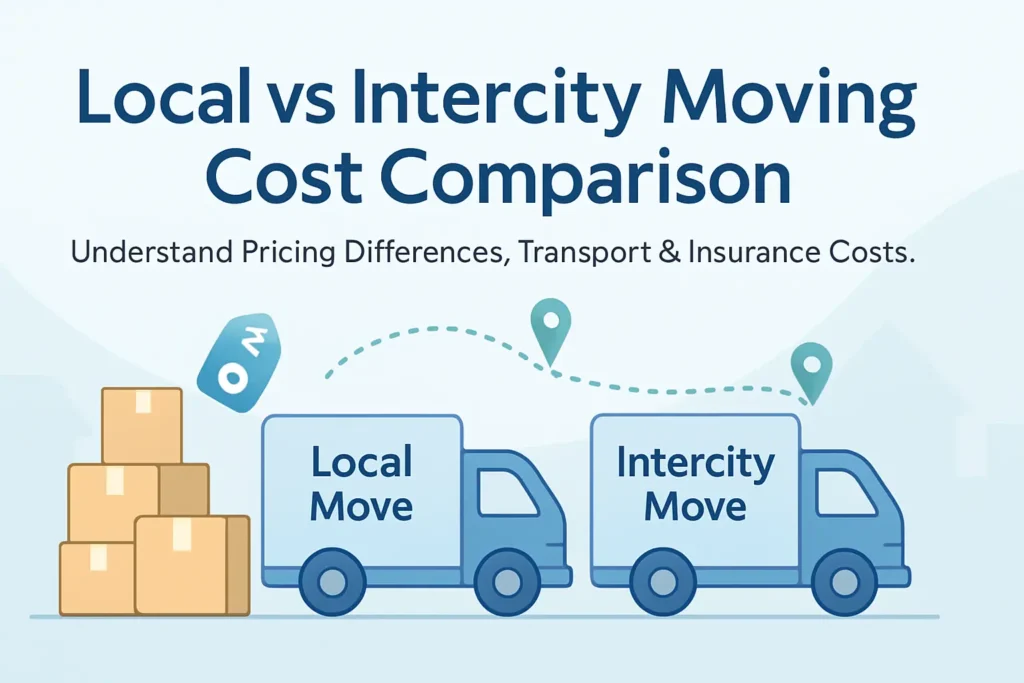
Planning a relocation often starts with one crucial question: how much will it cost? Whether you are moving within the same city or shifting your household to another city, the pricing structure can differ significantly. Understanding the local shifting cost vs intercity moving cost helps you budget better, avoid hidden charges, and interpret moving cost calculator estimates accurately. “If you are comparing service providers, you can explore verified relocation options through Packers And Movers, how transport and insurance affect pricing, and why intercity packers movers charges are usually higher.
If you are comparing service providers, you can explore verified packers and movers services to understand available options before requesting quotes.
Understanding the Basics of Local and Intercity Moving
What Is Considered a Local Move?
A local move generally refers to household shifting within the same city or nearby areas, usually completed within a single day. Because travel distance is limited, the cost structure focuses more on manpower, vehicle size, and time spent rather than per-kilometre charges.
Key characteristics of local moves:
- Short distance, usually within city limits
- Same-day pickup and delivery
- Lower transport and fuel costs
- Insurance often optional due to limited transit risk
Common cost components in local shifting:
- Loading and unloading labour
- Packing materials (basic protection)
- Local transport vehicle charges
Indicative local shifting cost range (India):
Home Size | Typical Cost Range |
1 BHK | ₹3,000 – ₹9,000 |
2 BHK | ₹4,500 – ₹13,000 |
3 BHK | ₹6,000 – ₹18,000 |
What Qualifies as an Intercity Move?
An intercity move involves shifting household goods from one city to another, often across districts or states. These moves require detailed logistics planning, longer transit times, and stronger packing standards, which directly impacts overall pricing.
Key characteristics of intercity moves:
- Long-distance transport (hundreds of kilometres)
- Multi-day transit in most cases
- Higher fuel, toll, and driver costs
- Insurance strongly recommended due to transit risk
Major cost drivers in intercity shifting:
- Distance travelled (per-km basis)
- Volume or weight of goods
- Packing quality and materials
- Transport type (shared vs dedicated truck)
Indicative intercity packers movers charges:
Home Size | Approximate Cost Range |
1 BHK | ₹8,500 – ₹28,500 |
2 BHK | ₹12,000 – ₹35,000 |
3 BHK | ₹15,000 – ₹45,000 |
4 BHK | ₹20,000 – ₹60,000+ |
Local vs Intercity Moves: Basic Cost Logic Comparison
Factor | Local Move | Intercity Move |
Distance impact | Minimal | Primary cost factor |
Pricing method | Time / vehicle based | Distance + volume based |
Packing standard | Basic | Multi-layer, reinforced |
Insurance | Optional | Highly recommended |
Overall cost | Lower | Significantly higher |
For a detailed breakdown of pricing components, refer to our complete packers and movers cost guide that explains charges by house size, distance, and service type.
Local Shifting Cost vs Intercity Moving Cost – Core Differences
Understanding the cost gap between local and intercity relocation starts with how movers structure their pricing. While both services may appear similar on the surface, the underlying cost logic is very different. Local shifting focuses on time, labour, and vehicle usage within a limited radius, whereas intercity packers movers charges are driven by distance, logistics complexity, and transit risk. This section breaks down those differences clearly, with factual ranges and comparison tables.
Average Cost Range for Local Shifting
Local shifting costs are generally lower and more flexible because the move is completed within a short time frame and limited distance. Movers often quote a consolidated price that includes packing, loading, transport, and unloading.
Typical factors affecting local shifting cost:
- Size of the house (BHK)
- Number of labourers required
- Size of the transport vehicle
- Time taken for loading and unloading
- Floor level and lift availability
Indicative local shifting cost range (India):
Home Size | Average Local Cost Range |
1 BHK | ₹3,000 – ₹9,000 |
2 BHK | ₹4,500 – ₹13,000 |
3 BHK | ₹6,000 – ₹18,000 |
4 BHK | ₹8,000 – ₹25,000+ |
Why local shifting is cheaper:
- Short travel distance reduces fuel cost
- Same-day delivery avoids driver stay expenses
- Basic packing materials are often sufficient
Average Intercity Packers Movers Charges
Intercity shifting costs are significantly higher because pricing is calculated using multiple variables instead of a flat local rate. Movers usually estimate charges after evaluating inventory volume and travel distance.
Major elements included in intercity charges:
- Per-kilometre transport cost
- Packing material and labour
- Toll charges and fuel
- Driver allowance and route expenses
- Insurance (optional but recommended)
Indicative intercity packers movers charges:
Home Size | Cost Range (Long Distance) |
1 BHK | ₹8,500 – ₹28,500 |
2 BHK | ₹12,000 – ₹35,000 |
3 BHK | ₹15,000 – ₹45,000 |
4 BHK | ₹20,000 – ₹60,000+ |
Why intercity moves cost more:
- Long-distance transport increases fuel and toll expenses
- Multi-day transit requires stronger packing
- Higher risk exposure during transportation
For example, intercity relocation costs from tech hubs like Cochin may vary depending on demand and distance. You can check verified packers and movers in Cochin for location-specific estimates.
Pricing Logic Differences Between Local and Intercity Moves
The biggest reason for the gap in local shifting cost vs intercity moving cost lies in how packers and movers calculate prices. Local moves follow a simpler, time-and-resource-based pricing model, while intercity packers movers charges are built on distance, volume, and logistics complexity. This section explains those pricing mechanics clearly so readers understand why quotes differ.
How Local Shifting Costs Are Calculated
Local shifting charges are usually service-driven rather than distance-driven. Since the vehicle travels within city limits, movers focus on how much time, manpower, and equipment are required to complete the move.
Primary pricing factors for local shifting:
- Number of labourers required
- Size and type of transport vehicle
- Time taken for packing, loading, and unloading
- Floor level and lift availability
- Basic packing material usage
Typical local pricing logic includes:
- Flat rate for a specific BHK size
- Hourly or half-day billing in some cities
- Additional charges only if time or manpower increases
Example cost components in a local move:
Cost Component | Pricing Basis |
Labour charges | Per person / per shift |
Vehicle cost | Based on truck size |
Packing material | Fixed or item-based |
Loading & unloading | Included in base quote |
How Intercity Packers Movers Charges Are Calculated
Intercity pricing follows a multi-variable cost model, where distance and volume are the dominant factors. Movers often conduct a pre-move survey to estimate the total load before sharing a quote.
Key elements used in intercity cost calculation:
- Total distance between origin and destination
- Weight or volume of household goods
- Type of transport (shared or dedicated truck)
- Packing quality and materials
- Insurance and transit risk coverage
Common intercity pricing methods:
- Cost per kilometre × estimated load
- Slab-based pricing for distance ranges
- Separate line items for packing, transport, and insurance
Example intercity pricing components:
Cost Component | Pricing Logic |
Transport charges | Per km or route-based |
Packing charges | Based on volume |
Labour | Fixed for packing & loading |
Insurance | Percentage of declared value |
Role of Minimum Billing and Base Charges
Minimum billing plays a larger role in intercity relocation than in local shifting.
For local moves:
- Minimum charges are lower
- Flexible adjustments based on actual time or labour used
For intercity moves:
- A base transport cost applies even for small inventories
- Minimum distance slabs often apply (e.g., first 300–500 km)
- Costs remain high even if goods volume is limited
Why base charges matter more in intercity shifting:
- Truck deployment and driver allocation are fixed costs
- Fuel, tolls, and permits apply regardless of load size
Transport Cost Impact – Distance, Vehicle Type & Fuel
Transport charges form the largest cost component, especially when comparing local shifting cost vs intercity relocation. While local moves involve short travel within city limits, intercity packers movers charges increase sharply due to distance, fuel consumption, tolls, and vehicle deployment. This section explains how transport-related factors directly influence the final moving bill.
Transport Cost in Local Moves
In local shifting, transport cost is controlled and predictable because the vehicle travels a limited distance and usually completes the move in a single trip.
How transport cost is calculated in local moves:
- Based on truck size (mini truck, pickup, tempo, etc.)
- Short-distance fuel consumption
- Same-day driver charges (no overnight allowance)
Common vehicle types used for local shifting:
- Small pickup / Tata Ace for 1 BHK
- 14–17 ft trucks for 2–3 BHK
- Larger trucks for villas or 4 BHK homes
Why transport cost stays low in local moves:
- No highway tolls or interstate permits
- Minimal fuel usage
- No driver accommodation or route planning cost
Transport Cost in Intercity Moves
For intercity relocation, transport cost becomes the dominant pricing factor. Movers calculate charges primarily on the distance travelled and the type of vehicle assigned.
Key transport cost drivers in intercity shifting:
- Total kilometres between cities
- Fuel consumption for long-haul travel
- Highway tolls and state entry taxes
- Driver allowance and transit days
Vehicle options used in intercity transport:
- Shared truck (cost-efficient, longer delivery time)
- Dedicated truck (higher cost, faster and safer delivery)
Indicative per-km transport logic (varies by city and route):
- Local transport: charged as part of package or low per-km rate
- Intercity transport: charged on per-km or distance slab basis
Dedicated Truck vs Shared Truck – Cost Impact
Choosing the right transport mode significantly affects intercity packers movers charges.
Transport Type | Cost Impact | Delivery Speed | Best For |
Shared truck | Lower | Slower | Small loads, flexible timelines |
Dedicated truck | Higher | Faster | Full households, urgent delivery |
Why shared transport is cheaper:
- Fuel and toll costs are split between multiple customers
- Truck space is optimised
Why dedicated trucks cost more:
- Entire vehicle reserved for one customer
- Direct route without load transfers
Fuel, Tolls & Route Expenses – Hidden Transport Add-ons
Transport costs in intercity moves often increase due to route-related expenses that do not apply to local shifting.
Additional transport-related charges may include:
- Highway toll charges
- Fuel price fluctuations
- State or regional entry fees
- Route diversions or longer detours
These costs are either included in the transport quote or added as separate line items in intercity estimates.
Insurance Cost Differences in Local vs Intercity Shifting
Insurance plays a very different role when comparing local shifting cost vs intercity moving cost. In short-distance moves, the risk exposure is limited, whereas in long-distance relocation, transit duration and handling points increase the possibility of damage. This is why intercity packers movers charges often rise noticeably when insurance is included.
Before opting for insurance, it’s important to understand exactly what transit insurance covers during house shifting and how claims are handled.
Is Insurance Optional for Local Shifting?
For local moves, insurance is usually optional and many customers choose to skip it to reduce costs. Since goods are transported over short distances and delivered the same day, the perceived risk remains low.
Why insurance is often skipped in local moves:
- Minimal transit time
- Fewer handling stages
- Direct pickup and delivery
How insurance affects local shifting cost:
- Adds a small percentage to the total bill
- Often calculated on declared value of goods
- Many movers offer it only on request
Common practice in local shifting:
- Basic liability may be included
- Full transit insurance is optional
Insurance as a Necessity in Intercity Moves
In intercity relocation, insurance is strongly recommended due to longer travel distance and higher handling risk. Goods may be loaded, unloaded, or stored temporarily during transit, increasing exposure to damage or loss.
Why insurance is important for intercity shifting:
- Long-haul transport across highways
- Multi-day transit duration
- Higher value goods moved together
Impact of insurance on intercity packers movers charges:
- Insurance cost is usually calculated as a percentage of declared value
- Adds a noticeable amount to the final quote
- Protects against transit damage or loss
How Insurance Percentage Impacts Total Cost
Insurance charges vary based on the declared value of household goods, not on distance or house size alone.
Typical insurance cost logic used by movers:
- Declared value × insurance percentage
- Higher value items increase insurance premium
- Separate GST may apply on insurance charges
Example impact on total cost:
Move Type | Declared Value | Insurance Impact |
Local move | Lower | Minor increase |
Intercity move | Higher | Significant increase |
Insurance Cost Comparison – Local vs Intercity
Insurance Aspect | Local Shifting | Intercity Shifting |
Requirement | Optional | Highly recommended |
Risk exposure | Low | High |
Cost impact | Minimal | Noticeable |
Transit duration | Same day | Multiple days |
Overall value | Situational | Essential |
Packing Quality & Material Cost Comparison
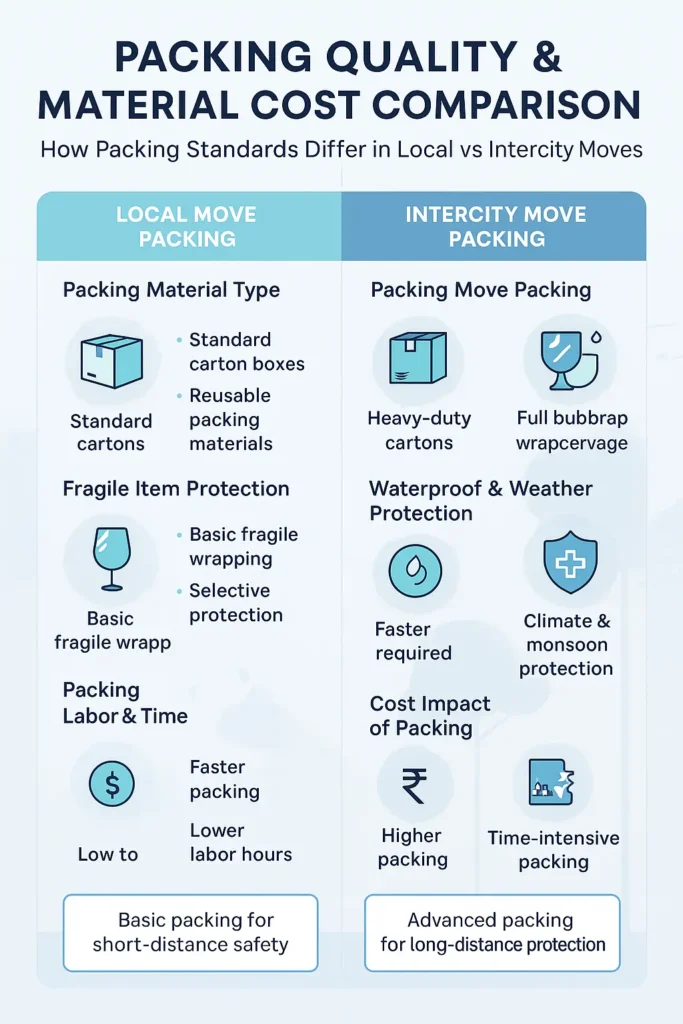
Packing standards play a major role in explaining the difference between local shifting cost vs intercity moving cost. While local moves usually rely on basic protection, intercity relocation requires stronger, multi-layer packing to withstand long-distance transit. This directly increases intercity packers movers charges, even before transport and insurance are added.
Packing Standards for Local Moves
Local shifting generally involves basic to moderate packing, as goods are transported for a short distance and delivered the same day.
Common packing practices in local moves:
- Single-layer carton boxes for household items
- Bubble wrap for fragile items only
- Stretch film for furniture and appliances
- Reusable packing materials in many cases
Why packing costs stay lower in local shifting:
- Limited movement and vibration during transport
- No exposure to long transit hours or weather changes
- Less need for waterproof or reinforced packing
Typical packing cost impact in local shifting:
- Packing charges are often bundled into the overall quote
- Cost increases mainly with house size and fragile items
Packing Standards for Intercity Moves
Intercity relocation requires high-quality, reinforced packing to protect goods during long-distance travel. This significantly affects the final moving cost.
Standard packing methods used for intercity shifting:
- Multi-layer carton boxes
- Bubble wrap and foam sheets for fragile items
- Corrugated sheets for furniture
- Waterproof wrapping for monsoon or long transit
- Special packing for electronics and glass items
Why packing costs are higher in intercity moves:
- Longer transit duration increases damage risk
- Multiple handling points during loading and unloading
- Exposure to road vibration, stacking pressure, and climate
Hidden & Additional Charges – Local vs Intercity
Hidden or additional charges often explain the difference between the estimated and final bill when comparing local shifting cost vs intercity relocation charges. These costs are not always visible in initial quotes or calculator estimates, especially in long-distance moves. Understanding these charges helps you evaluate intercity packers movers charges more accurately and avoid last-minute surprises.
Common Extra Charges in Local Shifting
Local shifting generally involves fewer add-on charges, but certain conditions can still increase the final cost.
Typical additional charges in local moves:
- Extra labour due to heavy items or access issues
- Staircase charges when lifts are unavailable
- Long parking distance from pickup or delivery point
- Extended working hours beyond the estimated time
Why local extra charges are usually limited:
- Short travel distance
- Same-day delivery
- Fewer logistical uncertainties
Common Extra Charges in Intercity Moves
Intercity relocation involves more variables, making additional charges more common and impactful.
Typical extra charges in intercity shifting:
- Storage or warehousing charges due to transit delays
- Waiting or detention charges if delivery is delayed
- Route deviation costs due to road conditions
- Higher packing upgrades for fragile or high-value items
Why intercity moves face more add-ons:
- Multi-day transit increases uncertainty
- Long-distance logistics require contingency planning
- Goods may pass through multiple handling stages
GST and Tax Impact on Moving Costs
Taxes are a standard additional cost applied to both local and intercity moves.
Key GST-related points:
- GST applies on transportation and full-service moving
- GST is charged separately on insurance if opted
- Tax rates increase the final payable amount
Impact on final cost:
- Local shifting sees a smaller absolute tax impact
- Intercity shifting sees a higher tax amount due to larger base charges
Hidden Charges – Local vs Intercity
Charge Type | Local Move | Intercity Move |
Extra labour | Occasional | Common |
Stair / lift charges | Possible | Possible |
Storage charges | Rare | Possible |
Waiting charges | Minimal | More frequent |
GST impact | Lower | Higher |
Final Comparison Summary – Local vs Intercity Moving Costs
Choosing between a local and intercity move is not only about comparing prices but understanding what drives those costs and what value you receive. The comparison between local shifting cost vs intercity relocation clearly shows that distance, logistics complexity, transport risk, and service scope are the main reasons behind the pricing gap.
Quick Decision Guide – Local vs Intercity Moving
Use this comparison to decide which option fits your situation best:
Decision Factor | Local Moving | Intercity Moving |
Distance | Within the same city | City-to-city / state-to-state |
Cost range | Lower | Higher |
Pricing logic | Time + manpower | Distance + volume |
Transport impact | Limited | Major cost component |
Packing standard | Basic | Reinforced & multi-layer |
Insurance role | Optional | Strongly recommended |
Cost predictability | High | Moderate |
Key Takeaways for Budget Planning
- Local shifting cost is influenced mainly by labour, vehicle size, and time taken.
- Intercity packers movers charges increase due to long-distance transport, fuel, tolls, packing quality, and insurance.
- Transport and packing form the largest share of intercity moving costs, while labour dominates local shifting expenses.
- Moving cost calculators provide estimates, not final bills—especially for intercity relocation.
- Hidden charges and taxes have a greater impact on intercity moves than on local ones.
Final Insight
- If you are relocating within the same city, local shifting offers better cost control and predictability.
- For long-distance relocation, higher costs are justified by logistics, safety, and risk coverage.
- The smartest approach is to compare quotes, understand inclusions, and align the service type with your relocation needs rather than choosing purely on price.
Planning a move and confused about costs? 6 Packers And Movers helps you compare verified local and intercity relocation services with transparent pricing. Whether you’re estimating local shifting charges or evaluating intercity packers movers costs, you can explore reliable options, understand inclusions, and request quotes that match your budget and needs. Avoid surprises, plan smarter, and make your relocation smooth with trusted moving professionals listed on one platform.
For long-distance relocation, higher costs are justified by logistics, safety, and risk coverage. The smartest approach is to compare quotes and understand inclusions before booking. Use this guide on choosing the best packers and movers to avoid hidden charges and unreliable providers.