
Storage vs Direct Move: Which House Shifting Option Is Better for You?
Storage-based relocation is ideal when home possession is delayed or renovations are ongoing, while a direct move is better when dates are confirmed and budget control is a priority. The right choice depends on timeline certainty, inventory size, and relocation distance.
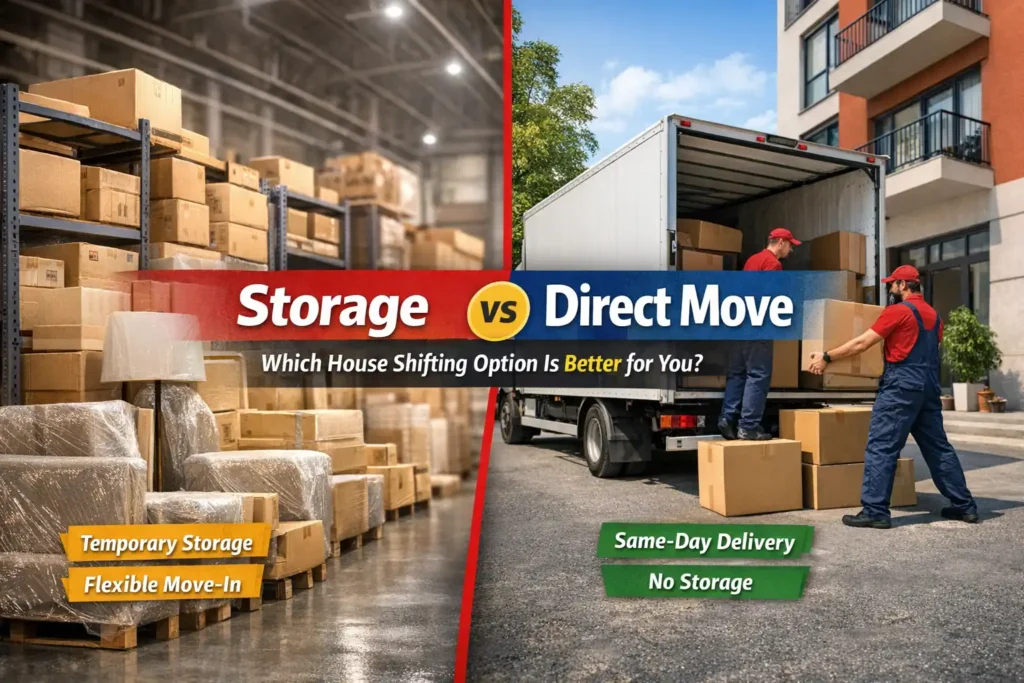
Relocating a home in India often comes down to one critical decision: should your household goods be stored temporarily in a warehouse, or should they move directly from your old home to the new one? This choice affects your moving timeline, total cost, safety of belongings, and overall stress level. Many Indian households face gaps between vacating a property and getting possession of the next one, while others prefer a single, seamless relocation. In this guide, we compare storage-based relocation and direct house shifting in detail to help you choose the right approach for your situation. If you are planning your move and evaluating professional help, you can explore professional packers and movers services that support both storage-based relocation and direct house shifting across India.
Key Differences Between Storage-Based Move and Direct Move
Choosing between storage and a direct move is not just about preference—it depends on time availability, budget control, handling risk, and flexibility needs. Below is a clear comparison of how both relocation methods differ in real-world Indian moving scenarios.
Core Comparison
Factor | Storage-Based Move | Direct Move (No Storage) |
Timeline | Multi-stage process with storage period in between | Single pickup and direct delivery |
Cost Structure | Monthly storage + additional handling charges | One-time moving and transit cost |
Handling Frequency | Goods handled multiple times | Goods handled once |
Risk Exposure | Higher due to re-loading and stacking | Lower cumulative handling risk |
Flexibility | High flexibility for delayed possession | Low flexibility if dates change |
Convenience | Easier when timelines don’t match | Simpler when dates are confirmed |
The cost and complexity of both options depend heavily on your inventory size, distance, and services chosen. Understanding how movers calculate charges helps avoid surprises.
Timeline Differences
A storage-based move typically follows this flow:
Pickup → Warehouse unloading → Storage period → Re-loading → Final delivery.
This adds days or even months to the relocation timeline but provides a buffer when possession dates don’t align.
A direct move, on the other hand, involves pickup from the old home and delivery to the new home in one continuous operation. This is faster and efficient only when the new house is ready for immediate occupancy.
Cost Structure Differences
Storage-based relocation involves recurring monthly charges based on the volume of goods and storage duration. In India, practical household storage costs usually run into thousands of rupees per month for apartment-sized inventories, apart from pickup and re-delivery charges.
Direct moves usually have a one-time cost, covering packing, loading, transportation, and unloading. When no storage is required, this option often turns out to be more economical, especially for local and short-distance moves.
Handling Frequency & Risk Exposure
Storage-based moves increase handling frequency:
- Loading at origin
- Unloading at warehouse
- Re-loading for final delivery
Each handling stage increases the chance of scratches, breakage, or inventory mismatch, especially if storage duration is long.
Direct moves reduce handling to:
- One loading
- One unloading
This significantly lowers cumulative damage risk, though transit risks still exist during transportation.
Flexibility vs Convenience
Storage-based moves offer flexibility, allowing:
- Date changes
- Gradual move-ins
- Renovation-friendly shifting
However, they require more coordination, including inventory checks and delivery scheduling.
Direct moves offer convenience, with:
- Fewer coordination steps
- Faster completion
- Less administrative effort
But they demand strict date alignment, leaving little room for last-minute changes.
Cost Comparison – Storage & Warehousing vs Direct Move
Cost is one of the most decisive factors for Indian households choosing between storage-based relocation and a direct move. While storage offers flexibility, it also introduces recurring expenses and extra handling charges. A direct move usually keeps costs simpler and more predictable—provided timelines align. Below is a clear, India-focused breakdown.
Storage Charges (Short-Term vs Long-Term)
In India, storage pricing is generally based on volume (house size or cubic feet) and duration.
- Short-term storage (few days to a couple of months) is commonly used during possession delays or renovations and is billed monthly.
- Long-term storage (several months or more) may offer lower per-month rates but results in higher overall cost due to duration.
Typical residential storage for apartment-sized households is charged per month, with costs increasing for:
- Larger inventories (2BHK / 3BHK)
- Climate-controlled or secured warehouses
Handling, Loading, Unloading & Re-Loading Costs
Storage-based moves are multi-stage, which adds service components beyond monthly rent:
- Packing and pickup from the old home
- Unloading and stacking at the warehouse
- Storage handling and inventory management
- Re-loading for final delivery
- Transportation and unloading at the new home
Each of these stages may be charged separately, especially when storage and delivery happen weeks or months apart.
Direct moves usually include:
- Packing
- One-time loading
- Transportation
- One-time unloading
This consolidated process helps keep costs lower and easier to estimate upfront.
Cost Comparison
Cost Component | Storage-Based Move | Direct Move |
Packing | Included or charged once | Included |
Transportation | Often split (to warehouse + final delivery) | One-time |
Storage Rent | Monthly recurring cost | Not applicable |
Re-loading Charges | Applicable | Not applicable |
Total Cost Trend | Increases with time | Fixed & predictable |
When Storage Increases Total Relocation Cost
Storage-based relocation tends to become expensive when:
- Storage duration extends beyond a few weeks
- Re-loading and re-delivery charges accumulate
- Premium or climate-controlled storage is chosen
- Inventory volume is large
In such cases, the combined cost of storage + multiple handling can exceed what a single direct move would have cost.
When a Direct Move Is More Cost-Effective
A direct move usually saves money when:
- The new home is ready for immediate occupancy
- The move is local or short-distance
- Household inventory is limited
- Budget control is a priority
Since there are no recurring charges, the total expense remains confined to one invoice, making budgeting easier for families and working professionals.
Safety & Risk Factors – Which Option Protects Your Belongings Better?
Safety of household goods is a top concern during relocation. In Indian moving conditions—varying climate, long transit routes, and multiple handling stages—the choice between storage-based relocation and a direct move directly affects the risk profile of your belongings.
Regardless of whether you choose storage or a direct move, understanding what transit insurance covers during house shifting is essential to protect against damage or loss.
Multiple Handling Risks in Storage-Based Moves
Storage-based relocation involves additional physical handling, which increases exposure to damage. Typical handling stages include:
- Loading from the old home
- Unloading and stacking inside the warehouse
- Re-loading for final delivery
- Unloading at the new home
Each additional touchpoint raises the possibility of:
- Scratches and dents on furniture
- Breakage of fragile items
- Inventory mismatches during long storage periods
This risk becomes more significant when storage duration is extended or when goods are moved in and out of storage multiple times.
Environmental Risks in Storage (Moisture, Pests, Stacking)
Indian climatic conditions make warehouse environment control a critical safety factor.
Potential storage-related risks include:
- Moisture and humidity, which can affect wooden furniture, mattresses, and electronics
- Pest exposure, especially in non-climate-controlled facilities
- Stacking pressure, where heavy cartons placed improperly can damage fragile goods
Climate-controlled or professionally managed warehouses reduce these risks, but they usually come at a higher cost and are more common in metro cities.
Transit-Only Risk in Direct Moves
In a direct move, goods are handled fewer times, but all risk is concentrated during transportation.
Common transit-related risks include:
- Road vibrations and shocks
- Accidental drops during loading or unloading
- Theft or damage during long-distance transport
However, since goods are loaded once and unloaded once, the cumulative risk from handling is lower compared to storage-based relocation.
Role of Packing Quality & Inventory Management
Regardless of the move type, packing standards and documentation play a crucial role in reducing loss and disputes.
Effective safety practices include:
- Multi-layer packing for fragile and electronic items
- Clear carton labeling and room-wise segregation
- Detailed inventory lists prepared at pickup
- Condition notes for high-value items
For storage-based moves, proper inventory tracking becomes even more important due to longer holding periods and re-delivery scheduling.
Flexibility & Convenience Comparison
Flexibility and convenience often become the deciding factors when cost and safety appear comparable. In Indian relocations—where possession delays, renovation overruns, and travel schedules are common—the ability to adjust timelines without disruption plays a major role in choosing between a storage-based move and a direct move.
Flexibility in Move-In Dates
A storage-based move allows households to decouple the move-out date from the move-in date. This flexibility is especially useful when:
- New home possession is delayed
- Rental agreements end before the new house is ready
- Construction or interior work is still in progress
With storage, goods can remain safely packed and stored until the home is ready for delivery.
A direct move requires both dates to align closely. Any delay in possession can result in last-minute rescheduling or additional charges.
Convenience for Families, Senior Citizens & Working Professionals
Storage-based relocation offers convenience for:
- Families who want to move essentials first and non-essentials later
- Senior citizens who prefer a phased and less rushed move
- Working professionals who cannot supervise full unpacking immediately
It enables a staggered setup, reducing physical strain and time pressure.
Direct relocation is more convenient when:
- All household members can be present on moving day
- Immediate occupancy is possible
- A quick, one-day shifting process is preferred
Stress Levels & Coordination Effort
Storage-based moves reduce time pressure but increase coordination effort. Additional steps include:
- Monitoring warehouse inventory
- Scheduling re-delivery
- Coordinating access and delivery dates
Direct moves involve:
- Fewer administrative steps
- Shorter relocation window
- Higher stress if timelines change unexpectedly
The stress trade-off is often between timeline flexibility (storage) and operational simplicity (direct move).
When Should You Choose Storage & Warehousing?
Storage and warehousing are not optional add-ons—they become practical necessities in many Indian relocation scenarios. This option works best when timing, space, or logistics do not align with a direct move. Below are the most common situations where storage-based relocation is the smarter choice.
Delayed Home Possession
One of the most frequent reasons Indian households opt for storage is delayed possession of the new home. This can happen due to:
- Construction delays
- Documentation or handover issues
- Builder-related extensions
In such cases, storage provides a secure holding space for packed household goods until the home is legally and physically ready.
Temporary Relocation Needs
Storage is ideal when relocation is temporary, such as:
- Short-term job assignments
- Medical or family-related relocations
- Trial stays in a new city before final housing
Instead of moving goods multiple times, storing them once reduces repeated handling and transportation.
Home Renovation or Reconstruction
During major renovations or rebuilding:
- Furniture and appliances can get damaged by dust, paint, or construction work
- Space constraints make it difficult to store items safely inside the home
Using professional warehousing keeps goods protected and allows renovation work to proceed without obstruction.
International or Intercity Transit Gaps
For international relocations or long-distance intercity moves:
- Travel schedules may not match cargo arrival
- Customs clearance or documentation may cause delays
- Families may relocate first and receive goods later
Storage bridges these gaps and ensures goods are delivered only when the destination is ready.
Section Takeaways (When Storage Makes Sense)
- Ideal for possession delays and renovations
- Reduces repeated moves in temporary relocations
- Essential for international and long-distance transitions
- Offers breathing room when timelines are uncertain
When Is a Direct Move the Better Choice?
A direct move—where household goods are transported straight from the old home to the new one without interim storage—is often the most efficient and cost-controlled option in Indian relocations. This approach works best when timing, distance, and inventory size are well aligned.
Confirmed Move-In Date
A direct move is ideal when:
- The new home is fully ready for possession
- Keys, utilities, and access are confirmed
- There is no gap between vacating the old home and occupying the new one
With confirmed dates, a direct move eliminates the need for temporary storage and avoids additional coordination.
Short-Distance Relocation
Direct moves are particularly suitable for:
- Local or intra-city shifting
- Relocations within nearby localities or suburbs
Shorter distances reduce transit time and make same-day delivery possible, which minimizes disruption to daily routines.
Budget-Sensitive Moves
For households prioritizing cost control:
- Direct moves avoid monthly storage rent
- There are no re-loading or re-delivery charges
- The cost remains limited to one invoice
This makes direct relocation the preferred option for budget-conscious families, tenants, and first-time movers.
Minimal Household Items
If the inventory is limited—such as:
- Single-room or studio setups
- Partial household moves
- Essential items only
A direct move is more practical than paying for storage space that exceeds actual needs.
Storage vs Direct Move for Different Relocation Types
The suitability of storage-based relocation or a direct move varies depending on the type of relocation. Distance, coordination complexity, and timing gaps play a major role in determining which option works best in Indian moving scenarios.
Local Shifting
For local or intra-city moves, a direct move is usually preferred because:
- Travel distance is short
- Same-day pickup and delivery are feasible
- Possession dates are often aligned
Storage is generally used only when:
- Renovation work is ongoing
- Temporary accommodation is required
- The move is split across multiple days
Intercity Relocation
In intercity moves, both options are commonly used.
- Direct move works well when the new city accommodation is ready and delivery can be scheduled immediately.
- Storage-based move is preferred when:
- Families travel ahead of goods
- Rental or owned property possession is delayed
- The destination city requires phased move-in
Intercity distances increase transit time, making storage a practical buffer when timelines do not align.
International Relocation
For international moves from India, storage is frequently used due to:
- Customs clearance timelines
- Visa or travel scheduling differences
- Overseas housing readiness
Goods may be stored temporarily in India or at the destination until delivery is authorized. Direct delivery is possible only when customs clearance and housing access are perfectly synchronized.
Corporate Relocation
In corporate or employer-sponsored relocations:
- Storage is often provided to accommodate reporting dates, onboarding schedules, or temporary housing.
- Direct moves are used when relocation is immediate and housing is pre-arranged.
Corporate moves tend to favor flexibility and staging, making storage a common component.
Pros and Cons – Storage-Based Move vs Direct Move
Both relocation methods come with clear advantages and limitations. Understanding these trade-offs helps Indian households choose the option that aligns best with their timeline certainty, budget, and risk tolerance.
Advantages of Using Storage & Warehousing
- Allows relocation even when new home possession is delayed
- Enables phased move-in, reducing immediate setup pressure
- Protects goods during renovation or reconstruction work
- Useful for international and long-distance relocations
- Helps declutter and organize belongings before final delivery
Disadvantages of Using Storage & Warehousing
- Adds recurring monthly storage charges
- Involves multiple handling stages, increasing damage risk
- Requires additional coordination for inventory and re-delivery
- May need climate-controlled storage for sensitive items
- Total relocation cost increases with storage duration
Advantages of Direct Move (No Storage)
- Lower overall cost when timelines align
- Fewer handling stages reduce cumulative damage risk
- Faster relocation with same-day or next-day delivery
- Simple logistics with a single pickup and drop
- Easier budgeting with one consolidated invoice
Limitations of Direct Move
- Requires confirmed possession dates
- Little flexibility for last-minute delays
- Not suitable during home renovations
- Can be stressful if timelines shift unexpectedly
- Less practical for staggered or phased relocations
Which Option Is Better for You?
Choosing between storage & warehousing and a direct move becomes easier when you evaluate your relocation against a few practical criteria. This checklist is designed for Indian households to make a clear, situation-based decision rather than relying on assumptions.
If you are still unsure, this step-by-step guide on choosing the best packers and movers can help you evaluate service quality, pricing transparency, and reliability.
Decision Checklist: Answer These Before Finalising Your Move
- Is your new home ready for immediate possession?
- Yes → A direct move is usually suitable
- No / Unsure → Storage & warehousing is the safer option
- How certain is your moving timeline?
- Fixed and confirmed → Direct move works well
- Flexible or unpredictable → Storage provides a buffer
- What is your relocation budget priority?
- Strict budget control → Direct move avoids recurring costs
- Willing to pay for flexibility → Storage offers convenience
- How large is your household inventory?
- Minimal or partial household goods → Direct move is practical
- Full household or bulky items → Storage may simplify phased delivery
- Are renovations or repairs planned at the new home?
- Yes → Storage protects goods from dust and damage
- No → Direct move is feasible
- How comfortable are you with coordination and follow-ups?
- Prefer minimal coordination → Direct move
- Okay with scheduling re-delivery and inventory tracking → Storage
Final Verdict – Storage & Warehousing vs Direct Move
There is no universally “better” option between using storage and opting for a direct move—the right choice depends entirely on your relocation timeline, budget flexibility, and home readiness.
A storage & warehousing–based move is the practical solution when:
- Your new home possession is delayed or uncertain
- Renovation or reconstruction work is ongoing
- You are relocating temporarily or internationally
- You need flexibility to receive goods in phases
Storage provides breathing room and reduces time pressure, but it comes at the cost of recurring charges and additional handling.
A direct move without storage is the smarter choice when:
- Your move-in date is confirmed
- The relocation is local or short-distance
- Budget control is a priority
- You want faster completion with fewer coordination steps
Direct moves are simpler, quicker, and usually more cost-effective when timelines align—but they leave little room for unexpected delays.
Final Recommendation (Expert Perspective)
- Choose storage when flexibility and timeline uncertainty matter more than cost
- Choose a direct move when speed, simplicity, and cost control are your priorities
- Always confirm possession dates, inventory size, and total cost impact before finalising
Regardless of the option you select, proper packing, clear inventory documentation, and professional coordination remain essential for a smooth relocation experience.
Planning Your Move?
If you’re relocating in a metro city like Bangalore, choosing experienced packers and movers in Jalandhar can make storage coordination or direct delivery much smoother.
If you’re unsure which option fits your situation—or need professionals who can support both storage-based relocation and direct house shifting—connect with experienced Packers and Movers to evaluate your move and plan it with confidence.
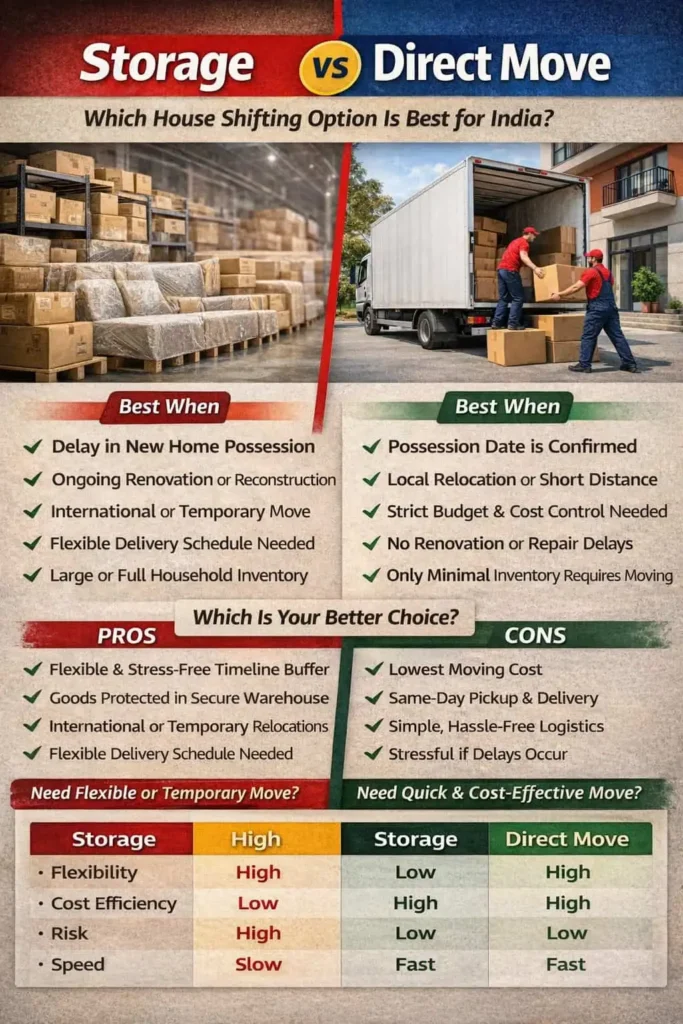
Confused Between Storage or Direct Move? Get Expert Help Today
Every relocation is different. Choosing the wrong moving method can lead to unnecessary costs, delays, or damage. Instead of guessing, get professional guidance tailored to your timeline, budget, and home readiness.
Planning a move with or without storage?
Connect with Verified Packers and Movers to:
- Assess whether you really need storage
- Compare total relocation costs upfront
- Schedule pickup and delivery dates accurately
- Avoid re-handling risks and last-minute surprises
Make your relocation stress-free—get a moving plan that fits your situation, not assumptions.