
Full-Service Door-to-Door Move vs Partial Moving Services: Which Option Is Right for You?
Full-service door-to-door moving includes packing, loading, transport, and unloading handled entirely by professionals, offering lower risk and higher convenience. Partial moving services cover only selected tasks like packing-only or loading-only, reducing upfront cost but increasing customer effort, coordination, and liability.
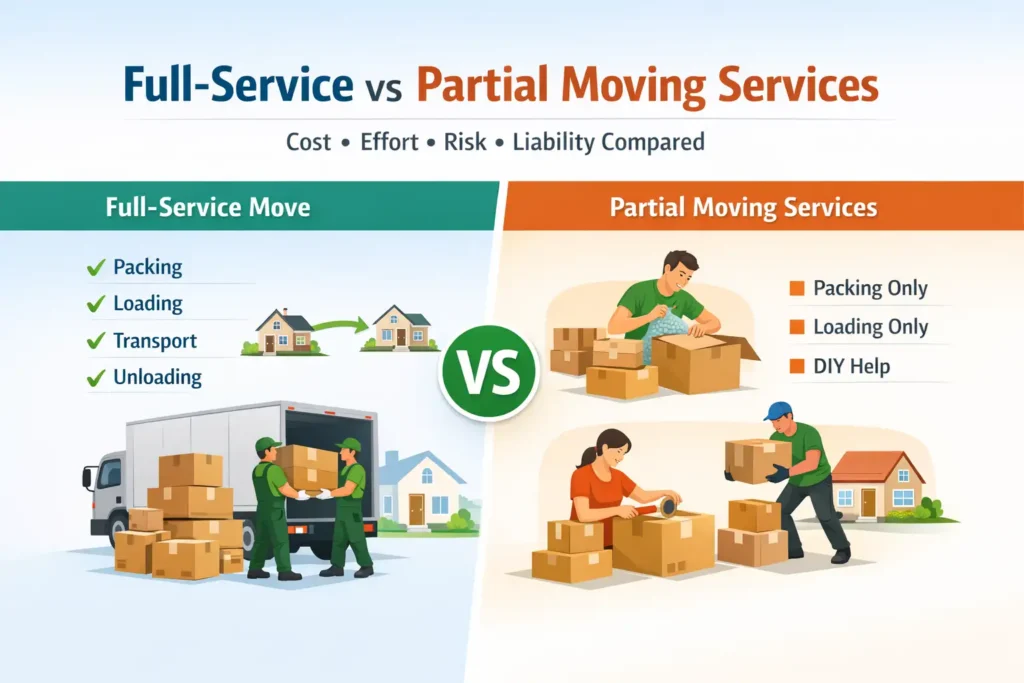
Choosing between a full-service door-to-door move and partial moving services is one of the most important decisions during house shifting in India. The type of service you select directly affects your moving cost, time involvement, physical effort, risk of damage, and overall stress level. Many people assume that Hiring packers and movers always means a complete end-to-end service, but in reality, moving companies offer multiple service models—ranging from complete professional handling to limited, task-specific assistance.
A full-service door-to-door move typically covers everything from packing your household items at the origin to unloading them at the destination, making it ideal for long-distance relocations, families, and time-constrained professionals. To make the process even smoother, following expert Moving Tips can help you stay organized and avoid common relocation mistakes. On the other hand, partial services—such as packing-only, loading-only, or customer-managed packing with professional transport—are often chosen by people looking to reduce costs or maintain control over certain parts of the move.
However, the difference between these options goes far beyond price. Factors such as liability for damage, insurance coverage, coordination responsibility, and safety risks vary significantly depending on how much of the move is handled by professionals versus the customer. Understanding these differences clearly helps you avoid common relocation mistakes, unexpected expenses, and disputes during or after the move.
What Is a Full-Service Door-to-Door Move?
A full-service door-to-door move is a relocation model where the moving company manages the entire shifting process from your current home to your new address. This service is designed to minimise customer involvement by assigning responsibility for packing, handling, transportation, and unloading to trained professionals. In India, this option is commonly chosen for intercity moves, large households, and relocations involving fragile or high-value items.
Under a full-service arrangement, the customer’s role is largely limited to supervision and coordination, while the movers handle the operational and physical aspects of the move. Because the same service provider manages the move end-to-end, accountability is clearer compared to partial or DIY-based relocations.
Services Included in Full-Service Moving
A standard full-service door-to-door move generally includes the following stages:
- Pre-move assessment or survey to understand volume and special handling needs
- Professional packing using cartons, bubble wrap, stretch film, and cushioning materials
- Safe loading of packed goods onto the moving vehicle
- Transportation from origin to destination
- Unloading of items at the new location
- In some cases, unpacking and basic placement of household items
The exact scope may vary by provider, but the defining feature is that customers are not expected to physically handle goods during any stage of the move.
What Are Partial Moving Services? (Packing-Only, Loading-Only & DIY Options)
Partial moving services refer to relocation options where the customer hires professional movers for specific tasks only, instead of outsourcing the entire move. These services are commonly chosen by people looking to reduce moving costs, retain control over certain activities, or manage smaller or local relocations. Unlike full-service moves, responsibility in partial services is shared between the customer and the mover, which directly affects cost, effort, and liability.
Partial services are flexible by design, but they also require clear role definition, as gaps in responsibility can lead to confusion, damage disputes, or delays if not planned properly.
Packing-Only Services – What Movers Do and Don’t Do
In packing-only services, professional movers are hired exclusively to pack household items, while transportation and unloading are managed separately by the customer or another service provider.
What packing-only services usually include:
- Supply of packing materials such as cartons, bubble wrap, and cushioning
- Professional packing of household goods
- Labelling of boxes for identification
What packing-only services usually exclude:
- Loading onto the vehicle
- Transportation
- Unloading and unpacking at destination
Because movers do not handle transportation, liability for damage during transit may not rest with the packing team, especially if the goods are moved by a third party.
Loading & Unloading-Only Services Explained
Loading-only or unloading-only services provide trained labour to move packed goods onto or off the transport vehicle. These services are commonly used when customers pack items themselves or arrange transportation independently.
Key characteristics:
- Movers handle heavy lifting and placement
- Customers are responsible for packing quality
- Service is limited to a few hours or a single day
- Often used for local moves or rented trucks
Since movers are not involved in packing, damage caused by improper packing may not be covered, even if labour is professionally provided.
DIY Moving with Professional Help for Some Tasks
A DIY-assisted move combines self-managed relocation with selective professional support. Customers may pack personal items themselves and hire movers only for transportation, heavy furniture handling, or loading assistance.
Common DIY-assisted patterns include:
- Self-packing + professional transport
- Self-packing + loading/unloading labour
- Professional packing for fragile items + DIY packing for rest
While this approach can reduce upfront costs, it increases the customer’s responsibility for packing quality, coordination, and risk management.
Common Combinations People Choose in Partial Moves
Partial services are often combined based on budget and effort tolerance:
- Packing-only + self-arranged vehicle
- Self-packing + movers for loading, unloading, and transport
- Professional packing for fragile items + self-packing for clothing and books
- Labour-only services for shifting within the same building or locality
Each combination shifts cost savings against higher personal involvement and liability, making clarity on responsibilities essential before booking.
Cost Comparison – Full-Service vs Partial Moving Services
Cost is often the first deciding factor when choosing between a full-service door-to-door move and partial moving services. Understanding how movers calculate charges helps you compare full-service and partial moving options more accurately. However, the final expense of a relocation is influenced not only by the quoted price, but also by labour involvement, materials used, risk exposure, and post-move issues such as damage or rework. Understanding how costs are structured helps avoid surprises later.
Why Full-Service Moves Cost More
Full-service door-to-door moves are priced higher because they include end-to-end professional handling and bundled services under a single contract.
Key cost components typically include:
- Professional packing labour
- Packing materials (cartons, bubble wrap, cushioning)
- Skilled loading and unloading staff
- Transportation charges (distance, fuel, tolls)
- Coordination and supervision across the move
Since the mover manages the complete process, the pricing reflects higher labour involvement and operational responsibility.
How Partial Services Help Reduce Moving Expenses
Partial moving services reduce upfront costs by limiting professional involvement to selected tasks only.
Cost-saving areas in partial moves include:
- Self-packing reduces labour and material charges
- Hiring labour-only services lowers service scope
- Customer-arranged transport can cut vehicle costs
By handling some tasks independently, customers can reduce the initial bill. However, these savings depend heavily on proper execution and planning.
Hidden Costs to Watch in Partial or DIY Moves
While partial or DIY moves appear cheaper initially, several indirect or hidden costs are commonly reported:
- Damage due to improper packing
- Additional labour required to fix poor packing
- Extra trips due to space miscalculations
- Time loss due to coordination delays
- Replacement or repair costs for damaged items
These costs are often not visible at the time of booking but can significantly increase the final moving expense.
Which Option Offers Better Value for Money?
Value for money depends on move complexity rather than just price.
Scenario | Better Value Option |
Intercity or long-distance move | Full-service |
Large household with fragile items | Full-service |
Small local move | Partial services |
Tight budget with time flexibility | Partial services |
Limited physical ability | Full-service |
For complex or long-distance relocations, full-service moves often provide better overall value by reducing damage risk and coordination burden. Partial services may offer better value for simple, local, and well-managed moves.
Effort, Time & Risk Comparison
Beyond cost, the real difference between full-service door-to-door moves and partial moving services becomes clear when you compare the physical effort involved, time required, and risk exposure. Many relocation problems in India arise not from transportation itself, but from manual handling, improper packing, and poor coordination—all of which vary significantly based on the service model chosen.
Physical Effort Required in Each Moving Option
The level of physical effort required from the customer changes drastically depending on the service type.
Full-Service Door-to-Door Move
- Packing handled entirely by trained staff
- Heavy lifting managed by movers
- Minimal customer involvement beyond supervision
Partial / DIY-Based Moving
- Customers often pack boxes themselves
- Lifting, carrying, or supervising labour may fall on the customer
- Higher physical strain, especially in staircases or non-lift buildings
Improper lifting and manual handling are commonly cited causes of injury and item damage during self-managed moves.
Time Involvement for Full vs Partial Services
Time commitment is another major differentiator.
- Full-service moves reduce personal time spent on packing, loading coordination, and follow-ups
- Partial services require time for packing, material procurement, labour supervision, and multi-vendor coordination
- DIY-assisted moves often take multiple days, especially for larger households
Delays are more likely when tasks are split across multiple parties instead of handled by a single service provider.
Risk of Damage, Injury, or Delays
Risk exposure increases as professional involvement decreases.
Common risks in partial or DIY moves include:
- Damage due to improper packing or weak cartons
- Breakage during lifting or stacking
- Injury while carrying heavy furniture
- Delays caused by labour unavailability or miscoordination
In full-service moves, the mover typically controls packing and handling methods, reducing the likelihood of damage caused by packing errors or unsafe lifting practices.
Stress Levels: Professional Handling vs Self-Management
Stress during relocation is closely tied to responsibility and accountability.
- Full-service moves centralise responsibility with one provider
- Partial moves require customers to manage packing quality, timing, and multiple vendors
- Disputes are more common when responsibility is shared or unclear
Customers handling parts of the move themselves must be prepared for higher stress levels, especially if unexpected issues arise during transit or unloading.
Safety, Liability & Damage Responsibility
Safety and liability are among the most misunderstood aspects of house shifting, especially when comparing full-service door-to-door moves with partial moving services. Many relocation disputes arise because customers assume that all damages are automatically covered, regardless of who packed or handled the goods. In reality, responsibility and insurance applicability depend heavily on the scope of services chosen. Knowing exactly what transit insurance covers during house shifting can prevent disputes and rejected claims.
Who Is Responsible for Damage in Full-Service Moves
In a full-service door-to-door move, the moving company typically manages packing, handling, and transportation. Because the mover controls these stages, responsibility for damage during transit or handling usually rests with the service provider, subject to the terms agreed at booking.
Key points commonly stated in moving and insurance guides:
- Liability applies when damage occurs due to handling or transit managed by the mover
- Claims are evaluated based on declared value and service scope
- Coverage depends on whether basic carrier liability or transit insurance was opted for
This clearer chain of responsibility is one of the main reasons customers prefer full-service moves for long-distance or high-value relocations.
Liability Gaps in Packing-Only or Loading-Only Services
Partial services introduce shared responsibility, which can create liability gaps.
Common scenarios include:
- Items packed by the customer are damaged during transit
- Poor-quality cartons or insufficient cushioning cause breakage
- Labour-only providers handle goods without knowing item fragility
In such cases, movers and insurers often limit or deny liability if damage can be linked to improper packing or handling outside their service scope. This makes it essential to clearly understand what the mover is and is not responsible for.
Insurance Considerations for Partial vs Full Moves
Transit insurance plays a critical role in damage protection, but its applicability varies.
Key insurance-related facts:
- Basic carrier liability offers limited coverage
- Comprehensive transit insurance provides broader protection but must be opted separately
- Insurance claims may be affected if items were self-packed
- Declared value and documentation impact claim outcomes
Customers using partial or DIY-assisted moves are often advised to verify insurance exclusions carefully, as improper packing or undeclared items may not be covered.
Common Mistakes That Increase Risk in DIY Moves
Several recurring mistakes increase the likelihood of loss or disputes in partial or DIY moves:
- Using weak or reused cartons
- Not cushioning fragile items adequately
- Failing to label boxes correctly
- Not opting for transit insurance
- Assuming movers will accept responsibility for customer-packed items
These issues frequently lead to damage claims being rejected or disputed, especially when responsibility is unclear.
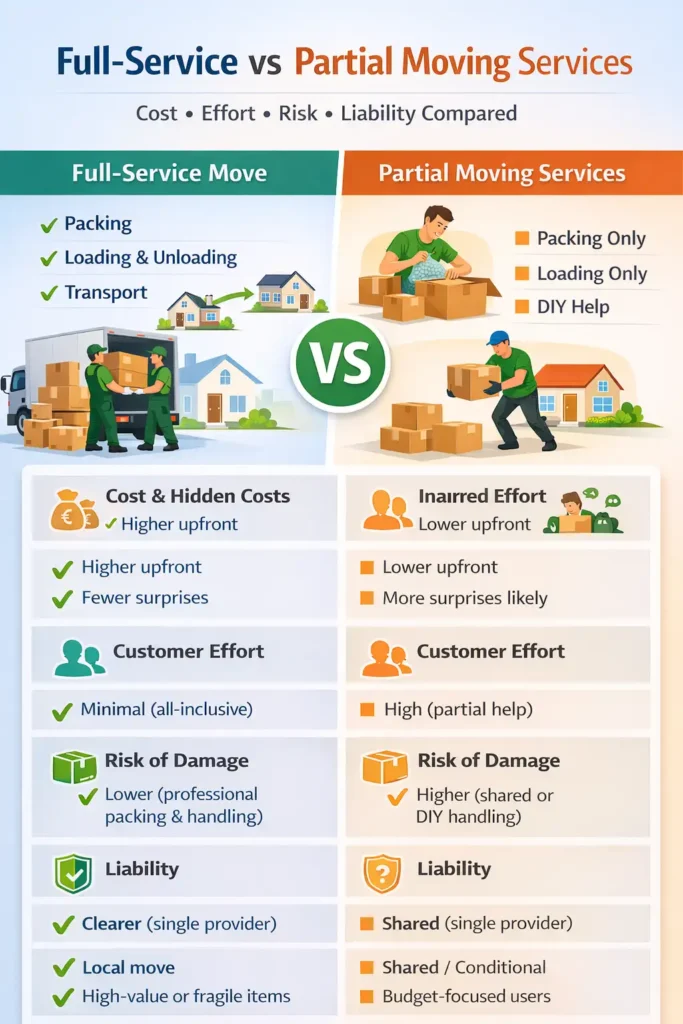
Full-Service Door-to-Door Move vs Partial Services: Side-by-Side Comparison
This side-by-side comparison summarises the practical differences between a full-service door-to-door move and partial moving services across cost, effort, risk, and accountability. The parameters below are derived from industry guidance, consumer complaint patterns, and insurance explanations, helping you make a clear, informed decision.
Comparison: Full-Service vs Partial Moving Services
Parameter | Full-Service Door-to-Door Move | Partial Moving Services |
Packing | Done entirely by professionals | Done by movers or customer |
Loading & unloading | Handled by movers | Movers or customer |
Transportation | Included | Included or self-arranged |
Customer physical effort | Very low | Medium to high |
Time involvement | Low | High |
Coordination required | Minimal (single provider) | High (multiple tasks/vendors) |
Risk of damage | Lower (professional packing & handling) | Higher (self-packing or shared handling) |
Injury risk | Lower | Higher |
Liability clarity | Clearer | Shared / conditional |
Insurance applicability | Easier to define | Depends on packing & handling |
Cost | Higher upfront | Lower upfront |
Hidden costs | Less likely | More likely |
Stress level | Lower | Higher |
Best suited for | Intercity moves, families, senior citizens | Local moves, small households, budget-focused users |
Key Takeaways from the Comparison
- Full-service moves prioritise convenience and accountability, making them suitable for complex or long-distance relocations
- Partial services trade cost savings for higher effort and risk, requiring careful planning and role clarity
- Liability and insurance outcomes are generally more predictable in full-service moves
- Partial services work best when the move is simple, local, and well-managed
Which Moving Option Is Best for You?
Choosing between a full-service door-to-door move and partial moving services should be based on your move complexity, distance, budget, time availability, and risk tolerance—not just the quoted price. This decision guide breaks down practical scenarios to help you select the option that aligns with your needs while minimising stress and unexpected costs.
Choose Full-Service Door-to-Door Moving If You…
A full-service move is generally the better option when:
- You are relocating intercity or long-distance
- Your household includes fragile, bulky, or high-value items
- You have limited time to pack and coordinate
- You want clear liability and accountability with a single service provider
- Physical effort or safety is a concern (e.g., senior citizens)
In these cases, professional packing and end-to-end handling reduce the chances of damage caused by improper packing, lifting, or coordination gaps.
Choose Partial Moving Services If You…
Partial services may be suitable when:
- The move is local or short-distance
- You are relocating a small household
- You can pack items properly and manage timelines
- Budget constraints are a priority
- You are comfortable coordinating multiple tasks or vendors
Partial services work best when the move is simple and well-planned, and when the customer understands the limits of liability and insurance.
Questions to Ask Yourself Before Deciding
Before finalising your moving option, consider the following:
- How far am I moving—within the city or to another state?
- How many fragile or heavy items do I have?
- Can I safely pack and lift items myself?
- Do I have time to coordinate packing, labour, and transport?
- Am I comfortable with shared responsibility and conditional liability?
Before finalising your choice, review this step-by-step guide on how to choose the best packers and movers.
Clear answers to these questions help avoid last-minute changes, disputes, or cost overruns.
Expert Tip to Avoid Choosing the Wrong Service
To reduce risk regardless of the option you choose:
- Get itemised quotations that clearly list inclusions and exclusions
- Clarify packing responsibility and liability terms in writing
- Check insurance coverage and exclusions, especially for self-packed items
- Avoid selecting a service based on price alone
These steps are consistently recommended to prevent damage claims, misunderstandings, and unexpected expenses.
Common Mistakes People Make When Choosing Partial Moving Services
Partial moving services can be effective when planned correctly, but a large number of relocation issues arise due to incorrect assumptions and poor preparation. Consumer complaints and moving-industry guidance consistently show that most problems occur not during transportation, but because responsibilities were unclear or underestimated at the time of booking.
Underestimating the Effort Required for Packing
Many customers choose partial services assuming packing is simple. In reality:
- Improper packing increases breakage risk
- Fragile items need specialised cushioning
- Overloaded or weak cartons collapse easily
Professional movers highlight that packing quality directly impacts transit safety, especially when customers pack items themselves without proper materials.
Assuming All Damage Will Be Covered Automatically
A common misconception is that any damage during transit will be compensated, regardless of who packed the items.
In practice:
- Liability may be limited if items were self-packed
- Insurance claims can be rejected due to improper packing
- Shared responsibility leads to disputes
This misunderstanding is a frequent reason for claim rejections and customer dissatisfaction.
Choosing Services Based Only on the Lowest Price
Low-cost partial services often exclude:
- Quality packing materials
- Skilled labour
- Clear liability coverage
Selecting a service purely on price increases the likelihood of hidden costs, damage, or last-minute add-ons.
Not Clarifying Responsibility and Scope in Writing
Many customers fail to confirm:
- Who is responsible for packing quality
- Who bears damage liability
- What services are excluded
Without written clarity, resolving disputes becomes difficult if something goes wrong during the move.
Skipping Transit Insurance or Declaring Incorrect Value
Another frequent mistake is:
- Not opting for transit insurance
- Declaring lower value to reduce premium
This can significantly reduce compensation or result in no payout at all in case of loss or damage.
FAQ About Full-Service vs Partial Moving Services
Full-service moving covers packing, loading, transportation, and unloading, while partial services involve hiring movers for selected tasks such as packing-only or loading-only, with the rest handled by the customer.
Full-service moves generally involve lower risk because professional movers handle packing and transportation, reducing damage caused by improper packing or handling.
Partial services usually have a lower upfront cost, but improper packing, coordination delays, or damage can increase the final expense.
Responsibility depends on who packed and handled the goods. If items are self-packed, liability and insurance coverage may be limited.
Yes, many people choose hybrid options such as professional packing for fragile items and self-packing for others, depending on budget and effort tolerance.
Transit insurance may be available, but coverage can be affected if items are packed by the customer or if exclusions apply.
Planning a Stress-Free Move? Let Professionals Handle It End-to-End
Whether you choose a full-service door-to-door move or need custom partial moving services, the right packers and movers make all the difference. Avoid damage risks, coordination hassles, and last-minute surprises by working with experienced professionals who understand every stage of relocation.
If you’re planning a relocation in Amritsar, working with experienced packers and movers in Amritsar ensures smoother execution and clear accountability.
- Get verified packers and movers for your move
- Compare full-service and partial moving options
- Receive transparent quotes with clear service scop
Get Free Moving Quotes from 6 Packers And Movers