
How to Pay for Your Move? – A Complete Guide to Moving Payments, Safety & Smart Decisions
Pay a small advance at booking, make a partial payment after packing or loading (if agreed), and release the final payment only after the vehicle reaches your destination or after unloading. Avoid paying the full amount before services begin, as stage-wise payment offers the best balance of safety and service assurance.
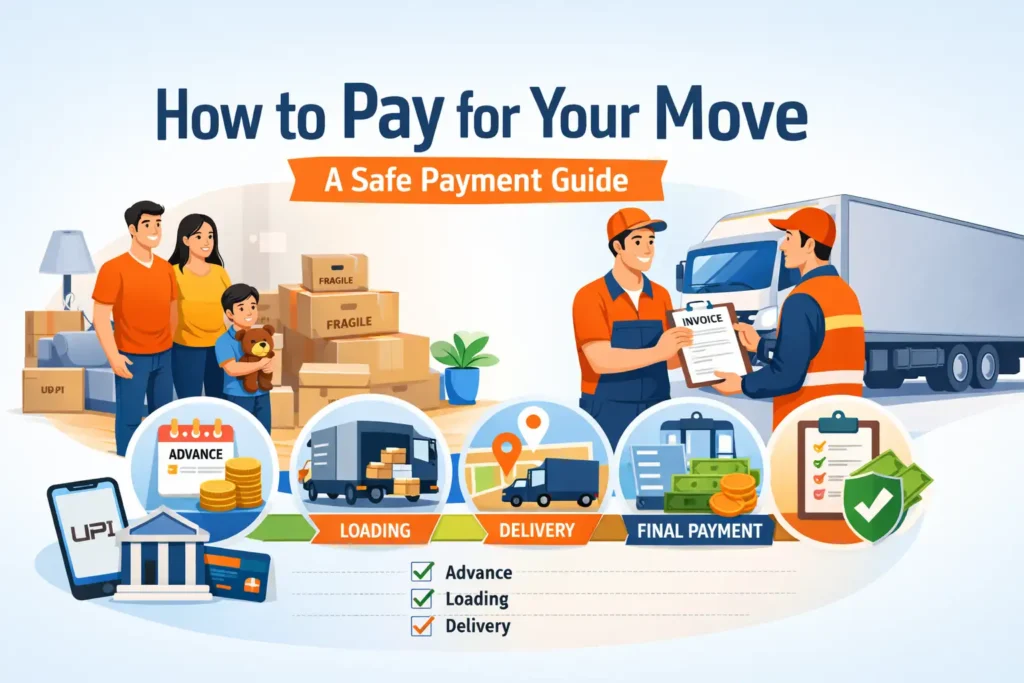
Paying for a house move is not just about transferring money—it’s about knowing when to pay, how much to pay, and how to protect yourself from hidden charges or payment risks. Many people face problems during relocation because they are unclear about moving costs, advance payments, payment stages, or the right payment method to use. This guide is designed to help you understand the entire payment process for packers and movers, so you can plan your budget confidently and avoid last-minute surprises.
If you’re Booking Professional Packers And Movers services, understanding payment structure becomes even more important. Moving charges vary based on distance, volume of goods, services selected, and timing of the move. Without clarity on these factors, customers often end up paying more than expected or falling into common payment traps.
Important: This guide is written using verified industry practices and consumer information. No assumptions or invented facts are used.
Right Time vs Wrong Time to Pay Movers
| Payment Stage | Right Time to Pay | Wrong Time to Pay |
|---|---|---|
| Booking | Small advance after final quote confirmation | Full payment before survey or quotation |
| Packing Day | Partial payment only if pre-agreed | Paying extra without written confirmation |
| Transit | No payment while goods are in transit | Clearing full balance before truck arrival |
| Delivery | Final payment after arrival or unloading | Paying without checking delivery/inventory |
| Extra Charges | After revised invoice is issued | Paying verbally demanded charges |
| Mode of Payment | Bank transfer / UPI with receipt | Cash without receipt or proof |
Understanding Moving Costs Before You Pay
Before making any payment to packers and movers, it’s essential to understand how moving costs are calculated. This clarity helps you evaluate quotes correctly, avoid overpaying, and question any unclear charges before confirming your booking.
To understand how different factors impact your final bill, you can also refer to our detailed packers and movers cost guide explaining charges by distance, house size, and services.
Key Factors That Determine Moving Costs
Professional movers calculate charges based on multiple practical factors, not a flat rate. The most common cost components include:
- Distance of the move
Local moves are generally cheaper than intercity or interstate relocations because fuel, tolls, and travel time are lower. - Volume or weight of household goods
The total quantity of items directly affects packing material usage, labor strength, and vehicle size. - Type of services selected
Packing, loading, unloading, unpacking, dismantling, reassembly, and storage services are usually priced separately or bundled. - Packing materials used
Bubble wrap, corrugated boxes, foam sheets, stretch wrap, and wooden crates can increase the total cost depending on item fragility. - Manpower and handling complexity
Extra labor may be required for heavy furniture, appliances, or difficult access conditions.
Why Written Estimates Matter Before Payment
Paying without a written estimate is one of the most common mistakes customers make. A proper estimate helps you:
- Understand what services are included and excluded
- Compare multiple quotes on the same parameters
- Reduce the risk of unexpected charges later
- Use the estimate as reference if disputes arise
Customers should also know how to compare multiple moving quotes correctly before confirming payment or advance.
Most movers provide approximate estimates initially and finalize costs after a physical or video survey. This final estimate should always be reviewed carefully before paying any advance.
Local vs Intercity Cost Differences
- Local shifting costs mainly include labor, packing materials, and vehicle charges for short distances.
- Intercity shifting costs add fuel, tolls, driver allowance, transit time, and sometimes insurance, making payment planning more critical.
Understanding this difference helps you judge whether the quoted amount aligns with your type of move.
Common Payment Methods Used by Packers and Movers
Once you understand your moving cost, the next important step is choosing the right payment method. Professional packers and movers usually offer multiple payment options to make the process convenient and traceable. Selecting a safe payment mode also protects you in case of disputes or claims.
Cash Payment
Cash is still accepted by many movers, especially for local relocations. However:
- Carrying large amounts of cash can be risky
- Cash payments offer limited proof if disputes arise
- Always insist on a printed receipt if paying in cash
Cash is generally better suited for small local moves with lower total charges.
UPI & Mobile Wallet Payments
Digital payments through UPI and mobile wallets are widely used today. These methods:
- Are fast and convenient
- Provide instant transaction records
- Reduce the risk of cash handling
When using UPI or wallets, ensure the payment is made to the company’s official account or registered number, not a personal ID without verification.
Bank Transfer (NEFT / IMPS / RTGS)
Bank transfers are considered one of the safest payment methods for moving services because:
- Transactions are fully traceable
- Payment details can be matched with invoices
- They are suitable for higher-value intercity or interstate moves
Always cross-check the company name on the bank account before transferring funds.
Debit & Credit Cards
Some organized moving companies accept card payments. This option:
- Offers transaction transparency
- May provide additional consumer protection
- Is useful for customers who prefer non-cash payments
Card availability depends on the mover’s infrastructure and service model.
Digital Invoices & Receipts
Regardless of the payment method used, professional movers issue:
- Digital or printed invoices
- Payment confirmation receipts
- GST-compliant bills (if applicable)
These documents are essential for records, reimbursements, and insurance claims.
Advance Payment: How Much Should You Pay Upfront?
Advance payment is a common part of the moving booking process, but it must always stay reasonable and controlled. As a customer, you should clearly understand why an advance is taken, how much is acceptable, and when it becomes a warning sign.
Understanding advance payments is easier when you know how to choose reliable packers and movers who follow ethical payment practices.
Is Advance Payment Mandatory?
Most professional packers and movers ask for a small advance to:
- Confirm your booking date
- Allocate manpower and vehicle
- Block scheduling during busy or peak periods
However, advance payment is not a legal requirement, and policies vary from company to company.
How Much Advance Is Safe to Pay?
A safe and widely accepted practice is to pay up to 10% of the total estimated moving cost as an advance.
Paying more than 10% upfront is not recommended, especially before:
- Packing starts
- Goods are physically loaded
- Any official documents are issued
Advance payment should only act as a booking confirmation, not full service payment.
Red Flags to Watch Out For
You should be cautious if a mover:
- Demands full payment before packing or loading
- Asks for a large advance without a written estimate
- Refuses to issue a receipt or invoice for the advance
- Pressures you using urgency tactics like “last slot available”
Many payment-related issues arise due to moving scams or unverified operators, which customers should learn to identify early.
Such practices increase the risk of overcharging or service disputes.
Best Practices for Paying Advance Safely
- Always pay advance after receiving a written estimate
- Prefer traceable payment methods (UPI or bank transfer)
- Ensure the payment is made to the company’s official account
- Collect a receipt or invoice mentioning the advance amount
This approach protects you while still securing your moving date.
Payment Stages During the Moving Process
To avoid disputes and ensure service accountability, packers and movers generally follow a stage-wise payment structure. Below is a practical and widely followed payment split, suitable for both local and intercity moves.
1. Payment at the Booking Stage – ~10%
At the time of booking:
- Around 10% of the estimated moving cost is paid as an advance
- This amount is used to confirm the booking, block the moving date, and allocate resources
- The advance should be acknowledged with a receipt or written confirmation
You should make this payment only after receiving a written estimate that clearly outlines services and charges.
2. Payment After Packing or Loading – ~60% to 70%
Once packing is completed or goods are loaded into the vehicle:
- Movers usually collect 60% to 70% of the total cost
- This stage confirms that the core service (packing + loading) has been delivered
- It also reduces operational risk for the mover after deploying manpower and materials
Payment at this stage should be supported by:
- A payment receipt
- Updated invoice (if required)
- Inventory or packing list reference
3, Payment at Destination (Before or After Unloading) – Remaining Balance
The remaining balance amount is typically paid:
- After the vehicle reaches the destination, and
- Either just before unloading starts or immediately after unloading, as agreed earlier
This final payment stage:
- Ensures the mover completes delivery as promised
- Gives the customer leverage until goods arrive safely
For intercity or interstate moves, this is considered the safest payment sequence for both parties.
Stage-wise payments work best when movers follow a transparent process, including proper documentation and transit insurance coverage.
Why This Stage-Wise Payment Structure Works
- Prevents full payment risk before service completion
- Keeps accountability at every stage of the move
- Reduces chances of service drop or last-minute disputes
Avoid releasing 100% payment before packing or loading, as it removes your control over service quality and timelines.
To avoid payment-related risks, it’s equally important to understand the best time to pay your movers. Paying too early or too late can affect service quality and delivery assurance. The section below explains the safest payment timing for both local and intercity moves.
Paying for Additional or Unexpected Moving Charges
Even with a confirmed quotation, some moving situations may lead to additional charges. Knowing what these charges are—and how to handle payment for them—helps you avoid confusion and disputes during the move.
Common Reasons for Additional Moving Charges
Extra charges usually arise due to conditions that were not visible or disclosed during the initial survey, such as:
- Stair carry or long carry charges when lifts are unavailable or parking is far
- Waiting charges if loading or unloading is delayed due to access restrictions
- Bulky or oversized items requiring special handling
- Extra packing materials used for fragile or high-value items
- Shuttle services when large trucks cannot reach the building
These charges are not arbitrary; they are typically linked to additional time, labor, or resources used during the move.
How to Handle Extra Charges the Right Way
If movers inform you about additional costs:
- Ask for a clear explanation of why the charge applies
- Request the amount to be added to the invoice in writing
- Avoid paying verbally agreed extras without documentation
Written confirmation protects both parties and avoids confusion after delivery.
When You Should Question Additional Payments
Be cautious if:
- Extra charges are demanded without explanation
- The amount was already included in the original quotation
- You are asked to pay additional money without a revised bill
Professional movers revise invoices transparently when legitimate additional services are required.
Best Practice to Minimize Surprise Charges
- Share accurate details during the pre-move survey
- Inform movers about stairs, parking issues, and large furniture
- Keep a copy of the final agreed quotation handy during the move
Clear communication before payment is the most effective way to prevent unexpected expenses.
Payment Tips for Local vs Intercity Moves
Payment planning changes significantly depending on whether you are moving within the same city or to another city/state. Understanding these differences helps you release payments at the right time and avoid unnecessary risks.
Payment Tips for Local (Intra-City) Moves
Local moves are usually completed within a single day, which makes payment handling relatively simpler.
Best practices include:
- Pay a small advance to confirm booking
- Release the balance amount after loading or after unloading, as agreed
- Avoid full payment before packing begins
- Ensure all services (packing, loading, unloading) are completed before final settlement
Since the move duration is short, customers typically have better control over service quality and payment timing.
Payment Tips for Intercity & Interstate Moves
Intercity moves involve longer transit time and higher costs, so payment structure becomes more critical.
Key points to follow:
- Pay advance only after a survey-based quotation
- Release partial payment after loading, if required
- Make the final payment only after the vehicle reaches the destination
- Do not clear full payment while goods are still in transit
For long-distance moves, keeping a portion of the payment pending ensures delivery commitment and service accountability.
Why Payment Timing Matters More in Intercity Moves
Intercity relocations involve:
- Fuel, tolls, driver allowance, and transit risks
- Multiple days of transportation
- Higher dependency on documentation and communication
Releasing payments in stages protects you if there are delays, route changes, or service deviations.
Recommended Payment Approach
- Local move → Fewer stages, shorter payment cycle
- Intercity move → Milestone-based payments with final payment at destination
This structured approach reduces disputes and improves overall moving experience.
What Documents You Must Collect After Payment
Collecting the right documents after making payments is crucial for accountability, dispute resolution, reimbursements, and insurance claims. Many post-move issues arise not because of service failure, but due to missing or incomplete paperwork.
Mandatory Documents You Should Receive
After paying packers and movers, ensure you receive the following:
- Payment Receipt
Confirms the amount paid, date, and mode of payment. This applies to advance, partial, and final payments. - Final Invoice / Bill
The invoice should clearly mention:- Company name and address
- Charge breakup (packing, transport, loading/unloading, insurance, taxes)
- Total amount paid and balance (if any)
- GST Invoice (If Applicable)
If GST is charged, the invoice must include:- GST number
- Tax amount and rate
- Taxable value
This is especially important for official records or employer reimbursement.
Transport & Inventory Documents
For intercity or interstate moves, also collect:
- Lorry Receipt (LR) / Consignment Note – proof that goods were handed over for transport
- Item Inventory List – list of packed items with carton numbers and condition notes
These documents help track goods and support damage or loss claims.
Insurance-Related Documents
If you opted for insurance, you must receive:
- Insurance policy or cover note
- Declared value details
- Claim procedure information
Without these, insurance claims may not be processed.
Why Document Collection Should Happen Before Closing Payment
Documents should ideally be collected:
- Before releasing final payment, or
- Immediately after delivery and unloading
Missing paperwork can make it difficult to raise complaints or seek compensation later.
Best Practice
- Store all documents digitally and physically
- Do not discard receipts until the move is fully closed
- Match document details with your quotation and payments
If you’re planning a local or intercity move, working with professional packers and movers in Vadodara ensures safe payment handling, proper documentation, and reliable service delivery.
FAQs – Paying Packers and Movers
The best time to pay packers and movers is through stage-wise payments—a small advance at booking, partial payment after packing or loading (if agreed), and the final payment after the vehicle reaches the destination or after unloading.
You should not pay the full amount before delivery. For intercity moves, final payment is safest after the truck arrives at the destination. For local moves, payment is usually made after unloading is completed.
Advance payment should be a small portion of the total estimated cost to confirm the booking. Paying the full amount upfront before services start is not recommended.
Cash payments are accepted by some movers, but they carry higher risk. If paying in cash, always collect a written receipt. Digital or bank payments are safer because they provide transaction proof.
Far far away, behind the word mountains, far from the countries Vokalia and Consonantia, there live the blind texts. Separated they live in Bookmarksgrove right at the coast
Move with Confidence. Pay Only When It’s Safe.
Choosing the right payment timing is easier when you work with a professional relocation partner. 6 Packers And Movers follows a transparent, stage-wise payment approach, so you never feel pressured to pay before services are delivered.
Why customers trust 6 Packers And Movers:
Clear quotations with defined payment stages
No full upfront payment demands
Written invoices & receipts for every transaction
Payment support for local & intercity relocations
Planning a move?
Get a clear estimate, safe payment structure, and end-to-end relocation support from experienced professionals.