
Truck Rental vs Hiring Professional Movers: Cost, Risk & Best Choice
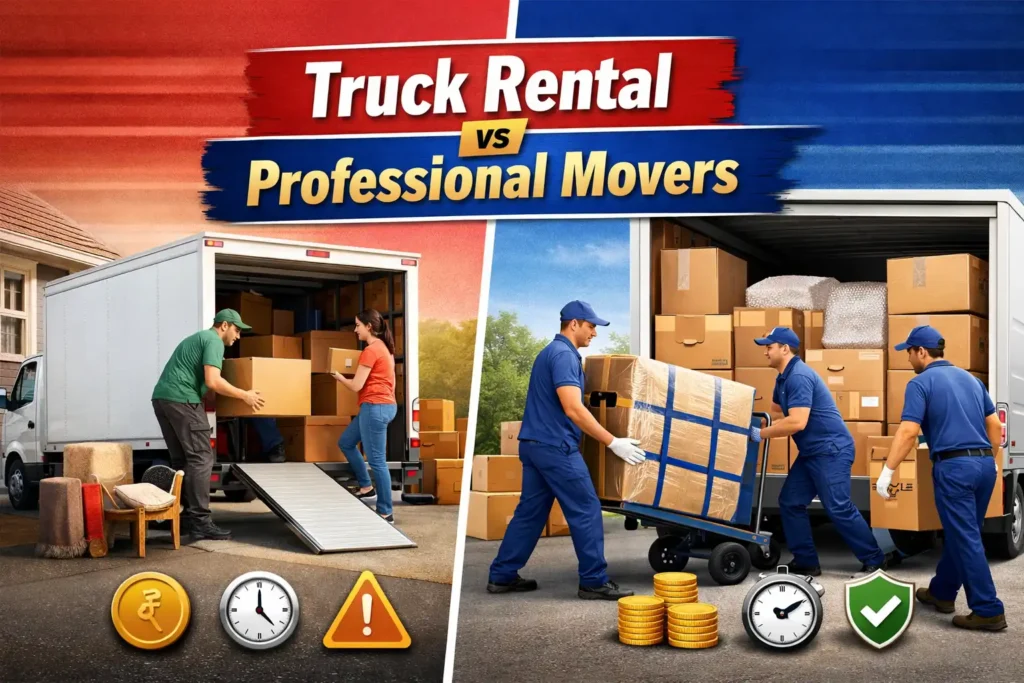
Relocating a home involves multiple decisions, but one of the most critical is choosing between renting a truck yourself or hiring professional packers and movers. This choice directly impacts your moving cost, time, safety, and overall stress level. Whether you are shifting locally or relocating to another city, understanding how each option works helps you avoid hidden expenses and unnecessary risks. If you are planning to hire verified relocation services, exploring Packers And Movers can simplify the process and reduce uncertainty.
Understanding the Two Moving Options
What Truck Rental Means for House Shifting
Truck rental for moving typically involves hiring a vehicle such as a mini-truck, tempo, or large goods carrier on a per-kilometre or per-day basis. In India, these rentals are commonly used for local household shifting and may be self-driven or come with a driver provided by the rental platform. The responsibility of packing, loading, unloading, and item protection usually remains with the customer.
This option requires arranging labour separately, purchasing packing materials, planning routes, and supervising the entire move. Vehicle size selection also becomes the customer’s responsibility, as incorrect estimation can lead to multiple trips or last-minute upgrades.
What Hiring Professional Movers Involves
Hiring professional packers and movers means outsourcing the relocation process to a service provider that handles packing, loading, transportation, and unloading as part of an organised workflow. For city-based relocations, choosing experienced packers and movers in Vadodara ensures better coordination and predictable execution. Many providers also offer additional services such as unpacking, furniture dismantling, appliance handling, and temporary storage.
Before the move, professionals often conduct a pre-move assessment to estimate volume, manpower, and materials required. This structured approach reduces uncertainty on moving day and ensures systematic handling of household goods during transit.
Core Difference: DIY Responsibility vs Professional Execution
The fundamental difference between truck rental and professional movers lies in responsibility ownership. With truck rental, the customer manages logistics, labour coordination, packing quality, and damage risk. Any delay, injury, or breakage is handled personally.
In contrast, professional movers operate under defined service terms, where trained staff, specialised equipment, and transit insurance options shift much of the operational and risk burden away from the customer. This distinction becomes increasingly important for larger households, long-distance moves, and relocations involving fragile or high-value items.
Cost Comparison – Direct, Hidden & Long-Term Costs
Direct Costs Involved in Truck Rental
When choosing truck rental, the most visible cost is the vehicle hire charge, which is usually calculated on a per-kilometre, hourly, or daily basis depending on the provider and city. Charges vary based on vehicle size such as mini-trucks, tempos, or larger goods carriers. Fuel costs, driver charges (if not self-driven), and minimum booking hours are typically added to the base rental price.
For household shifting, customers must also separately arrange labour for loading and unloading, which is not included in most truck rental bookings.
Hidden and Indirect Expenses in Truck Rental
Truck rental often appears economical upfront, but several indirect costs can increase the final moving expense. Packing materials such as cartons, bubble wrap, tapes, and protective covers must be purchased separately. Additional costs may arise from toll charges, parking fees, waiting time, staircase handling, and last-minute labour demands.
If items are damaged during transit due to improper packing or handling, repair or replacement costs are borne entirely by the customer, as rental services typically do not include transit insurance for household goods.
How Professional Movers Calculate Pricing
Professional packers and movers generally calculate costs based on multiple factors rather than a single rate. These include the size of the household (often estimated by BHK type or volume), distance of relocation, quality of packing materials used, number of labourers required, and optional services such as unpacking or appliance handling.
Movers usually provide itemised quotations that clearly separate packing, loading, transportation, unloading, and insurance-related charges, allowing customers to understand service inclusions before confirming the move. You can review a detailed breakdown in our packers and movers cost guide to understand how pricing differs across move types.
Cost Comparison: Truck Rental vs Hiring Professional Movers
Cost Component | Truck Rental (DIY Moving) | Hiring Professional Movers |
Base Cost | Vehicle rental charged per km / hour / day depending on truck size | Quotation based on household size, distance, and services |
Fuel Charges | Paid separately by the customer | Usually included in the quoted price |
Driver Charges | Extra if driver is provided; self-drive requires license & responsibility | Included as part of service |
Loading & Unloading Labour | Arranged and paid separately | Included in most standard packages |
Packing Materials | Purchased separately (boxes, bubble wrap, tape, covers) | Included as part of packing service |
Packing Quality | Depends on customer skill and material choice | Professional-grade packing by trained staff |
Hidden Charges | Toll, parking, waiting time, extra labour, staircase handling | Usually disclosed in itemised quotation |
Damage Risk Cost | Customer bears full repair or replacement cost | Liability defined; insurance option available |
Insurance Cost | Not included | Optional transit insurance available |
Final Cost Predictability | Variable and often increases during execution | More predictable when scope is fixed |
Time, Convenience & Planning Effort
Planning and Coordination Required in Truck Rental Moves
When opting for truck rental, the entire planning responsibility rests with the customer. This includes booking a suitable vehicle, arranging loading and unloading labour, sourcing packing materials, and coordinating timelines between drivers, helpers, and building access. Any delay in labour availability or vehicle arrival can directly disrupt the moving schedule.
Customers must also plan routes, account for traffic conditions, and manage entry permissions in residential societies, especially during peak hours.
Time Investment During Packing, Loading, and Transport
Packing household goods without professional assistance is time-intensive. Items must be sorted, packed securely, labelled, and loaded manually. Improper sequencing during loading can increase unloading time and risk of damage. For larger households, this process can extend over multiple days.
In addition, coordinating labour for both origin and destination locations often requires the customer to be physically present throughout the move, increasing time commitment.
How Professional Movers Improve Convenience
Professional movers follow a structured workflow that significantly reduces customer involvement. The process typically begins with a pre-move assessment, followed by systematic packing using standardised materials and trained manpower. Loading and unloading are executed using defined procedures, which helps complete the move within a predictable timeframe.
Because services are bundled, customers do not need to coordinate multiple vendors or supervise every stage of the relocation.
Safety, Risk, Insurance & Legal Protection
Risk of Damage in Truck Rental Moves
When renting a truck for household shifting, the safety of goods largely depends on packing quality, load distribution, and handling during transit. Improper packing, lack of cushioning materials, and incorrect stacking inside the vehicle significantly increase the risk of breakage, scratches, and appliance damage. Since truck rental services usually provide only transportation, responsibility for damage remains with the customer.
In most cases, vehicle rental platforms do not offer transit insurance for household goods, making customers financially liable for any loss during the move.
Physical Injury Risks During DIY Loading and Unloading
Manual lifting of heavy furniture, appliances, and cartons poses serious physical risks during DIY moves. Improper lifting techniques can lead to back strain, muscle injuries, and long-term musculoskeletal issues. Staircase handling, narrow corridors, and uneven surfaces further increase the likelihood of accidents.
Safety guidelines for manual handling clearly highlight the importance of correct posture, weight assessment, and use of mechanical aids—measures that are often unavailable in self-managed truck rental moves.
Insurance Coverage with Professional Movers
Professional movers offer optional transit insurance that covers household goods against loss or damage during transportation. Insurance premiums are generally calculated as a percentage of the declared value of goods and may vary based on coverage type. This insurance provides financial protection and a defined claims process in case of accidental damage.
Without insurance, mover liability is often limited by service terms, which makes opting for transit insurance an important consideration for high-value or long-distance relocations. Understanding what transit insurance covers during house shifting helps assess whether professional movers provide adequate financial protection.
Legal Accountability and Claims Process
Hiring professional movers usually involves written documentation such as quotations, invoices, and service terms. These documents establish accountability and provide customers with a formal channel to raise complaints or claims. In cases of service deficiency or damage, documented agreements support dispute resolution.
Consumer cases related to household shifting demonstrate that documented service arrangements play a key role in securing compensation, reinforcing the importance of formal contracts in professional moving services.
Step-by-Step Risk Evaluation Guide
- Identify fragile, heavy, and high-value items
- Assess personal ability to lift and handle goods safely
- Check availability of packing materials and equipment
- Evaluate need for transit insurance
- Compare risk exposure between DIY and professional moving
Skill, Expertise & Equipment Differences
Skills Required to Execute a DIY Move Safely
A successful DIY move using a rented truck requires multiple skills beyond basic packing. These include selecting appropriate packing materials, cushioning fragile items correctly, dismantling furniture, balancing load weight inside the vehicle, and securing goods to prevent shifting during transit. Incorrect packing or load placement can result in item damage, even over short distances.
Guides on household shifting consistently highlight that lack of experience in these areas is a major cause of breakage during self-managed moves.
Tools and Equipment Used by Professional Movers
Professional movers use specialised equipment designed to handle heavy and fragile household goods safely. Common tools include trolleys and dollies for heavy items, lifting straps, sliders, furniture pads, mattress covers, and multi-layer packing materials such as bubble wrap and corrugated sheets. For sensitive items, wooden crating may also be used.
These tools help reduce physical strain on workers and minimise the risk of damage during loading, transportation, and unloading.
Why Expertise Matters for Appliances and Fragile Items
Handling appliances such as refrigerators, washing machines, and air conditioners requires specific preparation steps, including proper draining, securing internal components, and correct positioning during transport. Similarly, fragile items like glassware, electronics, and decorative pieces need layered packing and controlled handling.
Improper handling of such items during DIY moves is a commonly cited reason for transit damage, particularly in the absence of specialised tools and trained manpower.
Stress, Physical Effort & Overall Moving Experience
Physical Exhaustion in Truck Rental Moves
Self-managed moving with a rented truck involves continuous physical effort, including lifting, carrying, and loading heavy household items. Tasks such as moving furniture through staircases, handling appliances, and repeated bending and lifting significantly increase fatigue levels. Extended physical exertion without proper equipment or trained support can lead to exhaustion and reduced efficiency on moving day.
Occupational safety guidance indicates that repeated manual handling and improper lifting posture are major contributors to physical strain during such activities.
Mental Stress and Decision Fatigue in DIY Moving
DIY moves also involve high mental load. Coordinating vehicle timing, labour availability, packing order, route planning, and building access permissions requires continuous decision-making. Any unexpected delay or error often forces quick problem-solving under pressure, adding to stress levels.
Moving guides note that handling multiple logistics simultaneously is a common reason people experience anxiety and fatigue during self-managed relocations.
How Professional Movers Reduce Moving-Day Stress
Professional movers reduce stress by dividing responsibilities across trained teams and following a predefined process. Customers are not required to supervise every activity, as packing, loading, and unloading are handled according to standard procedures. This structured execution reduces uncertainty and allows customers to focus on personal or work-related commitments.
The availability of optional services such as unpacking further simplifies post-move settling, contributing to a smoother overall moving experience.
Experience-Based Comparison: DIY vs Professional Moving
- Truck Rental: High physical involvement, continuous supervision, and greater mental pressure
- Professional Movers: Lower physical effort, reduced decision-making, and predictable workflow
This difference in experience becomes more significant for larger households and relocations involving time constraints.
Local vs Long-Distance Moving Considerations
Challenges in Local Moves Using Truck Rental
For short-distance or local shifting, truck rental is commonly used due to easy vehicle availability and perceived cost savings. However, even local moves require careful coordination of labour, timing, and building permissions. Delays in loading or unloading can lead to additional waiting charges, while traffic congestion can disrupt schedules.
Local moves also involve frequent handling of goods over short but repeated movements, increasing the chance of scratches or minor damage when packing quality is inadequate.
Increased Risks in Long-Distance DIY Relocation
Long-distance or intercity relocation significantly increases logistical complexity when using truck rental. Extended travel time exposes goods to continuous vibration, road conditions, and multiple loading or inspection points. Customers must plan rest halts, toll payments, route selection, and overnight parking security.
Guides on intercity relocation indicate that longer transit duration directly increases the probability of damage, especially when goods are not professionally packed or secured.
Why Professional Movers Are Preferred for Long-Distance Moves
Professional movers follow defined protocols for intercity relocation, including route planning, vehicle sealing, load balancing, and monitoring during transit. Transit insurance options are more commonly recommended for long-distance moves due to higher risk exposure.
The structured process and documentation involved in professional intercity shifting help reduce uncertainty and provide customers with accountability throughout the journey.
Step-by-Step Distance-Based Decision Guide
- Identify whether the move is local or intercity
- Estimate total transit time and number of travel days
- Assess packing quality required for distance
- Evaluate security and insurance needs
- Compare risk exposure between DIY and professional options
This step-by-step evaluation helps determine whether the convenience of truck rental outweighs the risk factors associated with longer distances.
Which Option Suits Your Moving Scenario?
Truck Rental for Students and Single Professionals
Truck rental is commonly chosen by students and single professionals who have a limited number of household items and are relocating over short distances. Smaller loads such as a few cartons, a bed, or basic furniture can often be moved using mini-trucks or tempos. This option allows cost control when packing is minimal and items are non-fragile.
Rental platforms and relocation guides indicate that small-volume moves with flexible timelines are more manageable through self-arranged transport.
Professional Movers for Families and Larger Households
Families typically have higher item volumes, including furniture, appliances, kitchenware, and fragile belongings. Managing such loads through truck rental increases coordination effort, damage risk, and physical strain. Professional movers are commonly preferred for family relocations because they offer structured packing, trained manpower, and optional insurance coverage.
Household shifting guides consistently associate professional services with better outcomes for multi-room homes and moves involving children or elderly family members.
Office and Business Relocation Requirements
Office moves involve additional complexity such as handling electronic equipment, documents, furniture, and time-sensitive operations. Downtime minimisation and asset protection are critical factors. Professional movers are typically used for office relocations because they provide planned execution, systematic labelling, and accountability through documentation.
Business relocation guides emphasise that organised handling reduces operational disruption and data or equipment loss.
Final Comparison & Decision Checklist
Truck Rental vs Professional Movers
When comparing truck rental and professional movers, the decision comes down to how much responsibility, risk, and effort you are willing to manage. Truck rental offers flexibility and upfront cost control but places the burden of packing quality, labour coordination, safety, and damage risk entirely on the individual. Professional movers, on the other hand, provide a structured service model that bundles packing, handling, and transportation under defined terms.
Relocation guides consistently show that bundled services improve predictability and reduce execution-related issues, especially as move size and distance increase.
When Truck Rental Is the Right Choice
Truck rental is generally suitable when:
- The move involves a small volume of household items
- The relocation distance is short and local
- Items are mostly non-fragile
- Time flexibility is available
- The individual is prepared to manage labour, packing, and supervision
These conditions reduce exposure to damage risk and make self-managed transportation more practical.
When Hiring Professional Movers Is the Better Option
Professional movers are more appropriate when:
- The household includes furniture, appliances, and fragile goods
- The move is intercity or long-distance
- Time constraints limit personal supervision
- Physical handling poses safety concerns
- Insurance and legal accountability are important
For such scenarios, structured execution and defined liability significantly reduce uncertainty during relocation.
Final Step-by-Step Decision Checklist
Before finalising your choice, evaluate the following:
- Volume of goods – small load or full household
- Distance – local or intercity
- Budget clarity – visible vs hidden costs
- Risk tolerance – ability to absorb damage or delays
- Time availability – supervision and coordination effort
- Safety needs – physical handling capability
- Need for accountability – documentation and insurance
If you’re unsure how to evaluate service providers, this guide on choosing the best packers and movers can help you compare options safely.
Using this checklist helps align your moving choice with practical realities rather than just upfront cost considerations.
Making the Right Choice for a Safe and Cost-Effective Move
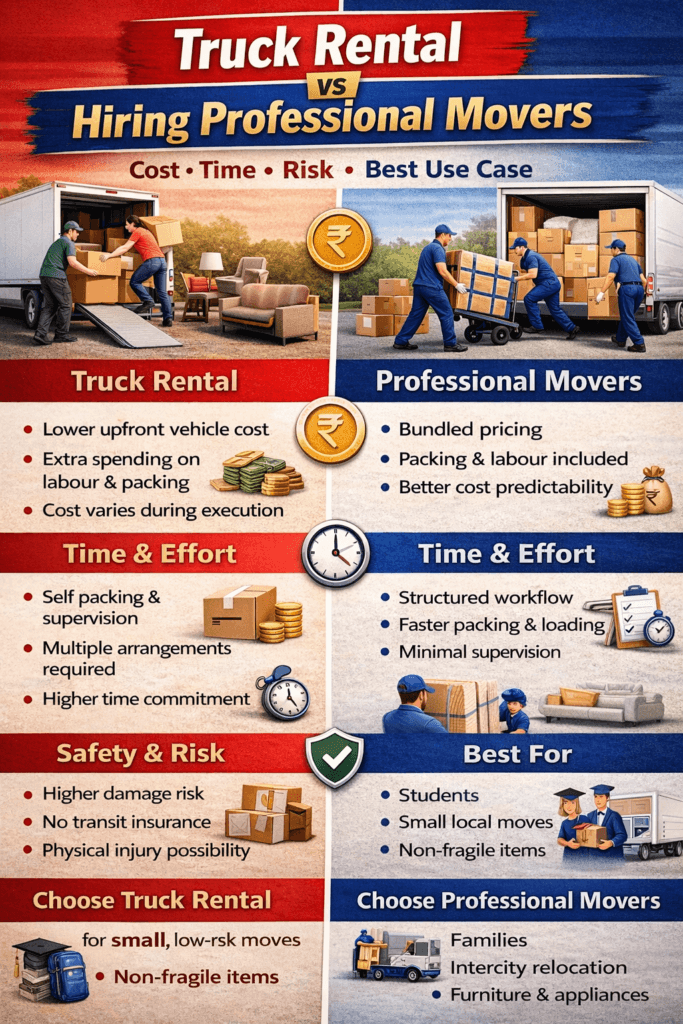
Choosing between truck rental and hiring professional movers depends on more than just upfront cost. Truck rental offers flexibility and can work well for small, local moves where packing is minimal and risk exposure is low. However, it requires significant personal involvement, physical effort, and acceptance of full responsibility for damage, delays, and coordination.
Professional movers provide a structured relocation process that includes systematic packing, trained handling, defined timelines, and optional transit insurance. This approach reduces uncertainty, physical strain, and risk—making it more suitable for families, long-distance moves, and relocations involving valuable or fragile household goods.
A careful evaluation of household size, distance, time availability, safety concerns, and risk tolerance is essential before deciding. Using a checklist-based approach helps avoid decisions driven purely by price and ensures a smoother moving experience.
If you want to minimise risk, save time, and avoid last-minute complications, comparing verified service providers before booking is critical. Explore trusted Packers And Movers to evaluate service options, compare inclusions, and choose a relocation solution that aligns with your budget and moving requirements.