
Local Shifting vs. Long-Distance Shifting — What’s the Difference?
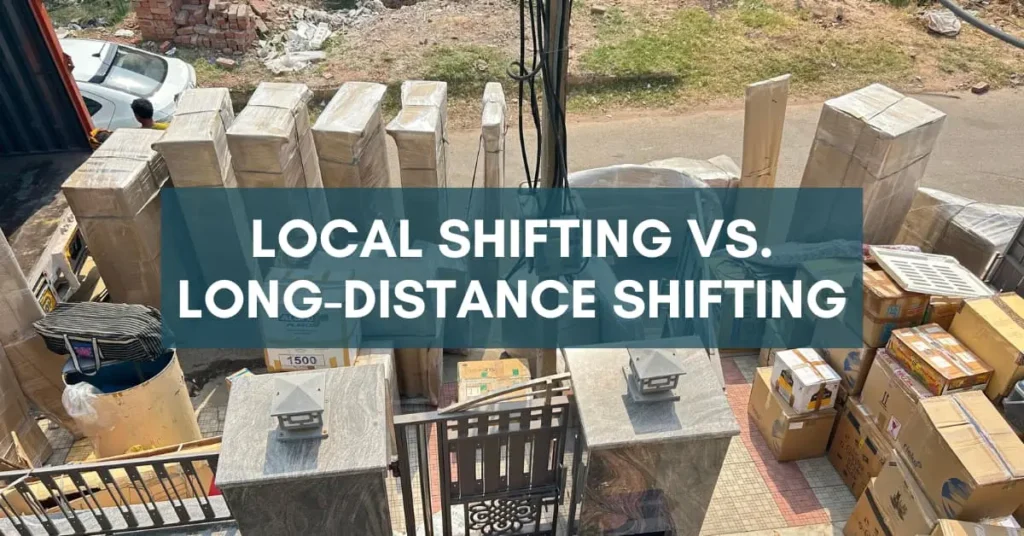
Local Shifting vs. Long-Distance Shifting — What’s the Difference?
Thinking of relocating? Whether you’re moving just across town or to a different state, understanding how local shifting differs from long-distance shifting is crucial. Before you Hire your Movers And Packers, check out this guide to grasp the major distinctions, make informed choices, and plan effectively.
Overview — What Exactly Is Local vs. Long-Distance Shifting?
When planning a move, one of the first questions is: is it a local shift or a long-distance relocation? The categorisation fundamentally influences every aspect of your move — from cost and timing to packing style and logistics.
Definitions
- Local Shifting: Typically means relocating within the same city or to nearby localities (often up to ~100 km). These moves can often be completed within a day.
- Long-Distance Shifting: Usually involves moving to a different city or state, crossing hundreds of kilometres and often multiple days in transit.
- The difference matters because the greater the distance and complexity, the more planning, higher cost, and more specialised services you’ll need.
For city-based relocations, choosing experienced packers and movers in Coimbatore helps ensure faster loading, safer handling, and same-day completion.
Quick Comparison
Feature | Local Shifting | Long-Distance Shifting |
Typical distance | Within city / nearby (~0-100 km) | Cross-city/state (100 km+ or interstate) |
Time required | Often same day or 1–2 days | Several days, possibly 2–7+ days |
Documentation / permits | Minimal | More documentation, permits, interstate tax |
Cost complexity | Lower – fewer variables | Higher – many more variables |
Key Differences in the Moving Process
When comparing local shifting and long-distance shifting, the processes diverge significantly—from survey and planning to loading, transit, and delivery. Below is a breakdown of what to expect in each scenario, plus actionable tips for your own move.
Survey, Planning & Quoting
Long-distance quotations are influenced by distance, volume, and risk—factors explained in detail in our packers and movers cost guide.
Local Shifting
- A move within the same city or nearby (often < 100 km) usually qualifies as “local”.
- The moving company might do a quick visit (or even a video/photo survey) and provide a quote based on hours and volume.
- Because the distance is short and transit time low, planning is simpler.
Long-Distance Shifting
- Cross-city or interstate relocations (100 km+ or across states) demand far more detailed planning: routing, truck availability, transit days.
- Survey will often include weight/volume estimate, route constraints, special items.
- Quoting is based on weight + distance + vehicle type, not simply hours.
Loading, Unloading & Transit
Local
- Loading and unloading are often done in a single morning/afternoon since transit is short.
- Vehicle size may be smaller—just one truck, one crew.
- Minimal stops, fewer hand-offs.
Long-Distance
- Loading may happen one day, transit next days, unloading at the end. Timeline: 2-7+ days are common.
- Larger or multiple vehicles may be used; possibly consolidation of goods or sharing space.
- More risk in transit: driving conditions, weather, multiple stops.
Documentation, Permits & Insurance
Local
- Minimal formalities: invoice, basic receipts; less regulatory burden.
- Insurance optional, often not deeply discussed.
Long-Distance
- Important to check permits (interstate or inter-region), e-way bills, tolls, taxes depending on states crossed.
- Strongly recommended to get transit insurance, detailed inventory, labelled pallets/boxes.
Understanding exactly what transit insurance covers during house shifting can protect you from financial loss if items are damaged or lost in transit.
Unpacking & Settling In
Local
- Because the move is short, unpacking can begin almost immediately.
- You can be hands-on, supervise easily.
Long-Distance
- Unpacking might take longer; goods arrive later, may need warehousing or “storage-in-transit” if destination isn’t ready.
- Need more coordination to check for damage and file claims if required.
Phase | Local Shifting | Long-Distance Shifting |
Survey & quoting | Simple, based on hours/volume | Detailed, based on weight, distance, route & risk |
Loading/Transit | One day, single vehicle, short route | Multiple days, larger vehicle, possibly part-load/shared |
Documentation & Insurance | Minimal paperwork, optional insurance | Permits, tolls, e-way bills, detailed inventory, strong insurance |
Unpacking/Settling | Quick settlement | Might involve storage, delayed unpacking |
Pro-Tips for Your Move
- Book early: For long-distance moves, scheduling a few weeks ahead gives more options and better pricing.
- Get a detailed inventory: Especially for long haul moves, photograph items, list condition/value.
- Choose a verified mover: Check licences, reviews, transparent quoting.
- Clarify delivery window: Long-distance moves often come with delivery windows; ask what happens if there’s delay.
- Supervise loading: Even in local moves, supervising that fragile items are packed properly helps avoid damage.
Cost Comparison — Local vs. Long-Distance Moving Charges
Cost is one of the biggest differences between local shifting and long-distance shifting. Distance, labour, fuel, packing materials, tolls, and documentation all impact the final price. Below is a detailed, fact-based breakdown using verified online sources only.
Key Cost Drivers
Local Shifting (Within ~0–100 km)
- Charges are usually based on hours taken + manpower + vehicle size.
- Fuel consumption is minimal, so labour becomes the primary cost factor.
- Packing may be lighter, reducing material costs.
- Typical cost range for 1–2 BHK moves: ₹3,000 to ₹10,000.
Long-Distance Shifting (100 km+ or Interstate)
- Pricing depends on distance + volume/weight + packing + fuel + toll taxes + driver allowances.
- Requires more materials, reinforced packing, insurance, route planning.
- Typical cost range: ₹15,000 to ₹60,000+ depending on destination and load size.
Cost Component Comparison
Cost Component | Local Shifting | Long-Distance Shifting |
Base Charges | Low | High |
Fuel Consumption | Low | Very High |
Packing Material | Basic | Heavy Multi-Layer |
Loading/Unloading Labour | Moderate | High |
Vehicle Type Cost | Small tempo | Larger trucks/containers |
Tolls & Taxes | Rare/Minimal | Significant |
Transit Insurance | Optional | Highly recommended |
Total Estimated Cost | ₹3,000–₹10,000 | ₹15,000–₹60,000+ |
Time to Complete | 1 day | 2–7+ days |
Hidden / Additional Costs to Watch Out For
- Staircase/lift issues (extra manpower)
- Long carrying distance from truck to door
- Parking challenges in local moves
- Detours/tolls/state taxes during long-distance transport
- Warehousing/storage charges if your new home isn’t ready
- Insurance premium for long hauls
How to Reduce Your Moving Cost
- Declutter to reduce volume (especially for long-distance).
- Book movers early to avoid dynamic pricing.
- Avoid last-minute moves, weekends, or month-ends (rates spike).
- Ask for all-inclusive written quotations to avoid hidden costs.
You can also reduce expenses by learning how to choose the best packers and movers and avoid unreliable or overpriced vendors.
Packing Style & Materials Required for Both Types
Packing is one of the most crucial differences between local shifting and long-distance shifting. The distance, handling frequency, and risk factors determine how much protection your household items need. While local moves may allow minimal packing, long-distance moves demand multi-layer, high-grade protection to withstand long transit hours, multiple checkpoints, and varied road conditions.
Packing Style for Local Shifting
Local moves involve short transit and fewer handling points, which means packing can be simpler and quicker.
Common Practices
- Basic packing for furniture and appliances
- Fragile items are wrapped but not always double-layered
- Less use of carton boxes due to short travel
- Faster loading/unloading reduces handling damage
Materials Used in Local Moves
- Stretch film
- Moving blankets
- Basic bubble wrap
- Small/medium cartons
- Tape + labels
Packing Style for Long-Distance Shifting
Long-distance relocation requires high-quality, multi-layer packing because goods face bumpy highways, weather exposure, and long transport hours.
Common Practices
- Full-scale professional packing (complete household)
- Heavy-duty carton boxes for all items
- Extra cushioning for fragile and glass items
- Waterproofing layers for long routes
- Disassembly of bulky furniture to reduce damage
Materials Used in Long-Distance Moves
- 3–5 layer bubble wrap
- Corrugated sheets
- Foam sheets, thermocol for fragile items
- Waterproof laminated sheets
- Wooden crates for high-value items
- Seal-proof industrial tapes
- Numbered labels + inventory sheet
Packing Materials Comparison
Packing Requirement | Local Shifting | Long-Distance Shifting |
Carton Boxes | Basic use | Mandatory, heavy-duty |
Bubble Wrap | Single layer | Multi-layer (3–5 wraps) |
Waterproofing | Rare | Essential |
Furniture Protection | Basic cover | Thick blankets + foam |
Fragile Items | Simple wrap | Foam + bubble + carton |
Crating | Very rare | Common for expensive items |
Labelling & Inventory | Basic | Detailed documentation |
Why Packing Differs So Much
- Risk Factor: Long-distance trucks encounter rough roads, multiple state borders, and weather shifts (rain, heat).
- Transit Duration: More exposure time = higher chance of impact damage.
- Handling Frequency: Long-distance goods may be reloaded or cross-docked on the way.
- Safety Requirement: Higher value items must remain protected for several days.
Transportation & Logistics Planning Differences
Transportation is where local and long-distance shifting differ the most. From the type of truck used to route planning, transit time, and logistics coordination, everything scales dramatically when you move beyond city limits. Understanding these differences will help you choose the right service level and avoid unwanted delays or damage.
Vehicle Types Used
Local Shifting
- Smaller trucks/tempos such as Tata Ace, Bolero Pickup, Eicher 14ft.
- Compact vehicles allow easier movement through narrow lanes and congested urban areas.
- Short-distance coverage means fewer fuel requirements.
Long-Distance Shifting
- Larger trucks or container vehicles such as 17ft/19ft/22ft/24ft closed-body containers.
- Designed for highway travel, better shock absorption, and long transit protection.
- May include specialised trucks for car/bike transport.
Route Planning & Transit Time
Local Moves
- Shorter distances, usually within city limits.
- Transit time: 1–4 hours depending on traffic and distance.
- Rarely require route planning except to avoid no-entry zones or peak traffic.
Long-Distance Moves
- Requires detailed planning: highways, toll points, fuel stops, state border rules.
- Transit time: 2–7+ days depending on distance and weather.
- Possible delays due to checkpoints, inter-state entry rules, and traffic diversions.
Logistics Factors & Risk Management
Local Shifting
- Minimal logistics: one team, short transit, fewer risks.
- Lower chances of damage due to fewer handling points.
- Parking constraints or narrow streets remain the most common challenge.
Long-Distance Shifting
- Higher risks due to long-route vibrations, weather exposure, and lengthy drives.
- More checkpoints increase handling frequency.
- Requires strict inventory systems, waterproof packing, and insurance.
Tracking, Communication & Coordination
- Local: Real-time communication with drivers; you can coordinate closely since the team stays with you throughout the day.
- Long-Distance: Movers often provide GPS tracking, periodic updates, or delivery windows (not exact timings) due to unpredictable transit variations.
Challenges in Local and Long-Distance Shifting
Every relocation—whether local or long-distance—comes with its own set of challenges. Understanding these issues in advance helps you prepare better, avoid delays, and reduce the risk of damages. Below is a detailed, fact-based breakdown of the most common challenges associated with both types of moves.
Challenges in Local Shifting
Local shifting might seem easier, but urban environments create unique obstacles.
Common Local Move Challenges
- Narrow Lanes & Parking Restrictions: Urban areas often lack proper truck parking space, leading to long-carry charges or delays.
- Lift / No-Lift Issues: Extra manpower may be required for stair-heavy buildings.
- Traffic Congestion: Peak-hour traffic slows down loading/unloading and increases hourly labour charges.
- Quick Turnaround Pressure: Since local moves are completed in a single day, the team must work faster—sometimes causing rushed handling.
Seasonal Factors
- Heavy rains within the city cause delays and disrupt moving schedules.
- Local movers may take multiple jobs a day, leading to scheduling overlaps.
Challenges in Long-Distance Shifting
Long-distance shifting is more complex because goods travel across multiple states, roads, weather conditions, and handling points.
Common Long-Distance Move Challenges
- High Transit Risk: Long highway journeys expose goods to vibrations, bumps, and sudden braking.
- Weather Variations: Heat, rain, and humidity can damage items without proper waterproof packing.
- Interstate Rules & Checkpoints: Trucks may face delays at borders due to documentation or state-specific entry timings.
- Multi-Day Transit: Longer travel time increases uncertainty around arrival windows.
- Risk of Handling Damage: In shared/part-load trucking, goods may be loaded/unloaded multiple times.
- Route & Road Conditions: Highways under construction, bad stretches, or traffic diversions can delay deliveries.
How to Overcome These Challenges
For Local Moves
- Book movers for early morning slots to avoid traffic.
- Reserve parking space in advance.
- Check lift permissions with society/RWA.
For Long-Distance Moves
- Use waterproof, multi-layer packing.
- Ensure insurance coverage for expensive items.
- Ask movers for tracking updates + a delivery window.
- Verify list of checkpoints and expected toll/state taxes.
- Confirm whether your goods are dedicated or shared load.
Which One Requires More Professional Help?
Both local and long-distance shifting can be handled with or without professional assistance—but the level of complexity varies significantly. Long-distance relocations require far more planning, coordination, documentation, and protection. Below is a complete analysis of when DIY is possible and when professional packers and movers become essential.
Do You Need Professionals for Local Shifting?
Local moves often involve shorter distances, flexible timing, and fewer risks. In many cases, people manage with smaller vendors or even DIY, especially for 1RK or 1BHK moves.
When DIY or Basic Movers Are Enough
- Shifting within 5–10 km
- Moving fewer items or minimal furniture
- Availability of lift and easy parking
- No fragile, antique, or high-value items
- You have enough manpower from friends/family
When You Still Need Verified Packers for Local Shifting
- 2BHK or larger homes
- Heavy appliances (fridge, washing machine, sofa sets, wardrobes)
- Buildings with no lift
- Narrow lane access
- Want professional packing (for safety and speed)
Local moves are cheaper and easier, but they can still go wrong without proper handling. Professional local movers offer faster packing, better material, and organised transport.
Why Long-Distance Shifting Absolutely Requires Professionals
Long-distance relocation is a high-stakes move involving:
- Multi-day transport
- Interstate permits
- Weather exposure
- Higher damage probability
- Complex loading/unloading
- Detailed packing standards
- Insurance requirements
This type of move cannot and should not be managed without verified movers.
Key Reasons Professionals Are Essential for Long-Distance Moves
- Multi-layer packing: Fragile and household items need foam, corrugated sheets, and bubble wrap for road vibrations.
- Closed container trucks: Provide dust-proof, waterproof, and theft-resistant transport.
- Inventory documentation: Necessary for insurance and interstate movement.
- Damage protection: Experienced handling prevents breakage over long transit.
- Predictable timelines: Professionals plan routes, check tolls/state tax rules, and manage driver schedules.
- Tracking & coordination: GPS or scheduled updates help you track your goods.
DIY vs Professional in Local vs Long-Distance
Move Type | DIY Possible? | Professional Help Needed? | Key Notes |
Local (small homes) | Yes | Optional | Minimal packing, quick move |
Local (2BHK+) | No | Yes | Heavy items, manpower issues |
Long-Distance (any size) | No | Mandatory | Packing, insurance, permits |
Fragile/valuable items | No | Yes | Require crates & special packing |
Ideal Movers for Local vs. Long-Distance Shifting
Move Type | What to Look For |
Local Shifting | Affordable rates, quick packing, urban expertise |
Long-Distance Shifting | Strong packing standards, insurance, container trucks, GPS tracking |
Choosing the right movers is not just about pricing—it’s about reliability, safety, and experience. Whether it’s a quick local shift or a multi-state relocation, always select verified, insured, professional packers and movers.
Whether it’s a local shift or a long-distance relocation, choosing verified and insured packers and movers in Bangalore ensures safety, transparency, and peace of mind.