
International Relocation Guide: Everything You Need to Know Before Moving Abroad
International relocation is the process of moving household goods and personal belongings from one country to another. It involves advance planning, visa approvals, international packing, air or sea transportation, customs clearance, insurance, and final delivery. Starting preparations 3–6 months in advance helps reduce delays, control costs, and ensure a smooth overseas move.
International relocation involves far more than packing household items and booking transport. Moving abroad requires structured planning, legal documentation, customs compliance, cost evaluation, and coordination across multiple countries. Without proper preparation, international moves can face delays, unexpected expenses, shipment holds, or immigration issues. Choosing experienced packers and movers helps streamline packing, transportation, customs clearance, and delivery across borders. Learn more about our international relocation services for overseas household moves. Professional relocation planning ensures household goods are packed according to international shipping standards, documents are prepared correctly, and shipments reach the destination safely and legally.
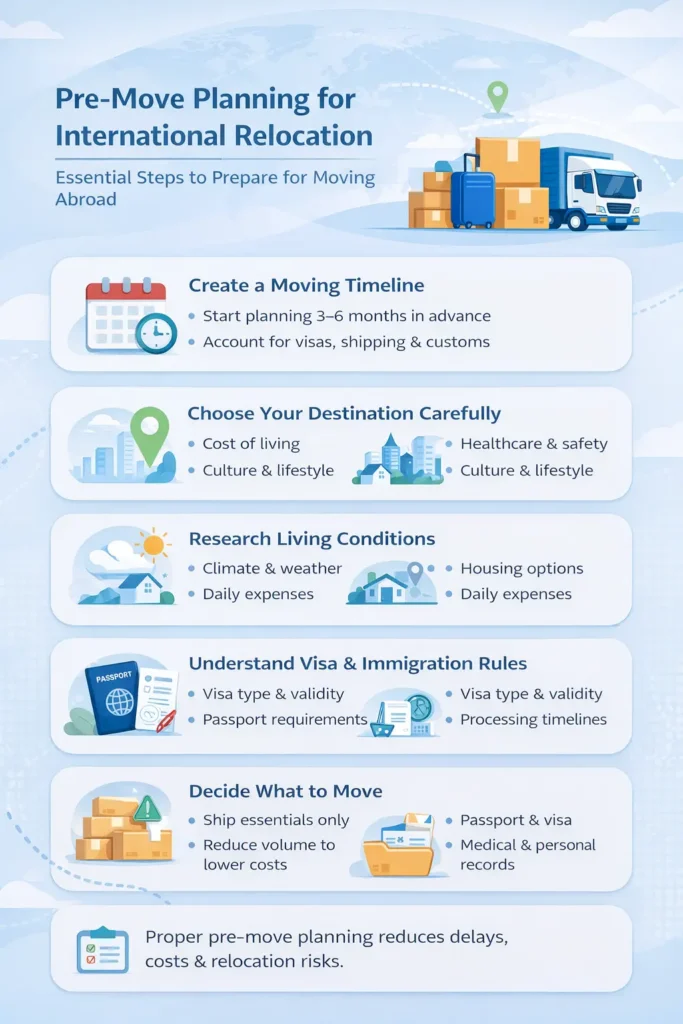
Pre-Move Planning for International Relocation
Pre-move planning forms the foundation of a successful international relocation. Unlike domestic shifting, international moves require early coordination between immigration authorities, customs departments, shipping carriers, and destination agents. Proper planning helps avoid shipment delays, visa complications, and cost overruns while ensuring compliance with destination country regulations.
A professional pre-move survey conducted by international packers and movers helps assess shipment volume, documentation requirements, and packing standards before relocation.
Creating an International Moving Timeline
International relocation planning should ideally begin 3–6 months before the intended moving date. This time frame allows sufficient room for visa approvals, documentation collection, shipping schedules, and customs formalities.
Key planning milestones include:
- Visa and immigration application timelines
- Pre-move survey by international movers
- Finalizing shipping mode (air or sea)
- Documentation preparation for customs
- Insurance arrangements
Delaying the planning stage often leads to higher freight costs and limited shipping options.
Choosing the Right Destination Country
Selecting the destination country impacts relocation costs, documentation requirements, and post-move settlement. Planning should include evaluation of:
- Cost of living and housing availability
- Healthcare facilities and insurance needs
- Safety and local regulations
- Education options (if relocating with family)
- Cultural and lifestyle compatibility
These factors directly affect long-term financial planning and quality of life after relocation.
Researching Cost of Living, Climate, and Culture
Understanding local conditions helps prevent adjustment challenges after arrival.
Important research areas include:
- Average living expenses and utility costs
- Climate conditions affecting housing and clothing needs
- Cultural norms influencing workplace and daily interactions
Advance research supports better budgeting and smoother cultural adaptation.
Understanding Visa and Immigration Requirements
Visa requirements vary by destination country and purpose of relocation, such as employment, education, or residency. Most countries require visas to be approved before arrival, and processing timelines may extend from weeks to several months.
Common immigration requirements include:
- Valid passport (often with at least 6 months validity)
- Approved visa or residence permit
- Supporting documents based on visa category
Failure to complete visa formalities in advance can delay or cancel relocation plans.
Deciding What to Move and What to Leave Behind
International moving costs are heavily influenced by shipment volume and weight. Movers generally recommend relocating only essential household goods and high-value items.
Before packing, consider:
- Cost of shipping vs replacement at destination
- Destination country restrictions on certain goods
- Storage or disposal options for non-essential items
Early inventory planning helps reduce costs and avoids customs issues.
Organizing Important Documents Before the Move
Document organization is critical before packing begins. Missing or incomplete paperwork can delay customs clearance or immigration approval.
Essential documents typically include:
- Passport and visa
- Birth and marriage certificates
- Medical and vaccination records
- Employment or education documents
Keeping both physical copies and secure digital backups helps prevent loss during transit.
International Moving Costs & Budgeting
International relocation costs vary significantly based on distance, shipment volume, destination regulations, and the selected mode of transport. Unlike domestic moves, international shifting includes multiple cost components such as international freight, customs handling, documentation, insurance, and destination delivery. Understanding these cost drivers in advance helps prevent budget overruns and unexpected charges during the relocation process.
Before finalizing an overseas move, reviewing a detailed international relocation cost guide helps compare freight options, insurance charges, and customs-related expenses.
Factors That Affect International Relocation Costs
International moving costs are not fixed and depend on several measurable factors.
Key cost-influencing factors include:
- Distance between origin and destination countries
- Total volume or weight of household goods
- Mode of transport (air freight or sea freight)
- Customs duties and destination regulations
- Packing complexity and special handling needs
Larger shipments and longer distances generally result in higher relocation expenses.
Air Freight vs Sea Freight vs Road Transport
Choosing the correct transportation mode plays a major role in cost and delivery timelines. Choosing the right shipping mode becomes easier when you work with experienced international relocation experts.
- Air Freight:
Faster delivery, suitable for limited and urgent shipments, but significantly more expensive. - Sea Freight:
Cost-effective for full household relocations, with longer transit times. - Road Transport:
Used primarily for cross-border relocations between neighboring countries.
Each option should be selected based on budget, shipment size, and urgency.
Typical Cost Components in International Moving
International relocation costs usually include multiple service elements bundled together or billed separately.
Common cost components include:
- Packing material and labor charges
- Inland transportation to port or airport
- International freight charges
- Export and import customs clearance
- Destination delivery and optional unpacking
- Insurance premium (if opted)
Understanding each component helps compare quotations more accurately.
How to Reduce International Relocation Expenses
While international moving cannot be inexpensive, careful planning can help reduce unnecessary costs.
Cost-saving strategies include:
- Decluttering and reducing shipment volume
- Choosing sea freight for non-urgent moves
- Booking movers well in advance
- Avoiding restricted or prohibited items
- Comparing quotes after a proper pre-move survey
Reducing shipment size directly lowers freight and handling costs.
Hidden Costs to Watch Out For
Some international relocation expenses may not be obvious at the quotation stage.
Potential hidden costs include:
- Customs storage charges due to document delays
- Destination port handling fees
- Duties or taxes on restricted items
- Re-delivery or waiting charges
- Insurance exclusions due to under-declaration
Clarifying inclusions and exclusions in advance helps avoid post-move disputes.
Packing & Transportation for International Moves
Packing and transportation play a critical role in international relocation, as household goods must withstand long transit durations, multiple handling points, and varying climatic conditions. International packing standards differ from domestic packing and require specialized materials, techniques, and compliance with airline or shipping line regulations. Choosing the right transportation method ensures goods reach the destination safely while meeting customs and carrier requirements.
How Household Goods Are Packed for International Shipping
International packing focuses on durability, moisture resistance, and shock protection to prevent damage during long-distance transit.
Standard international packing practices include:
- Multi-layer wrapping using corrugated sheets and cushioning material
- Moisture-resistant packing for sea shipments
- Proper labeling and inventory tagging
- Reinforced cartons and wooden crates for fragile items
Packing quality directly impacts damage risk and insurance claim eligibility.
Packing Standards for Air Cargo Shipments
Air cargo packing is designed to meet airline safety and weight restrictions.
Air freight packing characteristics include:
- Lightweight but strong cartons
- Compact packing to reduce volumetric weight
- Compliance with airline safety regulations
- Restrictions on liquids, batteries, and flammable items
Improper packing can lead to shipment rejection by airlines.
Packing for Long Sea Transit (Moisture & Shock Protection)
Sea freight shipments are exposed to humidity, salt air, and prolonged transit times.
Sea packing protections include:
- Vacuum wrapping or shrink wrapping
- Desiccants to control moisture
- Wooden crating for breakable items
- Anti-rust treatment for metal goods
These measures help prevent corrosion, mold, and transit damage.
Containerized Shipping vs Groupage (LCL)
International sea shipments are commonly moved using two container options.
- Full Container Load (FCL):
A dedicated container for one customer’s household goods, suitable for large relocations. - Less than Container Load (LCL):
Shared container space, suitable for smaller shipments and cost optimization.
The choice depends on shipment volume, budget, and delivery urgency.
Handling Fragile, High-Value, and Prohibited Items
Certain items require special handling or may be restricted for international transport.
Special handling applies to:
- Glass furniture and artwork
- Electronics and appliances
- Antiques and valuables
Commonly restricted or prohibited items include:
- Flammable liquids and aerosols
- Perishable food items
- Certain medicines and chemicals
Destination country regulations must be checked before packing begins.
Customs Clearance & Documentation
Customs clearance is one of the most critical stages of international relocation. Even well-packed shipments can face delays or holds if documentation is incomplete or destination-country regulations are not followed. Each country applies its own customs rules for household goods, duties, and restricted items, making advance documentation planning essential for a smooth international move.
Experienced international movers assist with customs documentation and clearance, reducing the risk of shipment delays or penalties.
Essential Documents Required for International Relocation
International household goods shipments usually require a defined set of documents for export and import clearance.
Commonly required documents include:
- Passport copy of the shipper
- Valid visa or residence permit
- Detailed packing list / inventory
- Bill of Lading or Airway Bill
- Power of Attorney for customs clearance
Missing or inaccurate documents can lead to shipment holds or additional charges.
Customs Rules and Regulations by Country
Customs regulations vary based on the destination country and immigration status of the shipper.
Key variations may include:
- Duty-free allowance for used household goods
- Residency or length-of-stay conditions
- Inspection requirements
- Import restrictions on specific categories
Checking destination-specific customs rules before shipping helps prevent compliance issues.
Restricted and Prohibited Goods in International Shipping
Most countries maintain strict lists of items that are restricted or prohibited for import.
Commonly restricted or prohibited items include:
- Perishable food items
- Plants, seeds, and soil
- Flammable liquids and aerosols
- Certain medicines and chemicals
- Weapons and counterfeit goods
Shipping restricted items without approval can result in confiscation or penalties.
How Customs Duties and Taxes Are Calculated
Customs duties, if applicable, are typically assessed based on:
- Declared value of goods
- Nature and category of items
- Local customs valuation rules
Some countries offer duty exemptions for personal effects when conditions are met, while others apply partial or full taxes.
Role of Movers in Customs Clearance Assistance
Professional international movers assist with:
- Document verification and submission
- Customs coordination through licensed agents
- Communication with port or airport authorities
- Managing inspections and release procedures
Mover-assisted clearance reduces the risk of delays and non-compliance.
Insurance & Risk Management in International Relocation
International relocation involves multiple handling stages, long transit durations, and exposure to varying transport risks. Even with professional packing and careful transportation, household goods may face risks such as damage, loss, or delays. Insurance plays a crucial role in protecting the financial value of your belongings during international movement and helps manage unexpected transit-related incidents.
Understanding what transit insurance covers during house shifting helps protect household goods against damage or loss during international transport.
Why Insurance Is Important for International Moves
International shipments travel through ports, warehouses, customs inspections, and long-distance carriers. Each transfer increases exposure to potential risks.
Insurance helps protect against:
- Transit damage due to handling or movement
- Loss during international transport
- Theft or non-delivery
- Environmental damage during sea transit
Without insurance, compensation options may be limited in case of loss or damage.
Types of International Moving Insurance
Different insurance options are available based on shipment value and risk tolerance.
Common insurance types include:
- All-risk coverage for a wide range of transit-related incidents
- Named-perils coverage for specific listed risks
- Total loss coverage for complete shipment loss
- Single-shipment or annual coverage options
Choosing the correct insurance type depends on shipment size and declared value.
What Is Covered and What Is Not
Insurance policies define inclusions and exclusions clearly.
Typically covered:
- Accidental damage during transit
- Loss due to shipping incidents
Common exclusions include:
- Wear and tear
- Pre-existing damage
- Improper packing (if not packed by professionals)
- Undeclared high-value items
Understanding exclusions helps avoid claim rejections.
How to Declare Item Value Correctly
Insurance coverage depends on the declared value of household goods.
Best practices for value declaration include:
- Preparing an accurate inventory
- Declaring high-value items separately
- Avoiding under-declaration to reduce premiums
Incorrect valuation may limit compensation in case of damage.
Claim Process for International Transit Damage
In case of damage or loss, claims must follow defined procedures.
Typical claim steps include:
- Reporting damage immediately upon delivery
- Submitting inventory, photos, and transport documents
- Completing claim forms within specified timelines
Delayed reporting may affect claim eligibility.
Delivery, Unpacking & Settling Abroad
Delivery and post-move services mark the final stage of an international relocation. After customs clearance, household goods must be transported safely to the destination residence, unpacked systematically, and placed as required. Proper coordination during this phase helps avoid delays, additional charges, and post-move damage while supporting a smoother transition into the new country.
Door-to-Door International Relocation Process
Door-to-door international relocation covers the entire moving journey from the origin residence to the destination address.
This process typically includes:
- Pickup and packing at the origin location
- Inland transport to port or airport
- Export customs clearance
- International air or sea transit
- Import customs clearance
- Final delivery to the destination residence
Door-to-door services reduce coordination effort for customers by managing multiple stages under one service scope.
Delivery Timelines for Air and Sea Shipments
Delivery timelines vary based on the chosen transportation mode and destination regulations.
- Air freight deliveries: Usually completed within days after customs clearance
- Sea freight deliveries: Typically take several weeks, depending on route, port congestion, and inspection requirements
Unforeseen delays may occur due to customs checks or documentation issues.
Unpacking and Placement Services
Many international movers offer unpacking and placement services after delivery.
These services generally include:
- Unpacking cartons and crates
- Placing items in designated rooms
- Basic furniture reassembly (where applicable)
Unpacking services help reduce post-move workload and speed up home setup.
Disposal of Packing Waste Abroad
After unpacking, packing waste such as cartons, plastic wraps, and crates must be disposed of responsibly.
Disposal options may include:
- Removal by movers as part of the service package
- Local recycling or disposal facilities
- Compliance with local waste management rules
Waste disposal availability depends on destination country regulations and service agreements.
Initial Setup Tips After Moving Overseas
Settling into a new country involves more than unloading goods.
Important post-arrival tasks include:
- Inspecting delivered goods against the inventory
- Reporting damages immediately, if any
- Completing local registrations or address updates
- Understanding local utility and service connections
Early organization helps avoid complications during the settling phase.
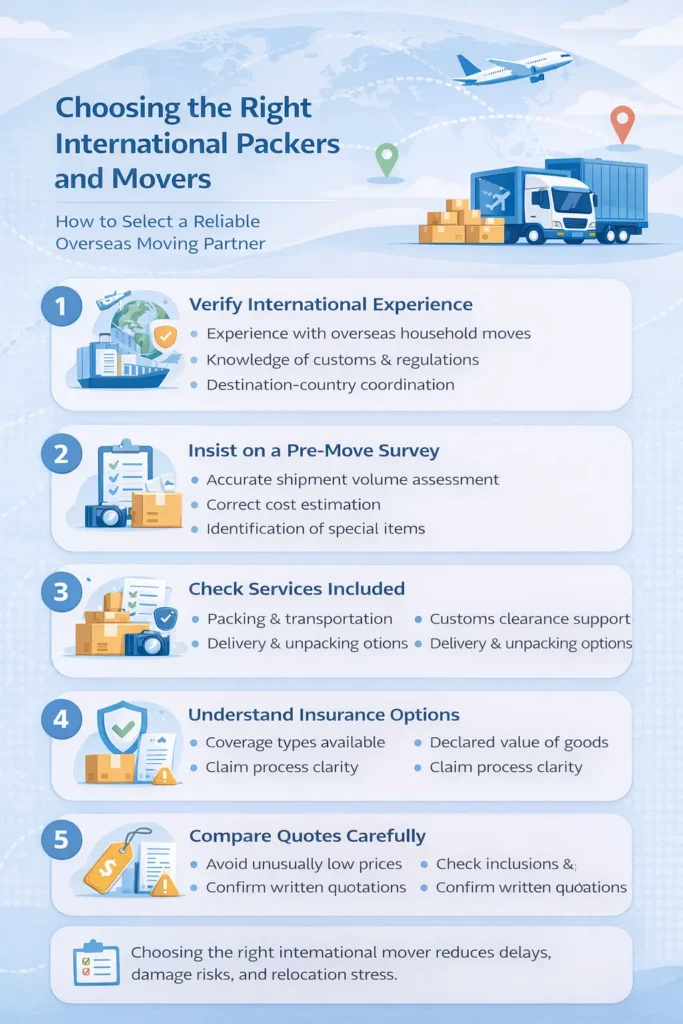
Choosing the Right International Packers and Movers
Selecting the right international packers and movers is a decisive factor in the success of an overseas relocation. International moves involve cross-border regulations, customs coordination, and long-distance transportation, making it essential to work with movers who understand international shipping procedures and destination-specific requirements. Careful evaluation helps reduce risks such as shipment delays, hidden charges, and documentation errors.
Before finalizing a mover, review this complete checklist for choosing packers and movers to avoid hidden charges and service gaps.
How to Verify International Movers’ Credentials
Before finalizing an international mover, credentials and operational capabilities should be verified.
Key verification points include:
- Experience in handling international household relocations
- Availability of pre-move surveys (physical or virtual)
- Ability to manage customs documentation and clearance
- Clear written quotation and service scope
Verifying these aspects ensures the mover is equipped to manage international logistics.
Importance of Pre-Move Surveys
A pre-move survey allows movers to assess shipment volume, access conditions, and special packing requirements.
Benefits of a pre-move survey include:
- Accurate cost estimation
- Proper packing and transport planning
- Identification of restricted or special items
- Reduced chances of post-booking cost revisions
Quotations provided without surveys often lack accuracy.
Questions to Ask Before Finalizing a Mover
Asking the right questions helps clarify responsibilities and service coverage.
Important questions include:
- What services are included in the quotation?
- Does the service include customs clearance assistance?
- What insurance options are available?
- Are delivery timelines estimated or guaranteed?
Clear communication helps avoid misunderstandings during relocation.
Red Flags to Avoid in International Relocation Companies
Certain warning signs indicate potential risks when choosing a mover.
Common red flags include:
- Extremely low quotations without surveys
- No written contract or inventory list
- Unclear insurance or liability terms
- Lack of destination-country coordination
Ignoring these signs can lead to service disputes or shipment delays.
Many overseas relocation issues arise due to fraudulent operators. Understanding common moving scams helps reduce such risks.
Benefits of Using a Verified Moving Platform
Using an organized platform to connect with international movers offers additional safeguards.
Platform-based advantages include:
- Access to multiple verified movers
- Standardized comparison of services
- Reduced risk of fraudulent operators
- Better transparency in quotations
Such platforms help simplify the selection process.
Common Mistakes to Avoid in International Relocation
International relocation involves complex coordination between immigration, customs, shipping, and destination delivery. Even small oversights can lead to shipment delays, additional costs, or legal issues. Understanding common mistakes helps individuals and families avoid preventable problems and ensures a smoother overseas moving experience.
Last-Minute Documentation Errors
Delaying document preparation is one of the most frequent causes of relocation delays.
Common documentation mistakes include:
- Applying for visas too late
- Incomplete or incorrect packing lists
- Missing authorization for customs clearance
- Expired or insufficient passport validity
Early document review helps avoid customs holds and immigration issues.
Under-Insuring Household Goods
Some individuals reduce insurance coverage to lower costs, which increases financial risk.
Risks of under-insurance include:
- Limited compensation in case of damage
- No coverage for high-value items
- Claim rejection due to under-declared value
Proper insurance coverage protects against transit-related losses.
Ignoring Destination Country Rules
Every country applies different import regulations for household goods.
Frequently overlooked rules include:
- Restrictions on food, plants, and medicines
- Duty and tax requirements
- Residency-based exemptions
Ignoring local regulations can result in confiscation or penalties.
Choosing Movers Based Only on Low Quotes
Very low quotations may indicate limited services or hidden charges.
Risks of selecting movers solely on price include:
- Exclusion of customs clearance support
- Lack of insurance coverage
- Poor packing standards
- Post-booking cost escalation
Evaluating service scope is more important than price alone.
Poor Inventory Planning
An incomplete or inaccurate inventory can create issues during packing, customs clearance, and delivery.
Inventory-related issues include:
- Customs delays due to mismatched lists
- Difficulty in damage assessment
- Insurance claim complications
Preparing a detailed inventory before packing reduces these risks.
International Relocation Checklist
An international relocation checklist helps manage multiple tasks across documentation, shipping, customs, and post-arrival setup. Following a structured checklist reduces the risk of missing critical steps and ensures smoother coordination between movers, authorities, and destination service providers.
Checklist Before Moving Abroad
Pre-departure preparation sets the foundation for a successful international move.
Key actions before moving include:
- Confirming visa and immigration approvals
- Finalizing destination housing arrangements
- Conducting a pre-move survey with international movers
- Preparing a detailed inventory of household goods
- Organizing essential documents and digital backups
- Choosing the mode of transport (air or sea)
Early completion of these steps helps avoid last-minute complications.
Checklist During Packing & Shipping
The packing and shipping phase requires close coordination with movers and customs agents.
Important checks during this stage include:
- Verifying packing quality and labeling
- Ensuring prohibited items are excluded
- Confirming insurance coverage and declared values
- Reviewing shipping documents and transport details
- Tracking shipment progress
Active involvement during packing reduces the risk of errors.
Checklist After Arrival at Destination
Post-arrival actions help ensure delivery accuracy and settlement readiness.
After arrival, focus on:
- Inspecting delivered goods against the inventory
- Reporting damages or missing items immediately
- Completing customs or residence registrations
- Arranging utilities and essential services
- Disposing of packing waste responsibly
Prompt checks support insurance claims and smoother settlement.
Planning a Successful International Relocation
International relocation is a structured process that requires early planning, accurate documentation, compliant packing, customs coordination, and reliable delivery support. From visa approvals and shipment budgeting to insurance coverage and post-arrival settlement, each stage plays a critical role in ensuring a smooth move abroad. Understanding international regulations, choosing the right transport mode, and working with experienced movers significantly reduce risks such as delays, damage, or unexpected costs. A well-planned international relocation not only protects household goods but also helps individuals and families settle into their new country with confidence and clarity.
Planning an international move requires expert coordination across packing, shipping, customs, and delivery. Working with verified international packers and movers ensures compliance, safety, and smooth overseas relocation. 6 Packers And Movers helps you connect with experienced international relocation professionals who manage every stage of your overseas move with clarity and compliance. From pre-move surveys and documentation support to safe transportation and destination delivery, trusted movers reduce risks and simplify the relocation journey. Start your international relocation with confidence by choosing professional assistance through 6 Packers And Movers.