
The Best 50 Practical Ways to Save Money When Moving
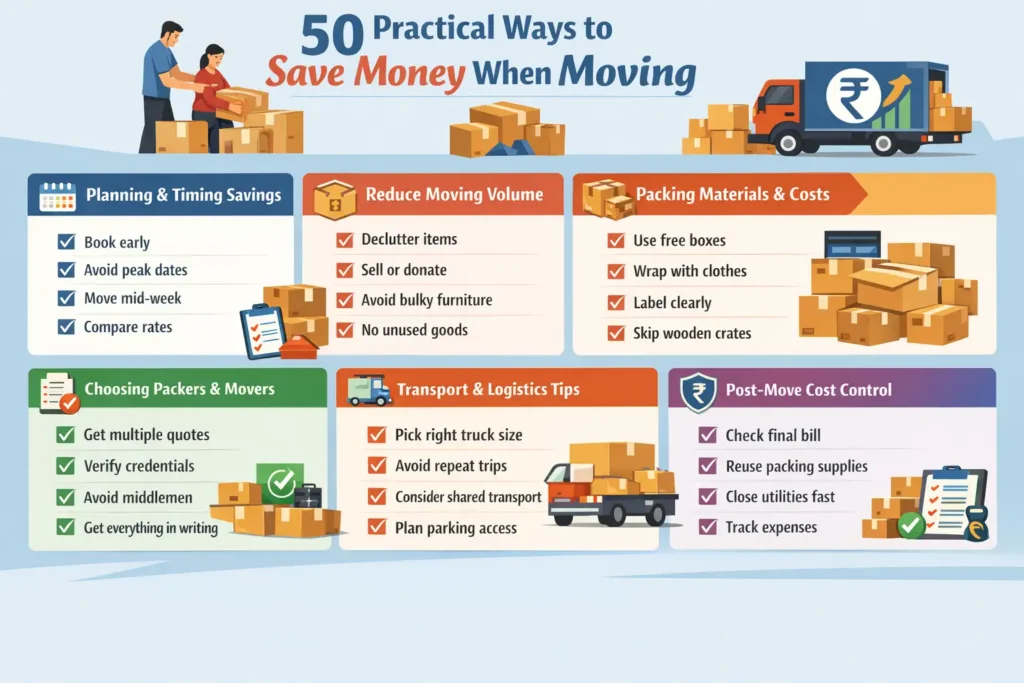
You can save money when moving by planning early, reducing moving volume, packing smartly, choosing the right movers, optimizing transportation, managing insurance wisely, and controlling post-move expenses.

Moving to a new home can be expensive, but with the right strategy, you can save money on moving without compromising safety or quality. Expenses such as packing materials, transportation, labor charges, insurance, storage, and post-move adjustments add up faster than most people expect. Many households end up overspending not because moving is inherently expensive, but because of poor timing, lack of information, and last-minute decisions. By understanding how relocation pricing works and making informed choices at each stage, it is possible to reduce overall moving costs significantly without compromising safety or quality.
Whether you are planning a local move or an intercity relocation, these practical strategies will help you control costs at every step. If you are actively planning your move, exploring professional packers and movers services early can help you compare options and avoid last-minute premium charges.
Plan Your Move Early to Avoid Last-Minute Expenses
Early planning is one of the most effective ways to save money when moving. Most cost overruns happen when bookings are rushed, options are limited, and service providers charge premium rates due to urgency.
Book Movers Well in Advance
Moving companies adjust prices based on demand and availability. Booking early gives you access to better pricing, flexible schedules, and more service options. Last-minute bookings often attract higher charges due to limited truck and labor availability. Understanding how packers and movers calculate moving costs also helps you plan better and avoid unnecessary expenses.
Avoid Peak Moving Days and Seasons
Moving during weekends, month-ends, and peak seasons such as summer or school holidays typically costs more due to high demand. Choosing a weekday or mid-month move can reduce transportation and labor costs.
Plan Your Move Timeline Realistically
Creating a clear relocation timeline helps you avoid emergency decisions like express packing, urgent truck allocation, or overnight storage — all of which increase costs. A planned schedule allows smoother coordination between packing, loading, transit, and delivery.
Compare Quotes Before Finalizing
Getting multiple quotations in advance helps you understand standard pricing and avoid overpaying. Comparing itemized quotes also reveals which services are essential and which can be avoided or negotiated. You can also refer to this step-by-step guide on choosing the best packers and movers to avoid hidden charges and unreliable operators.
Stay Flexible With Moving Dates
Flexibility in pickup and delivery dates can lower costs, especially for intercity moves. Movers often offer better pricing when your shipment can be adjusted within a broader delivery window rather than a fixed date.
Reduce Moving Volume to Lower Packing & Transportation Costs
One of the biggest cost drivers in relocation is the total volume of goods being moved. Packers and movers calculate pricing based on the space your household items occupy inside the truck, the packing materials required, and the labor involved. Reducing the number of items you move directly lowers packing, transportation, and handling costs.
Declutter Before You Start Packing
Every extra item adds to packing material usage, labor time, and truck space. Decluttering before the move helps you eliminate items that are unused, broken, or no longer needed, reducing overall moving volume. Professional movers often recommend decluttering early, especially for local moves handled by packers and movers in Ludhiana, where pricing is highly volume-dependent.
Sell Items That Cost More to Move Than Replace
Low-value furniture, appliances, or bulky items may cost more to transport than to repurchase at the destination. Selling such items before relocation helps you recover cash and avoid unnecessary transportation expenses.
Donate or Dispose of Unused Household Goods
Donating clothes, books, utensils, and extra household items reduces volume while supporting a good cause. Disposing of unusable items avoids paying for packing and transport of things you won’t use again.
Avoid Moving Restricted or Non-Essential Items
Liquids, plants, perishables, and hazardous items are often restricted by movers or excluded from insurance coverage. Packing such items increases effort without providing real value and can lead to waste or additional handling charges.
Measure Volume Instead of Guessing
Many people underestimate how much space their belongings take. Conducting a pre-move survey or requesting a volume assessment helps ensure the correct truck size is selected, preventing overpayment for unused vehicle capacity.
Avoid Unnecessary Storage Decisions
Temporary storage adds recurring monthly costs. If storage is not essential, scheduling direct pickup and delivery can help you avoid extra warehouse and handling charges altogether.
Save Money on Packing Materials & Packing Services
Packing is one of the most underestimated cost components of moving. Expenses related to cartons, wrapping materials, wooden crates, and professional packing labor can significantly increase your final bill if not managed properly. Making smart choices at this stage helps reduce both material and labor costs without compromising the safety of your household items.
Use Household Items as Packing Material
Clothes, towels, bedsheets, and blankets can be used to wrap fragile items, reducing the need for additional bubble wrap or packing paper. This lowers packing material costs and makes efficient use of items you are already moving.
Source Free or Low-Cost Boxes Locally
Local grocery stores, electronics shops, and community groups often give away sturdy cartons. Using free boxes significantly reduces the expense of purchasing new packing cartons from movers.
Pack Non-Fragile Items Yourself
Items such as clothes, books, shoes, and linens do not always require professional packing. Self-packing these items reduces labor charges while allowing professionals to focus on fragile or high-value goods.
Avoid Unnecessary Wooden Crating
Wooden crating provides maximum protection but comes at a higher cost. It should be used only for items that genuinely require extra safety, such as glass furniture, artwork, or sensitive electronics.
Understanding the difference between standard packing and premium protection helps you decide when transit insurance coverage is actually required.
Prevent Overpacking and Overweight Boxes
Overpacked cartons increase labor effort and risk of damage, which may result in additional handling charges. Packing boxes within recommended weight limits helps keep loading and unloading efficient.
Label Boxes Clearly to Save Labor Time
Clearly labeled cartons reduce confusion during unloading and unpacking. This can shorten labor time, especially for hourly-based moving services, indirectly lowering total costs.
Choose the Right Packers & Movers Without Overpaying
Selecting the right packers and movers is not about choosing the cheapest quote—it’s about understanding what you are paying for and avoiding unnecessary or hidden costs. Many people end up overspending due to vague quotations, middlemen involvement, or lack of documentation. Making informed choices at this stage protects both your budget and your household goods.
Always Get a Pre-Move Survey
A physical or video survey allows movers to assess volume, access conditions, and special handling requirements accurately. This helps prevent under-quoting initially and cost escalation later.
Compare Itemized Quotations, Not Just Final Prices
A low total price may hide extra charges for packing materials, labor, stairs, long carry, or taxes. Itemized quotations make it easier to compare services fairly and avoid paying for unnecessary add-ons.
Watch Out for Brokers and Fake Listings
Some listings act as intermediaries and subcontract your move at higher rates after booking. Dealing directly with the service provider reduces markup risks and improves accountability.
Many cost overruns happen due to fraud or misrepresentation, so it’s important to know the common moving scams and red flags before booking.
Verify Business Details Before Booking
Checking registration details, GST information, and physical office presence helps ensure you are dealing with a legitimate moving company. This reduces the risk of fraud and post-payment disputes.
Understand Payment Terms Clearly
Many consumer advisories recommend avoiding large advance payments. Structured payments—partial advance and balance after delivery—reduce financial risk if service issues arise.
Get Everything in Writing
Written quotations, inventories, and service terms help resolve disputes and support insurance or damage claims. Verbal promises are difficult to enforce once the move begins.
Cut Transportation, Fuel & Logistics Costs Smartly
Transportation usually forms the largest share of your moving expenses. Costs vary based on distance, vehicle size, fuel usage, tolls, permits, and handling efficiency. Making informed logistics decisions can significantly reduce unnecessary spending without affecting delivery safety.
Choose the Right Truck Size
Selecting a vehicle that matches your household volume prevents overpaying for unused space. Smaller households often require compact carriers, while larger homes need full-sized trucks. Incorrect vehicle selection can inflate transport costs unnecessarily.
Avoid Multiple Trips
Multiple loading or delivery trips increase fuel, labor, and handling costs. Proper volume assessment and correct truck selection help ensure your entire household is moved in a single trip whenever possible.
Consider Shared or Consolidated Transport
For partial loads or long-distance moves, shared transportation allows multiple shipments to travel in one truck, reducing individual transportation costs. This option works well when delivery dates are flexible.
Plan Access and Parking in Advance
Narrow roads, lack of parking, or long carry distances from truck to home increase labor time and may attract additional charges. Pre-planning access helps avoid unexpected handling fees.
Avoid Unnecessary Waiting Charges
Delays at pickup or delivery locations can lead to waiting charges. Ensuring elevator availability, building permissions, and clear access at both locations keeps loading and unloading efficient.
Understand Route-Based Costs
Long-distance moves include tolls, permits, and route-specific costs that vary by state and distance. Understanding these variables helps you evaluate whether a quoted transportation cost is reasonable.
Save on Insurance, Damages & Post-Move Expenses
Insurance and damage-related costs are often overlooked while budgeting for a move. However, poor decisions in this area can lead to significant out-of-pocket expenses after delivery. Understanding when insurance is necessary and how to prevent damage helps protect both your belongings and your finances.
Understand When Transit Insurance Is Worth It
Transit insurance is usually calculated as a percentage of the declared value of your household goods. It is most beneficial for high-value or fragile items where potential damage could result in substantial financial loss.
Avoid Over-Insuring Low-Value Goods
Declaring unnecessarily high values increases insurance premiums without providing proportional benefits. Declaring realistic values helps control insurance costs while maintaining adequate coverage.
Know the Difference Between Declared Value and Insurance
Declared value determines the maximum liability, while insurance coverage defines compensation conditions. Misunderstanding this difference can lead to inadequate claims or unexpected expenses after damage. Misunderstanding this difference is one of the main reasons insurance claims get rejected during house shifting.
Inspect Goods Immediately After Delivery
Checking household items during or immediately after unloading helps identify damage early. Prompt reporting improves the chances of resolution and avoids disputes over when the damage occurred.
Document Damage Properly
Photographs, delivery reports, inventories, and written acknowledgements are often required for damage claims. Proper documentation prevents claim rejection and saves money otherwise lost to repairs or replacements.
Avoid Repacking or Repairing Before Claim Submission
Repairing or discarding damaged items before claim assessment can weaken or invalidate claims. Waiting for insurer or mover instructions helps ensure reimbursement eligibility.
Smart Post-Move Decisions That Prevent Extra Spending
Saving money during relocation doesn’t end once your household goods are delivered. Many people incur avoidable expenses after the move due to poor coordination, billing issues, or rushed decisions. Making smart post-move choices helps you close the relocation process without unnecessary financial leakage.
Reconcile the Final Bill With the Original Quotation
Before making the final payment, compare the invoice with the agreed quotation and inventory list. This helps identify unapproved add-ons, excess charges, or billing errors that can otherwise go unnoticed.
Unpack Strategically Instead of Rushing
Unpacking everything immediately may lead to unnecessary furniture replacements or purchases. Living in the space for a few days helps you understand what you truly need, avoiding impulsive spending.
Reuse or Repurpose Packing Materials
Boxes, cartons, and protective wraps can be reused for storage, future moves, or shared with others. Reusing materials reduces waste and eliminates the need to buy new storage supplies.
Close Utility and Rental Overlaps Quickly
Overlapping rent, electricity, internet, and maintenance charges at both the old and new homes can significantly increase relocation costs. Coordinating move-out and move-in dates minimizes duplicate payments.
Track Moving Expenses for Reimbursements
If your move is employer-supported or eligible for reimbursement, keeping invoices, receipts, and payment proofs ensures you don’t miss recoverable expenses. Missing documentation often leads to unreimbursed costs.
Address Claims and Complaints Promptly
Delays in raising claims or service complaints can weaken your case. Prompt follow-ups help resolve issues faster and prevent permanent financial loss.
FAQs About Save Money When Moving
You can save the most money by planning early, avoiding peak moving dates, reducing the volume of items, packing non-fragile goods yourself, and comparing itemized quotes from movers.
Weekday moves are generally cheaper than weekends because demand is lower, allowing movers to offer better pricing and availability.
Yes. Movers calculate charges based on volume, labor, and truck size. Decluttering reduces packing materials, labor time, and transportation space, directly lowering costs.
Self-packing non-fragile items like clothes and books can reduce packing charges. Fragile or high-value items are usually safer with professional packing.
Moving costs are typically calculated based on volume, distance, packing materials, labor, transportation type, and additional services such as insurance or storage.
Transit insurance is useful for high-value or fragile goods. It helps cover potential damage during transportation, but may not be necessary for low-value items.
Common hidden charges include stair carry fees, long carry charges, waiting time, packing material costs, and taxes if not clearly mentioned in the quotation.
Planning a Cost-Effective Move? Let Experts Handle It Smartly
Saving money while moving doesn’t mean cutting corners—it means making the right decisions at the right time. With 6 Packers And Movers, you get transparent pricing, proper planning, and professional handling that helps you avoid unnecessary relocation expenses.
Why choose 6 Packers And Movers?
- Transparent, itemized quotations
- Verified packing and transportation process
- Smart volume and logistics planning
- Safe handling with optional transit insurance
- No last-minute surprise charges
Get a free moving estimate today and relocate with confidence while keeping your moving budget under control.
If you’re planning a local or intercity move, working with verified packers and movers in Ludhiana helps you control costs without compromising safety.