
Wooden Crates vs. Cardboard Boxes — Which Offers Better Protection?
Wooden crates offer better protection than cardboard boxes for moving fragile and high-value items because they provide rigid structural support, resist crushing, and reduce internal movement. Cardboard boxes are lightweight and cost-effective but are best suited for non-fragile household goods and short-distance moves.
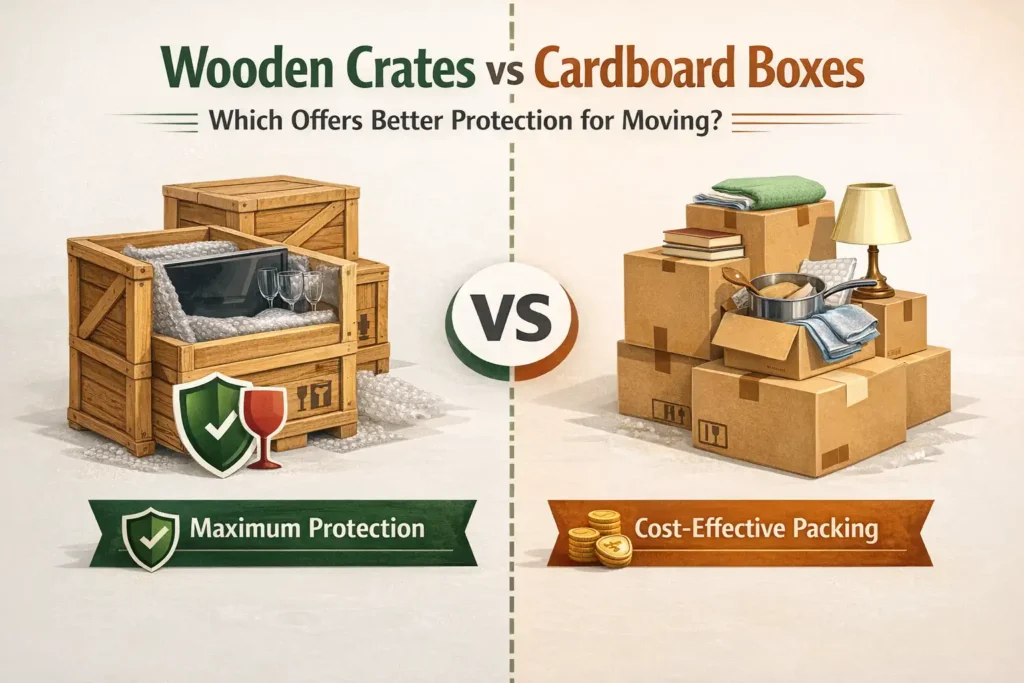
When planning a move, choosing the right packing material plays a critical role in preventing damage during transit. Items are exposed to multiple risks such as stacking pressure, vibrations, handling errors, moisture, and long transit hours. This is why many people comparing packing options often narrow the choice down to wooden crates and cardboard boxes—two widely used but very different protection solutions. For long-distance or high-value relocations, professional packers and movers help assess whether wooden crates or cardboard boxes are the safer choice based on transit conditions.
For residential and commercial relocations booked through Professional Packers And Movers, understanding how these two packing materials perform in real moving conditions helps in making an informed, damage-free decision. Wooden crates are known for their rigid structure and high load tolerance, while cardboard boxes are valued for their affordability, lightweight handling, and ease of disposal. However, the level of protection they offer can vary significantly depending on the nature of the items being packed, transit distance, and environmental conditions.
Material Strength & Structural Durability: Which Packing Option Is Stronger?
The primary difference between wooden crates and cardboard boxes lies in how each material responds to physical stress during packing, loading, stacking, and transportation. Structural durability directly impacts how well items remain protected when exposed to pressure, shocks, and rough handling—common conditions during both local and long-distance moves.
Wooden Crates: High Structural Strength
Wooden crates are built using solid wooden panels that create a rigid, self-supporting structure. This rigidity allows them to withstand significant external pressure without collapsing or deforming.
Key durability characteristics of wooden crates:
- Strong resistance to crushing and compression during stacking
- Maintains shape under heavy loads and long transit durations
- Better impact resistance during loading, unloading, and vehicle movement
- Can be engineered to match the size and weight of the item being packed
Because the structure does not flex easily, wooden crates offer consistent protection even when placed under other heavy packages or transported across uneven roads.
Cardboard Boxes: Moderate Strength with Limitations
Cardboard boxes are typically made from corrugated fiberboard, where strength comes from layered paper fluting sandwiched between flat liners. While this design provides reasonable rigidity for lightweight items, it has clear limitations under stress.
Structural limitations of cardboard boxes:
- Reduced strength when exposed to repeated stacking
- Susceptible to bending and buckling under heavy weight
- Structural integrity decreases if the box absorbs moisture
- Less resistant to sharp impacts or sudden pressure
Cardboard boxes perform best when weight limits are respected and when boxes are stacked correctly. However, their durability drops significantly in demanding transit conditions.
Durability Comparison
Durability Factor | Wooden Crates | Cardboard Boxes |
Load-bearing capacity | High | Moderate |
Resistance to crushing | Strong | Limited |
Impact tolerance | High | Moderate |
Shape retention | Excellent | Can deform |
Performance in long transit | Reliable | Risk-prone |
Which Is More Durable?
- Wooden crates provide superior structural durability, especially for heavy, high-value, or sensitive items.
- Cardboard boxes offer adequate strength for lightweight household goods, but their performance depends heavily on handling conditions and environment.
Fragile & High-Value Items: Which Packing Method Prevents Damage Better?
When transporting delicate or expensive belongings, protection against shock, vibration, and internal movement becomes more important than basic strength. The ability of a packing material to keep items stable and cushioned during transit largely determines whether fragile goods arrive safely or suffer damage.
Wooden Crates: Superior Protection for Delicate Items
Wooden crates offer a rigid outer shell that limits external pressure and reduces the risk of sudden deformation. This makes them highly effective for packing items that cannot tolerate bending, compression, or movement.
Why wooden crates protect fragile items better:
- Fixed structure prevents external force from reaching the item directly
- Allows custom internal bracing and padding to hold items firmly in place
- Reduces internal shifting during road vibrations and braking
- Suitable for items that require upright or position-specific packing
Wooden crates are commonly used for items where even minor damage can result in high repair or replacement costs.
Cardboard Boxes: Protection Depends on Internal Cushioning
Cardboard boxes rely heavily on internal packing materials—such as bubble wrap, foam, or paper—to protect fragile items. While they can be effective for light and moderately delicate goods, the outer box itself offers limited resistance to pressure.
Limitations when packing fragile items in cardboard boxes:
- Outer walls can compress under weight, affecting internal cushioning
- Increased risk of damage if boxes are dropped or mishandled
- Requires careful weight distribution and extra padding
- Not ideal for items with sharp edges or uneven shapes
Cardboard boxes work best for fragile items only when transit distance is short and handling conditions are controlled.
Fragile Item Suitability Comparison
Item Type | Wooden Crates | Cardboard Boxes |
Glass items | Highly suitable | Suitable with heavy padding |
Electronics | Highly suitable | Suitable for light devices |
Artwork & antiques | Recommended | Risk-prone |
Machinery parts | Recommended | Not suitable |
Household decor | Suitable | Suitable |
Fragility Protection Verdict
- Wooden crates provide maximum protection for fragile and high-value items by minimizing both external impact and internal movement.
- Cardboard boxes offer conditional protection, effective only when reinforced with proper cushioning and used for lower-risk items.
To minimize financial loss from transit damage, it’s important to understand what transit insurance covers during house shifting when choosing packing materials.
Moisture, Weather & Transit Risks: How Each Packing Material Performs
During relocation, packed items are often exposed to unpredictable environmental conditions such as rain, humidity, temperature changes, and prolonged storage inside vehicles or warehouses. The ability of packing materials to resist these conditions directly affects the safety of the items inside.
Wooden Crates: Better Stability in Harsh Transit Conditions
Wooden crates provide a solid external barrier that performs more reliably than cardboard when exposed to rough transit environments. While wood can absorb moisture, its structural strength remains largely intact compared to paper-based materials.
Environmental resistance advantages of wooden crates:
- Maintains structural shape even in damp or humid conditions
- Less likely to collapse during rain exposure or wet handling areas
- Provides physical protection against external transit hazards
- Suitable for long-distance moves involving multiple handling points
Wooden crates are especially effective when items may face extended transit time or temporary storage during relocation.
Cardboard Boxes: Highly Sensitive to Moisture
Cardboard boxes are vulnerable to moisture absorption, which significantly reduces their strength and stability. Even brief exposure to water or high humidity can compromise the box’s ability to protect its contents.
Weather-related limitations of cardboard boxes:
- Loses rigidity when exposed to moisture or damp air
- Increased risk of tearing or collapsing under weight
- Requires plastic wrapping or waterproof covering for protection
- Less reliable during monsoon conditions or long storage periods
Because of this sensitivity, cardboard boxes demand extra protective measures when used in challenging weather conditions.
Environmental Resistance Comparison
Condition | Wooden Crates | Cardboard Boxes |
Moisture exposure | Moderate resistance | Poor resistance |
Humidity impact | Structural strength retained | Strength degrades |
Rain during transit | Lower risk | High risk |
Long storage periods | Suitable | Not recommended |
Weather Resistance Verdict
- Wooden crates offer more reliable protection in variable weather and long transit conditions.
- Cardboard boxes are weather-sensitive and require additional waterproofing to remain effective.
Cost Comparison: Are Wooden Crates Worth the Higher Price?
Cost is a major deciding factor when selecting packing materials, but focusing only on the upfront price can be misleading. A proper comparison looks at initial expense, potential damage risk, and long-term usability to understand the true value of wooden crates versus cardboard boxes.
Cardboard Boxes: Lower Initial Cost
Cardboard boxes are widely used because they are affordable and easy to source. Their low upfront cost makes them suitable for moves where packing materials are needed for a short duration.
Cost-related advantages of cardboard boxes:
- Lower purchase or procurement cost
- Suitable for single-use or short-distance moves
- Lightweight nature may reduce handling effort
- Easy to dispose of or recycle after use
For standard household items with minimal risk, cardboard boxes offer a cost-effective solution.
Wooden Crates: Higher Upfront Cost with Long-Term Value
Wooden crates require more material, labor, and customization, which increases the initial cost. However, this higher investment often translates into better protection and long-term usability.
Cost-related advantages of wooden crates:
- Designed for multiple reuse cycles
- Can be repaired rather than replaced
- Reduces risk of costly item damage
- Better cost efficiency for high-value goods
For items where damage would result in significant loss, wooden crates can offer better value despite the higher starting price.
Cost Comparison
Cost Aspect | Wooden Crates | Cardboard Boxes |
Initial cost | High | Low |
Reusability | High | Low to moderate |
Replacement frequency | Low | High |
Damage-related loss risk | Low | Moderate to high |
Long-term value | Strong | Limited |
Cost Efficiency Verdict
- Cardboard boxes are budget-friendly for low-risk, short-term packing needs.
- Wooden crates offer better long-term value when protection and reuse are prioritized.
Packing material choices also influence overall relocation expenses, which is why reviewing a detailed packers and movers cost breakdown helps in accurate budget planning.
Handling & Transportation: Weight, Loading, and Moving Efficiency Compared
Beyond protection and cost, the practical aspects of handling and transportation significantly influence the choice between wooden crates and cardboard boxes. Weight, maneuverability, and loading requirements can affect moving efficiency, labor effort, and overall transit safety.
Wooden Crates: Heavy but Stable
Wooden crates are inherently heavier due to solid construction, which impacts how they are handled during a move. Their weight, however, contributes to stability and reduces the likelihood of accidental shifting.
Handling characteristics of wooden crates:
- Heavier weight requires more manpower or mechanical support
- Stable structure reduces risk during stacking and vehicle movement
- Less prone to tipping or collapsing during loading
- Suitable for controlled handling environments
Because of their weight, wooden crates are typically used when protection is prioritized over ease of movement.
Cardboard Boxes: Lightweight and Easy to Manage
Cardboard boxes are favored for their lightweight design, making them easier to lift, carry, and load without specialized equipment.
Handling advantages of cardboard boxes:
- Easy to carry and stack manually
- Faster packing and unpacking process
- Suitable for quick local moves
- Convenient for multi-box household packing
Their ease of handling makes cardboard boxes practical for everyday moving scenarios where speed and simplicity are important.
Handling & Transportation Comparison
Factor | Wooden Crates | Cardboard Boxes |
Weight | Heavy | Light |
Manual handling | Limited | Easy |
Stability during transit | High | Moderate |
Loading speed | Slower | Faster |
Equipment requirement | Sometimes required | Not required |
Handling Verdict
- Wooden crates provide stable, secure handling but demand more effort and resources.
- Cardboard boxes offer ease and speed, making them ideal for routine household moves.
Best Use Cases Explained: When to Use Wooden Crates vs Cardboard Boxes
Choosing between wooden crates and cardboard boxes ultimately depends on what you are moving, how far it is traveling, and the level of risk involved. Each packing option serves a specific purpose, and selecting the right one helps balance protection, cost, and efficiency.
When Wooden Crates Are the Better Choice
Wooden crates are best suited for situations where maximum protection and stability are required. Their rigid structure and high load tolerance make them ideal for demanding relocation conditions.
Recommended use cases for wooden crates:
- Fragile or high-value items that cannot risk impact damage
- Heavy equipment or items with uneven shapes
- Long-distance or intercity relocations
- Moves involving multiple loading and unloading points
- Storage situations where stacking and pressure are expected
Wooden crates are particularly effective when damage prevention is a higher priority than packing speed or material cost.
When Cardboard Boxes Are the Better Choice
Cardboard boxes work well for everyday household packing where items are relatively durable and transit conditions are less severe.
Recommended use cases for cardboard boxes:
- Clothing, books, kitchenware, and non-fragile items
- Local or short-distance moves
- Situations requiring lightweight and easy handling
- Budget-conscious relocations
- One-time use packing needs
When used with proper padding and careful handling, cardboard boxes offer reliable performance for standard moving requirements.
Use Case Comparison
Moving Scenario | Wooden Crates | Cardboard Boxes |
Fragile items | Ideal | Conditional |
High-value goods | Recommended | Risk-prone |
Local moves | Optional | Ideal |
Long-distance moves | Ideal | Conditional |
Storage use | Suitable | Limited |
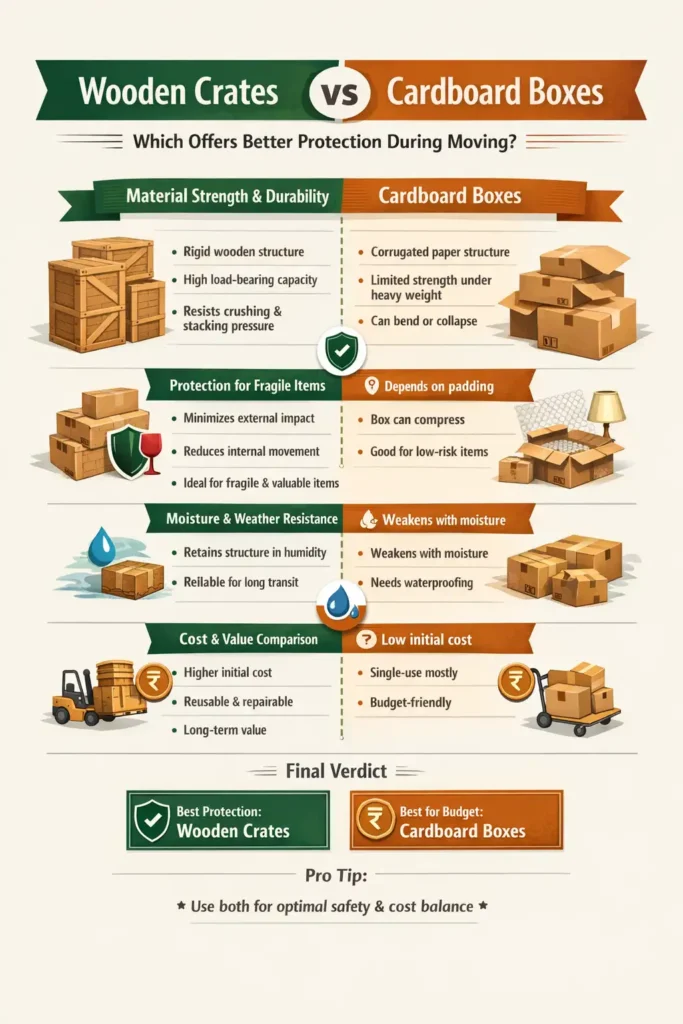
Which Offers Better Protection?
- Wooden crates provide the highest level of protection, especially for fragile, heavy, or high-value items.
- Cardboard boxes offer practical and economical protection for standard household goods when used correctly.
For the best results, many moves benefit from a combined packing approach, using wooden crates for sensitive items and cardboard boxes for general household belongings.
FAQs About Wooden Crates vs. Cardboard Boxes
Yes, wooden crates offer stronger structural support and reduce the risk of impact damage, making them more suitable for fragile and high-value items.
Cardboard boxes can be used for long-distance moves if items are lightweight, properly padded, and protected from moisture exposure.
Wooden crates are used when items require rigid protection, higher load tolerance, and minimal movement during transit.
Wooden crates have a higher upfront cost, but they provide better protection and long-term value for sensitive items.
Yes, cardboard boxes can lose structural strength when exposed to moisture, which is why waterproof wrapping is often required.
Yes, combining both methods is common—wooden crates for fragile items and cardboard boxes for general household goods.
Moving Soon? Choose the Right Packing for Maximum Protection
Whether your move requires wooden crates for fragile valuables or cardboard boxes for efficient household packing, expert packing decisions make all the difference. Our trained professionals assess item risk, transit distance, and handling conditions to select the safest packing method for your move.
Get professional-grade packing and damage-free relocation support today.
🔹 Free Pre-Move Survey
🔹 Item-Specific Packing Solutions
🔹 Transparent Pricing with No Hidden Charges
Book Trusted Packers And Movers Now
If you’re relocating locally or intercity, experienced packers and movers in Lucknow can recommend the right combination of wooden crates and cardboard boxes for safe transport.