
Air Freight vs Sea Freight: Which Shipping Method Is Best for Your International Move from India?
Relocating internationally is a major life transition, and one of the most important decisions you’ll face is choosing the right shipping method for your household goods. Should you ship your belongings by air for faster delivery, or choose sea freight for a more budget-friendly option? Both methods have clear advantages—and understanding the differences can help you avoid unnecessary delays, manage your moving costs effectively, and protect your items during transit. If you’re planning a move abroad and still exploring professional assistance, you can also check reliable movers here: Packers and Movers.
For Indians relocating to the USA, UK, Europe, Australia, UAE, or Canada, If you’re planning a global move, working with experienced international relocation services can simplify shipping, customs clearance, and delivery. Following expert Moving Tips can also help you understand the key differences between air and sea freight, as this choice affects everything from timelines and budgeting to packing methods, insurance requirements, and customs clearance. Verified industry data shows that air freight is significantly faster—but also far more expensive per kilogram—while sea freight is slower yet ideal for large-volume shipments.
Air Freight vs Sea Freight
Factor | Air Freight | Sea Freight |
Speed | 2–8 business days (fastest) | 15–50 days depending on destination |
Best For | Small, high-value, urgent items | Full-house moves, bulky items |
Pricing Basis | Chargeable weight (actual vs volumetric) | Cubic meter volume (LCL) or full container cost (FCL) |
Cost Level | Significantly higher | Most economical for large volumes |
Handling Risk | Low—minimal handling, less transit time | Higher—longer exposure, moisture & port delays |
Restrictions | Strict size, weight, and hazardous goods limits | Fewer restrictions; large items acceptable |
Environmental Impact | Higher CO₂ footprint per ton-km | Lower CO₂ footprint per ton-km |
Customs Clearance Speed | Faster at most airports | Slower due to port processing and container steps |
Ideal Use Case | Essentials you need immediately | Furniture, appliances, and full-home shipments |
Understanding the Key Differences Between Air Freight and Sea Freight
Air and sea freight differ in speed, cost, handling, and capacity—and these differences directly affect your international moving experience. Air freight shipments typically travel via commercial or cargo aircraft and reach their destination in 2–8 business days, depending on the route. Sea freight, shipped in 20ft or 40ft containers, usually takes 15 to 50 days depending on origin and destination ports.
- Air freight uses volumetric (dimensional) weight for pricing, which means large but lightweight household items may still be billed at a high rate.
- Sea shipments are priced as FCL (Full Container Load) or LCL (Less-than-Container Load), making them cost-efficient for larger volumes.
These distinctions determine which mode aligns better with your budget, shipment size, and urgency.
Cost Comparison: Which Option Is More Budget-Friendly?
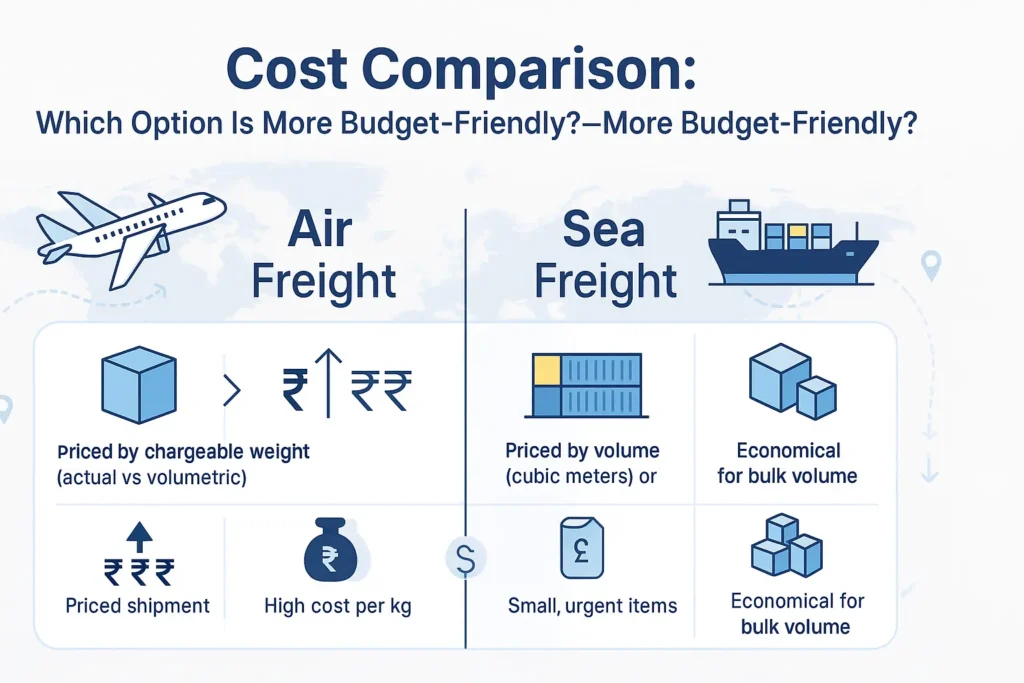
When planning an international move from India, cost becomes one of the biggest deciding factors between air freight and sea freight. Although air shipping offers unmatched speed, it is significantly more expensive—often many times costlier—than sending your goods by sea. Verified freight-industry guidance shows that air freight rates from India to destinations like the USA, UK, and Australia commonly range from USD $3 to $10 per kg, depending on carrier, season, fuel surcharges, and weight breaks. Sea freight, on the other hand, becomes increasingly economical as shipment volume increases, especially when using FCL (Full Container Load). To understand how relocation charges are calculated across different moving scenarios, refer to our detailed packers and movers cost guide.
Below are the key cost components that help you understand how each mode is priced.
How Air Freight Charges Are Calculated (Volumetric vs Actual Weight)
Air freight charges are calculated using chargeable weight, which is determined by comparing:
- Actual weight of the shipment, and
- Volumetric weight (dimensions converted into weight)
Airlines use a standard volumetric formula where 1 cubic meter = 167 kg chargeable weight.
So even lightweight household goods (like cushions or plastic storage drawers) may be billed at high chargeable weights if they take up significant space.
This is why air freight becomes expensive quickly for household relocations—volume matters as much as weight.
How Sea Freight Charges Are Calculated (LCL vs FCL Pricing)
Sea freight charges depend primarily on shipment volume, not weight.
Two major pricing categories apply:
- LCL (Less-than-Container Load): You pay for the volume you occupy inside a shared container. Ideal for small shipments (1–5 cubic meters).
- FCL (Full Container Load): You hire an entire 20ft or 40ft container, making it far more economical for 1BHK–3BHK household moves.
LCL is beneficial for small consignments but includes additional consolidation/deconsolidation fees.
FCL is cost-effective for large moves because the container cost is fixed regardless of how much you fill it.
Additional Costs You Should Expect in Both Methods
Regardless of whether you choose air or sea shipping, expect several mandatory additional charges, including:
- Fuel surcharge (airline or carrier-specific)
- Terminal Handling Charges (THC)
- Documentation & processing fees
- Customs clearance fees
- Port or airport handling charges
- Delivery to and from port/airport
- Insurance premiums
- LCL consolidation charges (for sea shipments)
These charges can significantly impact your final moving budget, so always request a detailed quotation from your mover.
How to Estimate Your Total Moving Budget Accurately
To avoid surprises during an international move, calculate your estimated budget using the following steps:
- Measure your shipment volume accurately (total cubic meters).
- Compare air chargeable weight vs. sea volume cost using real quotes.
- Account for add-ons such as packing, insurance, customs, THC, and last-mile delivery.
- Check seasonal variations—rates increase during peak months (June–August & November–January).
- Use online freight calculators or request door-to-door quotations from professional movers.
Industry tools like Freightos and carrier rate portals provide updated rate trends that help you benchmark costs.
Transit Time Differences: Which Shipping Method Is Faster?
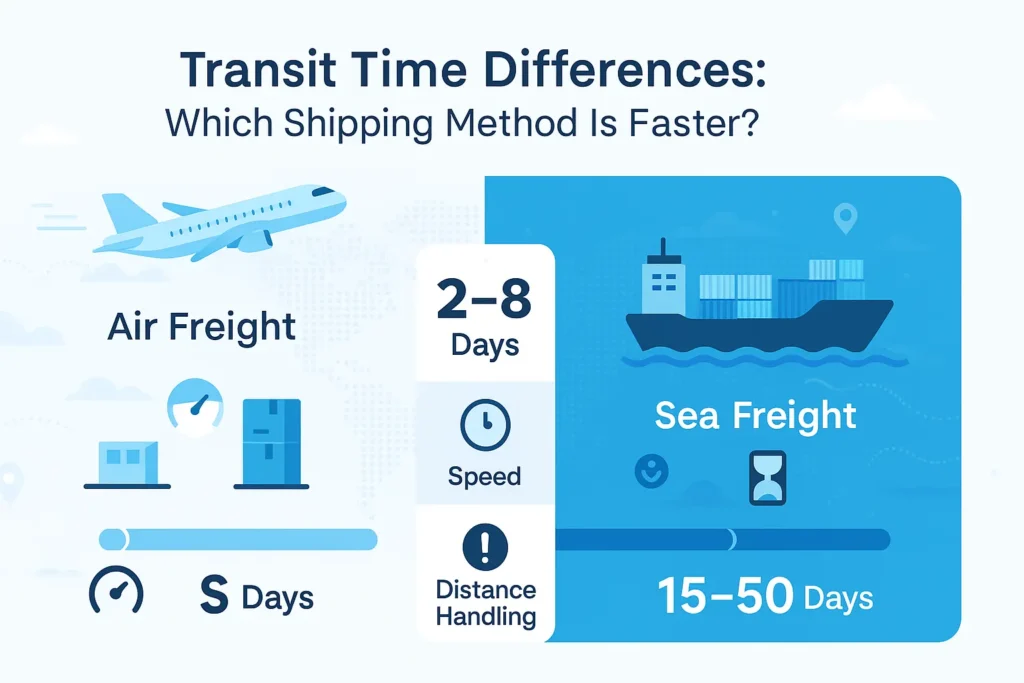
Transit time is one of the biggest differentiators between air and sea freight—especially for international moves from India. Verified global freight data shows that air freight typically reaches major destinations such as the USA, UK, Europe, Australia, and the Middle East within 2 to 8 business days, depending on routing, carrier schedules, and customs processing speed. Sea freight, however, moves much slower. Shipping lines operating out of India’s key ports—Nhava Sheva (JNPT), Mundra, and Chennai—generally take 15 to 50 days to reach foreign ports, depending on the destination and whether transshipment is required.
In real-world relocations, the timeline extends beyond port-to-port movement. Sea freight may additionally require:
- Container stuffing at origin
- Port gate-in procedures
- Customs clearance at both ends
- Deconsolidation (for LCL shipments)
- Final-mile delivery
Air shipments, though faster, still depend on customs release, airport handling, and delivery schedules—but overall, they minimize waiting time and offer greater consistency. This is why people moving under strict deadlines (such as joining-date commitments, lease start dates, or academic schedules) often prefer air freight despite the higher cost.
Shipment Size & Volume: How Much Are You Planning to Move?
The volume of goods you plan to ship plays a major role in deciding whether air freight or sea freight is the better option for your international move from India. Air freight is typically suited for small, essential, high-value, or time-sensitive items, because pricing is based on chargeable weight, which can become extremely expensive for larger shipments. In contrast, sea freight is designed for medium to large household volumes, especially when moving complete 1BHK, 2BHK, or 3BHK homes, where goods can fill part or all of a 20ft or 40ft container. (source: https://www.maersk.com)
For smaller shipments—generally under 1 to 3 cubic meters—air freight may be worth considering if speed is a priority. However, once your volume exceeds 5 cubic meters, sea freight becomes more economical through either LCL (Less-than-Container Load) or FCL (Full Container Load) options. With LCL, your cargo shares container space with others, and pricing depends on cubic meters used. With FCL, you pay a flat rate for the entire container, making it ideal for full-house relocations.
Because international household goods can be bulky (furniture, appliances, mattresses, etc.), most family relocations from India naturally lean toward sea freight unless the shipment is small or urgent. Understanding your total cubic meter volume—often calculated through a pre-move survey—helps you choose the most suitable and cost-effective shipping method for your move abroad.
Safety, Handling & Risk Factors During International Shipping
Safety and handling conditions vary significantly between air and sea freight, and these differences can influence the condition of your belongings upon arrival. Verified industry guidance shows that air freight generally involves fewer handling steps, shorter transit durations, and lower exposure to environmental conditions—making it a safer choice for fragile, high-value, or time-sensitive household items. Because shipments move quickly through the airport system, the risk of moisture damage, mishandling, or prolonged storage is considerably reduced.
Sea freight, while reliable, exposes cargo to a longer supply chain. Containers may face multiple handovers, loading and unloading at ports, weather conditions, and extended storage periods. This increases the importance of professional export packing, moisture protection (such as vacuum packing or desiccants), and adequate marine cargo insurance. Containers traveling by sea also encounter risks such as condensation buildup (“container rain”) or delays caused by port congestion or customs holds. Regardless of the shipping method, it’s important to know what protection you have—here’s a breakdown of what transit insurance covers during house shifting.
Both methods are safe when handled by certified movers, but their risk profiles differ. Air freight minimizes damage risks due to limited handling and reduced transit time, while sea freight requires more robust packing standards and insurance coverage to mitigate long-duration exposure.
Customs Clearance Procedures for Air and Sea Shipments
Customs clearance is a crucial step in any international relocation, and the process shares many similarities between air and sea freight—though timelines and handling differ due to each mode’s speed and operational flow. Verified export/import procedures from Indian authorities show that both air and sea shipments require core documentation, including a Packing List, Commercial Invoice, Airway Bill or Bill of Lading, Shipping Bill/Bill of Export, and any supporting certificates required for specific goods. Professional movers handle documentation, inspections, and coordination—here’s how packers and movers work during complex relocations.
For air freight, customs clearance generally moves faster because shipments arrive quickly and pass through airport terminals designed for high turnover. Clearance windows are often shorter, reducing the total time your belongings spend in storage or waiting for release. However, airports have stricter security checks, and shipments may be examined more frequently due to aviation safety standards.
For sea freight, customs procedures follow the same legal requirements but involve additional steps such as container scanning, port handling, and—in the case of LCL shipments—deconsolidation before final delivery. Clearance may take longer due to vessel schedules and port congestion. Import regulations at the destination also vary; many countries require declarations for used household goods, and some may impose duties or require proof of residency or employment visas.
In both cases, professional movers and freight forwarders manage documentation, filings, and coordination with customs authorities to ensure compliance and smooth passage. Proper paperwork and accurate packing lists remain essential to prevent holds, fines, or delays.
Destination Country Factors That Influence the Right Choice
Your destination country plays a major role in determining whether air freight or sea freight is the better option for your international relocation. Shipping routes, customs regulations, port efficiency, and even geography all influence cost, transit time, and reliability. Verified freight lane data shows that countries with direct sea routes from India—such as the USA, UK, and parts of Europe—typically offer multiple sailing schedules each month, making sea freight a practical and economical option for larger shipments.
However, for landlocked countries or destinations with limited port infrastructure, sea freight may require additional overland transport after arrival at the nearest port, adding both cost and time. In such cases, air freight can simplify logistics, especially when the receiving country has well-connected international airports.
Destination customs policies for used household goods also matter. Many countries require detailed inventories, import declarations, and supporting documents such as visas, work permits, or proof of long-term stay. Some destinations scrutinize goods more strictly or impose duties on certain items. Indian customs guidance and embassy documentation resources confirm that compliance varies widely between countries, making it essential to check destination-specific rules before choosing your shipping mode.
If speed and predictability are priorities—for instance, moving to countries where port congestion is common—air freight becomes attractive despite its higher cost. Conversely, if your destination is well-served by ocean carriers and you have a large household shipment, sea freight will likely offer the best value.
Pros and Cons of Air Freight for International Relocation
Air freight is the fastest and most reliable method for transporting household goods during an international move. Verified freight-industry data shows that air shipments from India typically reach destinations such as the USA, UK, Europe, Australia, and the Middle East within 2 to 8 business days, offering unmatched speed compared to sea transport. This makes air freight particularly suitable for people who need their essential belongings quickly—such as professionals relocating for work, students joining academic programs, or families with immediate accommodation arrangements.
Another advantage is reduced handling and lower risk exposure. Air cargo moves through tightly controlled airport environments, experiences minimal handling steps, and spends far less time in transit. This decreases the likelihood of damage, moisture exposure, and delays. For high-value or fragile household items—electronics, important documents, artwork, or delicate décor—air freight offers enhanced safety.
However, the primary drawback is cost. Air freight is significantly more expensive because pricing is based on chargeable weight, which compares actual weight with volumetric weight (calculated using the global standard: 1 cubic meter = 167 kg). Large or bulky household items can therefore become extremely expensive to ship by air. Additionally, there are stricter restrictions on hazardous materials, lithium batteries, and oversize items, limiting what can be transported.
In summary, air freight is ideal when speed, safety, and predictability matter—but its high cost makes it suitable mainly for small, urgent, or high-value shipments rather than full household relocations.
Pros and Cons of Sea Freight for International Home Shifting
Sea freight is the most widely used shipping method for full-house relocations from India because it is significantly more cost-effective for medium to large volumes. Verified freight data shows that sea shipments are priced primarily on cubic meter volume rather than weight, allowing families to move furniture, appliances, and bulkier household goods economically—especially when using FCL (Full Container Load) options such as 20ft or 40ft containers. Even LCL (Less-than-Container Load) is a practical alternative for smaller volumes, making sea freight flexible for different shipment sizes.
One of the major advantages of sea freight is its capacity. Containers are designed to hold large and varied items, allowing movers to transport almost everything from an entire 1BHK to a 3BHK home, depending on container size. Sea freight also accommodates items that would be restricted or heavily surcharged in air freight—such as bulky furniture, liquids, or certain appliances.
However, the primary drawback is transit time. Sea freight from Indian ports such as Nhava Sheva (JNPT), Mundra, or Chennai can take 15 to 50 days to reach destinations worldwide, depending on sailing schedules, transshipment hubs, and port congestion. Longer transit periods increase exposure to risks such as moisture, condensation (“container rain”), weather delays, and handling at multiple points. This is why professional export-grade packing, moisture barriers, and marine cargo insurance are strongly recommended for sea shipments.
Start by assessing your total volume in cubic meters, understanding your timeline, and reviewing the import regulations of your destination country. When necessary, combining both methods—sending essentials by air and the rest by sea—can give you the speed and affordability needed for a smooth transition. With proper planning and professional export packing, you can make an informed and cost-efficient choice for your international move. Before finalizing a mover, review this guide on how to choose the best packers and movers to avoid hidden costs or service issues.
For end-to-end support, packing, documentation, and international shipping coordination, speak to verified packers and movers before planning your move.