
How Packers and Movers Work: Complete Relocation Process Explained
Packers and movers follow a step-by-step relocation process that starts with a pre-move survey to assess goods and requirements. Based on this, they provide a written quotation. On moving day, items are professionally packed, labeled, and listed in an inventory, then loaded and transported safely to the destination. After arrival, goods are unloaded, unpacked, and verified, completing the move with proper documentation and delivery confirmation.
Relocating a home or office involves far more than just shifting boxes from one place to another. Professional packers and movers follow a structured, step-by-step process designed to reduce damage, avoid delays, and ensure accountability at every stage of the move. Understanding how packers and movers work helps customers make informed decisions, compare quotes correctly, and avoid common relocation disputes. If you are planning a move, choosing a Reliable Packers And Movers service becomes easier when you clearly understand what happens before, during, and after relocation. For city-specific relocation needs, you can explore professional packers and movers services offered across major cities in India.
Explains the actual working process of packers and movers, including packing methods, transportation flow, documentation, and post-move responsibilities. By knowing how professional movers operate, you gain cost transparency, better coordination, and greater control over your relocation
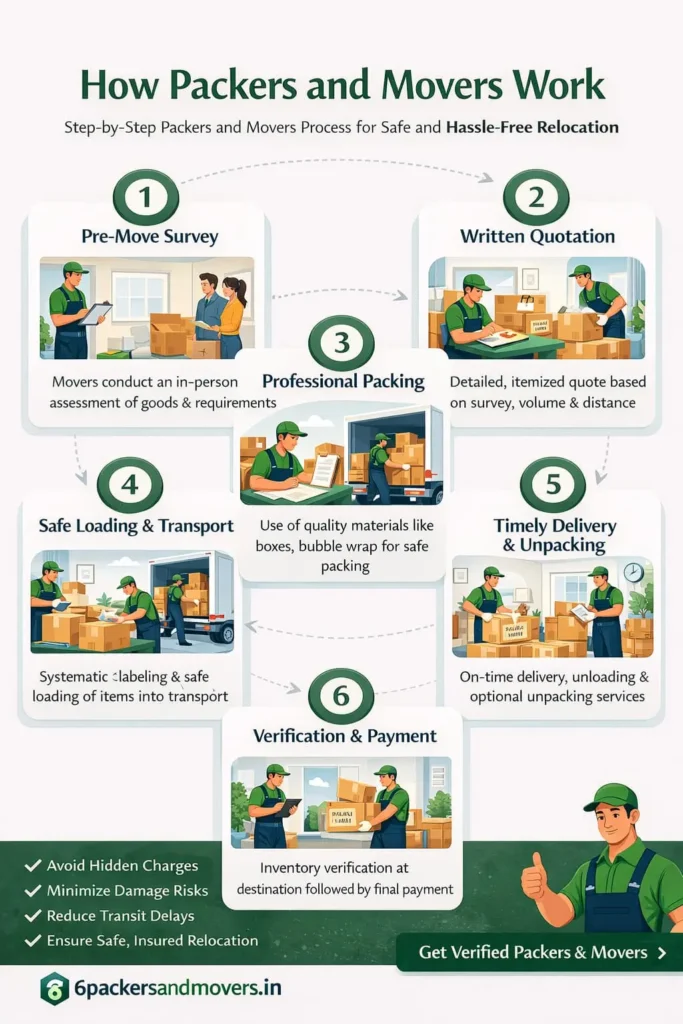
How the Packers and Movers Process Works Step by Step
Professional packers and movers in India follow a defined relocation workflow to ensure accuracy, safety, and legal compliance. The process begins well before the moving day and continues until delivery confirmation is completed.
Step-by-step working process of packers and movers
1. Customer enquiry and requirement assessment
The process starts when a customer shares basic move details such as pickup location, destination, tentative moving date, and type of goods. This information helps movers determine whether a local or intercity relocation process is required.
2. Pre-move survey (physical or virtual)
A pre-move survey is conducted to assess the volume of goods, packing complexity, access conditions (stairs, lift, parking), and special handling requirements. Many movers now conduct video surveys to achieve similar accuracy while saving time.
This survey forms the foundation of cost estimation and vehicle selection. Understanding how survey findings impact pricing is important—refer to this detailed guide on how packers and movers calculate moving costs.
3. Quotation preparation and cost estimation
Based on survey findings, movers prepare a quotation that reflects:
- Total volume of goods
- Distance to be covered
- Packing materials required
- Manpower and vehicle size
- Additional services such as insurance or storage
Accurate surveys reduce last-minute price changes and billing disputes.
To avoid billing disputes, customers should review a complete packers and movers cost breakdown before confirming a booking.
4. Booking confirmation and move scheduling
Once the customer approves the quotation, the booking is confirmed. Movers assign a schedule, manpower team, and transport plan. Written confirmation ensures clarity on service scope and timelines.
5. Move coordination and execution
A move coordinator may be assigned to oversee packing, loading, transportation, and delivery coordination, especially for intercity moves.
Process flow overview
Stage | Purpose | Customer Benefit |
Enquiry & Survey | Assess volume and requirements | Accurate cost & planning |
Quotation | Define service scope and charges | Cost transparency |
Booking | Lock date and resources | Reduced delays |
Packing & Loading | Protect goods | Damage prevention |
Delivery & Closure | Complete relocation | Accountability |
Why this step-by-step process matters
- Prevents underestimation of costs
- Ensures correct truck size and manpower
- Reduces risk of item damage or missing goods
- Creates documentation trail for dispute resolution
Understanding this workflow allows customers to evaluate whether a mover follows professional standards or skips critical steps.
Professional Packing Process Used by Packers and Movers
The packing stage is the most critical part of the entire relocation process because it directly impacts the safety of your belongings during loading, transportation, and unloading. Professional packers and movers follow standardized packing methods to minimize damage, prevent breakage, and ensure traceability of items throughout the move.
Unlike self-packing, professional packing focuses on material selection, item categorization, and inventory control, which together reduce loss and insurance disputes.
How professional packers pack household goods
- Use of professional packing materials
Movers select packing materials based on the nature of items being packed. These materials are designed to absorb shocks, resist moisture, and prevent movement inside cartons. - Room-wise packing approach
Goods are packed room by room (kitchen, bedroom, living room) to maintain order and simplify unpacking at the destination. This also improves inventory accuracy. - Fragile-item protection techniques
Fragile items such as crockery, glassware, mirrors, and electronics are wrapped individually using cushioning layers and placed in reinforced cartons. Items are marked for careful handling. - Furniture and appliance packing
Large furniture and appliances are wrapped with corrugated sheets, bubble wrap, and stretch film to prevent scratches, moisture exposure, and impact damage during transit. - Inventory preparation and labeling
Each packed box is labeled and recorded in an inventory list. This inventory is checked during loading and again at delivery to confirm item count and condition.
Proper inventory documentation also plays a crucial role in insurance protection—here’s what transit insurance covers during house shifting.
Common packing materials used by packers and movers
Packing Material | Used For | Purpose |
Corrugated cartons | Clothes, books, utensils | Structural protection |
Bubble wrap | Fragile items | Shock absorption |
Stretch/shrink film | Furniture, appliances | Dust & moisture protection |
Foam / thermocol sheets | Glass & electronics | Impact cushioning |
Packing tape & labels | All cartons | Sealing & identification |
Why professional packing reduces relocation risks
- Prevents item movement inside cartons
- Reduces chances of transit damage
- Creates documented inventory for verification
- Supports insurance claims if required
Professional packing is not just about wrapping items—it is a controlled process that safeguards goods from the point of pickup until final delivery.
Loading and Transportation Process Explained by Packers and Movers
After packing is completed, the relocation process moves into the loading and transportation stage. This phase is operationally sensitive because improper loading or vehicle selection can lead to damage, transit delays, or missing items. Professional packers and movers follow defined loading practices and transport planning methods to ensure goods reach the destination safely.
How professional movers handle loading
- Systematic loading sequence
Movers load goods in a planned order, placing heavier items such as furniture and appliances first, followed by lighter cartons. This sequence maintains balance and prevents crushing of fragile boxes. - Weight distribution and securing methods
Items are positioned to distribute weight evenly across the vehicle. Movers use ropes, straps, and locks to secure goods and restrict movement during transit. - Use of handling equipment
Equipment such as trolleys, sliders, ramps, and lifting belts are used to reduce manual strain and prevent accidental drops during loading and unloading.
Transportation planning and vehicle selection
Professional movers select vehicles based on survey data, route conditions, and load volume. Choosing the correct vehicle reduces reloading risks and transit damage.
Types of transport commonly used
- Small trucks or tempos for local shifting
- Medium or large trucks for intercity moves
- Containerized vehicles for long-distance household relocation
Shared vs dedicated transportation
Transport Type | How It Works | Impact on Delivery |
Shared transport | Goods combined with other consignments | Lower cost, longer transit |
Dedicated transport | Entire vehicle assigned to one customer | Faster delivery, less handling |
Transit safety and delay management
Movers plan routes in advance, considering distance, road conditions, and delivery timelines. Delays may occur due to traffic, weather, or regulatory checks, especially for intercity moves. Professional coordination reduces idle time and improves delivery predictability.
Why loading & transportation quality matters
- Prevents shifting and breakage during transit
- Reduces re-handling risks
- Improves delivery timelines
- Protects packed inventory integrity
Customers should also be aware of common risks during transit and how to identify reliable versus fraudulent moving companies.
Unloading, Unpacking, and Post-Move Services Explained
The relocation process does not end when the transport vehicle reaches the destination. Unloading, unpacking, and post-move services play a crucial role in ensuring that the relocation is completed smoothly and without unresolved issues. Professional packers and movers follow a structured delivery protocol to maintain accountability and customer satisfaction.
How unloading is carried out at the destination
- Systematic unloading of goods
Movers unload items in a controlled sequence, starting with heavy furniture and appliances, followed by cartons. This prevents congestion and reduces accidental damage. - Placement as per customer instructions
Goods are placed in designated rooms as directed by the customer, reducing unnecessary re-handling and confusion during unpacking.
Unpacking and reassembly support
- Unpacking of cartons
If included in the service scope, movers unpack household items, remove protective materials, and assist with basic arrangement. - Furniture and appliance reassembly
Beds, tables, wardrobes, and other dismantled furniture are reassembled. Appliances are positioned as per customer guidance.
Post-move inspection and closure
- Inventory verification at delivery
The inventory list prepared during packing is checked again at the destination to confirm item count and condition. This step is critical for identifying missing or damaged items. - Debris removal and cleanup
Packing debris such as cartons, wrapping materials, and tapes may be removed if the service includes cleanup support. - Delivery confirmation and sign-off
Once goods are received and inspected, customers provide delivery confirmation. Any visible damage or discrepancies are recorded at this stage.
What post-move services typically include
Service Component | Purpose | Customer Benefit |
Unloading | Safe removal from vehicle | Damage prevention |
Unpacking | Organized setup | Time savings |
Reassembly | Restore furniture usability | Convenience |
Inventory check | Verify items | Dispute protection |
Debris removal | Clear living space | Clean handover |
Why post-move services matter
- Prevents unnoticed damage or missing items
- Enables faster settlement of claims if needed
- Ensures proper closure of the relocation job
- Improves overall relocation experience
Common Problems During Relocation and How Packers and Movers Handle Them
Documentation and legal compliance are critical parts of how professional packers and movers work. These documents ensure service transparency, protect customer rights, and provide a legal trail in case of disputes, delays, or insurance claims. Understanding these documents helps customers identify whether a mover operates in a compliant and accountable manner.
Key documents involved in the moving process
- GST invoice
Professional packers and movers issue a GST invoice that reflects the nature of services provided, applicable tax rate, and total charges. This invoice acts as official proof of transaction and service delivery. - Quotation and service agreement
The quotation shared after the pre-move survey outlines the agreed services, pricing structure, and scope of work. Written confirmation helps prevent post-move billing disputes. - Inventory list
An itemized inventory list is prepared during packing and is verified again at delivery. This document is essential for tracking items and resolving missing or damaged goods issues. - Lorry Receipt (LR) / Transport document
The LR serves as proof that goods have been handed over to the transporter for movement. It contains shipment details such as consignor, consignee, vehicle number, and destination. - Insurance policy (if opted)
Transit insurance documents define coverage scope, declared value, and claim conditions. Insurance is usually optional and must be specifically requested by the customer.
GST applicability in packers and movers services
The tax rate applied depends on how the service is classified and invoiced. Full relocation services that include packing, loading, transportation, and unloading are typically taxed at a higher rate than transport-only services.
Service Type | GST Treatment | What It Means for Customer |
End-to-end relocation | Higher GST rate | Covers packing + moving |
Transport-only service | Lower GST rate | No packing services |
Invoice without GST | Non-compliant | Higher risk |
Why documentation and compliance matter
- Confirms legality of the moving service
- Helps resolve disputes and claims
- Required for insurance and tax records
- Protects customers from unaccounted charges
Customers should always ensure documentation is complete and compliant—especially the GST invoice issued by packers and movers.
Common Myths vs Reality About Packers and Movers
Many relocation issues arise not because of poor service, but due to incorrect assumptions about how packers and movers actually work. Understanding the difference between common myths and real-world practices helps customers set correct expectations and avoid disputes during the move.
Myth vs Reality: What customers often misunderstand
Myth 1: All packers and movers follow the same process
Reality: Service quality, packing standards, documentation practices, and coordination methods vary widely between movers. Professional movers follow structured surveys, inventory preparation, and documented workflows, while others may skip critical steps.
Myth 2: Insurance is automatically included in moving charges
Reality: Transit insurance is usually optional and must be requested separately. Movers may offer assistance in arranging insurance, but coverage depends on declared value and policy terms.
Myth 3: Online quotes are final prices
Reality: Online or phone estimates are indicative. Accurate pricing is based on a pre-move survey that accounts for volume, access conditions, and special handling needs.
To avoid confusion, customers should follow a structured checklist before hiring packers and movers.
Myth 4: Movers are responsible for every type of item
Reality: Certain items such as flammable materials, perishable goods, and valuables may be excluded from standard moving services unless declared in advance.
Why clearing these myths matters
- Prevents unrealistic expectations
- Reduces post-move conflicts
- Encourages informed decision-making
- Improves relocation planning
Common Problems During Relocation and How Packers and Movers Handle Them
Relocation involves multiple variables—people, vehicles, routes, timelines, and handling conditions. Even with planning, certain problems can arise during household or office shifting. Professional packers and movers manage these challenges through preventive processes, documentation, and standardized handling methods.
Common relocation problems and professional handling methods
- Damage during packing or transit
Damage can occur due to improper packing, poor loading balance, or movement inside the vehicle. Professional movers reduce this risk by using appropriate packing materials, secure strapping, and inventory-based handling. - Missing or misplaced items
Missing items are usually linked to poor labeling or lack of inventory control. Movers address this by preparing itemized inventory lists and verifying them during loading and unloading. - Delays in pickup or delivery
Delays may result from traffic conditions, route restrictions, weather, or shared-transport schedules. Professional movers plan routes in advance and communicate realistic delivery timelines. - Billing disputes after relocation
Disputes often arise when quotations are not survey-based or when service scope is unclear. Movers minimize this by issuing written quotations and confirming inclusions before booking. - Insurance claim complications
Claims may be rejected if packing standards are not followed or inventory documentation is incomplete. Professional movers assist by maintaining packing records and inventory verification.
Many claims are rejected due to documentation gaps—here’s a detailed explanation of why packers and movers insurance claims get rejected in India.
Problem vs solution overview
Common Problem | Professional Handling Method | Outcome |
Item damage | Protective packing & securing | Reduced loss |
Missing goods | Inventory & labeling | Traceability |
Delivery delays | Route planning & coordination | Predictability |
Cost disputes | Written survey-based quotes | Transparency |
Claim rejection | Documentation support | Faster resolution |
Why professional handling matters
- Reduces risk exposure during transit
- Ensures accountability at each stage
- Protects customer interests legally
- Improves overall relocation reliability
Why Understanding the Packers and Movers Process Matters
Understanding how packers and movers work is essential for anyone planning a household or office relocation. When customers are aware of the complete relocation process—from survey and packing to documentation and delivery—they are better equipped to make informed decisions, avoid unnecessary risks, and ensure smoother coordination throughout the move.
A clear understanding of the process also helps customers identify professional movers who follow structured workflows instead of relying on vague promises or verbal commitments. This awareness significantly reduces relocation-related stress and disputes.
Key benefits of understanding the moving process
Cost transparency
When customers understand how quotes are calculated—based on volume, distance, packing needs, and services—they can compare estimates accurately and avoid hidden charges.
Risk reduction
Knowledge of packing standards, loading methods, insurance options, and inventory checks helps customers minimize the risk of damage, loss, or claim rejection during transit.
Better coordination
Understanding timelines, documentation, and service scope allows customers to coordinate more effectively with movers, housing societies, and delivery schedules.
Stress-free relocation
When expectations are aligned with actual processes, relocation becomes predictable and manageable. Customers can focus on settling into their new space instead of resolving avoidable issues.
Planning a Move? Choose a Process-Driven Packers and Movers Service
Avoid hidden charges, damage risks, and relocation stress by working with professional movers who follow a transparent, step-by-step moving process.
- Compare verified packers and movers near you
- Get survey-based quotes with clear documentation
- Ensure safe packing, insured transport, and on-time delivery
If you’re planning a local or intercity move, compare verified packers and movers Ahmedabad to ensure a safe, documented relocation process.
Get instant moving assistance from Trusted Packers And Movers