
How to Negotiate with Packers and Movers for Better Rates
To negotiate with packers and movers, compare 3–5 quotes, ask for a detailed cost breakup, remove unnecessary services, choose off-peak moving dates, reduce volume by decluttering, and request shared truck options. Get all charges in writing and clarify insurance, taxes, and extra fees before finalizing.
Moving costs can vary widely, and most customers do not realise that a large part of the quote is negotiable. When you understand how pricing works and how companies structure their estimates, you can effectively negotiate and reduce your overall moving expenses. If you are still exploring trusted movers, you can compare verified professionals Packers and Movers.
Negotiation isn’t about “cheapening” the service — it is about ensuring transparency, removing unnecessary costs, and paying the right price.
Whether you’re moving locally or across states, packers and movers typically calculate charges using several price components—packing materials, labour, transportation, additional services, and seasonality. Because so many variables affect pricing, two companies can give very different quotes for the same job.
This wide variation is exactly why negotiation works. When you know how movers calculate pricing, what hidden charges exist, and which components are flexible, you can negotiate confidently and secure a better rate. Real-world sources confirm that total moving charges depend heavily on distance, volume of goods, labour, packing material quality, truck type, and additional service.
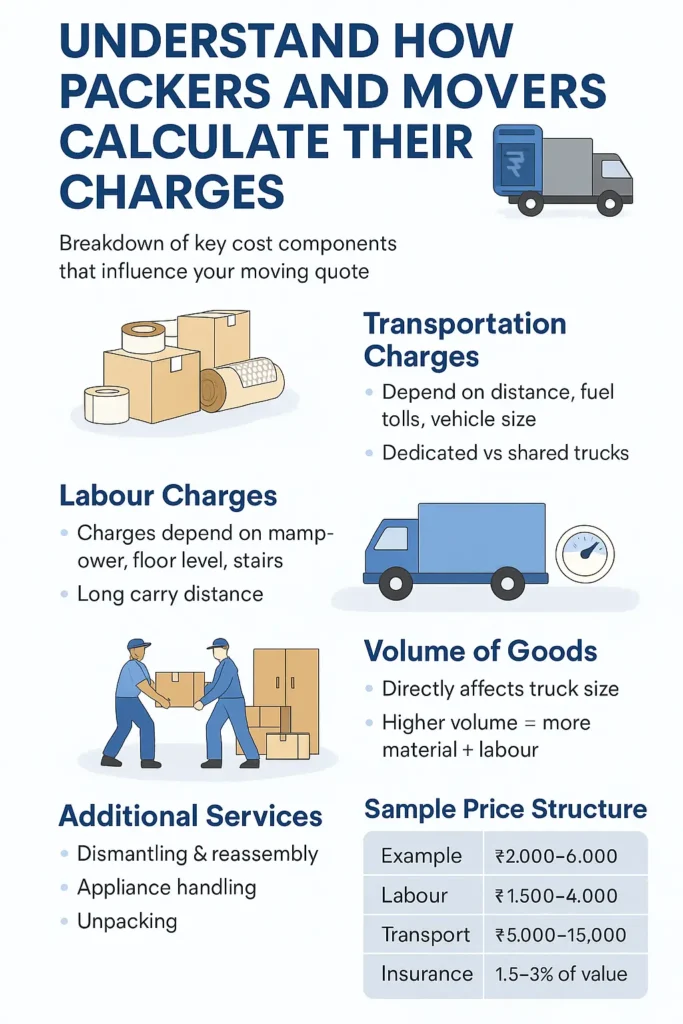
Understand How Packers and Movers Calculate Their Charges
Understanding the price structure is your biggest negotiation leverage. Movers usually follow a cost model that includes multiple components—some are fixed, others are negotiable. You can also review a detailed packers and movers cost breakdown to understand average charges and negotiable components.
Key Cost Factors That Influence the Final Quote
Most companies calculate charges based on:
Cost Component | What It Includes | Why It Matters |
Packing Charges | Boxes, bubble wrap, tape, foam, labour | Premium materials increase cost significantly |
Transportation Cost | Vehicle type, fuel, tolls, distance | Long-distance moves cost more; truck size affects rates |
Loading & Unloading | Manpower needed, difficulty level | High floors or long carry distance add extra charges |
Volume of Goods | Number of boxes + bulky items | Higher volume = higher labour + bigger truck |
Additional Services | Unpacking, disassembly, reassembly, storage | Often optional and negotiable |
Insurance | Goods-in-transit safety cover | Usually 1.5%–3% of declared value |
Local moving price benchmarks (supported by online listings):
- 1 BHK: ₹4,000–₹11,000
- 2 BHK: ₹6,500–₹16,000
- 3 BHK: ₹10,000–₹20,000
These numbers help you identify whether a mover is overcharging or undercharging during negotiation.
Seasonal Pricing and Peak-Time Variations
Movers adjust prices based on demand:
- End-of-month is expensive (many houses have rent renewals).
- Weekends cost more than weekdays.
- Festive seasons & monsoon may increase rates due to scarcity of manpower or risk factors.
- Off-season shifts allow better negotiation because movers want to fill empty slots.
This pricing fluctuation is recognized in expert guides that highlight timing as a major influence on shifting charges.
Hidden Charges You Should Know About
Many customers only discover extra charges on moving day. Common add-ons include:
- Long walking distance between truck and home
- Staircase labour if elevator is unavailable
- Dismantling or reassembling furniture
- Special handling fee for fragile items
- Fuel surcharge / tolls
- Parking or state-entry fees
To avoid last-minute surprises, make sure you understand what is excluded from packers and movers charges before finalising your quote.
Breakdown of hidden charges discussed widely online.
Tip for negotiation:
Always ask for a written, itemized quote to prevent surprise additions.
How Distance, Volume & Services Affect Negotiation Power
Distance and volume contribute the largest share of the bill.
Understanding these helps you negotiate:
- Volume of goods directly determines truck size → bigger truck = costlier.
- Distance affects fuel, tolls, driver allowance → less flexible but still negotiable.
- Services selected (packing, unpacking, disassembly) → negotiable or removable to lower cost.
Most pricing models online confirm that reducing volume is one of the most effective ways to reduce charges
Research Multiple Movers Before Negotiating
Before you negotiate, you need a strong information base. Getting quotes from multiple movers, checking their background, and comparing their service breakdowns will give you the leverage needed to negotiate confidently. Online guides consistently advise customers to collect 3–5 quotations because it creates price transparency and exposes inflated estimates.
Shortlisting Reliable Packers and Movers
Not all movers provide the same quality, pricing transparency, or professionalism. Start by building a list of verified, well-reviewed companies.
This step-by-step guide on how to choose the best packers and movers explains how to verify credentials, reviews, and pricing transparency.
How to shortlist movers effectively
- Check whether they offer in-home or video surveys to give accurate quotes.
- Review customer feedback on trusted platforms.
- Ensure they provide itemized estimates, not vague lump-sum quotes.
- Ask whether they include packing, labour, fuel, and toll charges in the price.
- Verify GST number, office address, and customer support availability.
These verification steps are also widely recommended in online relocation checklists.
Comparing Quotes the Right Way — Apples to Apples
Two companies may give very different prices simply because they include different services.
That’s why comparison must be based on equal service lists.
What to align before comparing quotes
- Packing material quality (basic vs premium)
- Truck type (shared vs dedicated)
- Labour count for loading/unloading
- Whether dismantling and reassembly are included
- Whether unpacking services are included
- Insurance cost and coverage limits
Sample Comparison
Feature / Charge Type | Mover A | Mover B | Mover C |
Packing Material | Basic | Premium | Basic |
Labour Count | 3 persons | 4 persons | 3 persons |
Truck Type | Shared | Dedicated | Shared |
Insurance | Not included | Included | Optional |
Quote Amount | ₹12,500 | ₹16,000 | ₹11,800 |
This structured comparison helps spot inflated or missing components that affect negotiation.
Quote comparison is a common negotiation tactic recommended by many guides.
Identifying Overpriced and Underpriced Estimates
When you collect multiple quotes, patterns begin to emerge.
Here is how to interpret them:
Signs a quote is overpriced
- Higher labour or truck charges without explanation
- Expensive packing material charges for basic protection
- Insurance pushed at inflated rates
- Vague “miscellaneous fees”
Signs a quote may be suspiciously low
- Missing essential services like unloading or unpacking
- Low manpower count leading to delays or mishandling
- Extra charges likely to appear later (hidden fees)
- Poor or inconsistent reviews online
This aligns with industry observations that extremely low quotes often lead to disputes or last-minute price hikes.
Reading Reviews and Spotting Red Flags Before Negotiation
Reviews give insight into a mover’s reliability, professionalism, and transparency before you even speak to them.
What to look for in reviews
- Complaints about damages, delays, or last-minute price changes
- Mention of hidden charges after loading
- Positive mentions of punctuality, safety, and staff behaviour
- Consistent patterns — not isolated comments
Red flags indicating a risky mover
- No website or poor online presence
- Only providing telephone quotes without survey
- No written agreements
- Unusually high advance payment demands
Many customers face issues due to fraud, which is why it’s important to understand common moving scams used by packers and movers.
Consumer guides repeatedly warn about choosing movers without proper verification, which often leads to disputes.
Use Quote Comparison as Your Negotiation Leverage
Once you have 3–5 quotations, you gain real negotiation power. Movers know customers compare prices, and many companies will adjust their charges rather than lose a booking. Using competitor quotes as leverage is a widely recommended negotiation tactic.
The key is to understand which portions of the quote are flexible, which are fixed, and how to present comparison details professionally.
Why Getting 3–5 Quotes Strengthens Your Bargaining Power
Multiple quotes allow you to:
- Identify the average market rate for your move.
- Spot overpriced components like inflated packing charges.
- Understand how different movers define inclusions/exclusions.
- Use the lowest competitive quote to negotiate with your preferred mover.
Online relocation advice consistently states that collecting several estimates helps prevent overpriced deals and gives buyers negotiation leverage.
Example: What Comparing 3 Quotes Reveals
Charge Category | Mover A | Mover B | Mover C | Observation |
Packing Charges | ₹3,000 | ₹4,800 | ₹3,200 | Mover B is overpriced |
Transport | ₹6,000 | ₹5,500 | ₹6,200 | Mover B is most competitive |
Labour | ₹2,500 | ₹3,500 | ₹2,300 | Mover B uses extra manpower |
Insurance | Optional | Included | Optional | Inclusion affects total |
Total | ₹11,500 | ₹13,800 | ₹11,700 | Clear comparison shows negotiable gaps |
This comparison makes it easy to tell movers:
“Another company is offering a similar service for ₹2,000 less — can you adjust your price?”
How to Present Competing Quotes During Negotiation
Movers respond better when you negotiate professionally rather than aggressively.
Effective ways to present competitor quotes
- Share only the price difference, not the entire document.
- Mention that you prefer their service but need a better rate to decide.
- Point out specific cost areas (packing, labour, truck type) where competitors are lower.
- Politely ask if they can match or beat a particular quote.
Industry negotiation guides confirm that movers are more willing to offer discounts when they know customers have verified competing offers.
Example negotiation script
“Your team seems more professional, and I am inclined to book with you. However, another mover is quoting ₹10,500 for the same volume and packing quality. If you can adjust your price closer to that, I’d prefer booking with your company.”
This method shows seriousness and fairness — encouraging them to negotiate.
Asking for a Breakup of Charges to Identify Negotiable Sections
A detailed breakup exposes areas where movers commonly inflate costs.
Breakup components you should request
- Packing materials cost
- Labour charges
- Transportation
- Loading/unloading
- Insurance
- Extra services
- Taxes and tolls
Online pricing guides emphasize that itemized quotes help identify hidden or unnecessary charges, enabling stronger negotiation.
Why Breakups Help in Negotiation
- Shows where you’re being overcharged
- Lets you question specific line items
- Helps compare “same-to-same” with other movers
- Prevents last-minute price hikes
- Allows removal of non-essential services to reduce cost
Negotiating Add-On Services (Packing, Insurance, Unpacking, etc.)
Add-ons are the most flexible part of the quote and often carry negotiable margins.
Common Add-On Services That You Can Negotiate
- Unpacking charges
- Furniture dismantling & reassembly
- Premium packing material
- Carpet / curtain / appliance handling
- Insurance cost (based on declared value)
Relocation guides often state that movers are willing to adjust or waive certain add-ons to secure a booking.
Negotiation tips for add-ons
- Request basic packing instead of premium if it suits your goods.
- Ask for free unpacking or at least reduce the charge.
- If you pack your own non-fragile items, request a discount.
- If you opt for shared truck transport, ask for a price reduction.
Sample Negotiation Line
“Since I don’t need unpacking and can handle small-item packing myself, can you reduce the total cost accordingly?”
Movers often agree because these services involve labour + material, both of which have flexible margins.
Smart Negotiation Techniques to Get Better Rates
Even after comparing quotes, you can further reduce your shifting costs by applying negotiation techniques that movers respond to. Several relocation guides highlight how timing, communication style, service selection, and flexibility significantly influence the final price a mover offers.
Negotiation is most effective when you present yourself as an informed, serious customer — someone who understands pricing components and is ready to book once the mover gives a reasonable offer.
How to Communicate Confidently and Professionally
Movers often adjust pricing based on the customer’s clarity and confidence.
Guidelines for effective negotiation communication
- Keep your tone polite but firm.
- Clearly state your expectations and budget range.
- Mention you have compared quotes and understand standard pricing.
- Ask specific questions like:
- “Can you clarify why packing material costs are higher?”
- “Is the labour charge negotiable if I shift on a weekday?”
- Show that you’re prepared to book quickly if the rate is right.
Negotiation success improves when the mover sees you’re knowledgeable and serious (supported by relocation negotiation guidance:
Sample communication statement
“I like your service approach, and I’m ready to finalize today if we can adjust the packing and labour charges slightly.”
Such statements motivate movers to offer their best possible rate.
Timing Your Negotiation for Maximum Discounts
Negotiation power increases or decreases depending on when you book.
Best times to negotiate
- Weekdays (lower demand)
- Mid-month rather than month-end
- Off-season periods (non-festive months or non-monsoon periods)
- Times when movers openly advertise discounts to maintain bookings
Many moving guides mention that shifting charges drop when demand is low, and customers can negotiate better discounts.
Avoid negotiating during
- End-of-month surge
- Festival seasons
- Peak weekends
- Days of heavy rain (risk-based prices rise)
When demand is high, movers have little incentive to reduce rates.
Asking for Flexibility in Dates or Sharing Trucks
Flexibility often leads to immediate cost reductions.
Ways flexibility lowers your cost
- Many movers offer discounts if you can shift on a date when they already have a truck on the same route.
- Shared truck options reduce your transportation cost significantly because charges are split among customers.
- Choosing non-peak times allows movers to reduce labour and fuel-related overheads.
Shared truck and flexible scheduling are frequently mentioned as ways to reduce relocation costs.
Negotiation example
“If I shift one day earlier, can you reduce the transportation cost or allow a shared truck option?”
Movers often agree because it improves their route efficiency.
Using Bulk Items or Frequent-Mover History to Negotiate
Sometimes your moving profile itself gives you negotiation leverage.
If you have bulky or multiple items
Movers prefer high-volume jobs because they generate bigger invoices.
You can use this to negotiate:
- Ask for a reduced packing charge on bulky items
- Request free disassembly/assembly
- Negotiate a lower labour fee since the job guarantees good business for them
If you’re a repeat customer
Movers value loyalty.
If you moved before or plan to move again, mention it.
“I move every year due to my job. If this shift goes well, I’ll book you for future moves. Can you offer a better rate?”
Negotiation advice confirms that long-term or high-volume customers can secure better pricing because companies want repeat business.
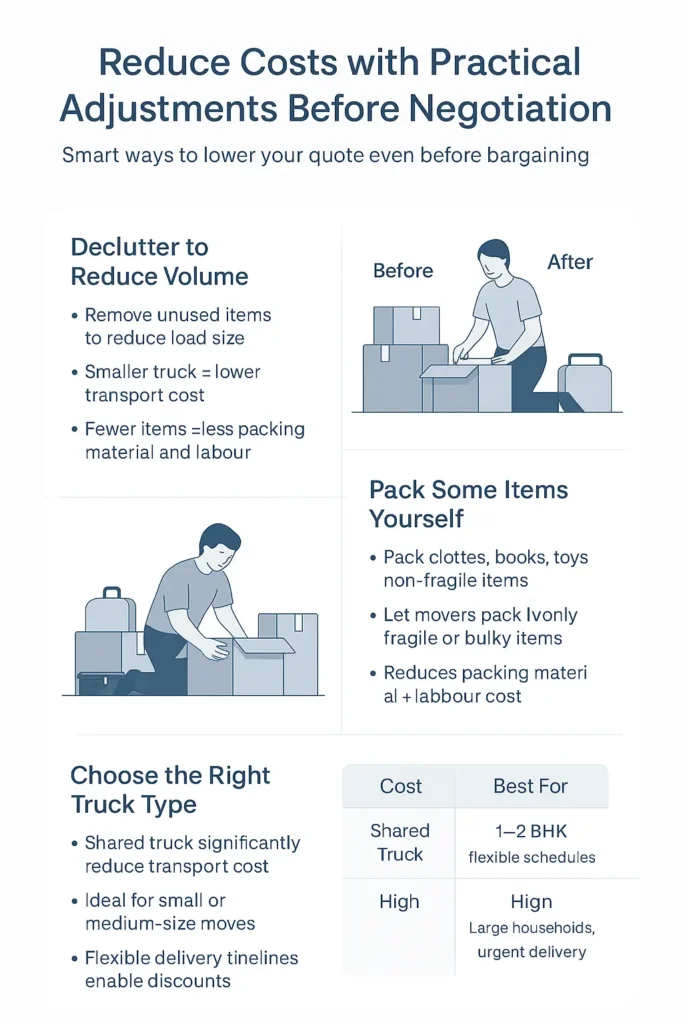
Reduce Costs with Practical Adjustments Before Negotiation
Before negotiating, you can lower your moving cost even before asking for a discount. Movers calculate quotes largely based on volume, labour effort, packing materials, and truck size — so reducing these factors gives you automatic cost reductions. Multiple relocation resources highlight that decluttering, self-packing, choosing the right truck type, and early booking are some of the most efficient ways to bring down shifting charges.
These adjustments not only reduce the size of your quote but also strengthen your negotiation position.
Decluttering to Reduce Volume and Price
Movers calculate transportation and labour charges primarily based on the volume of goods. Reducing the number of items reduces:
- Truck size
- Loading/unloading time
- Packing materials
- Labour count
Guides focusing on moving-cost reduction frequently emphasize decluttering because lower volume almost always results in a smaller truck and lower charges.
Items you can declutter before moving
- Old furniture
- Duplicate appliances
- Unused clothing
- Books, toys, stored goods, seasonal items
- Damaged or rarely used household items
Impact of decluttering on cost
Category Reduced | Cost Benefit | Why It Helps |
Furniture & bulky items | High | Lowers truck size + labour |
Clothes & small items | Moderate | Reduces boxes + packing material |
Appliances | High | Lowers risk + handling charges |
Fewer items = lower base quote = better negotiation outcome.
Packing Yourself (Partial or Full) to Lower Charges
Packing is one of the most negotiable and flexible components of a moving quote. Online cost breakdowns show that packing material + labour can represent 20–40% of the total bill depending on the volume and material quality.
If you can pack some items yourself — especially:
- Clothing
- Books
- Toys
- Soft household goods
- Non-fragile items
— movers will reduce packing charges significantly.
How to save with self-packing
- Ask movers to pack only fragile or valuable items.
- Use suitcases, bags, and containers you already own.
- Purchase your own basic cartons if required.
Negotiation benefit
If you self-pack 30–40% of your items, you can request a proportional reduction in packing material + labour charges.
Choosing the Right Truck Type (Shared vs. Dedicated)
Transportation is often the largest cost component in a quote. Choosing the right truck type can reduce this portion significantly.
Truck Type Comparison
Truck Type | Best For | Cost | Notes |
Dedicated Truck | Large households, premium safety | High | Faster delivery, direct route |
Shared Truck | Small–medium moves | Low | Transportation cost is split across customers |
Shared truck options reduce transportation costs because the charges are divided. This method is frequently recommended in relocation cost-saving guides.
When shared transport helps the most
- 1 BHK or 2 BHK intercity moves
- Small office relocations
- Moves with flexible delivery dates
Negotiation angle
You can request:
“If I shift via a shared truck, can you reduce the transport cost by 20–30%?”
Movers often agree because shared transport optimizes their operational efficiency.
Avoiding Last-Minute Bookings to Prevent Price Surges
Last-minute bookings usually trigger higher prices due to:
- High demand
- Unavailability of manpower
- Limited truck slots
- Urgency charges
Online moving guides note that early booking helps secure lower pricing and gives you better choices for truck type, date, and labour availability.
How early booking helps negotiation
- Movers offer early-bird discounts or promotional rates
- You get leverage because you are not in a rush
- You can choose weekdays or off-peak dates
- You have time to gather multiple quotes and compare
Recommended booking timeline
Move Type | Ideal Booking Time | Why |
Local Move | 7–10 days before | Guarantees labour availability |
Intercity Move | 10–20 days before | Helps secure preferred truck + date |
Festival/Peak Season | 20–30 days before | Avoids seasonal price hikes |
Booking early ensures you don’t pay premium “emergency” prices.
Finalizing the Deal: Ensuring a Safe & Fair Agreement
Negotiation ends only when the final agreement is clear, written, and transparent. Many disputes in the moving industry arise not from the move itself, but from unclear terms, missing documents, or last-minute added charges. Online relocation guides strongly emphasize the importance of written contracts, clear breakdowns, and verified terms before making a payment.
A properly finalized agreement protects you from hidden charges, delayed delivery, misunderstandings, or insurance-related issues.
Getting the Quote in Writing to Avoid Future Disputes
A written agreement is essential because verbal commitments often lead to confusion or price manipulation on moving day.
Your written quote should include:
- Total cost + taxes
- Packing charges
- Labour charges
- Loading & unloading
- Transportation
- Insurance cost (if opted)
- Additional services
- Any extra fees (tolls, fuel, parking, stair charges)
- Delivery time estimate
- Payment terms
Online guides warn that without written documentation, customers risk unexpected additions after goods are loaded.
Tip:
Ask for the quote on letterhead or email, not WhatsApp chat only.
Clarifying Insurance Coverage and Liability Terms
Insurance reduces financial risk but must be understood clearly.
Before agreeing to insurance charges, understand clearly what transit insurance covers during house shifting.
Key points to confirm
- Type of insurance (transit insurance / full value protection)
- Percentage charged (usually 1.5%–3% of declared value)
- What losses are covered (damage, theft, accident)
- What is not covered (minor scratches, glass breakage without proper packing, self-packed items)
- Claim process and time limits
- Who is responsible for packing quality
Online sources highlight the importance of directly asking movers to explain their insurance coverage to avoid misunderstandings later.
Insurance Comparison Table
Insurance Type | Coverage | Cost | Recommended For |
Transit Insurance | Damage during transport | Low | Regular household goods |
Full Value Protection | Repair/replace full value of goods | Higher | Expensive electronics, luxury furniture |
Understanding the Cancellation and Rescheduling Policy
Before paying any advance, confirm how the company handles:
- Date changes
- Cancellations
- Refunds
- Rescheduling charges
Relocation advisory guides recommend understanding these policies because movers may charge fees for last-minute cancellations or date shifts.
Questions to ask
- “Is the booking deposit refundable?”
- “How many days in advance can I reschedule without charges?”
- “What happens if the truck is delayed due to weather or traffic?”
These clarifications prevent conflict on moving day.
Confirming Payment Terms and Accepted Modes
Before finalizing the deal, ensure you are comfortable with the payment structure.
Typical Payment Structure
Payment Stage | Description |
Advance (10–30%) | Paid during booking; may be adjusted in final bill |
Before Loading | Some movers request partial payment |
After Delivery | Final settlement after unloading |
Many relocation guides suggest confirming payment milestones to avoid last-minute pressure tactics.
Confirm accepted payment modes
- UPI
- Bank Transfer
- Card Payment
- Cash
Important:
Always insist on a GST invoice, especially for interstate moves.
Finalizing your move through clear, transparent agreements ensures you get the negotiated rate without surprises. Written quotes, clarified insurance terms, and agreed payment milestones are your protections against hidden charges or disputes.
By following all the steps in this guide — from researching movers, comparing quotes, negotiating smartly, reducing volume, and formalizing agreements — you ensure a smooth moving experience at the best possible price.
If you’re planning a move in Ahmedabad, working with experienced packers and movers in Ahmedabad can help you negotiate better rates and avoid hidden charges.
Ready to move without the stress of high charges or unreliable movers? 6 Packers And Movers helps you compare verified relocation experts, get fair quotes, and choose the best mover for your budget. Avoid hidden costs, save time, and secure trusted professionals for local or intercity shifting.
Start your move the smart way — Book with 6 Packers And Movers today!