
Vehicle Transportation Guide: Bike & Car Shifting Explained
Vehicle transportation is the process of moving bikes or cars from one location to another using specialized carriers instead of self-driving. Professional movers inspect the vehicle, secure it using straps or clamps, transport it via open or enclosed carriers, and deliver it after final inspection to ensure safety and damage protection.
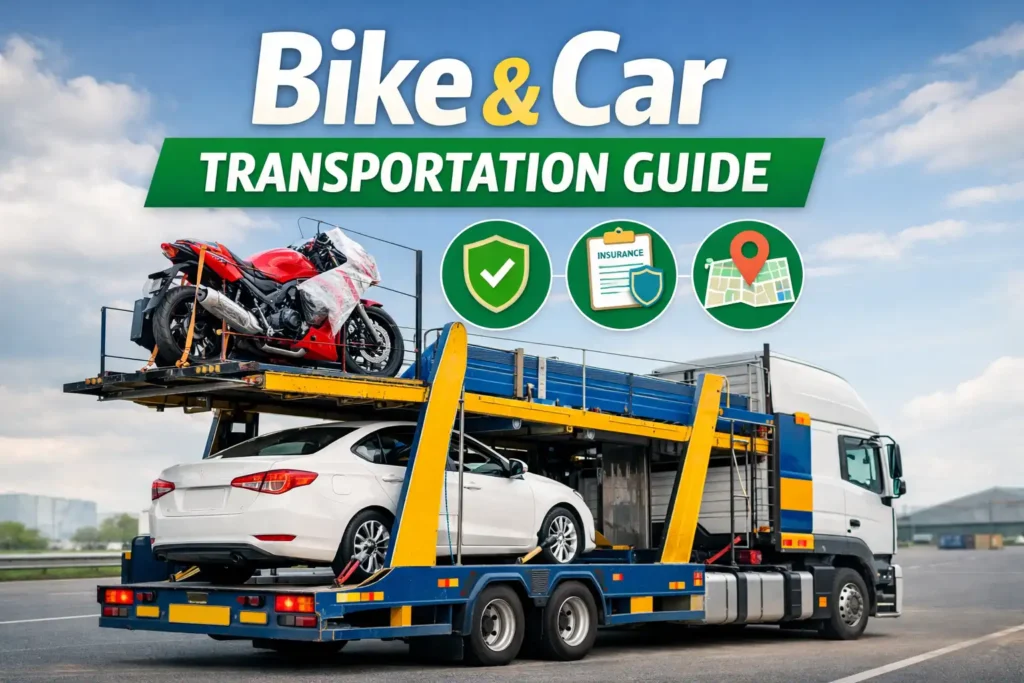
Relocating a vehicle during house shifting can be challenging if you’re unaware of the right process, costs, documents, and safety measures involved. Whether you’re moving a two-wheeler or a four-wheeler, professional vehicle transportation services help ensure safe, damage-free delivery across cities and states. Many people prefer booking Reliable Packers And Movers to handle vehicle shifting along with household goods, as trained professionals use specialized carriers, proper securing techniques, and transit insurance to minimize risk during transportation. This guide explains how bike and car transportation works, the exact process followed, cost factors, required documents, and how to choose the right movers for safe vehicle relocation. Many people prefer booking professional packers and movers who offer dedicated bike and car transportation services along with household shifting for safer relocation.
How Vehicle Transportation Works
- The vehicle is picked up from the customer’s location
- A pre-transport inspection is conducted to record existing condition
- The vehicle is loaded onto a suitable carrier (open or enclosed)
- It is secured using straps, clamps, and wheel locks
- The vehicle is transported via road-based logistics routes
- Final inspection is done at the destination before delivery confirmation
If you are relocating within or from a metro city like Bangalore, choosing experienced packers and movers in Bangalore ensures proper carriers, permits, and faster vehicle delivery.
Common Types of Vehicle Transportation
Transport Type | Best Used For | Protection Level |
Open Carrier Transport | Regular cars & bikes | Standard |
Enclosed Carrier Transport | Luxury, vintage, or new cars | High |
Shared Carrier | Cost-effective relocation | Moderate |
Dedicated Carrier | Urgent or premium delivery | High |
Bike Transportation Process – Step-by-Step Guide
Bike transportation requires careful handling because two-wheelers are more exposed to balance issues, surface damage, and oil leakage during long-distance movement. Professional packers and movers follow a systematic bike shifting process to ensure safety from pickup to final delivery.
Pre-Transport Bike Inspection Checklist
Before packing begins, a detailed inspection is conducted to document the bike’s current condition. This helps avoid disputes at the time of delivery.
Inspection steps include:
- Checking existing scratches, dents, or paint damage
- Photographing the bike from multiple angles
- Reducing fuel level to a minimum for safety
- Removing loose accessories such as mirrors or carriers if required
- Verifying ignition and steering lock condition
Why inspection matters:
- Acts as proof of pre-move condition
- Helps in insurance claims if damage occurs
- Ensures accountability during delivery
Bike Packing Materials Used by Packers & Movers
Proper packing minimizes vibration impact, scratches, and pressure damage during transit.
Commonly used packing materials:
- Bubble wrap for body panels and fuel tank
- Foam sheets for shock absorption
- Corrugated cardboard for structural protection
- Stretch film to hold packing layers in place
- Wooden crates (used for premium or long-distance moves)
Packing Material | Purpose |
Bubble Wrap | Scratch & impact protection |
Foam Sheets | Cushioning during movement |
Cardboard Sheets | Structural safety |
Wooden Crate | Maximum protection (optional) |
Loading & Securing the Bike
After packing, the bike is carefully loaded onto the transport vehicle using ramps and safety equipment.
Loading process includes:
- Using ramps to avoid manual lifting damage
- Positioning the bike upright to prevent oil leakage
- Securing wheels using clamps or chocks
- Tightening straps to restrict movement during transit
This step is crucial, as improper strapping can lead to imbalance or internal damage.
Transit & Delivery Process
During transit, bikes are usually transported via shared or dedicated carriers, depending on distance and service type.
What happens during delivery:
- Bike is unloaded using ramps
- Packing is removed carefully
- Final inspection is conducted against the pre-move condition
- Delivery acknowledgment is signed only after inspection
Recommended tip:
Always inspect the bike before signing the delivery receipt.
Car Transportation Process – Step-by-Step Guide
Car transportation involves moving a four-wheeler using specialized vehicle carriers designed to handle weight, size, and safety requirements. Professional packers and movers follow a documented process to reduce the risk of dents, scratches, mechanical stress, and transit-related damage.
Pre-Move Car Inspection & Documentation
Before loading, the car undergoes a detailed inspection to record its existing condition.
Pre-move inspection includes:
- Cleaning the car exterior for accurate inspection
- Noting existing dents, scratches, or paint marks
- Taking dated photographs from multiple angles
- Checking fuel level (kept low for safety)
- Ensuring no personal belongings are left inside the car
Why this step is critical:
- Serves as a condition report for delivery comparison
- Helps validate insurance claims if damage occurs
- Prevents post-delivery disputes
Open Carrier vs Closed Carrier Transport
The choice of carrier directly affects cost and protection level.
Carrier Type | Suitable For | Protection Level | Cost Impact |
Open Carrier | Standard cars | Moderate | Lower |
Closed Carrier | Luxury, vintage, or new cars | High | Higher |
Key differences explained:
- Open carriers expose vehicles to weather and road dust
- Enclosed carriers protect cars from rain, debris, and sun
- Closed carriers are preferred for premium or high-value vehicles
Car Loading, Strapping & Safety Measures
Once the carrier is selected, the car is loaded using ramps or hydraulic lifts.
Safety measures followed during loading:
- Vehicle is driven or winched onto the carrier platform
- Parking brake is engaged
- Wheels are secured using soft straps or wheel ties
- Car alarms are switched off to avoid battery drain
- Gear position is set as per safety norms
Proper strapping ensures the car does not shift during transit, even on uneven roads.
Unloading & Final Inspection
At the destination, the car is unloaded and inspected before handover.
Delivery inspection checklist:
- Compare vehicle condition with pre-move inspection report
- Check bumpers, mirrors, roof, and underbody
- Report any damage immediately
- Sign delivery receipt only after inspection
Important note:
Once the delivery receipt is signed without remarks, claims may become difficult.
Bike vs Car Transportation – Key Differences Explained
Although bike and car transportation fall under vehicle relocation services, the process, handling methods, cost structure, and risk factors differ significantly. Understanding these differences helps customers choose the right service and set realistic expectations for transit time, safety, and pricing.
Difference in Packing & Handling
- Bikes require manual handling and balance control during loading and unloading
- Cars are driven or winched onto carriers, reducing manual lifting
- Bikes need layered packing for exposed parts, while cars rely more on strapping and immobilization
Difference in Transport Carriers
- Bikes are transported in:
- Shared trucks
- Mini carriers
- Crated enclosures (optional)
- Cars are transported using:
- Open car carriers
- Enclosed car carriers
Carrier choice impacts protection level and transportation cost.
Difference in Cost Structure
Factor | Bike Transportation | Car Transportation |
Space Requirement | Low | High |
Weight Impact | Minimal | Significant |
Carrier Type | Shared / Crated | Open / Enclosed |
Average Cost Range | Lower | Higher |
Bike transportation is generally more economical due to smaller size and lower fuel impact.
Risk Level & Damage Probability
- Bikes have higher exposure to:
- Scratches
- Minor dents
- Handle or mirror damage
- Cars have lower surface risk but may face:
- Underbody scratches
- Mirror or bumper scuffs if improperly secured
Using proper packing, strapping, and insurance reduces these risks significantly.
Delivery & Inspection Differences
- Bike delivery requires unpacking and reattachment of removed parts
- Car delivery focuses on condition verification against inspection reports
- Damage reporting timelines are similar for both vehicle types
Cost of Bike and Car Transportation in India
The cost of vehicle transportation in India depends on multiple variables related to distance, vehicle type, carrier selection, and service scope. Since rates fluctuate based on route demand and logistics availability, costs are usually quoted as approximate ranges rather than fixed prices.
Factors Affecting Bike Transportation Charges
Bike transport costs are generally lower due to compact size and lighter weight.
Key cost-influencing factors include:
- Distance between origin and destination cities
- Type of transport (shared carrier or wooden crate)
- Engine capacity and bike size
- Packing materials used
- Insurance coverage (optional but recommended)
- Pickup and delivery accessibility
Factors Affecting Car Transportation Charges
Car transport costs are higher because of space occupancy and carrier requirements.
Major pricing factors include:
- Distance and route complexity
- Car size and ground clearance
- Open carrier vs enclosed carrier selection
- Fuel prices and toll charges
- Insurance coverage value
- Door-to-door vs terminal-based delivery
Approximate Bike Transportation Cost in India
Distance Range | Estimated Cost Range |
Up to 500 km | ₹3,000 – ₹6,000 |
500 – 1,000 km | ₹5,000 – ₹9,000 |
1,000 – 1,500 km | ₹7,000 – ₹12,000 |
Above 1,500 km | ₹10,000 – ₹15,000 |
Actual charges may vary based on city, carrier type, and packing method.
Approximate Car Transportation Cost in India
Distance Range | Hatchback / Sedan | SUV / Luxury Car |
Up to 500 km | ₹6,000 – ₹10,000 | ₹8,000 – ₹14,000 |
500 – 1,000 km | ₹9,000 – ₹15,000 | ₹12,000 – ₹20,000 |
1,000 – 1,500 km | ₹14,000 – ₹22,000 | ₹18,000 – ₹30,000 |
Above 1,500 km | ₹18,000 – ₹30,000 | ₹25,000 – ₹40,000 |
To understand how transport charges are calculated, refer to our detailed packers and movers cost guide, which explains pricing factors for local and intercity moves.
Additional Charges to Be Aware Of
- Enclosed carrier premium
- Wooden crating for bikes
- Insurance premium based on declared value
- Remote area pickup or delivery surcharge
Understanding these variables helps avoid pricing confusion and unexpected add-ons.
Documents Required for Bike & Car Transportation
Vehicle transportation in India requires basic ownership and identity documents to ensure legal movement across cities and state borders. Submitting the correct documents helps avoid delays, penalties, or delivery holds during transit.
Mandatory Documents for Bike Transportation
For two-wheeler shifting, movers usually ask for copies of the following:
- Registration Certificate (RC) of the bike
- Government-issued photo ID of the owner
- Insurance copy (recommended for claims support)
- Pickup and delivery address proof (if required)
These documents verify ownership and allow lawful transportation during intercity or interstate movement.
Mandatory Documents for Car Transportation
Car transportation follows similar documentation requirements but with stricter checks due to higher vehicle value.
Commonly required documents include:
- Car Registration Certificate (RC copy)
- Owner’s valid photo ID
- Insurance policy copy (mandatory for insured moves)
- Booking confirmation or transport agreement
Owner Absent? Authorization & ID Requirements
If the vehicle owner is unavailable during pickup or delivery, additional authorization may be required.
In such cases, movers may ask for:
- Authorization letter signed by the vehicle owner
- ID proof of the authorized person
- Relationship or employment proof (in some cases)
Document Checklist at a Glance
Document Type | Bike Transport | Car Transport |
RC Copy | Required | Required |
Owner ID Proof | Required | Required |
Insurance Copy | Recommended | Recommended |
Authorization Letter | If owner absent | If owner absent |
Important Notes to Remember
- Original RC is usually not required; photocopy or digital copy is sufficient
- Documents should match the owner name on the RC
- Incomplete paperwork can delay loading or delivery
Safety, Insurance & Damage Protection During Vehicle Shifting
Vehicle transportation involves multiple handling stages—loading, transit, and unloading—where damage risks can arise if proper precautions are not followed. To address this, professional movers rely on standard safety practices and transit insurance to protect bikes and cars during relocation.
Common Vehicle Damages During Transportation
Despite careful handling, certain risks are commonly associated with vehicle shifting.
Typical damages include:
- Minor scratches or paint scuffs
- Mirror or handle damage (more common in bikes)
- Bumper or underbody scrapes (in cars)
- Strap marks due to improper securing
Most of these risks can be reduced with correct packing, strapping, and carrier selection.
What Transit Insurance Covers
Transit insurance provides financial protection against damage caused during the transportation period.
Transit insurance generally covers:
- Damage during loading and unloading
- Accidental damage during road transit
- Loss caused by vehicle overturning or collision
Transit insurance usually does NOT cover:
- Pre-existing damage
- Mechanical or electrical failure
- Normal wear and tear
- Personal belongings left inside the vehicle
How Insurance Claims Work
To ensure smooth claim processing, documentation is critical.
Claim process typically involves:
- Pre-move inspection report
- Photographic evidence before and after transit
- Delivery acknowledgment with damage remarks
- Insurance claim form submission
How to Minimize Risk Before Vehicle Handover
Safety best practices include:
- Choosing the right carrier (open or enclosed)
- Opting for wooden crating for premium bikes
- Removing loose accessories
- Inspecting the vehicle before and after delivery
- Reporting damage immediately at delivery
For a complete understanding of coverage limits and exclusions, read what transit insurance covers during house shifting before booking vehicle transport.
Transit Insurance Coverage Overview
Aspect | Covered | Not Covered |
Loading & Unloading Damage | ✔ | — |
Transit Accident Damage | ✔ | — |
Pre-existing Scratches | — | ✖ |
Mechanical Failure | — | ✖ |
How to Choose the Right Packers & Movers for Vehicle Transportation
Selecting the right packers and movers is critical for safe bike and car transportation. Since vehicle shifting involves high-value assets, choosing a service provider with proper credentials, transparent pricing, and clear liability terms helps reduce risk and ensures accountability throughout the move.
Verifying Vehicle Transport Experience
Not all movers specialize in vehicle transportation. Experience and infrastructure matter.
What to verify:
- Availability of vehicle-specific carriers (open or enclosed)
- Trained staff for loading and strapping vehicles
- Clear process for inspection and delivery acknowledgment
- Experience with intercity and interstate routes
Red Flags to Avoid While Selecting Movers
Certain warning signs indicate unreliable service providers.
Common red flags include:
- No written quotation or vague pricing
- Refusal to provide insurance details
- Lack of proper documentation or receipts
- Unrealistically low pricing compared to market range
- No clear damage or claims process
Before finalizing a service provider, go through this step-by-step guide on how to choose the best packers and movers to avoid unreliable transporters.
Questions to Ask Before Booking Vehicle Transportation
Asking the right questions improves transparency and trust.
Important questions include:
- What type of carrier will be used for my vehicle?
- Is transit insurance included or optional?
- How is vehicle condition recorded before pickup?
- What is the estimated delivery timeline?
- How are damage claims handled?
Checklist to Compare Packers & Movers
Evaluation Factor | Why It Matters |
Written Quotation | Prevents hidden charges |
Carrier Type Clarity | Determines protection level |
Insurance Terms | Reduces financial risk |
Inspection Process | Ensures condition tracking |
Customer Support Access | Helps during transit issues |
Why Verification Matters in Vehicle Transportation
Vehicle relocation involves multiple handovers. Choosing a verified mover helps ensure:
- Proper vehicle handling
- Timely delivery
- Documented accountability
- Clear communication during transit
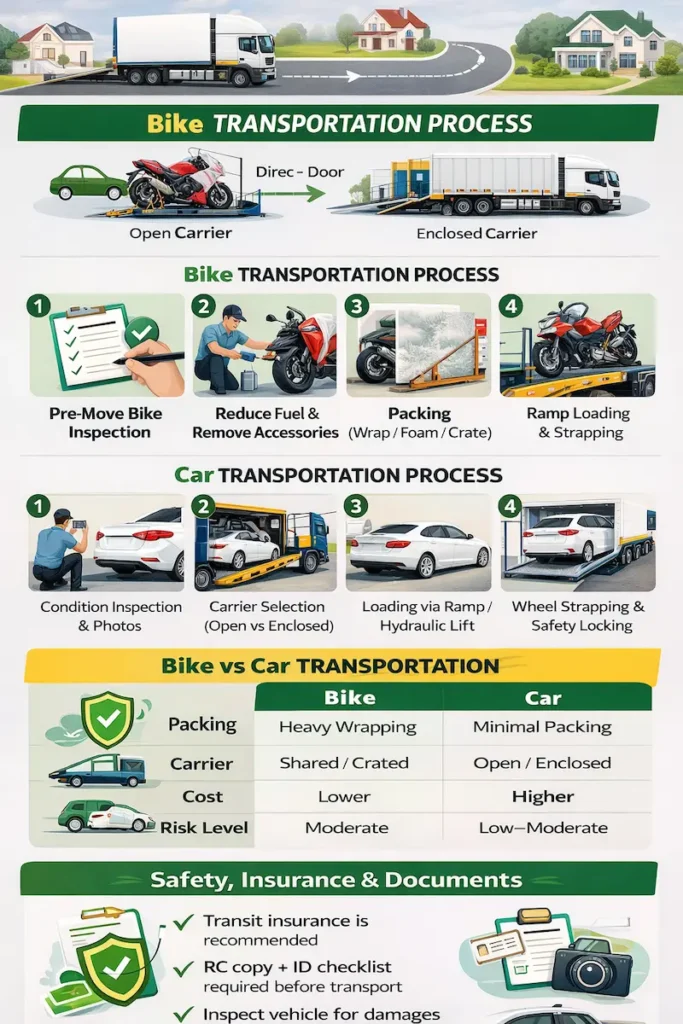
FAQs About Bike & Car Transportation
Vehicle transportation timelines depend on distance, route, and carrier availability. Short-distance moves usually take a few days, while long-distance or interstate transportation may take longer due to transit planning and delivery sequencing.
Transit insurance is not legally mandatory, but it is strongly recommended. Insurance provides financial protection against accidental damage during loading, transit, or unloading, especially for long-distance vehicle relocation.
In most cases, personal belongings are not allowed inside the car during transportation due to safety regulations and liability concerns. Some carriers may permit limited items, but this should be confirmed in advance.
No. A photocopy or digital copy of the Registration Certificate (RC) is usually sufficient. Original documents are generally not required for vehicle transportation.
Enclosed carrier transport is not mandatory for all cars. It is usually recommended for luxury, vintage, or new vehicles that require higher protection from weather and road debris.
Stress-Free Bike & Car Transportation Starts Here
Moving your bike or car doesn’t have to be risky or confusing. With 6 Packers And Movers, your vehicle is handled by trained professionals using specialized carriers, secure strapping, and optional transit insurance—ensuring safe delivery across cities and states.
Why customers choose 6 Packers And Movers for vehicle transportation:
- Dedicated bike & car transport carriers
- Pre-move inspection & delivery verification
- Transparent pricing with no hidden charges
- Support for intercity & interstate relocation
Get an instant quote for bike or car transportation
Our verified network of packers and movers in Bangalore provides safe bike and car transportation with proper documentation and insurance support.