
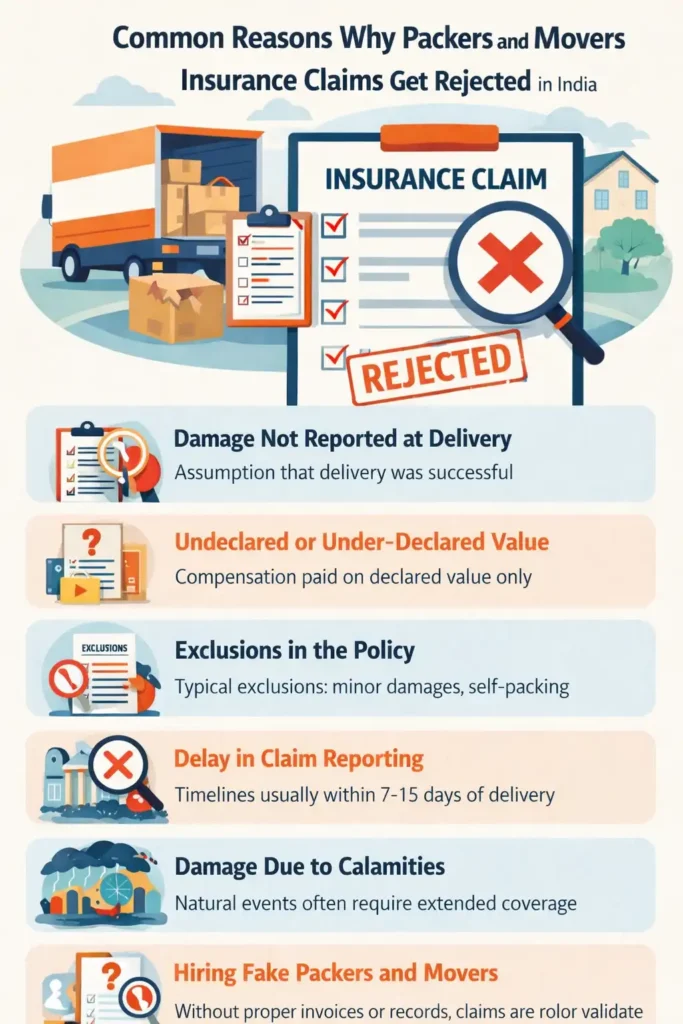
Common Reasons Why Packers and Movers Insurance Claim Get Rejected in India

Moving insurance is meant to protect your household goods during relocation, but many customers are surprised when their packers and movers insurance claim gets rejected. In most cases, claim rejection happens not because insurance is useless, but because policy conditions, documentation rules, or reporting timelines are not followed correctly. Following expert Moving Tips can help you understand these requirements in advance and avoid common mistakes. If you are hiring Professional Packers And Movers in India, understanding why claims get rejected can help you avoid costly mistakes and improve your chances of claim approval.
“If you’re planning a move in Pondicherry , working with verified packers and movers in Pondicherry can significantly reduce documentation and insurance-related issues.
1. Improper or Incomplete Documentation
One of the most common reasons packers and movers insurance claims get rejected in India is missing, incorrect, or incomplete documentation. Insurance companies rely heavily on paperwork to verify the existence, value, and condition of goods before and after transit. Even a small documentation gap can weaken your claim.
Why documentation matters
Insurance policies clearly state that claims must be supported with valid proof. If required documents are not submitted or do not match, insurers may treat the claim as unverifiable.
Understanding what documents are mandatory before booking helps you choose reliable movers and avoid insurance disputes.
Common documentation mistakes that lead to claim rejection
- Insurance policy copy not submitted
- Missing or unsigned inventory list
- Invoice or payment receipt not available
- Delivery receipt signed without noting damage
- Lack of photographs showing damaged items
Documents typically required for a movers insurance claim
Document | Purpose |
Insurance policy copy | Confirms coverage and insured value |
Verifies goods handed over for transit | |
Packing & moving invoice | Confirms service provider and payment |
Delivery receipt / challan | Records delivery condition |
Damage photos | Visual proof of loss or damage |
If any of these documents are missing or inconsistent, insurers may reject the claim on procedural grounds.
How to reduce rejection risk
- Ensure the inventory list is signed by both parties at pickup
- Keep copies of invoices, receipts, and insurance papers
- Avoid signing delivery receipts stating “goods received in good condition” if damage is visible
- Take clear photographs of damaged items immediately after delivery
2. Damage Not Reported at the Time of Delivery
Another major reason packers and movers insurance claims get rejected in India is failure to report damage at the time of delivery. Insurance policies usually require customers to inspect their goods immediately upon delivery and report any visible damage without delay. If damage is reported late, insurers may assume it occurred after delivery, not during transit.
Why immediate reporting is critical
When goods are delivered, the delivery receipt or challan acts as the official condition record. If damage is not mentioned at this stage, insurers may treat the shipment as successfully delivered without loss.
Common mistakes customers make
- Signing the delivery receipt before inspecting goods
- Accepting verbal assurance from movers instead of written remarks
- Reporting damage days or weeks after delivery
- Not informing the insurer within the policy’s notification window
Many customers face issues because they are unaware of standard packers and movers insurance coverage rules during delivery.
Typical delivery-stage errors that weaken claims
Mistake | Impact on Claim |
Signing “received in good condition” | Suggests no transit damage |
No written damage remarks | Lack of official evidence |
Delayed damage intimation | Violates policy conditions |
Missing delivery-day photos | Weakens proof of damage |
Best practices to avoid rejection
- Inspect all cartons before signing the delivery receipt
- Clearly write damage remarks on the challan if any item is affected
- Take photographs or videos immediately after delivery
- Inform the insurer as per the policy timeline, even if assessment happens later
Failing to follow these steps often results in claim rejection due to late intimation or lack of delivery-stage evidence, which is a common condition mentioned in transit insurance policies.
What Commonly Happens During Delivery
In most household relocations, customers sign the delivery receipt quickly to complete unloading. Once the receipt is signed without written damage remarks, insurers usually treat the delivery as successful. Any damage reported later may be considered post-delivery, which weakens the insurance claim.
3. Packing Done by the Customer Instead of Movers
Insurance claims related to household shifting are often rejected when packing is done partially or fully by the customer instead of professional packers. In India, transit insurance for packers and movers is generally issued on the assumption that goods are packed using standard professional packing methods. If this condition is not met, insurers may deny liability for damage.
Why self-packing affects claim approval
Insurance policies usually cover risks arising during transit, not risks caused by inadequate or improper packing. When customers pack items themselves, insurers may argue that damage occurred due to insufficient protection rather than transportation.
Common scenarios that lead to rejection
- Customer packs fragile items like crockery or glassware
- Electronics packed without original or protective packaging
- Partial packing where movers pack only furniture, not small items
- No mention in documents about who handled packing
How insurers assess packing responsibility
Scenario | Claim Outcome |
All items packed by movers | Higher claim acceptance chance |
Partial customer packing | High rejection risk |
Fragile items self-packed | Often excluded from coverage |
No packing responsibility mentioned | Claim may be disputed |
This is why opting for professional packing services is strongly recommended when insurance protection is important.
How to protect your claim
- Always opt for full professional packing by movers
- Avoid packing fragile or high-value items yourself
- Ensure the invoice clearly states “packing included”
- Get confirmation that insurance covers professionally packed goods
Improper or customer-led packing is frequently cited as a reason for claim rejection because insurers consider it a preventable risk, not a transit-related accident.
4. Non-Disclosure or Under-Declaration of Item Value
Non-disclosure or under-declaration of the actual value of household goods is another common reason why packers and movers insurance claims get rejected in India. Insurance coverage is calculated based on the declared value of items, and any mismatch between declared value and actual value can lead to claim reduction or outright rejection.
Why accurate value declaration matters
Insurance policies work on the principle of utmost good faith, meaning customers must disclose complete and accurate information. If high-value items are not declared correctly, insurers may consider it a material non-disclosure.
For a clearer understanding, it’s important to know the difference between declared value and insured value in moving insurance.
Common declaration mistakes
- Declaring a lower value to reduce insurance premium
- Not declaring high-value items separately
- Grouping expensive items under generic categories
- Declaring only resale value instead of actual replacement value
How under-declaration impacts claim settlement
Situation | Claim Impact |
Accurate item-wise declaration | Claim assessed fairly |
Under-declared total value | Claim paid proportionately |
High-value item not declared | Claim may be rejected |
Incorrect item description | Dispute during assessment |
How to avoid rejection due to value issues
- Declare all items clearly and item-wise in the inventory
- Mention high-value goods separately (electronics, appliances, furniture)
- Understand depreciation rules mentioned in the policy
- Avoid intentionally lowering value to save insurance cost
Incorrect or incomplete value disclosure can weaken your claim because insurers assess compensation strictly based on the declared insured value, not the market value at the time of loss.
Why Declared Value Matters in Insurance Claims
Insurance compensation is assessed based on the declared insured value mentioned in the policy and inventory. Claims are not settled on market assumptions or emotional loss, but strictly on declared figures and applicable depreciation terms.
5. Exclusions Mentioned in the Insurance Policy
Many packers and movers insurance claims in India are rejected because the damage or loss falls under policy exclusions. Insurance policies clearly list situations, item categories, and risk types that are not covered. If a claim is raised for an excluded item or event, insurers are not obligated to approve it.
Why exclusions cause claim rejection
Insurance coverage is not universal. Claims are assessed strictly based on what is explicitly included in the policy. If damage occurs due to an excluded cause or affects excluded items, the claim may be rejected even if insurance was taken.
Common exclusions in packers and movers insurance
- Fragile items such as glassware, idols, ceramics
- Cash, jewellery, documents, and valuables
- Damage due to normal wear and tear
- Electrical or mechanical breakdown without external impact
- Damage caused by inherent defects or poor item condition
Examples of exclusion-related claim issues
Claim Scenario | Likely Outcome |
Broken glassware | Often excluded |
Scratches on old furniture | Considered wear & tear |
Electronic failure without visible damage | May be excluded |
Damage due to item’s internal defect | Claim rejected |
How to reduce rejection risk due to exclusions
- Read the exclusions section before opting for insurance
- Ask for clarification on coverage for fragile or high-risk items
- Declare and document high-risk items separately
- Do not assume “all damage” is automatically covered
Policy exclusions are one of the most overlooked areas during household shifting. Claims are commonly rejected not because of insurer unfairness, but because the damage occurred under pre-defined excluded conditions.
Insurance does not automatically cover every type of damage. Coverage depends on policy inclusions, exclusions, and compliance with claim procedures. Understanding these limits helps prevent unrealistic expectations during claim settlement.
6. Delay in Claim Filing or Missing Claim Deadlines
Delay in filing an insurance claim is a frequent reason why packers and movers claims get rejected in India. Insurance policies usually specify a strict timeline for claim intimation and document submission. If these deadlines are missed, insurers may deny the claim on procedural grounds, even if the damage is genuine.
Why claim timelines are important
Insurance contracts require timely notification so that damage assessment can be conducted while evidence is still available. Delayed claims increase the risk of disputes about when and how the damage occurred.
Common delay-related mistakes
- Informing the insurer several days after delivery
- Waiting for verbal confirmation from movers before filing a claim
- Submitting documents after the allowed claim window
- Assuming late claims will still be considered
Typical claim timelines and consequences
Delay Scenario | Claim Impact |
Claim reported within policy timeline | Claim processed normally |
Delay in initial intimation | Claim may be questioned |
Late document submission | Claim can be rejected |
No written claim communication | Claim may be closed |
How to avoid rejection due to delays
- Notify the insurer immediately after noticing damage
- Follow the claim timeline mentioned in the policy document
- Submit all required documents within the stipulated period
- Keep written proof of claim intimation and follow-ups
Many claim rejections occur not due to lack of insurance, but due to missed deadlines, which insurers treat as non-compliance with policy conditions.
Why Procedural Errors Cause Most Claim Issues
Many insurance claim rejections occur due to missed timelines, incomplete documents, or delayed reporting rather than denial of genuine loss. Following claim procedures carefully plays a critical role in approval outcomes.
Claims involving natural or uncontrollable events are assessed strictly according to policy wording. Unless extended coverage is included, insurers may limit or deny liability for such events.
7. Damage Due to Natural Calamities or Uncontrollable Events
Packers and movers insurance claims in India may also be rejected when damage occurs due to natural calamities or uncontrollable events, commonly referred to as “Act of God” situations. These events are often treated separately in insurance policies and may be excluded unless specifically covered.
Why natural events lead to claim rejection
Insurance policies define certain risks as uncontrollable and beyond human intervention. Unless the policy explicitly includes coverage for such events, insurers may deny claims arising from them.
Events commonly classified as uncontrollable
- Floods, earthquakes, cyclones
- Landslides or extreme weather conditions
- Riots, strikes, or civil disturbances
- War-related or large-scale public disorder events
How such exclusions affect claims
Event Type | Claim Outcome |
Flood damage without special cover | Claim may be rejected |
Earthquake-related loss | Often excluded |
Damage during riots or strikes | May not be covered |
Accident due to uncontrollable external event | Depends on policy terms |
How to reduce rejection risk
- Review whether the policy includes coverage for natural calamities
- Ask for written clarification on “Act of God” exclusions
- Understand the difference between standard and extended coverage
- Do not assume all transit risks are automatically covered
Claims related to uncontrollable events are commonly rejected because customers assume insurance covers every possible risk, while policies clearly limit liability for such occurrences unless additional coverage is opted for.
8. Hiring Unverified or Fake Packers and Movers
One of the overlooked reasons packers and movers insurance claims get rejected in India is hiring unverified or unauthorized service providers. Insurance coverage is typically issued based on valid documentation, invoices, and service records. If the mover involved in the relocation cannot be verified, the insurer may question the legitimacy of the claim itself.
Why unverified movers create claim issues
Insurance claims depend on proof that goods were handled by a legitimate service provider under documented terms. When movers lack proper registration or issue incomplete paperwork, insurers may treat the claim as unsupported or invalid.
Before finalizing any service provider, always verify company credentials and follow a proper mover verification checklist.
Common red flags that weaken insurance claims
- No GST invoice issued by the mover
- Fake or incomplete bill without company details
- No written proof of transit insurance arrangement
- Movers operating without verifiable business credentials
How mover verification affects claim acceptance
Situation | Claim Impact |
Registered mover with valid invoice | Claim easier to validate |
No GST or service invoice | Claim may be rejected |
Insurance not clearly linked to mover | Claim disputed |
Fake or untraceable mover | Claim likely denied |
How to reduce rejection risk
- Hire packers and movers who provide proper invoices and documentation
- Ensure transit insurance is clearly mentioned in the service agreement
- Verify company details before finalizing the move
- Avoid cash-only transactions without paperwork
Hiring unverified movers increases the risk of claim rejection because insurers require traceable documentation and accountability to process any insurance claim.
Insurance claims rely on verifiable invoices, service records, and transport details. When movers cannot be verified through proper documentation, insurers may find it difficult to validate the claim.
FAQs - Packers and Movers Insurance Claim Get Rejected
Yes. Insurance claims can be rejected if policy conditions are not followed, such as delayed reporting, missing documents, damage falling under exclusions, or incorrect value declaration. Insurance only applies when claim procedures and coverage terms are strictly met.
Most insurance policies require damage or loss to be reported within the timeline mentioned in the policy, often immediately or within a few days of delivery. Delayed intimation may lead to claim rejection.
In most cases, items packed by customers are either excluded or carry a higher risk of claim rejection. Insurance generally assumes professional packing standards for coverage validity.
Common exclusions include fragile items, glassware, cash, jewellery, documents, wear and tear, and damage due to inherent defects. Coverage depends on policy exclusions mentioned in the insurance document.
Yes. If the declared value is lower than the actual value, insurers may reduce claim payouts proportionately or reject claims for undeclared high-value items.
Yes, professional packers typically use foam sheets as the first protective layer and bubble wrap as a secondary cushioning layer to handle both surface protection and impact resistance.
Packers and movers insurance is an important safety net during relocation, but claim approval depends heavily on procedural compliance, documentation accuracy, and policy awareness. Most claim rejections occur not because insurance is ineffective, but because customers unknowingly violate policy conditions or overlook critical steps during packing, delivery, or claim filing.
By understanding common rejection reasons—such as delayed reporting, improper packing, policy exclusions, and under-declared values—you can significantly reduce the risk of claim denial and protect your household goods during transit.
If you are planning a move, choose 6 Packers And Movers, ensure professional packing, read insurance terms carefully, and follow claim procedures strictly to safeguard your relocation investment.