
How To Calculate Packers And Movers Charges
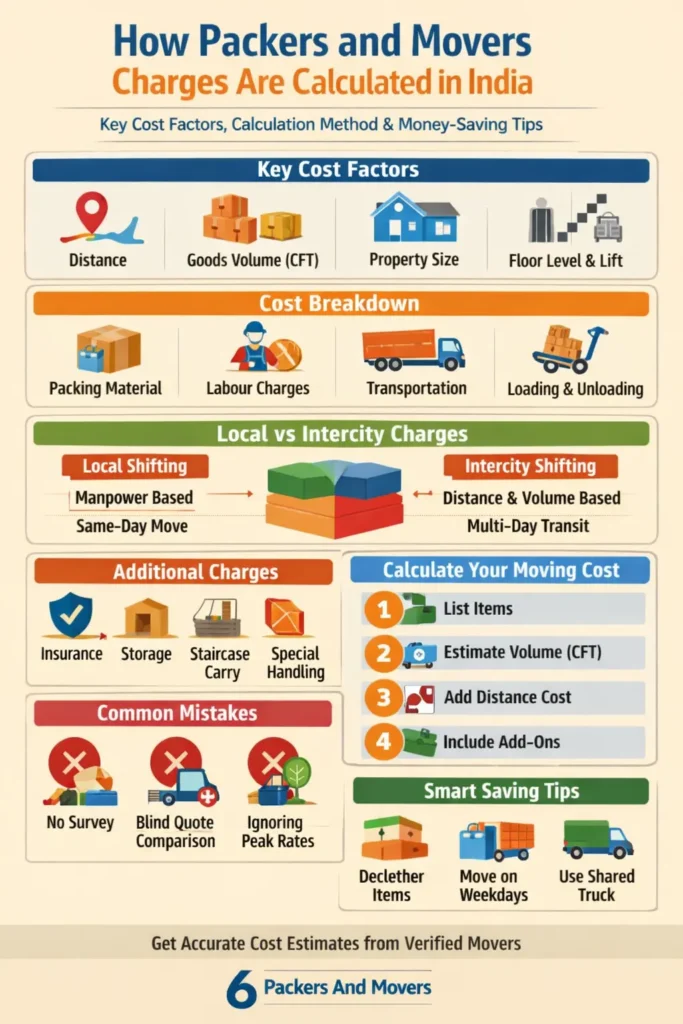
Packers and movers charges are calculated based on distance, volume of household goods (CFT), type of property, labour required, packing materials, transportation, and additional services like insurance or storage. Local shifting costs focus on manpower and vehicle usage, while intercity moves use distance-based and volume-based pricing models. Understanding these factors helps estimate relocation costs accurately and avoid hidden charges.

When planning a relocation, one of the most common concerns is how packers and movers calculate their charges and why estimates vary from one move to another. Understanding the cost calculation process helps you budget accurately, avoid last-minute price changes, and compare quotations on a like-to-like basis. Whether you are planning a local house shift or an intercity move, knowing how charges are structured allows you to make informed decisions before hiring professional Packers And Movers.
Packers and movers in India do not follow a flat pricing model. Instead, charges are calculated based on multiple factors such as distance, volume of goods, type of property, labour requirements, packing materials, and additional services like insurance or storage. These elements together determine the final moving cost. This guide explains each cost component in detail so you can understand how moving charges are calculated, estimate your expenses in advance, and reduce the risk of unexpected add-ons during relocation.
Why Packers and Movers Quotes Are Not Fixed Prices
There’s no universal tariff or fixed pricing model for moving services in India. Instead:
- Every relocation is different — the distance, number of items, packing needs, and access conditions vary from one move to another.
- Different companies use different cost models — some calculate based on distance, others may focus on volume or manpower requirements more heavily.
- Local vs long-distance moves are priced differently — even for the same size home, a move within the same city will be priced very differently from a move across state borders, because of higher transport costs, fuel charges, and logistics involved
Because of these variables, a company in one city may quote a starting charge of one amount while another may quote higher or lower for what appears to be a similar job. This isn’t arbitrary — it reflects the real operational differences behind each move.
Key Factors That Determine Packers and Movers Charges
Packers and movers charges in India are calculated using a multi-factor pricing model rather than a fixed rate. This approach helps movers assess the actual effort, resources, and risk involved in a relocation. Understanding these factors allows customers to interpret quotations correctly and avoid confusion when estimates vary between service providers.
Below are the primary factors that directly influence moving charges, applicable to both local and intercity shifting.
Distance Between Pickup and Delivery Location
Distance plays a critical role in calculating packers and movers charges, especially for intercity relocations. As the distance increases, transportation-related expenses also rise.
Key distance-related cost considerations include:
- Fuel consumption during transit
- Highway toll charges
- Driver allowance for long-distance travel
- Transit time and route complexity
For local shifting, distance has a limited impact as most costs are driven by manpower and vehicle type. However, for intercity moves, distance-based slabs are commonly used to calculate transport charges.
Volume or Weight of Household Goods
In India, packers and movers primarily calculate charges based on the volume of goods, measured in Cubic Feet (CFT). The total volume determines:
- Size of the moving vehicle
- Quantity of packing materials required
- Number of labourers needed for handling
Higher volume results in higher costs due to increased resource usage. For long-distance moves, volume-based estimation is preferred over item count because it provides a more accurate picture of space utilization inside the truck.
Type and Size of Property
Movers often use the type of residence as a quick reference point to estimate volume and labour requirements. Common property categories include:
- 1 BHK
- 2 BHK
- 3 BHK
- Independent house or villa
Larger homes usually involve more furniture, appliances, cartons, and handling effort. As a result, both packing and transportation charges increase with property size.
Floor Level and Lift Availability
The floor level of your current and destination property significantly affects labour effort. Charges may increase when:
- The property is on higher floors
- Elevators are unavailable or restricted
- Staircase carrying is required
Manual carrying through staircases increases time and manpower requirements, which directly impacts labour charges.
Key Cost Influencers at a Glance
|
Cost Factor |
Why It Affects Charges |
|
Distance |
Fuel, tolls, driver allowance |
|
Volume (CFT) |
Vehicle size, packing material |
|
Property Size |
Labour and handling effort |
|
Floor & Lift Access |
Manual carrying time |
Packers and Movers Cost Breakdown
Packers and movers charges are not a single lump-sum amount. Instead, they are calculated by adding multiple cost components, each linked to a specific service involved in the relocation process. Understanding this breakdown helps you identify what is included in your quotation and why prices differ between movers.
Below is a clear, component-wise explanation of how moving charges are structured in India.
Packing Material Charges
Packing material charges depend on the type, quantity, and quality of materials used to protect household goods during transit. Professional movers use different materials based on item fragility and size.
Common packing materials include:
- Corrugated cardboard boxes
- Bubble wrap for fragile items
- Stretch film and foam sheets
- Packing tape and protective covers
Fragile items such as glassware, electronics, or decorative pieces require additional protective layers, which increases packing material cost.
Labour Charges
Labour charges cover the manpower involved in:
- Packing household items
- Loading goods into the vehicle
- Unloading at the destination
- Unpacking services (if opted)
The number of labourers required depends on:
- Size of the house
- Volume of goods
- Floor level and accessibility
More labour and longer handling time result in higher labour charges.
Transportation Charges
Transportation charges form a major part of the total moving cost. These charges depend on the type and size of the vehicle used for shifting.
Key factors affecting transport charges include:
- Vehicle size (small truck, medium truck, container vehicle)
- Fuel cost for the journey
- Toll charges on highways
- Driver allowance for intercity moves
Larger vehicles are required for higher-volume moves, which directly increases transportation cost.
Loading and Unloading Charges
Loading and unloading may be:
- Included in the overall labour cost, or
- Charged separately depending on the service package
Charges increase when:
- Items are heavy or bulky
- Manual handling is required due to access limitations
Efficient loading and unloading are critical for safe transportation, making this a standard cost component.
Cost Breakdown Overview
|
Cost Component |
What It Covers |
|
Packing Material |
Boxes, wraps, protective materials |
|
Labour |
Packing, loading, unloading |
|
Transportation |
Vehicle, fuel, tolls, driver |
|
Handling |
Heavy or special item movement |
Local Shifting vs Intercity Moving Charges Calculation
Packers and movers charges vary significantly depending on whether the move is within the same city (local shifting) or between two cities (intercity shifting). The cost calculation logic for both is different because the resources, time, and risk involved are not the same.
Understanding this difference helps you evaluate quotations correctly and avoid unrealistic price comparisons.
How Local Packers and Movers Charges Are Calculated
Local shifting charges are primarily based on manpower, vehicle usage, and handling effort, rather than distance. Since travel usually happens within city limits, fuel and toll costs play a smaller role.
Key factors considered in local shifting cost calculation:
- Size of the house (1 BHK, 2 BHK, etc.)
- Volume of household goods
- Number of labourers required
- Truck size and rental duration
- Floor level and lift availability
In local moves, movers often calculate costs on a half-day or full-day basis, depending on the estimated time required to complete packing, loading, transportation, and unloading.
How Intercity Packers and Movers Charges Are Calculated
Intercity shifting involves longer travel distances and higher operational costs. As a result, charges are calculated using a distance-and-volume-based pricing model.
Major cost elements for intercity moves include:
- Distance between origin and destination cities
- Volume of goods (CFT-based estimation)
- Vehicle type (shared truck or dedicated vehicle)
- Fuel, toll, and driver allowance
- Transit handling and risk coverage
For long-distance moves, movers usually apply distance slabs and add service components such as packing, loading, unloading, and optional insurance separately.
Approximate Cost Differences Between Local and Intercity Moves
While exact prices vary, the cost difference between local and intercity shifting is substantial due to additional transport and time requirements.
|
Aspect |
Local Shifting |
Intercity Shifting |
|
Distance Impact |
Minimal |
High |
|
Pricing Basis |
Manpower & vehicle |
Distance & volume |
|
Transit Time |
Same day |
Multiple days |
|
Risk Handling |
Lower |
Higher |
Intercity relocation typically costs more than local shifting because it involves extended travel, fuel consumption, toll charges, and longer handling duration.
Additional Charges That Increase Packers and Movers Cost
Apart from basic packing, labour, and transportation costs, packers and movers may apply additional charges based on specific requirements or site conditions. These charges are not universal and usually apply only when certain services or situations arise.
Being aware of these cost components helps you understand why final bills sometimes differ from initial estimates.
Insurance Charges (Transit or All-Risk)
Insurance is an optional service but is commonly recommended for intercity relocations. It provides financial protection against loss or damage during transit.
Important points about insurance charges:
- Calculated as a percentage of the declared value of goods
- Applicable mainly for long-distance moves
- Separate from basic moving charges
Insurance cost increases with the declared value of household items.
Storage and Warehousing Charges
Storage or warehousing services are used when:
- Delivery is delayed
- The destination home is not ready
- Temporary holding is required
Charges are usually calculated:
- On a daily or monthly basis
- Based on space occupied and duration
Storage charges are billed separately and added to the total moving cost.
Staircase Carry or Long Carry Charges
These charges apply when goods need to be carried manually due to access limitations.
Situations that may trigger staircase or long carry charges:
- No lift available in high-rise buildings
- Lift size restrictions
- Truck parking far from the building entrance
Manual carrying increases labour effort and time, leading to additional charges.
Special Handling Charges
Special handling charges may apply for:
- Heavy items (safes, large appliances)
- Fragile or high-value items
- Oversized furniture requiring dismantling
These items need extra care, manpower, or customized packing, which adds to the overall cost.
Additional Charges Summary
|
Additional Charge |
When It Applies |
|
Insurance |
Long-distance or high-value moves |
|
Storage |
Delayed delivery or temporary holding |
|
Staircase/Long Carry |
No lift or distant parking |
|
Special Handling |
Heavy or fragile items |
Online Quotes vs Physical Pre-Move Survey
Packers and movers use two common methods to generate estimates: online/phone-based quotes and physical pre-move surveys. Industry relocation guides consistently explain that the accuracy of a quote depends heavily on how the assessment is done.
How Online or Phone-Based Quotes Are Calculated
Online or phone-based quotes are usually prepared using the information provided by the customer, such as:
- Approximate house size (1BHK, 2BHK, etc.)
- Pickup and delivery locations
- Expected moving date
- General list of items
Many packers and movers and relocation platforms explain that these quotes are preliminary estimates, intended to give a rough cost idea rather than a final amount. Since movers do not physically verify the volume or access conditions, online quotes may change later if actual conditions differ from what was shared initially.
Why Physical Pre-Move Surveys Lead to More Accurate Quotes
A physical pre-move survey allows the moving company to assess the relocation requirements in person. According to industry explanations, this survey helps movers:
- Measure the actual volume of goods
- Identify fragile or special items
- Evaluate floor levels, lift access, and parking distance
- Plan packing material and manpower more accurately
Because all critical factors are verified on-site, quotes generated after a physical survey are generally more detailed and less likely to change, provided no additional items or services are added later.
Virtual Surveys as a Middle Option
Some companies also offer virtual surveys using video calls. Industry sources note that while virtual surveys are more accurate than phone-only quotes, they still depend on camera coverage and customer cooperation, which means they may not fully replace a physical inspection in complex moves.
What Is Usually Included in a Packers and Movers Quote
Packers and movers quotes generally include a basic set of services required to complete a standard relocation. Industry cost guides and moving calculators clarify that inclusions can vary between companies, but most estimates cover the core operational activities involved in shifting household or office goods.
Packing of Household or Office Goods
Most quotes include basic packing services, where movers use standard packing materials to secure items for transportation. This typically covers:
- Packing of furniture, appliances, and cartons
- Use of commonly required packing materials such as boxes, wrapping material, and tape
Industry sources note that the quality and quantity of packing materials included depend on what has been agreed upon during the survey or quotation stage.
Loading of Goods at the Pickup Location
Loading refers to moving packed items from the premises into the transport vehicle. Quotes usually account for:
- Manpower required for lifting and carrying
- Use of basic equipment needed for safe loading
Loading is considered a standard part of the relocation process and is commonly bundled into the overall estimate.
Transportation Between Locations
Transportation charges are a core component of any moving quote. According to industry explanations, this includes:
- Use of a truck or carrier suitable for the volume of goods
- Transport of items from the pickup location to the delivery address
The type of vehicle and distance involved influence how transportation is calculated, but the transport service itself is typically included in the quote.
Unloading at the Delivery Location
Unloading services generally form part of the quoted amount. This involves:
- Removing goods from the vehicle
- Carrying items into the delivery premises
Unloading is usually included as long as access conditions match what was disclosed during the quotation process.
Basic Manpower for the Move
Most packers and movers quotes factor in the manpower required for:
- Packing
- Loading
- Unloading
Industry cost breakdowns indicate that manpower allocation is estimated based on the size of the move and the expected workload.
Important Note on Inclusions
Industry guides emphasize that what is included can differ between movers, and customers should always:
- Ask for a written quotation
- Confirm inclusions clearly
- Avoid assuming that all services are automatically covered
Understanding inclusions upfront helps prevent confusion during billing.
What Is Usually NOT Included in the Initial Quote
While packers and movers quotes typically cover core relocation services, industry cost guides clearly state that certain charges are often excluded from the initial estimate unless they are discussed and documented in advance. These exclusions are a common source of confusion for customers, which is why understanding them upfront is important.
Additional Items Added After the Quotation
Most movers calculate quotes based on the item list or volume assessed during the survey. If extra items are added later:
- Additional packing materials may be required
- Extra manpower or vehicle space may be needed
Industry sources explain that such changes can result in a revised final bill.
Unforeseen Access or Handling Challenges
Quotes are generally prepared assuming normal access conditions. Situations that may not be included unless disclosed earlier include:
- Long carrying distances due to parking restrictions
- Lack of lift access in multi-storey buildings
- Narrow staircases or entry points
These factors may require additional labor or time, which movers often assess separately.
Specialized Packing or Handling Services
Standard quotes may not include specialized services unless specifically requested, such as:
- Custom crating for delicate or high-value items
- Special handling for oversized or unusually heavy goods
Industry references note that these services involve extra materials and expertise, and are usually quoted separately.
Statutory or Location-Specific Charges
Some relocation guides point out that certain statutory or location-based costs may not be included upfront, especially for intercity moves. These can vary depending on:
- Route-specific requirements
- Local regulations at pickup or delivery locations
Because these charges are not uniform across locations, they may be clarified closer to the moving date.
Storage and Extended Warehousing Services
If goods need to be stored beyond the originally discussed duration, additional storage-related charges may apply. Industry explanations clarify that storage is usually calculated separately based on volume and time period.
Why Clarifying Exclusions Is Important
Industry best practices recommend that customers:
- Ask for a detailed, written breakdown of inclusions and exclusions
- Confirm conditions under which charges may change
- Avoid assuming that every possible scenario is covered
Clear communication at the quotation stage helps reduce disputes later.
How to Compare Packers and Movers Quotes Correctly
Industry relocation guides consistently advise customers to compare packers and movers quotes beyond just the final price. A meaningful comparison focuses on what is being offered, under what conditions, and how transparently the quote is presented.
Compare the Scope of Services, Not Just the Price
One of the most common recommendations from moving advisory platforms is to check whether each quote covers the same scope of work. Customers are advised to verify:
- Packing, loading, transportation, and unloading services
- Inclusion or exclusion of dismantling and reassembly
- Whether basic or premium packing materials are being used
Two quotes with different prices may not be directly comparable if the service scope differs.
Check Inclusions and Exclusions Carefully
Industry guidance highlights the importance of reviewing inclusions and exclusions line by line. Customers should confirm:
- What services are included in the quoted amount
- What situations may lead to additional charges
- Whether exclusions are clearly documented
This helps avoid misunderstandings on moving day or at the time of final billing.
Verify the Type of Survey Used for Quotation
Relocation experts recommend giving more weight to quotes prepared after:
- A physical pre-move survey, or
- A detailed virtual survey
Quotes given without proper assessment are more likely to change later, making comparisons less reliable.
Review Insurance and Risk Coverage Details
Industry sources advise checking whether transit insurance is:
- Included
- Optional
- Completely excluded
Understanding insurance terms allows customers to compare quotes based on risk protection, not just cost.
Assess Transparency and Communication Quality
Another commonly cited comparison factor is how clearly the mover explains:
- Pricing logic
- Payment terms
- Conditions under which charges may change
Clear communication is often viewed as an indicator of professionalism and reliability.
Why Proper Comparison Leads to Better Decisions
Industry best practices emphasize that comparing quotes correctly helps customers:
- Choose movers aligned with their expectations
- Reduce last-minute disputes
- Avoid decisions based solely on the lowest price
A structured comparison approach supports a smoother relocation experience.
How to Calculate Packers and Movers Charges Yourself (Step-by-Step)
If you want a rough cost estimate before requesting quotations, you can calculate packers and movers charges yourself using the same basic logic followed by moving companies in India. While the final price may vary after inspection, this method helps you understand the cost structure and avoid unrealistic estimates.
Step 1: List All Household Items
Start by preparing a complete list of items to be moved. This helps estimate volume, packing material, and labour requirements.
Your list should include:
- Furniture (beds, wardrobes, sofas, tables)
- Appliances (TV, refrigerator, washing machine)
- Kitchen items and cartons
- Fragile or high-value items
A detailed inventory improves accuracy and reduces chances of price revision after survey.
Step 2: Estimate Volume in Cubic Feet (CFT)
Packers and movers in India commonly use Cubic Feet (CFT) to estimate the space your goods will occupy in a truck.
Why volume matters:
- Determines truck size
- Influences packing material usage
- Impacts labour requirement
Volume estimation is usually done room-wise or item-wise during a physical or virtual survey.
Step 3: Add Distance-Based Transportation Cost
Once volume is estimated, transportation cost is calculated based on:
- Distance between origin and destination
- Type of vehicle required
- Intercity distance slabs (for long moves)
For local shifting, distance has limited impact. For intercity moves, longer distance results in higher fuel, toll, and driver allowance costs.
Step 4: Include Add-On Services
Add the cost of optional or situation-based services such as:
- Packing and unpacking
- Insurance coverage
- Storage or warehousing
- Staircase or long-carry handling
These services are charged separately and can significantly affect the final moving cost.
Self-Calculation Overview
|
Calculation Step |
Purpose |
|
Item Listing |
Estimate volume and materials |
|
Volume (CFT) |
Decide vehicle and labour |
|
Distance |
Calculate transport cost |
|
Add-On Services |
Final cost adjustment |
Common Mistakes People Make While Estimating Moving Charges
Many relocation cost disputes arise not because of unfair pricing, but due to incorrect assumptions made while estimating packers and movers charges. Understanding these common mistakes helps you set realistic expectations and avoid last-minute surprises.
Ignoring the Importance of a Physical Survey
One of the most frequent mistakes is relying only on phone or WhatsApp estimates without a physical or virtual survey.
Why this causes problems:
- Actual volume may be higher than estimated
- Floor level, lift access, and parking distance may be overlooked
- Special handling requirements may not be identified
Estimates given without inspection often change once movers assess the goods and site conditions.
Comparing Quotes Without Matching Service Scope
Many people compare quotes purely on price without checking what services are included.
Common comparison errors:
- One quote includes packing, another does not
- Insurance included in one estimate but excluded in another
- Loading/unloading counted separately in some quotes
A lower quote may appear attractive but can result in additional charges later if services are excluded.
Not Accounting for Seasonal Price Fluctuations
Moving costs in India vary depending on demand and seasonality.
When charges usually increase:
- Month-end and weekends
- Peak relocation seasons
- High-demand periods when availability is limited
Failing to consider these factors can lead to higher-than-expected quotes.
Mistakes Summary
|
Common Mistake |
Impact on Cost |
|
No physical survey |
Quote revision later |
|
Scope mismatch |
Hidden or extra charges |
|
Ignoring seasonality |
Higher moving cost |
Tips to Reduce Packers and Movers Charges Without Risk
Reducing packers and movers charges does not mean compromising on service quality or safety. By planning your move carefully and understanding how costs are calculated, you can control expenses without increasing risk.
Below are practical, widely followed methods to lower moving costs in India.
Declutter Before Moving
One of the most effective ways to reduce moving charges is to reduce the volume of goods being shifted.
Benefits of decluttering:
- Lower packing material usage
- Smaller vehicle requirement
- Reduced labour effort
Selling, donating, or discarding unused items before moving directly reduces volume-based costs.
Choose the Right Moving Date
Moving charges often vary depending on demand. Selecting the right date can help lower costs.
Cost-saving date strategies:
- Avoid month-end and weekends
- Prefer mid-month and weekdays
- Plan moves during low-demand periods
Lower demand improves availability and helps control pricing.
Opt for Shared Transportation (When Suitable)
For smaller shipments or flexible delivery timelines, shared transportation can reduce transport costs.
How shared loads help:
- Transport cost is split across multiple consignments
- Suitable for partial household moves
- Requires flexible delivery schedule
Shared transport is commonly used for intercity relocations with limited volume.
Cost-Saving Tips Overview
|
Cost-Saving Tip |
How It Helps |
|
Decluttering |
Reduces volume and packing cost |
|
Smart move date |
Avoids peak pricing |
|
Shared transport |
Lowers transport charges |
Our Role in Helping Customers Understand Moving Quotes
Understanding packers and movers quotes can be confusing, especially when customers receive multiple estimates with different scopes and conditions. Industry guidance recognizes the role of relocation platforms in helping users interpret quotes clearly, rather than influencing or fixing prices.
Facilitating Transparent Quote Comparisons
As a facilitation platform, our role is limited to helping customers:
- Receive quotes from multiple service providers
- Compare estimates based on disclosed services and conditions
- Identify differences in inclusions, exclusions, and survey methods
We do not determine pricing, as final quotes are prepared independently by the moving companies based on their own assessments.
Helping Customers Ask the Right Questions
Relocation advisory sources highlight that informed customers are less likely to face disputes. We assist customers by guiding them on:
- What details to confirm before accepting a quote
- Which inclusions and exclusions need clarification
- Why written quotations and surveys matter
This helps customers evaluate quotes more effectively before making a booking decision.
Promoting Informed and Responsible Booking Decisions
Our objective is to encourage customers to make decisions based on clarity and transparency, not just cost. By providing educational resources and comparison support, we help users understand how quotes are calculated and what factors may influence final billing.
Important Clarification
It’s important to note that:
- We act as a facilitator, not the service provider
- Actual relocation services are delivered by independent packers and movers
- Pricing, execution, and service quality depend on the chosen moving company
This clarification aligns with industry best practices for transparency and customer awareness.
Planning a move and unsure about the actual cost?
With 6 Packers And Movers, you get transparent pricing, verified movers, and accurate cost estimates based on your exact requirements. Share your moving details and get connected with professional packers and movers who follow clear cost calculation methods—no guesswork, no last-minute surprises.