
Packers And Movers Delivery & Unloading Process: Step-by-Step Guide
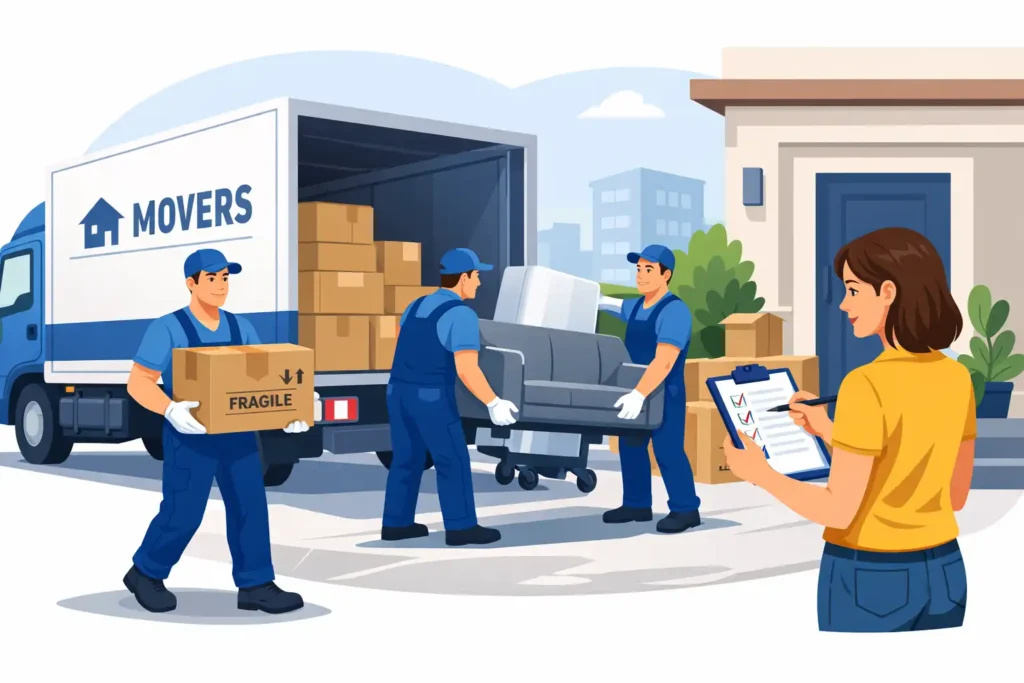
The delivery and unloading stage is the final and most sensitive phase of any relocation. After transportation, all household or office goods must be unloaded, verified, and handed over systematically to ensure nothing is misplaced or damaged. Professional Packers And Movers follow a defined delivery workflow to complete the move safely, transparently, and in an organized manner.
f you are planning a relocation, working with verified packers and movers helps ensure that your goods are delivered, unloaded, and accounted for properly at the destination, reducing post-move stress and disputes.
At an industry level, the delivery and unloading process is recognized as a distinct step that follows packing, loading, and transportation. To ensure everything goes smoothly, it’s important to follow practical Moving Tips, as this phase typically includes vehicle arrival, unloading of goods, inventory verification, optional unpacking, and final customer sign-off.
Pre-Delivery Planning and Route Coordination
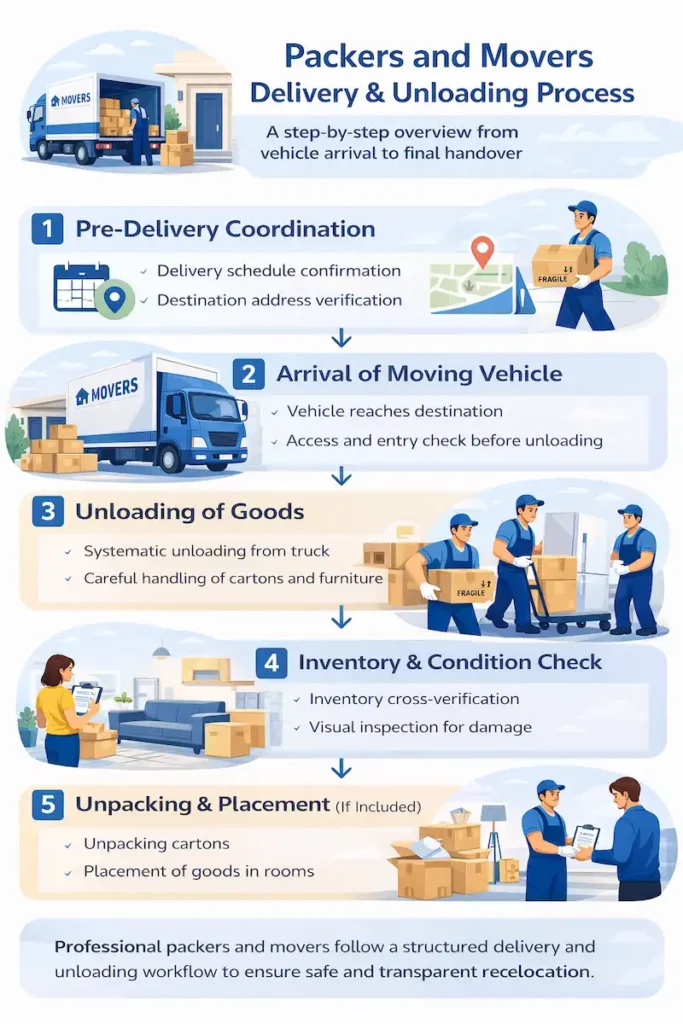
Before the moving vehicle reaches the destination, professional packers and movers carry out structured pre-delivery coordination to ensure the unloading phase is executed without delays or confusion. This planning is an extension of the overall relocation workflow and is essential for timely delivery and smooth handover of goods.
As part of standard moving practices, movers coordinate delivery schedules, confirm destination details, and prepare for unloading requirements in advance. This step helps reduce waiting time, prevent access issues at the destination, and align manpower availability with the delivery window.
Key activities involved in pre-delivery planning include:
- Delivery schedule confirmation
Movers typically inform the customer about the expected delivery date and time once transportation is nearing completion. This allows the customer to be present during unloading and inventory verification. - Destination address and access verification
The delivery team confirms the exact drop location to avoid misrouting or delays, especially for long-distance or intercity relocations. - Route and movement planning
Prior planning ensures the vehicle reaches the destination efficiently after transportation, forming a smooth transition into the unloading phase.
Industry relocation workflows consistently describe delivery coordination as a preparatory step before unloading and unpacking activities begin at the destination.
Pre-delivery coordination is part of the broader packers and movers working process, which starts from packing and continues through final handover.
Arrival of the Moving Vehicle at the Destination
Once transportation is completed, the moving vehicle arrives at the destination to initiate the unloading phase. This stage marks the physical transition of goods from transit to delivery and is handled in a controlled and methodical manner by professional packers and movers.
Standard relocation workflows describe vehicle arrival as a formal checkpoint before unloading begins. At this stage, movers ensure that the delivery location is correct and that unloading can be carried out without obstruction or confusion.
What typically happens upon vehicle arrival:
- Confirmation of destination details
The delivery team verifies the destination address before unloading to ensure goods are delivered to the correct location, especially in intercity or long-distance moves. - Preparation for unloading
Before opening the vehicle, movers assess the surroundings to determine how and where unloading will take place. This includes identifying access points such as gates, staircases, or entry corridors. - Sequential transition to unloading
Industry-standard moving processes define unloading as the immediate next step after arrival, following packing, loading, and transportation.
Relocation guides consistently outline arrival and unloading as connected stages, where unloading begins only after the vehicle has reached the confirmed destination and basic checks are completed.
Unloading of Household or Office Goods
Unloading is a core component of the delivery process and is carried out immediately after the moving vehicle reaches the destination. Professional packers and movers treat unloading as a structured operation, ensuring that all items are removed from the vehicle carefully and in an organized sequence.
Industry relocation workflows clearly identify unloading as a distinct step following transportation. During this phase, goods are transferred from the truck or container into the destination premises with controlled handling to minimize the risk of damage.
How professional unloading is typically carried out:
- Systematic removal of goods from the vehicle
Movers unload items one by one from the truck rather than in bulk, which helps maintain control and prevents mishandling during delivery. - Careful handling of household and office items
Standard moving procedures emphasize cautious unloading to protect furniture, appliances, cartons, and personal belongings during the final stage of the move. - Placement of items inside the premises
Once unloaded, goods are moved inside the destination property and placed in designated areas, preparing them for inventory checking or unpacking.
Unloading is commonly performed by trained manpower as part of the overall relocation service, forming the bridge between transportation and final handover to the customer.
Condition Check and Damage Inspection During Unloading
After unloading begins, professional packers and movers carry out a condition check to ensure that all delivered goods are intact and accounted for. This step is closely linked with the inventory prepared during the packing stage and serves as a verification mechanism at the destination.
Industry relocation processes highlight the importance of checking items during or immediately after unloading to identify missing goods, visible damage, or discrepancies while the delivery team is still present.
Key aspects of condition checking during unloading include:
- Inventory cross-verification
Movers compare unloaded items against the inventory list created at the time of packing. This helps confirm that all cartons and goods have arrived at the destination. This verification stage also plays a critical role in insurance protection, as damage or discrepancies must be identified during delivery for claims to remain valid. - Visual inspection for damage
During unloading, cartons and furniture are checked for visible signs of damage that may have occurred during transportation or handling. - Immediate reporting of issues
Any mismatch, damage, or missing item is typically noted at the time of delivery, allowing the issue to be documented before final handover.
Relocation guidelines consistently describe inventory verification and condition checks as an essential part of the unloading and delivery process, supporting transparency and post-move resolution if required.
Unpacking and Placement of Goods at the New Location
After unloading and initial condition checks, some packers and movers extend their services to include unpacking and basic placement of goods at the destination. This step is not universal and depends on the service package selected by the customer, but it is commonly offered as part of full-service relocation solutions.
Industry relocation workflows describe unpacking as a post-unloading activity that helps customers settle in faster by reducing manual effort after delivery.
What unpacking and placement typically involve:
- Opening packed cartons
Movers unpack cartons containing household or office items once unloading is completed, helping customers access their belongings without delay. - Removal of packing materials
Protective materials such as bubble wrap, packing paper, or cartons are removed after unpacking, reducing clutter at the destination. - Basic placement of items
Furniture and major items may be placed in designated rooms as instructed by the customer, supporting smoother post-move organization.
Unpacking and placement are described as optional but value-added steps in the relocation process, bridging the gap between delivery and complete move closure.
Final Handover, Payment Closure, and Customer Sign-Off
The final handover marks the official completion of the delivery and unloading process. At this stage, professional packers and movers conclude the relocation by ensuring all agreed services have been delivered and the customer formally acknowledges receipt of goods.
Industry relocation practices describe this step as a documentation-driven closure, where delivery confirmation and related records are completed after unloading and, where applicable, unpacking.
What typically happens during final handover:
- Delivery confirmation
Once unloading and inventory verification are completed, the customer confirms that the goods have been delivered as per the agreed inventory list. - Documentation and acknowledgment
Movers provide delivery-related documents such as inventory sheets or delivery receipts, which act as proof of completion of the move. - Payment settlement
Final payments, if pending, are usually settled after delivery and verification, completing the commercial aspect of the relocation. Final payments are usually settled after delivery verification, in line with standard packers and movers payment practices.
Customer sign-off serves as the formal endpoint of the moving process and helps both parties close the relocation with clear records in place.
Safety Measures Followed During Delivery and Unloading
Safety is an integral part of the delivery and unloading process, as this stage involves manual handling of goods, movement of heavy items, and activity within residential or commercial premises. Industry relocation processes emphasize controlled handling and cautious execution during unloading to minimize the risk of damage to goods and property.
Professional packers and movers incorporate safety-focused practices during delivery as part of standard operational procedures outlined in relocation workflows.
Common safety-related practices during delivery and unloading include:
- Careful handling of goods during unloading
Relocation procedures highlight the importance of cautious unloading to prevent damage to furniture, appliances, and packed cartons while transferring them from the vehicle to the destination premises. - Managed movement inside the premises
Goods are moved in an orderly manner from entry points to interior spaces, reducing the chances of collisions, falls, or impact damage. - Controlled unloading sequence
Unloading is performed in a step-by-step sequence rather than in bulk, which supports safer handling and better control over items.
These safety-oriented practices are described as part of the standard unloading phase in professional moving workflows and contribute to a smoother, incident-free delivery experience.
Common Delivery & Unloading Challenges and How Movers Handle Them
During the delivery and unloading phase, packers and movers may encounter practical challenges that can affect the speed and flow of the relocation. Industry relocation guides acknowledge that site-specific conditions and external factors often influence how unloading is carried out at the destination.
Professional movers address these challenges through planned execution and on-site coordination, ensuring the delivery process is completed without compromising item safety.
Common challenges observed during delivery and unloading include:
- Access limitations at the destination
Narrow entry points, staircases, or restricted access areas can slow down unloading. Relocation processes note that movers adjust unloading methods based on available access. - Delays due to site readiness
Unloading can be affected if the destination premises are not fully ready to receive goods. Industry workflows emphasize the importance of coordinating delivery timing to reduce such delays. - Handling multiple cartons and bulky items
Large volumes of goods require structured unloading to maintain control and prevent mix-ups, which is why unloading is performed systematically.
These challenges are recognized as part of real-world relocation scenarios, and structured unloading procedures help movers manage them efficiently during delivery.
Tips for Customers to Ensure a Smooth Delivery Experience
A smooth delivery and unloading process depends not only on the movers but also on customer preparedness at the destination. Industry relocation guides consistently highlight that customer coordination during delivery helps prevent delays, confusion, and post-move issues.
By staying involved during unloading and verification, customers can ensure that the delivery process is completed accurately and efficiently.
Practical steps customers can follow during delivery:
- Be present at the destination during delivery
Relocation workflows emphasize the importance of customer presence during unloading to confirm receipt of goods and support inventory verification. - Verify items against the inventory list
Customers are advised to cross-check unloaded goods with the inventory prepared at the packing stage to confirm that all items have been delivered. - Inspect goods before final sign-off
Industry guidance recommends checking items for visible damage or discrepancies before completing delivery acknowledgment. Following these steps and working with experienced packers and movers ensures a smooth and dispute-free delivery experience.
These customer-level practices align with standard delivery procedures and support a transparent and organized conclusion to the relocation process.