
How to Verify Transport Permits Used by Movers
Verifying transport permits used by movers is essential to ensure your household goods are moved legally and safely. Customers should check whether the truck is registered as a commercial goods carriage, holds a valid state or national transport permit, and is authorized for the relocation route. Permit details can be verified online using the vehicle number to confirm permit validity, permitted states, and expiry dates. Movers using vehicles without valid permits risk border delays, vehicle seizure, fines, and insurance claim rejection. Always verify transport permits before loading begins to avoid legal and financial issues during relocation.
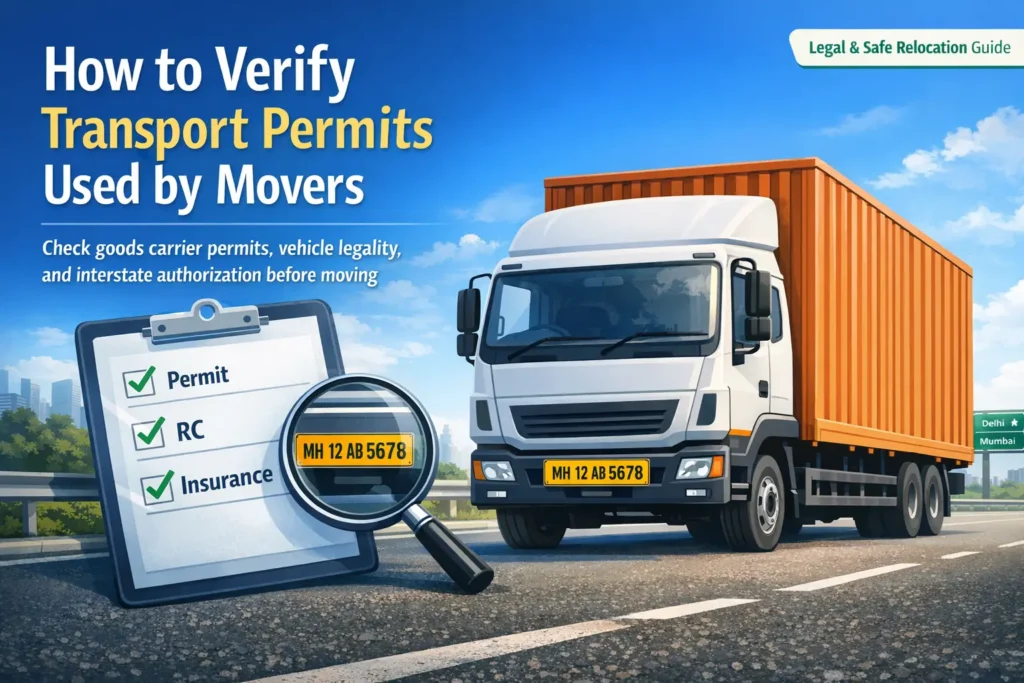
When you hire packers and movers for local or interstate relocation, the safety of your household goods depends not only on packing quality but also on whether the transport vehicle is legally authorized to operate. Many customers unknowingly book movers who use trucks without valid transport permits, which can lead to border delays, fines, vehicle seizure, and even insurance claim rejection during transit.
Verifying transport permits is a critical step before finalizing any relocation service. A valid permit confirms that the mover is using a registered commercial vehicle, approved by transport authorities to carry goods for hire. This guide explains how to verify transport permits used by movers, what documents to check, how to confirm permit validity online, and how to avoid common permit-related frauds—so you can move safely and legally with confidence.
Before booking, it’s equally important to work with professional packers and movers who follow verified transport and documentation practices.
If you are still comparing professional movers and packers, you can explore verified packers and movers in Madurai who use legally permitted transport vehicles.
Why Transport Permits Matter in Packing and Moving
Transport permits are a legal requirement for any commercial vehicle used to carry household goods for payment. Under Indian transport regulations, a truck carrying goods for hire must operate only within the scope of the permit issued to it. If a mover uses a vehicle without a valid permit—or uses a permit incorrectly—the shipment becomes legally non-compliant during transit.
Why permits are critical for customers
- Legal authorization: A transport permit confirms that the vehicle is approved to carry goods commercially and operate on public roads for relocation purposes.
- Interstate movement compliance: Vehicles moving across state borders must have permits that explicitly allow interstate operation; local permits are not sufficient.
- Protection during inspections: At RTO checkposts and state borders, enforcement officers verify permits first. Invalid permits often result in truck detention and unloading delays.
- Insurance validity: In multiple legal and insurance dispute cases, claims have been denied when goods were transported in vehicles lacking required permits.
- Customer liability risk: When goods are seized or delayed due to permit violations, customers may face additional costs, storage charges, or delivery postponements.
Understanding what transit insurance covers during house shifting helps customers avoid claim rejection caused by permit violations.
What happens when permits are not verified
- Trucks may be stopped or seized during highway inspections
- Goods can be delayed for days at state borders
- Movers may demand extra money to resolve permit issues (These unplanned expenses often fall under charges excluded from initial moving quotations, which customers should review in advance.)
- Insurance claims may be rejected due to regulatory violations
Types of Transport Permits Movers Must Have in India
When movers transport household goods for payment, the vehicle used must carry a valid goods transport permit issued by transport authorities. These permits define where the truck can operate, what it can carry, and for how long. Understanding the types of permits helps customers quickly identify whether a mover is legally eligible to handle local or interstate shifting.
Goods Carrier Permit (State or National Permit)
A goods carrier permit authorizes a commercial vehicle to transport goods for hire. Movers typically use trucks registered under the goods carriage category, which cannot legally operate without a permit.
- The permit is issued to a specific vehicle number
- It specifies whether the vehicle can operate within one state or across multiple states
- Operating outside the permitted area is treated as a violation during enforcement checks
State Permit vs National Permit
Movers may hold either a state permit or a national permit, depending on the type of relocation service they offer.
State Permit
- Allows operation within the issuing state only
- Suitable for local shifting or intracity moves
- Cannot be legally used for interstate relocation
National Permit
- Required for interstate and long-distance moving
- Allows movement across multiple states as approved
- Issued through centralized transport systems
Permit Type | Allowed Operation | Suitable For |
State Permit | Within one state | Local / intracity shifting |
National Permit | Across multiple states | Interstate household relocation |
Using a state-permitted vehicle for interstate shifting can result in border detention and penalties.
Commercial Vehicle Registration (Yellow Number Plate)
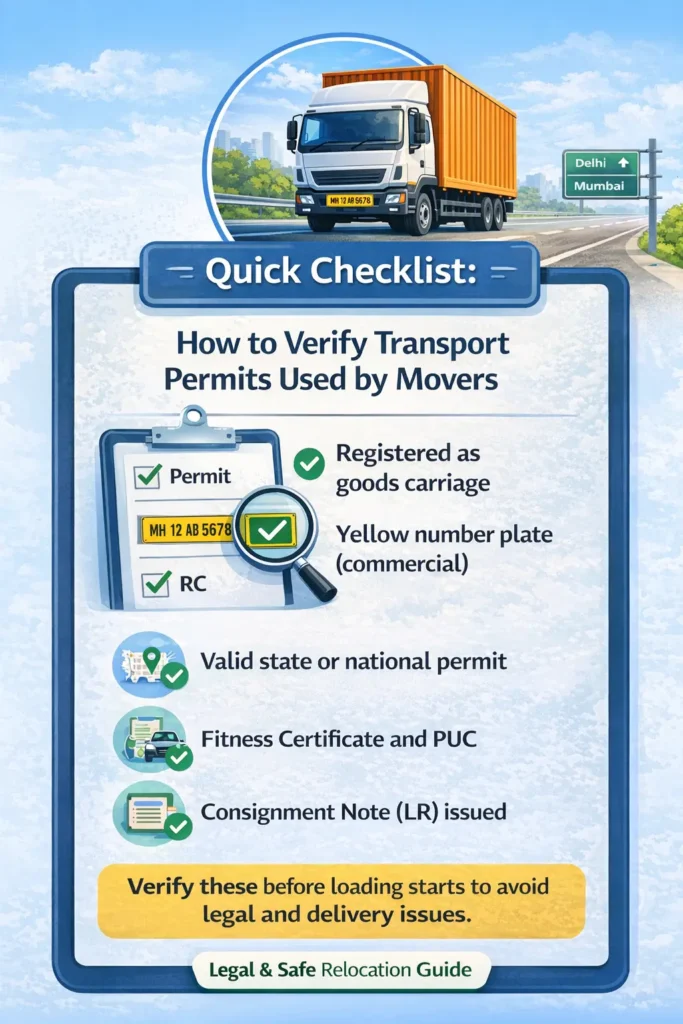
Vehicles used by movers must be registered as commercial transport vehicles, which are identified by yellow number plates with black lettering.
- Private vehicles (white plates) cannot be legally used for paid moving services
- Commercial registration confirms the vehicle is taxed, insured, and regulated for transport use
- Enforcement teams use number plate color as a primary compliance check
Customers should avoid movers who offer unusually low prices but use privately registered vehicles.
Fitness Certificate (FC) and Pollution Certificate (PUC)
In addition to permits, transport vehicles must meet roadworthiness and environmental standards.
Fitness Certificate
- Confirms the vehicle is mechanically fit for commercial operation
- Mandatory for transport vehicles and periodically renewed
- Checked during RTO inspections and highway enforcement
Pollution Under Control (PUC)
- Confirms emissions are within prescribed limits
- Mandatory for all commercial vehicles
- Absence of a valid PUC can result in fines and vehicle detention
Document | Purpose | Mandatory |
Fitness Certificate | Road safety & mechanical fitness | ✔ Yes |
PUC Certificate | Emission compliance | ✔ Yes |
Vehicles without valid FC or PUC may be declared unfit for transport, even if a permit exists.
Key Transport Documents You Should Ask Movers to Show
Before confirming any packing and moving service, customers should personally verify the transport documents of the vehicle that will carry their household goods. These documents prove that the truck, driver, and transport activity are legally authorized. Reliable movers share these details before dispatch, not after loading.
Vehicle Registration Certificate (RC)
The Registration Certificate confirms that the truck is legally registered as a goods carriage vehicle.
What to verify in the RC:
- Vehicle number matches the actual truck used on moving day
- Vehicle category shows goods carriage / transport vehicle
- Registration status is active, not suspended or expired
Customers can verify vehicle numbers online to ensure the RC details match the mover’s claims.
Valid Transport Permit Copy
A transport permit authorizes the vehicle to carry goods for hire.
Check the following details carefully:
- Permit number and issuing authority
- Validity period (expiry date)
- States or regions permitted for operation
- Vehicle number mentioned on the permit
If the relocation is interstate, confirm that the permit explicitly allows interstate movement. A local or state-only permit is not valid for long-distance shifting.
Driver License and Commercial Authorization
The truck driver must hold a valid driving license appropriate for the vehicle class.
Key points to check:
- License category permits driving of transport vehicles
- License is valid and not expired
- Driver details match the person operating the truck
At checkpoints, authorities frequently verify driver license and vehicle papers together, so missing or invalid licenses can delay the shipment.
Insurance Papers and Consignment Note (LR)
Transport Insurance
- Confirms coverage of goods during transit
- May be required for claim processing in case of loss or damage
Consignment Note / Lorry Receipt (LR)
- Acts as proof that goods were handed over to the transporter
- Includes consignor name, consignee name, vehicle number, and route
- Often required for insurance claims and legal disputes
Movers who refuse to issue a consignment note may not be following standard transport procedures.
Document | Why It Matters |
RC | Confirms legal vehicle registration |
Permit | Authorizes commercial goods transport |
Driver License | Confirms authorized driver |
LR / Consignment Note | Proof of goods handed over |
Important customer tip
Always ask for document copies before loading, not after the truck is sealed. Once goods are loaded, negotiating compliance becomes difficult.
How to Verify Transport Permits Online
Verifying transport permits online helps customers confirm whether the mover is using a legally authorized commercial vehicle before the relocation begins. Government transport portals allow public access to vehicle and permit details, making it possible to cross-check documents shared by movers.
Step 1: Verify Vehicle Details Using the Vehicle Number
Start by checking the vehicle registration details using the truck number provided by the mover.
What you can confirm online:
- Vehicle class (goods carriage / transport vehicle)
- Registration status (active or inactive)
- Registration authority and state
- Fuel type and basic specifications
If the vehicle is not listed as a transport or goods carriage vehicle, it should not be used for paid moving services.
Step 2: Check Transport Permit Status
After confirming the vehicle is registered as a commercial goods vehicle, verify the permit details.
Key details to match:
- Vehicle number on the permit
- Permit validity period
- Permit type (state or national)
- States authorized for operation
For interstate moves, ensure the permit explicitly allows multi-state operation. A state-limited permit is not valid for crossing borders.
Step 3: Match Permit Details with the Actual Truck
Before loading begins, visually confirm that:
- The truck number printed on the vehicle matches the RC and permit
- The permit copy is issued for the same vehicle, not another truck
- The permit validity has not expired
Permit misuse often occurs when movers show a valid permit copy but send a different truck on moving day.
Step 4: Verify Fitness and Pollution Certificates
Even if the permit is valid, the vehicle must also be fit for transport.
Check:
- Fitness Certificate validity
- Pollution Under Control (PUC) certificate validity
Vehicles without valid fitness or PUC can be stopped during inspections, leading to unloading or delays.
Common Red Flags During Online Verification
Watch out for these warning signs:
- Permit expired or nearing expiry
- Permit issued for a different vehicle number
- Vehicle registered as private but used for moving
- Local permit shown for interstate relocation
- Mover refusing to share vehicle number before dispatch
Red Flag | What It Indicates |
Expired permit | Illegal operation |
Mismatch in vehicle number | Permit misuse |
Private registration | Non-compliant vehicle |
No permit copy | High legal risk |
Always complete permit verification before packing starts. Once goods are loaded, changing the vehicle or mover becomes difficult.
Common Permit Fraud Practices Used by Unverified Movers
Customers often face problems during relocation not because permits don’t exist—but because they are misused, duplicated, or falsely represented. Understanding common permit fraud practices helps you identify red flags early and avoid legal and financial risks during transit.
Most permit-related problems can be avoided by following a structured checklist for choosing reliable packers and movers.
Using One Permit for Multiple Trucks
Some unverified movers operate several trucks but possess permits for only one or two vehicles.
How this fraud works:
- A single valid permit copy is shared digitally with multiple customers
- Different trucks are dispatched on moving day
- The actual truck used may not be covered under any permit
During highway checks, this results in immediate detention because permits are issued for specific vehicle numbers only.
Using Local or State Permits for Interstate Moves
Another common malpractice is using state-only permits for interstate household shifting.
Typical scenarios:
- Movers promise interstate service at a low cost
- A truck with a state permit is dispatched
- The vehicle gets stopped at the state border for permit violation
This often leads to:
- Transit delays
- Additional “settlement” charges demanded from customers
- Unplanned unloading or truck change mid-route
Using Privately Registered (White Plate) Vehicles
Some movers use:
- Pickup vans
- Small trucks
- Tempo vehicles
registered as private vehicles, not commercial goods carriers.
Why this is risky:
- Private vehicles are not authorized to carry goods for hire
- Insurance coverage may not apply
- Enforcement officers can penalize or seize the vehicle
Always check that the vehicle has a yellow number plate, indicating commercial registration.
Showing Edited or Expired Permit Copies
Permit fraud also includes:
- Digitally edited permit PDFs
- Expired permits presented as active
- Permits issued for vehicles already de-registered
Since many customers rely only on screenshots, such fraud often goes unnoticed until inspection.
Truck Swapping After Loading
In some cases:
- Goods are loaded into a permitted vehicle
- Goods are transferred to another truck mid-transit
- The second truck may lack valid permits
This practice increases the risk of:
- Damage during reloading
- Loss of tracking and accountability
- Legal non-compliance
Customer safety note
If a mover hesitates to share vehicle number, permit copy, or RC details in advance, treat it as a warning sign and reconsider the booking. Customers should also know how to verify genuine packers and movers before confirming any booking.
Consequences of Moving Without Valid Transport Permits
Hiring movers who operate without valid transport permits can expose customers to serious legal, financial, and logistical consequences. These issues often arise mid-transit, when the shipment is already on the road and difficult to control.
Legal Penalties and Vehicle Seizure
Transport enforcement authorities routinely inspect goods vehicles on highways and at state borders.
If a vehicle is found without:
- A valid transport permit
- Authorization for interstate movement
- Required supporting documents
Authorities may:
- Impose on-the-spot fines
- Detain or seize the vehicle
- Prevent the truck from proceeding until compliance is met
Such actions directly affect delivery timelines and may require customers to bear unexpected costs.
Delays at State Borders and Checkposts
For interstate relocation, permits are verified at:
- State border checkposts
- RTO inspection points
- Highway enforcement zones
If permit coverage does not match the route:
- Trucks can be held for hours or days
- Movers may request extra money to resolve permit issues
- Delivery schedules become unpredictable
Border delays are one of the most common outcomes of permit non-compliance.
Insurance Claim Rejection Risk
Transport and transit insurance policies typically require that:
- The vehicle used is legally authorized
- All mandatory permits and documents are valid
In documented insurance dispute cases, claims have been repudiated when goods were transported in vehicles lacking valid permits or operating outside permit scope. This means customers may receive no compensation even if goods are damaged or lost.
Additional Costs and Customer Liability
When permit violations occur, customers may face:
- Unexpected fines or “settlement charges”
- Storage or unloading fees
- Cost of arranging an alternate vehicle
In some cases, goods remain stranded until a compliant vehicle is arranged.
Impact on Delivery Timeline and Peace of Mind
Issue | Result |
Permit violation | Truck detention |
Border check failure | Delivery delay |
Insurance rejection | Financial loss |
Vehicle seizure | Shipment disruption |
Moving without permit verification can turn a planned relocation into a high-stress, high-cost experience.
Permit compliance is not just the mover’s responsibility—customers are affected directly when violations occur.
How Verified Packers and Movers Ensure Permit Compliance
Verified packers and movers follow structured transport compliance practices to ensure that household goods are moved legally, safely, and without disruption. Permit compliance is not handled casually—it is integrated into the mover’s dispatch and documentation process.
Pre-Dispatch Vehicle and Permit Verification
Before assigning a truck for any relocation, verified movers typically:
- Confirm the vehicle registration category (goods carriage)
- Check that the transport permit is active and valid for the planned route
- Ensure the permit allows interstate movement, if required
- Match the permit and RC with the exact vehicle number to be dispatched
This verification is completed before packing begins, reducing the risk of last-minute changes.
Use of Compliant Commercial Vehicles Only
Verified movers operate or source vehicles that:
- Are registered as commercial transport vehicles
- Display yellow number plates
- Hold valid fitness and pollution certificates
Using compliant vehicles ensures that the shipment passes routine highway and border inspections without interruption.
Dedicated Fleet vs Outsourced Vehicles
There is a practical difference in compliance handling:
Vehicle Type | Compliance Control |
Dedicated fleet | Easier document verification |
Outsourced trucks | Requires additional permit checks |
When outsourced trucks are used, verified movers still perform document matching and permit validation to avoid regulatory violations.
Transparent Sharing of Transport Documents
Professional movers share:
- Vehicle number
- Permit copy
- RC details
- Driver information
before dispatch, allowing customers to independently verify the details online. This transparency is a strong indicator of compliance-focused operations.
Issuing Consignment Note (LR) and Maintaining Records
Verified movers issue a consignment note (LR) that records:
- Vehicle number
- Transport route
- Consignor and consignee details
This document supports:
- Insurance claims
- Dispute resolution
- Proof of lawful transport
Why Permit Compliance Reflects Professional Standards
Permit compliance demonstrates that a mover:
- Understands transport law
- Operates within regulatory boundaries
- Protects customers from avoidable risks
Movers who follow permit rules consistently deliver predictable timelines, safer transit, and stronger legal protection for customers.
Frequently Asked Questions (FAQs) on Verifying Transport Permits Used by Movers
You can verify the truck’s registration and permit details using the vehicle number on official transport portals. Match the vehicle number with the permit copy shared by the mover and confirm the permit type, validity, and permitted states before loading begins.
No. A state permit allows operation only within the issuing state. For interstate relocation, the truck must hold a national permit or valid authorization covering multiple states. Using a state-only permit for interstate movement can result in border detention and penalties.
No. Vehicles used for paid moving services must be commercially registered transport vehicles, identified by yellow number plates. Private vehicles are not authorized to carry goods for hire and may lead to legal and insurance issues.
Yes. Reputable movers share vehicle number, permit copy, and RC details in advance, allowing customers to verify compliance before packing starts. Refusal or delay in sharing documents is a warning sign.
Choose Verified Movers with Legal Transport Compliance
Relocation problems often start when movers use unpermitted or non-compliant vehicles. Delays at state borders, unexpected fines, and rejected insurance claims can turn a smooth move into a stressful experience.
With 6 Packers And Movers, you get connected with verified packers and movers in Bangalore who follow legal transport permit practices and share documents before dispatch. This helps you verify permits in advance and move with confidence—without last-minute surprises.