
Red Flags to Watch Out for When Hiring Moving Companies
When hiring a moving company, watch out for red flags such as unusually low quotes, lack of a physical office address, refusal to provide written quotations, demands for large advance payments, absence of GST invoices or insurance documents, poor or fake online reviews, unprofessional behavior, low-quality packing materials, and lack of tracking or customer support. Verifying documentation, comparing written estimates, and avoiding cash-only deals can help protect you from moving scams and service failures.

Hiring a moving company is one of the most critical decisions during relocation, as it directly affects the safety of your household goods, delivery timelines, and overall moving cost. Many customers begin their search for packers and movers online, compare prices, and finalize a service provider within days—often without verifying essential details. This is where costly mistakes happen.
With the rise in relocation demand across Indian cities, cases of fake, unregistered, or unreliable moving companies have also increased. These operators often use attractive pricing, temporary phone numbers, and misleading promises to gain customer trust. Unfortunately, most red flags surface only on the moving day—when belongings are already packed or loaded—leaving customers with little bargaining power.
Based on documented consumer issues, relocation practices, and compliance requirements, it explains how to spot risky movers, understand common scam patterns, and protect yourself financially and legally. Whether you are planning a local shift or an intercity relocation, understanding these red flags can save you from damaged goods, hidden charges, delayed deliveries, or even complete loss of belongings. If you are comparing service providers, it is safer to choose professional packers and movers who follow proper documentation, pricing transparency, and verified relocation practices.
If you are currently comparing service providers, you can also explore verified relocation options through Professional Packers And Movers services that follow proper documentation, pricing transparency, and customer support standards.
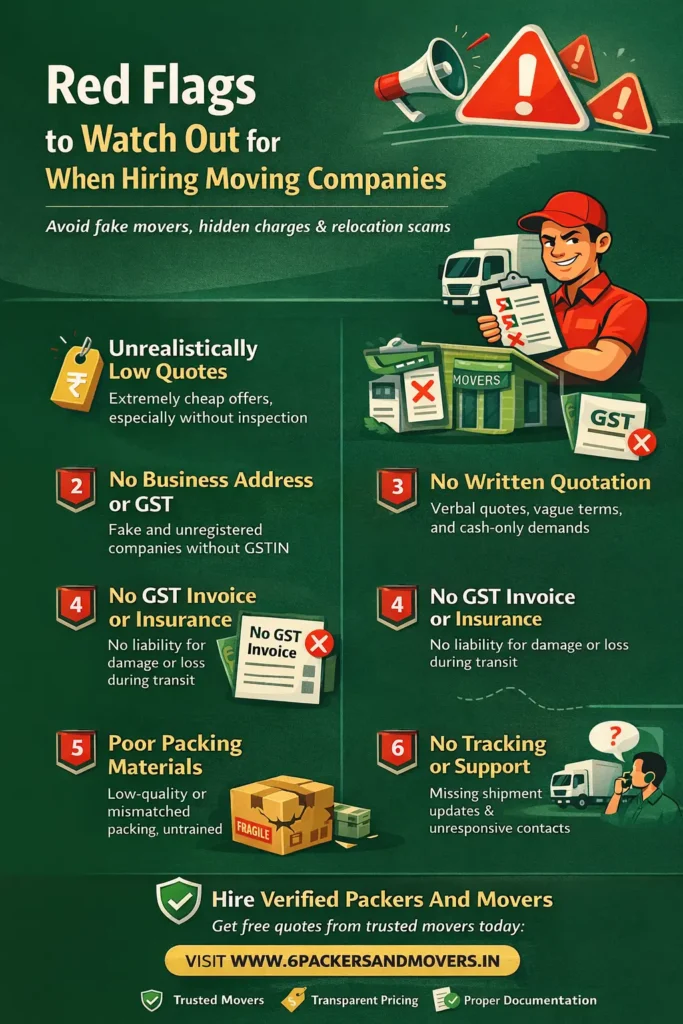
No Physical Office Address or Verifiable Business Details
One of the earliest and most dangerous red flags when hiring a moving company is the absence of a physical office address or verifiable business identity. Many fraudulent or unreliable movers operate only through mobile numbers, temporary websites, or social media ads, without maintaining any registered office or traceable business location. This makes it extremely difficult for customers to take action if something goes wrong during or after the move.
Legitimate moving companies usually operate from a registered commercial office or warehouse, where inspections, surveys, and customer visits are possible. When a mover avoids sharing their office address, provides vague location details, or claims they operate “only online,” it often indicates that the company is not properly established or may disappear after collecting payments.
Why this is risky for customers
- If goods are damaged, delayed, or lost, there is no physical location to approach
- Complaints and legal follow-ups become difficult without a registered address
- Such operators often change phone numbers or shut down websites after disputes
- Refunds or accountability are almost impossible to enforce
Common warning signs to watch for
- Office address not mentioned on the website or quotation
- Address listed as a residential building or shared virtual location
- Refusal to allow office visits or surveys from a business location
- Only WhatsApp or mobile contact with no landline or office number
What customers should do before booking
- Search the company’s office address on maps and verify if it exists
- Cross-check whether the address matches the one mentioned on documents
- Ask for business registration details that align with the office location
- Avoid finalizing movers who hesitate or give inconsistent information
Taking a few minutes to verify the physical presence of a moving company can prevent serious financial and legal trouble later. A genuine mover has nothing to hide and will always be transparent about where they operate from. Customers relocating in major cities should always verify the local presence of packers and movers in Madurai or their respective city before finalizing a booking.
Unusually Low Quotes That Sound Too Good to Be True
An unusually low moving quote is one of the most common red flags customers encounter when hiring a moving company. While everyone wants to reduce relocation costs, prices that are significantly lower than market rates are often used as bait to attract customers. These low estimates rarely reflect the actual cost of packing, labor, transportation, and handling involved in a move.
In many cases, such quotes are given without proper assessment of household goods or without explaining what services are included. Once the move begins—often after belongings are packed or loaded—customers are informed of additional charges such as packing material costs, stair charges, long-carry fees, or unexpected transport expenses. At this stage, refusing payment can lead to delays or even withholding of goods.
Why extremely low quotes are risky
- Final charges increase sharply on moving day
- Hidden costs are introduced after goods are packed
- Customers lose bargaining power once belongings are loaded
- Disputes become stressful and time-sensitive
Common tactics used with low quotes
- Providing estimates over phone without item inspection
- Quoting only transportation cost and excluding packing or labor
- Using vague terms like “approximate,” “starting from,” or “subject to change”
- Asking for revised payments midway through the move
How to protect yourself from pricing traps
- Compare at least 2–3 written quotations from different movers
- Ask what is included and excluded in the quoted price
- Ensure the estimate matches the actual volume and services required
- Avoid booking movers who refuse to explain cost breakdowns
A reliable moving company provides realistic pricing based on actual requirements, not misleading discounts. If a quote feels unrealistically low, it is often a warning sign rather than a bargain. Understanding how relocation pricing works can help you avoid such traps—this packers and movers cost guide explains standard charges and common pricing tricks.
No Written Quotation, Contract, or Service Agreement
A moving company that avoids providing a written quotation, contract, or service agreement should be treated as a serious red flag. Verbal promises—no matter how reassuring—do not offer any legal or financial protection once the move begins. Without written documentation, customers have little proof of agreed pricing, services, or delivery terms.
Reliable movers always issue written estimates and service agreements that clearly outline the scope of work. When a company insists that “everything will be discussed on moving day” or asks you to trust a phone conversation or WhatsApp message, it often signals an attempt to keep terms flexible in their favor.
Why written documentation is essential
- Confirms the agreed price and services in advance
- Helps prevent disputes over extra charges
- Acts as evidence in case of damage, delay, or loss
- Protects customers from last-minute price changes
Common warning signs customers overlook
- Refusal to share a formal quotation or contract
- Estimates sent without company letterhead or details
- Missing service scope, dates, or payment terms
- Vague language that allows charges to change later
What a proper moving quotation should include
- Complete list of services (packing, loading, transport, unloading)
- Estimated volume or itemized inventory
- Clear pricing and applicable taxes
- Payment terms and delivery timeline
- Company contact and business details
Before confirming any mover, ensure all commitments are documented in writing. A legitimate company will always be willing to put terms on paper, while unreliable movers prefer to keep agreements informal. Before confirming any mover, follow this step-by-step guide on how to choose reliable packers and movers to avoid documentation-related disputes.
Demanding Large Advance Payments or Cash-Only Deals
Being asked to pay a large advance amount or make cash-only payments is a major warning sign when hiring a moving company. While small booking amounts are sometimes required, demanding a significant portion—or even the full amount—before the move begins often indicates a lack of accountability. Such practices leave customers financially exposed if the mover delays, disappears, or delivers poor service.
Unreliable movers frequently pressure customers to pay quickly, claiming limited availability or special discounts. Once payment is made, follow-ups become difficult, phone calls go unanswered, or service quality drops sharply. Cash-only demands further increase risk because they leave no transaction trail for disputes or complaints.
Why this payment behavior is risky
- No financial protection if the mover fails to deliver services
- Difficulty proving payment without proper receipts
- Increased chances of last-minute cancellation or non-response
- Limited options for dispute resolution or refunds
Common red flags related to payments
- Asking for full payment before packing starts
- Refusing online, bank, or invoice-based payments
- Pressuring customers with urgency or scare tactics
- Not issuing a receipt or payment acknowledgment
Safer payment practices customers should follow
- Avoid paying the full amount before the move
- Prefer traceable payment methods linked to invoices
- Ensure payment terms are clearly mentioned in writing
- Make final payments only after services are delivered as agreed
A professional moving company follows balanced payment practices that protect both parties. If a mover insists on large advances or cash-only deals, it is safer to reconsider before proceeding. Many payment-related disputes arise due to unclear pricing—review what is included and excluded in packers and movers charges before paying any advance.
No GST Invoice, Insurance, or Transport Documentation
A moving company that cannot provide GST invoices, insurance options, or basic transport documentation should be considered high risk. These documents are not optional formalities—they are part of standard compliance and customer protection in relocation services. When movers avoid sharing such paperwork, it often indicates that the business is unregistered, operating informally, or unwilling to take responsibility for goods in transit.
A GST invoice helps establish that the company is legally registered and accountable for the service provided. Insurance and transport-related documents, on the other hand, clarify liability in case of damage, theft, or delay. Without these, customers have limited options if problems arise during the move.
Why missing documentation is dangerous
- No legal proof of service transaction
- Difficulty raising complaints or disputes
- No clarity on responsibility for damaged or lost goods
- Increased risk of fraud or service abandonment
Common documentation-related red flags
- GST number not shared or cannot be verified
- No invoice issued after payment
- Insurance discussed verbally but not documented
- Transport details disclosed only after loading—or not at all
What customers should insist on before dispatch
- A proper GST invoice mentioning service value and tax details
- Clear information on insurance coverage or liability terms
- Transport-related details linked to the move
- Documentation that matches the company’s registered identity
Movers who follow compliance norms are usually transparent about documentation. If a company avoids paperwork or treats it as unnecessary, it is often safer to pause and reassess your decision. Customers should also understand what transit insurance covers during house shifting to avoid claim rejection issues later.
Poor Online Reviews, Fake Ratings, or No Digital Presence
A moving company’s online presence—or lack of it—can reveal important warning signs. Consistently poor reviews, suspiciously perfect ratings, or no digital footprint at all often indicate unreliable or short-lived operators. Many fake movers create temporary listings, post paid or fake reviews, and disappear once complaints start surfacing.
While no company is completely free from negative feedback, genuine movers usually have a balanced review profile showing both positive and critical customer experiences over time. In contrast, risky movers often rely on newly created profiles with copied content, generic praise, or ratings that look manipulated.
Why online reputation matters
- Reviews reflect real customer experiences
- Repeated complaints indicate service quality issues
- Fake ratings hide pricing fraud or delivery problems
- Digital absence reduces accountability and traceability
Common review-related red flags
- Multiple reviews posted on the same date
- Overly generic comments without service details
- Company responding aggressively or not responding at all
- No reviews despite claiming years of experience
How customers should evaluate movers online
- Check reviews across multiple platforms, not just one
- Read detailed reviews mentioning pricing, delivery, and behavior
- Look for long-term activity instead of newly created profiles
- Avoid movers with no verifiable digital presence
Online research takes only a few minutes but can prevent serious relocation issues. A mover confident in their service quality will have transparent, verifiable feedback rather than fabricated praise. Here’s a practical guide on how to verify genuine packers and movers and identify fake reviews before booking.
Unprofessional Behavior During Calls or On-Site Visits
The way a moving company communicates during phone calls or on-site visits often reflects how they will handle your relocation. Unprofessional behavior at the initial stage—such as evasive answers, rushed conversations, or lack of clarity—should not be ignored. These early interactions provide strong signals about reliability, accountability, and service quality.
Movers who avoid direct questions about pricing, documentation, or procedures may be intentionally keeping details unclear. In some cases, representatives provide inconsistent information during different calls or change their statements when asked for written confirmation. Such behavior increases the risk of disputes once the move begins.
Behavioral warning signs to watch for
- Refusing to answer questions about costs or documents
- Providing conflicting information on calls and messages
- Using pressure tactics to rush booking decisions
- Showing indifference during surveys or inspections
Why communication quality matters
- Poor communication leads to misunderstandings and hidden costs
- Lack of clarity increases stress on moving day
- Unresponsive behavior makes problem resolution difficult
- Professional movers maintain consistent and transparent communication
What customers should expect from reliable movers
- Clear and patient explanations of services and pricing
- Willingness to share details in writing
- Professional conduct during surveys or calls
- Timely responses to queries before and after booking
A mover’s behavior before the move often predicts their conduct during execution. If communication feels careless or dismissive, it is usually safer to continue your search.
No Proper Packing Materials or Trained Staff
The quality of packing materials and the skill of the workforce play a crucial role in protecting household goods during relocation. Movers who arrive without proper packing materials or trained staff significantly increase the risk of damage, breakage, and loss. This is a common red flag associated with unprofessional or cost-cutting operators.
Reliable moving companies use appropriate materials such as sturdy cartons, protective wrapping, cushioning, and labeling systems based on the type of items being packed. In contrast, risky movers often rely on reused boxes, inadequate wrapping, or untrained labor, which compromises safety—especially for fragile or high-value belongings.
Why poor packing standards are dangerous
- Higher chances of breakage and surface damage
- No accountability if items are packed carelessly
- Insurance claims become difficult without proper packing
- Increased stress during unpacking and delivery
Warning signs related to packing practices
- Use of low-quality or mismatched packing materials
- Workers lacking basic packing knowledge
- No labeling or item segregation during packing
- Rushing through packing without inspection
What customers should confirm in advance
- Type of packing materials that will be used
- Whether staff are trained for household or fragile items
- Packing standards mentioned in the quotation or agreement
- Clear responsibility in case of damage due to packing
Professional packing is not an add-on—it is a core part of safe relocation. Movers who cut corners at this stage often create bigger problems later.
Lack of Tracking, Contact Person, or Customer Support
A moving company that does not provide clear tracking updates, a dedicated contact person, or accessible customer support creates unnecessary risk for customers. Once goods are in transit, lack of communication can lead to anxiety, confusion, and delays—especially during intercity or long-distance moves.
Reliable movers usually assign a single point of contact who remains reachable throughout the relocation process. This helps customers get timely updates, resolve issues quickly, and track the movement of their goods. In contrast, risky movers often stop responding after loading, change contact numbers, or shift responsibility between departments.
Why missing communication support is a serious concern
- Customers are left unaware of shipment status
- Delays or route changes go uncommunicated
- Problems during transit are harder to resolve
- Accountability becomes unclear without a responsible contact
Common warning signs customers report
- No tracking information shared after dispatch
- Calls and messages unanswered during transit
- No assigned coordinator or relationship manager
- Customer support numbers that are unreachable
What customers should verify before booking
- Name and contact details of the assigned coordinator
- Availability of tracking or regular status updates
- Clear escalation process for issues or delays
- Working customer support channels beyond sales calls
Transparent communication is a basic expectation in professional relocation services. Movers who fail to provide visibility or support during transit often leave customers feeling helpless when problems arise.
How to Protect Yourself Before Finalizing a Moving Company
Before signing any agreement or making a payment, customers should take a few essential steps to reduce risk and avoid common relocation problems. Many moving-related disputes arise not because of unavoidable issues, but due to skipped verification checks during the booking stage. Spending time on due diligence can prevent financial loss, service delays, and unnecessary stress.
A careful evaluation process helps you distinguish between genuine movers and risky operators, especially when multiple companies appear similar online. Protection starts with verification, documentation, and clarity—before the moving date is fixed.
Practical steps customers should follow
- Verify business registration details such as office address and GST information
- Insist on a written quotation clearly listing services and charges
- Compare multiple quotes to identify unrealistic pricing
- Avoid paying the full amount before the move begins
- Confirm insurance or liability terms for goods in transit
Checks to complete before confirming the booking
- Cross-check company contact details across website, quotation, and invoice
- Review online feedback from multiple platforms
- Ask clear questions about packing standards, delivery timelines, and payment terms
- Ensure all commitments are documented and shared in writing
When it is better to walk away
- If documentation is delayed or avoided repeatedly
- If pricing changes without explanation
- If communication becomes inconsistent after initial discussions
- If pressure tactics are used to rush payment or confirmation
Protecting yourself before finalizing a moving company is far easier than resolving disputes later. A reliable mover welcomes verification, answers questions clearly, and follows transparent processes throughout the booking stage.
Verified Movers vs Risky Movers
Understanding the difference between verified movers and risky movers becomes much easier when their practices are compared side by side. Many customers realize the risk only after the move begins, but most warning signs are visible before booking if you know what to look for.
The table below highlights key differences based on documented relocation practices and common consumer issues.
Comparison Table: Verified Movers vs Risky Movers
Aspect | Verified Movers | Risky Movers |
Business Identity | Registered company with verifiable office address | No clear office address or fake location |
Quotation | Written quotation with service details | Verbal quotes or vague estimates |
Pricing | Transparent pricing based on survey | Unrealistically low quotes with hidden charges |
Payment Method | Accepts traceable payments with receipts | Demands large advance or cash-only payments |
GST Invoice | Provides GST invoice after payment | Avoids or refuses GST invoice |
Insurance / Liability | Explains liability or insurance terms clearly | No written insurance or responsibility |
Packing Standards | Uses proper materials and trained staff | Poor packing materials and untrained labor |
Communication | Dedicated contact person and updates | No tracking, poor response after loading |
Online Presence | Consistent reviews and digital footprint | Fake reviews or no online presence |
Customer Accountability | Willing to resolve issues transparently | Avoids responsibility after problems arise |
How customers should use this comparison
- Match each mover’s claims against these indicators
- Do not rely on price alone when deciding
- Treat multiple red flags as a warning to stop and reassess
- Prefer movers who meet most or all verified criteria
This comparison makes it clear that verified movers focus on transparency and accountability, while risky movers rely on shortcuts that often lead to disputes, losses, or service failures.
Expert Advice — Choosing a Safe & Reliable Moving Company
Choosing a moving company should never be rushed. Most relocation problems reported by customers stem from skipped verification steps, unclear agreements, or trusting promises without documentation. Following established best practices and learning from common mistakes can significantly reduce risk and help ensure a smooth moving experience.
Industry Best Practices Customers Should Follow
Customers planning a move should always prioritize verification, documentation, and transparency over speed or low pricing. Safe relocation begins with choosing movers who follow structured processes and openly share their credentials.
Best practices to follow before booking:
- Verify the company’s office address, registration, and GST details
- Insist on a written quotation that clearly lists services and charges
- Ask how packing will be done and what materials will be used
- Understand payment terms and avoid full advance payments
- Confirm liability or insurance coverage for goods in transit
These practices help customers set clear expectations and reduce misunderstandings during the move.
Mistakes Even Experienced Movers Make
Even customers who have relocated before sometimes repeat avoidable mistakes. Familiarity with the moving process can create false confidence, leading people to overlook important checks that still matter.
Common mistakes to avoid:
- Assuming a known or previously used mover still follows the same standards
- Ignoring written documentation for repeat moves
- Overlooking insurance or liability details for valuable items
- Paying advance amounts to secure last-minute bookings
- Trusting verbal assurances without written confirmation
Avoiding these mistakes helps experienced movers maintain control and accountability throughout the relocation.
Final Expert Recommendations
To minimize risk and ensure a stress-free relocation, customers should approach the selection of movers with careful evaluation and clear documentation. The safest moving experiences are built on transparency, communication, and compliance—not on speed or discounted pricing.
Key recommendations to remember:
- Never finalize a mover without written agreements
- Avoid unusually low quotes that lack clarity
- Do not make full payments before services are delivered
- Keep copies of all documents and payment records
- Choose movers who are responsive and transparent at every stage
Following these recommendations can help you avoid common relocation pitfalls and select a moving company that handles your belongings responsibly.
Moving Soon? Avoid Costly Mistakes
Don’t risk your belongings with unreliable movers.
Choose verified, professional Packers And Movers who follow transparent pricing, proper documentation, and safe handling practices. For city-specific verified services, explore packers and movers in Bangalore with proper documentation and support.
✔ Verified service providers
✔ Transparent pricing
✔ Proper documentation & support
✔ Safer, stress-free relocation