
Relocation During Peak Hours vs. Off-Peak Hours: Traffic, Timing & Unloading Delays Compared
Off-peak hours are generally the best time to relocate because traffic is lighter, truck movement is smoother, unloading is faster, and the risk of delays or extra charges is lower. Peak-hour relocation may be necessary in some cases, but it often involves congestion, longer working hours, and higher stress.

Relocation timing plays a decisive role in how smooth, cost-effective, and stress-free your move turns out to be. Whether you are shifting locally within a city or relocating to another state, choosing between peak hours and off-peak hours can directly impact traffic delays, loading schedules, unloading efficiency, and even final moving charges. Many people focus only on distance and cost, but time of day is an equally critical factor that influences the overall moving experience.
During peak hours, roads are congested, residential societies are busy, and service elevators are often occupied, which can slow down every stage of the move. In contrast, off-peak relocations typically offer smoother road movement, better coordination with movers, and fewer interruptions at both origin and destination points. Understanding these differences helps you plan better and avoid unnecessary delays or additional charges.
If you’re planning a house shift with Professional Packers and Movers, knowing how peak and off-peak hours affect relocation logistics will help you make an informed decision that balances convenience, safety, and cost.
Understanding Peak Hours and Off-Peak Hours in Relocation
Before comparing delays, costs, and efficiency, it’s important to clearly understand what peak hours and off-peak hours mean in the context of relocation. These terms are closely linked to traffic density and daily commuting patterns, which directly influence how smoothly a moving truck can operate within a city.
What Are Peak Hours?
Peak hours are periods of the day when road traffic volume is at its highest due to office commutes, school travel, and commercial activity. During these hours, vehicle movement slows down significantly, especially in urban areas and near residential societies.
Common characteristics of peak hours:
- High traffic congestion on main roads and highways
- Frequent stop-and-go movement
- Increased travel time for heavy vehicles like moving trucks
- Greater chances of route diversions and bottlenecks
These conditions can delay truck arrival, disrupt loading schedules, and extend overall relocation time.
What Are Off-Peak Hours?
Off-peak hours are time slots when traffic density is comparatively low, allowing smoother and more predictable vehicle movement. These periods usually fall outside standard office commuting times.
Common characteristics of off-peak hours:
- Lighter traffic on city roads and highways
- Easier navigation for large moving vehicles
- More predictable arrival and departure timelines
- Better coordination between the moving crew and the client
Off-peak timings are often preferred for relocations that involve long distances, apartment complexes, or strict delivery schedules.
Peak vs Off-Peak Hours
Aspect | Peak Hours | Off-Peak Hours |
Traffic volume | Very high | Low to moderate |
Travel speed | Slow and inconsistent | Smoother and predictable |
Truck movement | Restricted and delayed | Easier and flexible |
Schedule reliability | Low | High |
Why This Difference Matters for Relocation
Understanding this timing difference helps homeowners:
- Choose realistic loading and unloading windows
- Reduce unexpected waiting time
- Avoid avoidable delays that can increase labour hours
- Plan moves around society and building access rules
Understanding how timing affects labour hours is also important when estimating overall packers and movers charges.
This foundational clarity sets the stage for deeper comparisons around traffic delays, timing risks, unloading challenges, and cost implications, which we’ll cover next.
Traffic Conditions and Route Delays
Traffic is one of the biggest variables affecting relocation timelines. The difference between moving during peak hours and off-peak hours is most visible on the road—where congestion, diversions, and slow movement can either disrupt or streamline the entire relocation process.
Peak-Hour Traffic Challenges
During peak hours, roads experience maximum congestion, especially near office hubs, schools, markets, and residential clusters. For relocation trucks, this creates multiple operational challenges.
Common issues during peak-hour moves:
- Slower truck movement due to heavy traffic
- Frequent stoppages at signals and bottlenecks
- Higher chances of route diversions or restrictions for heavy vehicles
- Delayed arrival at both pickup and delivery locations
These delays often cascade into extended loading times and postponed unloading, especially when the destination is a busy residential society.
Off-Peak Traffic Advantages
Off-peak hours typically have lighter traffic flow, allowing relocation trucks to move more freely across city roads and highways. This directly improves time predictability.
Benefits of off-peak traffic conditions:
- Faster and smoother truck movement
- Easier navigation through narrow or residential roads
- Reduced dependency on alternative routes
- More accurate estimated arrival times
With fewer vehicles on the road, movers can maintain steady speeds, reducing transit-related stress and delays.
Impact of Traffic on Transit Time and Fuel Usage
Traffic congestion doesn’t just affect time—it also impacts fuel consumption and operational efficiency.
- Stop-and-go traffic during peak hours increases travel time
- Longer transit duration can extend crew working hours
- Off-peak driving allows consistent movement, reducing idle time
This is why choosing the right relocation time can help reduce unexpected delays, especially for people hiring packers and movers in Coimbatore or other metro cities.
While fuel costs vary, smoother traffic conditions help maintain predictable schedules and reduce unnecessary halts during transit.
Peak vs Off-Peak
Traffic Factor | Peak Hours | Off-Peak Hours |
Road congestion | Very high | Low |
Average travel speed | Slow | Moderate to fast |
Route flexibility | Limited | High |
Risk of transit delays | High | Low |
Traffic conditions set the tone for the entire relocation. Once transit is delayed, loading, unloading, and coordination with building management are automatically affected.
Impact on Packing, Loading, and Departure Timing
The effect of peak and off-peak hours is not limited to road movement alone. Traffic conditions directly influence truck arrival time, packing coordination, loading efficiency, and final departure schedules. Even a small delay at this stage can push the entire relocation timeline off track.
Delays in Truck Arrival During Peak Hours
During peak traffic hours, relocation trucks often take longer than scheduled to reach the pickup location. This delay can disrupt pre-planned packing and loading timelines.
Common peak-hour challenges:
- Trucks arriving late due to congested access roads
- Packing teams waiting idle for vehicle arrival
- Compression of loading timelines once the truck reaches
- Increased pressure to load quickly to make up lost time
Such delays can lead to rushed loading, which may affect systematic placement of goods inside the truck.
Off-Peak Loading Efficiency
Off-peak hours generally allow better synchronization between the packing crew and transport vehicle. With lighter traffic, trucks arrive closer to their scheduled time.
Advantages during off-peak loading:
- Timely truck arrival at the pickup location
- Smooth coordination between packers and loaders
- Systematic loading without time pressure
- Better placement and securing of household items
This controlled environment supports safer handling and organized stacking inside the vehicle.
Effect on Departure Timing
Departure timing is critical, especially for intercity relocations or same-day delivery plans.
- Peak-hour congestion can push departures several hours later than planned
- Delayed departures may affect toll crossings and highway entry timing
- Off-peak departures help maintain planned travel windows
Predictable departure times are especially useful when unloading slots at the destination are pre-booked or restricted.
Packing & Loading Comparison
Aspect | Peak Hours | Off-Peak Hours |
Truck arrival punctuality | Often delayed | Mostly on time |
Loading pressure | High | Low |
Coordination efficiency | Moderate to low | High |
Departure predictability | Uncertain | Predictable |
Efficient packing and loading lay the foundation for a smooth relocation. When these stages are delayed, unloading challenges at the destination often follow—especially in busy residential areas.
Unloading Delays at Destination
Unloading is one of the most time-sensitive stages of relocation. Even if packing and transit go as planned, destination-side constraints can cause unexpected delays—especially when the move happens during peak hours. Traffic congestion, parking limitations, and building access rules all play a major role here.
Unloading Challenges During Peak Hours
During peak hours, residential areas and apartment complexes are usually busy with daily movement, deliveries, and vehicle traffic. This often slows down unloading operations.
Common peak-hour unloading issues:
- Difficulty finding temporary parking space for the moving truck
- Restrictions on truck entry during busy hours
- Longer waiting time for service elevators
- Higher foot traffic in common areas, slowing movement of goods
These factors can significantly extend unloading time, particularly in high-rise buildings or gated societies.
Off-Peak Unloading Advantages
Off-peak hours offer a comparatively quieter and more controlled environment at the destination, allowing unloading to proceed smoothly.
Benefits of off-peak unloading:
- Easier truck access near the building entrance
- Better availability of service lifts
- Minimal interference from residents or visitors
- Faster movement of goods into the home
With fewer operational constraints, the unloading team can work methodically without interruptions.
Impact on Overall Delivery Time
Delays during unloading can affect:
- Completion time of the relocation
- Labour working hours
- Same-day move commitments
Off-peak unloading helps maintain realistic delivery timelines and reduces last-minute coordination issues with building management.
Unloading delays often translate into extended labour hours and additional waiting time, which can affect overall relocation costs.
Cost Implications and Hidden Charges
The timing of your relocation can directly influence the final moving cost, even when distance and volume remain the same. Peak-hour delays often increase labour time and vehicle waiting periods, which may lead to additional charges. Off-peak relocations, on the other hand, usually offer better cost control due to smoother execution. Before finalising your move, it’s advisable to review what is included and excluded in packers and movers charges to avoid billing surprises.
Cost Impact of Peak-Hour Relocation
When a move is scheduled during peak hours, delays at multiple stages can extend the total working time of the moving crew.
Common cost-related issues during peak hours:
- Increased labour hours due to traffic and unloading delays
- Vehicle waiting time at pickup or destination locations
- Extended loading and unloading duration
- Higher operational strain due to congested routes
These factors can push the relocation beyond the originally estimated time window, affecting overall charges.
Cost Advantages of Off-Peak Moves
Off-peak relocations are often easier to plan and execute, which helps keep costs predictable.
Why off-peak moves are cost-efficient:
- Reduced waiting time for trucks and labour
- Faster loading and unloading cycles
- Better availability of movers, allowing flexible scheduling
- Lower risk of overtime due to delays
In many cases, off-peak timing allows the relocation to stay within the planned service duration.
Hidden Costs Linked to Poor Timing
Relocation costs are not limited to base charges. Timing-related delays can introduce indirect expenses such as:
- Additional labour hours
- Extended supervision time for the client
- Missed handover or society time slots
Choosing an off-peak time helps minimize these hidden cost risks.
While cost is an important factor, the overall relocation experience—including stress and safety—also varies significantly based on timing.
Stress Levels, Risk Factors, and Overall Moving Experience
Relocation is physically demanding and mentally taxing. The time of day you choose to move plays a significant role in determining stress levels, coordination efficiency, and handling risks. Peak-hour congestion often amplifies pressure on both the moving team and the homeowner, while off-peak moves tend to offer a calmer and more controlled experience.
Stress and Coordination Challenges During Peak Hours
Peak hours compress timelines and reduce flexibility, which can increase stress for everyone involved.
Common stress triggers during peak-hour moves:
- Constant delays due to traffic and access restrictions
- Rushed coordination between packers, drivers, and building security
- Pressure to finish loading or unloading within limited time windows
- Difficulty supervising the move amid congestion and crowd movement
These conditions can make it harder for homeowners to monitor packing quality and item handling.
Risk Factors Linked to Peak-Time Relocation
Time pressure and congestion can increase operational risks.
- Rushed loading or unloading may affect safe handling
- Congested common areas raise the chance of accidental bumps or scratches
- Fatigue due to prolonged delays can impact crew efficiency
Hiring verified movers and understanding transit insurance coverage during house shifting becomes even more important in such conditions.
While professional movers follow safety protocols, challenging conditions increase the likelihood of minor issues during execution.
Calmer and Safer Experience During Off-Peak Hours
Off-peak relocations usually provide a more relaxed working environment, benefiting both the moving team and the client.
Advantages of off-peak timing:
- Better focus and coordination among movers
- Less crowd interference in lifts and corridors
- More time to handle fragile or bulky items carefully
- Easier supervision and communication
With fewer external disruptions, the move progresses in a more structured and predictable manner.
Experience Comparison
Experience Factor | Peak Hours | Off-Peak Hours |
Stress level | High | Low |
Coordination ease | Challenging | Smooth |
Handling risks | Moderate to high | Lower |
Overall comfort | Limited | Better |
A smooth relocation isn’t just about speed or cost—it’s about how controlled and manageable the entire process feels. In some situations, however, peak-hour relocation may still be unavoidable.
When Does Peak-Hour Relocation Make Sense?
While off-peak hours are generally preferred for smoother relocations, peak-hour moves are sometimes unavoidable due to personal, administrative, or situational constraints. Understanding when peak-hour relocation is practical helps set realistic expectations and plan better.
Situations Where Peak-Hour Moving Is Necessary
Certain scenarios leave little flexibility in choosing relocation timing.
Common reasons peak-hour relocation may make sense:
- Fixed handover schedules from landlords or builders
- Society or apartment rules permitting moves only during daytime hours
- Office-approved moving windows for company-provided relocations
- School schedules or family commitments limiting early morning or late-night moves
In such cases, moving during peak hours becomes a practical necessity rather than a preference.
Short-Distance or Intra-Local Moves
Peak-hour relocation may be manageable when:
- The distance between origin and destination is short
- Loading and unloading points are within the same locality
- Travel time is less dependent on highways or major junctions
For short moves, the impact of traffic congestion is reduced compared to long-distance relocations.
How to Reduce Peak-Hour Moving Challenges
If peak-hour relocation is unavoidable, planning becomes critical:
- Pre-book service elevators and parking slots
- Keep packing completed before the truck arrives
- Coordinate building permissions in advance
- Allow buffer time in the schedule
These measures help minimize delays and manage expectations during peak-time moves.
These steps are part of a broader checklist shared in our guide on how to choose reliable packers and movers.
Peak-Hour Suitability Summary
Scenario | Peak-Hour Move Suitability |
Fixed daytime permissions | Suitable |
Short-distance relocation | Manageable |
High-rise apartment move | Challenging |
Long-distance relocation | Not ideal |
Even when peak-hour relocation is necessary, understanding its limitations helps you prepare better. In many cases, however, off-peak hours offer a clear advantage.
When Is Off-Peak Relocation the Smarter Choice?
Off-peak relocation is often the preferred choice for homeowners who want better control over timelines, reduced stress, and predictable execution. With fewer external constraints, off-peak hours allow packers and movers to operate more efficiently across all stages of the move.
Ideal Scenarios for Off-Peak Relocation
Off-peak hours are especially suitable in situations where timing flexibility is available.
Off-peak relocation works best when:
- The move involves long-distance or intercity travel
- You are relocating to or from a high-rise apartment
- There are strict unloading or delivery windows at the destination
- The move includes fragile, bulky, or high-value household items
Lower traffic and reduced crowd movement make it easier to handle such relocations smoothly.
Benefits for Families, Seniors, and Time-Sensitive Moves
Off-peak timing offers additional comfort for specific household needs.
- Easier supervision for families with children
- Reduced physical strain for senior citizens
- Better adherence to committed delivery schedules
- Less disruption to daily routines
These benefits contribute to a more organized and manageable relocation experience.
Operational Advantages of Off-Peak Timing
From an execution standpoint, off-peak moves allow:
- Faster truck movement on highways and city roads
- Better coordination with security and building management
- More flexibility to adjust timelines if needed
With fewer dependencies on external factors, movers can maintain consistency throughout the relocation.
Off-Peak Suitability
Scenario | Off-Peak Suitability |
Long-distance relocation | Highly suitable |
High-rise apartment move | Ideal |
Time-sensitive delivery | Recommended |
Flexible schedules | Best choice |
Choosing the right relocation timing is about balancing cost, convenience, and control. Off-peak hours often deliver the most reliable outcomes, especially for complex or long-distance moves.
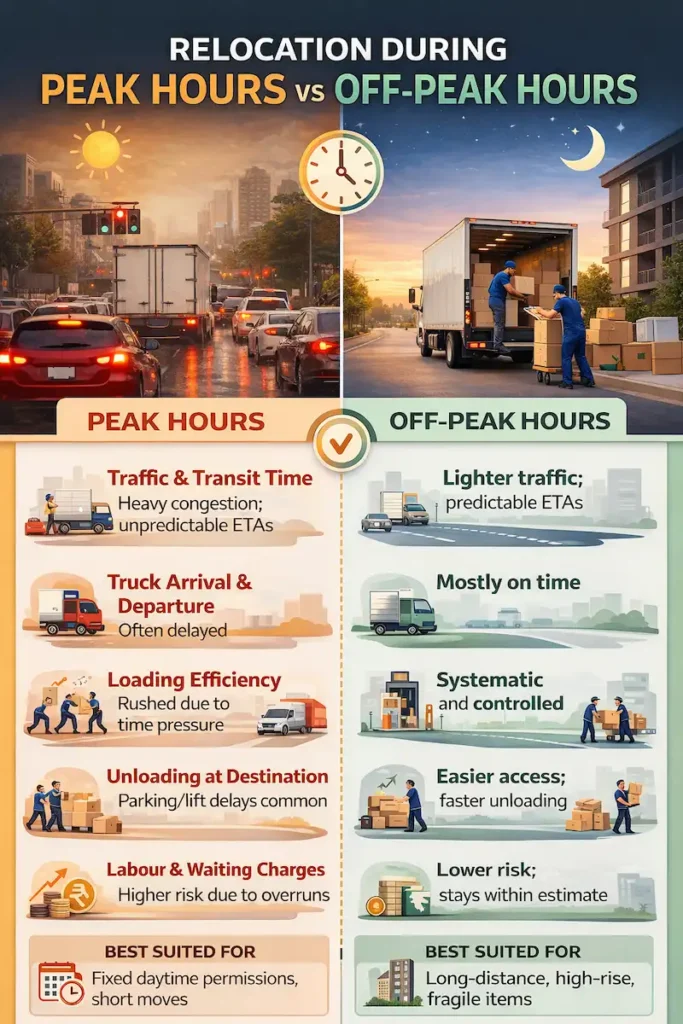
Peak Hours vs Off-Peak Hours
This consolidated snapshot helps readers make a fast, informed decision based on traffic, timing, unloading delays, cost predictability, and experience.
Decision Factor | Peak Hours | Off-Peak Hours |
Traffic & transit time | Heavy congestion; unpredictable ETAs | Lighter traffic; predictable ETAs |
Truck arrival & departure | Often delayed | Mostly on time |
Loading efficiency | Rushed due to time pressure | Systematic and controlled |
Unloading at destination | Parking/lift delays common | Easier access; faster unloading |
Labour & waiting charges | Higher risk due to overruns | Lower risk; stays within estimate |
Stress & supervision | High | Low |
Best suited for | Fixed daytime permissions, short moves | Long-distance, high-rise, fragile items |
FAQs: Relocation During Peak Hours vs Off-Peak Hours
Off-peak hours are generally better for relocation because traffic is lighter, truck movement is smoother, unloading is faster, and delays are less likely compared to peak hours.
Peak-hour relocation can face traffic congestion, delayed truck arrival, longer unloading time, limited parking access, and extended labour hours, which may increase stress and costs.
Heavy traffic during peak hours slows down moving trucks, increases travel time, and disrupts planned loading and unloading schedules.
Off-peak hours have fewer vehicles and people in residential areas, making parking easier, service lifts more available, and unloading more organized.
Peak-hour delays can extend labour time and vehicle waiting periods, which may result in higher overall relocation charges.
Early mornings or late evenings are usually the best times to shift a house because traffic is minimal and unloading can be completed faster.
Plan Your Move at the Right Time
Timing can save hours—and money. Whether you must move during peak hours or want the efficiency of off-peak relocation, plan it with experienced professionals.
Get a FREE, timing-optimized moving plan from Packers and Movers
- Route planning to reduce delays
- Pre-booked loading/unloading coordination
- Clear timelines to avoid waiting charges
- Safer handling with structured workflows