
How to Reduce Office Moving Costs Without Risk
Reducing office moving costs without risk requires early planning, detailed inventory management, optimized packing, smart scheduling, transparent quotations, and selective insurance coverage. Businesses that follow a structured relocation approach can control expenses while protecting assets and minimizing downtime during office relocation.
Office relocation is a major operational decision that directly impacts business continuity, employee productivity, and overall expenses. Without proper planning, office moving costs can increase unexpectedly due to last-minute bookings, excess inventory movement, poor coordination, or avoidable damage to assets. Businesses that approach relocation strategically are better positioned to control expenses while safeguarding valuable office equipment and minimizing downtime.
Professional planning plays a critical role in balancing cost efficiency and risk management during an office move. From inventory assessment to scheduling logistics, each decision influences the final relocation cost. Working with experienced Packers And Movers helps organizations streamline the relocation process through structured planning, trained manpower, and controlled execution—reducing both financial and operational risks.
Businesses planning relocation should work with reliable office relocation services backed by structured planning and cost transparency.
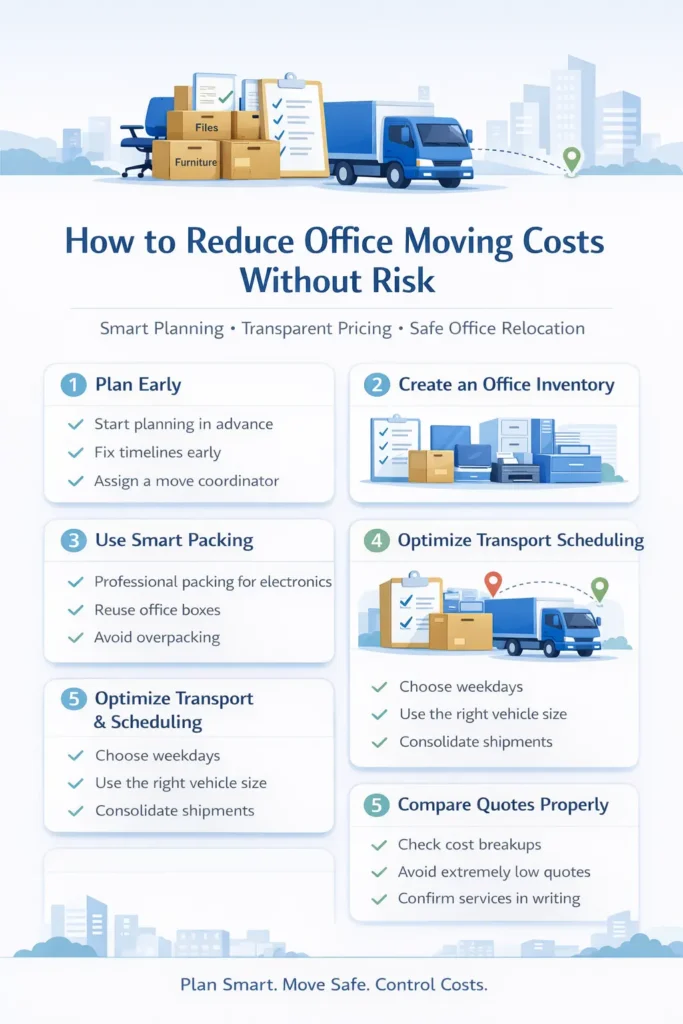
Plan Your Office Move Early to Avoid Last-Minute Expenses
Early planning is one of the most effective ways to reduce office relocation costs while maintaining control over risks. Businesses that begin planning months in advance gain flexibility in scheduling, vendor selection, and internal coordination, which helps avoid premium charges and rushed decisions.
Why Early Planning Reduces Office Relocation Costs
Planning an office move well in advance helps control expenses by allowing time for proper assessment and coordination.
Key cost benefits of early planning include:
- Avoiding urgent booking fees and peak-time charges
- Better availability of preferred moving dates
- Sufficient time to compare service scopes and cost structures
- Reduced chances of operational disruption during relocation
Businesses that delay planning often face higher labor costs, limited mover availability, and increased risk of errors during execution.
Creating a Realistic Office Moving Timeline
A structured relocation timeline helps businesses manage tasks sequentially and prevents cost overruns caused by missed steps or rushed execution.
A realistic office moving timeline typically includes:
- Pre-move planning and vendor coordination
- Inventory finalization and packing schedules
- IT disconnection and reconnection planning
- Buffer time for unforeseen delays
Clearly defined timelines ensure that departments move in coordination, reducing repeat work and unnecessary labor costs.
Assigning an Internal Move Coordinator
Designating an internal move coordinator provides centralized control over the relocation process and helps prevent miscommunication-related expenses.
Responsibilities of an internal move coordinator include:
- Acting as a single point of contact for movers and vendors
- Approving services and managing internal schedules
- Coordinating between departments, IT teams, and facility managers
- Tracking costs and preventing duplicate service requests
This role improves accountability and reduces the risk of unplanned expenses during the move.
Conduct a Detailed Office Inventory Before Moving
A detailed office inventory is one of the most effective cost-control tools during an office relocation. Moving charges are largely calculated based on volume, weight, handling complexity, and manpower, which means unnecessary items directly increase relocation costs. A structured inventory helps businesses move only what is required, reduce packing material usage, and optimize transportation planning—without increasing risk.
Conducting an inventory also improves accountability and reduces the chances of misplaced or damaged assets during transit, which helps avoid financial losses and operational delays.
Why Office Inventory Directly Impacts Moving Costs
Office movers calculate pricing based on the quantity and type of items being relocated. Without an accurate inventory, businesses often underestimate volume, leading to additional trips, last-minute vehicle upgrades, or extra labor charges.
A proper inventory helps:
- Accurately estimate packing and transportation costs
- Select the correct truck size
- Avoid repeated loading and unloading
- Reduce insurance exposure by identifying high-value items
Inventory-based planning allows movers to allocate resources efficiently, helping control costs without compromising asset safety.
Office moving costs are often calculated using the same factors explained in our detailed packers and movers cost guide.
Identify Items That Don’t Need Relocation
Office relocations often include items that no longer serve operational purposes. Transporting unused or outdated assets increases packing, labor, and transportation costs without business value.
Common items that may not require relocation:
- Broken or unused office furniture
- Outdated computers and peripherals
- Old files and records beyond retention periods
- Duplicate pantry or storage items
Removing these items before relocation reduces load size and lowers overall moving expenses.
Decide Between Disposal, Sale, or Donation
Once non-essential items are identified, businesses can choose the most cost-effective way to handle them instead of relocating.
Option | Cost Impact | Business Benefit |
Disposal | Eliminates packing and transport costs | Frees space immediately |
Sale | Offsets relocation expenses | Recovers value from assets |
Donation | Reduces handling volume | Simplifies logistics planning |
Selecting the right option prevents unnecessary transport costs and reduces the complexity of the move.
How Inventory Management Reduces Risk During Office Moves
Beyond cost savings, inventory planning also reduces relocation risks.
Risk-reduction benefits include:
- Clear tracking of office assets
- Lower chances of misplaced equipment
- Better insurance coverage decisions
- Faster unpacking and setup at the new location
A well-documented inventory ensures that cost reduction does not come at the expense of asset safety or operational continuity.
Choose the Right Packing Strategy to Reduce Expenses
Packing strategy plays a critical role in controlling office moving costs without increasing the risk of damage or delays. Packing charges often form a significant portion of office relocation expenses because they involve materials, skilled labor, and time. By selecting the right balance between professional packing and internal preparation, businesses can reduce costs while maintaining asset safety.
A planned packing approach also minimizes handling errors, speeds up loading and unloading, and reduces post-move disruptions.
Professional Packing vs. Partial Self-Packing
Not all office items require the same level of professional packing. High-value and sensitive equipment needs expert handling, while non-critical items can often be packed internally.
Professional packing is recommended for:
- IT servers, computers, and networking equipment
- Printers, scanners, and electronic devices
- Glass partitions and fragile furniture
Partial self-packing can be suitable for:
- Files and documents
- Stationery and pantry items
- Non-fragile storage materials
This hybrid approach reduces labor costs while keeping sensitive assets protected.
Reusing Existing Office Packing Materials
Many offices already have usable packing materials that can significantly reduce relocation expenses. Reusing these materials lowers the cost of purchasing new boxes and reduces waste.
Reusable packing materials commonly found in offices:
- File cartons and archive boxes
- IT equipment cartons
- Plastic crates and storage bins
- Pallets used for equipment storage
Reusing available materials reduces packing supply costs without increasing damage risk when used appropriately.
Avoid Overpacking and Unnecessary Packing Supplies
Overpacking increases both material and labor costs and can make items harder to handle safely. Proper packing optimization ensures protection without excessive usage of supplies.
Best practices to control packing costs:
- Use correct box sizes for item weight
- Avoid multiple layers of packing for non-fragile items
- Label boxes clearly to prevent rehandling
- Group similar items to reduce unpacking time
Efficient packing reduces time spent on loading, unloading, and unpacking, which directly lowers labor charges.
Cost Impact of Packing Choices
Packing Decision | Cost Effect | Risk Level |
Full professional packing | Higher upfront cost | Lower damage risk |
Partial self-packing | Reduced labor cost | Controlled with supervision |
Reusing office cartons | Lower material cost | Safe if boxes are sturdy |
Overpacking items | Increased material & labor cost | No added safety benefit |
Choosing the right packing mix helps balance savings and protection effectively.
How Smart Packing Reduces Overall Relocation Risk
Cost reduction through packing should never compromise safety. Smart packing improves both efficiency and asset protection.
Risk reduction benefits include:
- Lower chances of equipment damage
- Faster identification of items during unloading
- Reduced insurance claims
- Quicker office setup after relocation
When packing is planned correctly, businesses achieve cost savings without exposing themselves to operational or financial risk.
Optimize Transportation and Scheduling to Lower Costs
Transportation and scheduling decisions have a direct impact on office moving costs. Even with proper planning and packing, poor scheduling or incorrect vehicle selection can lead to multiple trips, idle labor, or premium charges. Optimizing how and when office assets are transported helps businesses reduce expenses while maintaining safety and efficiency.
Well-planned transportation also minimizes business downtime by ensuring timely delivery and systematic unloading at the new location.
How Move Timing Affects Office Moving Charges
Office moving costs can vary based on the chosen move date and time. Certain periods experience higher demand, which may result in increased pricing and limited availability.
Businesses can further reduce expenses by comparing local vs intercity moving costs before finalizing transportation plans.
Cost-saving scheduling considerations include:
- Weekday moves generally cost less than weekend moves
- Off-peak seasons offer better flexibility and pricing
- Early-day moves reduce overtime labor charges
- Avoiding financial year-end and peak business cycles
Selecting the right move window helps businesses secure better rates without compromising service quality.
Consolidating Multiple Moves into One Shipment
When offices relocate in phases or department-wise, poor coordination can result in multiple vehicle trips, increasing fuel, labor, and handling costs.
Benefits of consolidation include:
- Reduced number of trucks required
- Lower fuel and transportation expenses
- Shorter loading and unloading time
- Simplified coordination across departments
By combining assets into a single, well-planned shipment, businesses significantly reduce transportation overheads.
Choosing the Right Vehicle Size
Using a vehicle that does not match the inventory volume can result in wasted space or repeated trips, both of which increase costs.
Vehicle selection should be based on:
- Total volume and weight of office inventory
- Type of equipment being transported
- Floor access and parking restrictions
- Distance between old and new office locations
Proper vehicle sizing ensures efficient space utilization and prevents unnecessary transportation expenses.
Transportation Cost Optimization Overview
Transportation Decision | Cost Impact | Operational Benefit |
Weekday relocation | Lower demand pricing | Easier coordination |
Off-peak season move | Reduced overall charges | Better mover availability |
Consolidated shipment | Lower fuel and labor cost | Faster relocation |
Correct vehicle sizing | Prevents repeat trips | Efficient asset handling |
Strategic transportation planning helps control costs without increasing relocation risk.
How Transportation Planning Reduces Relocation Risk
Optimized transportation does more than reduce costs—it also enhances safety and reliability.
Risk-reduction benefits include:
- Lower chances of damage due to reduced handling
- Fewer delays caused by logistical errors
- Improved coordination at loading and unloading points
- Predictable delivery timelines for faster office setup
Efficient transportation planning ensures that cost savings are achieved without compromising asset protection or business continuity.
Compare Office Moving Quotes Carefully—Not Just Prices
Comparing office moving quotations is a critical step in reducing relocation costs without increasing risk. Many businesses focus only on the final quoted amount, which can lead to unexpected charges, service gaps, or inadequate protection for office assets. A detailed comparison of cost components helps ensure transparency, accountability, and cost control throughout the move.
Well-structured quotations also make it easier to evaluate whether a mover’s pricing aligns with the scope and complexity of the office relocation.
Before approving quotations, businesses should review this checklist of questions to ask before hiring packers and movers.
What Cost Components Should Be Compared in Quotations
Office moving quotations usually consist of multiple cost elements. Understanding each component helps businesses avoid hidden charges and budget overruns.
Key cost components to compare include:
- Packing material and packing labor charges
- Loading and unloading costs
- Transportation and fuel charges
- Handling fees for heavy or specialized equipment
- Insurance or liability coverage costs
- Optional services such as dismantling and reinstallation
Comparing these elements across quotations ensures that pricing differences are due to service scope—not omissions.
Risks of Choosing the Lowest Quote
Selecting the lowest quote without reviewing service details can increase both financial and operational risks during an office move.
Common risks associated with very low quotations:
- Exclusion of essential services like packing or insurance
- Additional charges raised after loading
- Inadequate manpower or untrained labor
- Increased risk of asset damage or delays
Low upfront pricing often results in higher overall costs once the move is underway.
Importance of Written Cost Breakups and Agreements
Written quotations with detailed cost breakups help protect businesses from disputes and unexpected billing.
Benefits of written cost documentation:
- Clear understanding of services included
- Accountability for agreed pricing
- Easier budget approval and internal reporting
- Reduced scope for last-minute cost escalation
Written agreements ensure that cost-saving decisions do not compromise service quality or asset safety.
Quotation Comparison Overview
Quotation Element | Why It Matters | Cost Risk if Ignored |
Packing charges | Impacts material and labor cost | Underquoted expenses |
Transportation fees | Major cost driver | Repeat trip charges |
Insurance coverage | Protects asset value | Financial loss |
Handling charges | Applies to heavy equipment | Surprise add-ons |
Written breakup | Ensures transparency | Billing disputes |
Comparing quotations holistically helps businesses select cost-effective yet reliable relocation services.
How Proper Quote Comparison Reduces Risk
Evaluating quotations thoroughly reduces both financial and operational risks.
Risk-reduction benefits include:
- Better cost predictability
- Reduced chances of service disputes
- Improved asset protection planning
- Stronger control over relocation timelines
Careful quote comparison ensures that cost savings are achieved through informed choices—not compromises.
Reduce Risk While Cutting Costs with Smart Insurance Decisions
Insurance is often misunderstood as an avoidable expense during office relocation, but skipping or underestimating insurance coverage can significantly increase financial risk. Office moves involve valuable assets such as IT infrastructure, electronic equipment, documents, and furniture. A balanced insurance approach helps control costs while protecting businesses from unexpected losses.
Smart insurance planning focuses on risk-based coverage, ensuring that cost savings do not come at the expense of asset security or business continuity.
Understanding what transit insurance covers during house shifting helps businesses balance protection and cost efficiency.
Why Skipping Insurance Can Increase Overall Costs
Avoiding insurance may reduce upfront moving costs, but it exposes businesses to higher financial losses in case of damage, theft, or mishandling.
Potential cost impacts of skipping insurance include:
- Replacement costs for damaged IT equipment
- Repair expenses for office furniture and fixtures
- Delays in business operations due to asset loss
- Out-of-pocket expenses during claim disputes
Insurance acts as a financial safeguard, preventing small incidents from turning into major losses.
Choosing Insurance Based on Asset Value
Not all office assets require the same level of insurance coverage. Cost-effective insurance planning focuses on protecting high-value and high-risk items while avoiding unnecessary premiums.
Assets commonly prioritized for insurance:
- Servers and networking equipment
- Computers, monitors, and peripherals
- Printers, copiers, and electronic machines
- Sensitive documents and records
By insuring critical assets selectively, businesses control insurance costs without increasing exposure to major risks.
Minimizing Claims Through Proper Packing and Labeling
Insurance costs and claims can be further reduced through preventive measures during packing and handling.
Effective risk-reduction practices include:
- Proper packing of fragile and electronic items
- Clear labeling of sensitive equipment
- Asset tagging for identification and tracking
- Coordinated loading and unloading supervision
These steps reduce the likelihood of damage, helping businesses avoid claims and associated delays.
Insurance Planning and Cost Control Overview
Insurance Decision | Cost Impact | Risk Outcome |
No insurance | Lower upfront cost | High financial exposure |
Selective coverage | Controlled premium | Protected critical assets |
Proper packing | Lower claim probability | Reduced downtime |
Clear labeling | Fewer handling errors | Faster resolution |
Strategic insurance planning ensures that cost reduction does not increase business risk during office relocation.
How Smart Insurance Decisions Support Cost-Efficient Office Moves
Balanced insurance decisions support both cost efficiency and risk management.
Key benefits include:
- Predictable relocation expenses
- Reduced financial shock from unexpected incidents
- Faster recovery in case of damage
- Improved confidence during relocation execution
Insurance, when planned correctly, becomes a cost-control tool rather than an unnecessary expense.
Avoid Costly Mistakes That Increase Office Moving Expenses
Even with proper planning, inventory management, and vendor selection, certain common mistakes can significantly increase office moving costs. These errors often occur due to rushed decisions, poor internal coordination, or underestimating the complexity of office relocation. Identifying and avoiding these mistakes helps businesses protect budgets while ensuring a smooth and risk-free transition.
Common Costly Mistakes Businesses Make During Office Moves
Many office relocations exceed budget due to preventable errors that increase labor, transport, and downtime costs.
Common mistakes include:
- Underestimating the total volume of office assets
- Adding extra items after the quotation is finalized
- Poor coordination between departments
- Last-minute changes to moving schedules
- Inadequate supervision during packing and loading
These issues often result in additional charges, repeated trips, and delays that disrupt business operations.
How Poor Coordination Increases Relocation Costs
Lack of internal coordination leads to inefficiencies that directly impact costs.
Cost implications of poor coordination:
- Idle labor waiting for approvals
- Repacking due to unclear instructions
- Delays in IT setup and workstation readiness
- Extended downtime affecting productivity
Centralized planning and clear communication reduce unnecessary expenses and keep relocation timelines on track.
How Professional Office Movers Help Control Costs
Professional office movers follow structured relocation processes that help control costs without increasing risk.
Cost-control advantages include:
- Standardized packing and handling methods
- Trained manpower for IT and equipment handling
- Planned loading sequences to reduce damage
- Predictable timelines that reduce downtime
Their experience helps prevent errors that typically lead to additional expenses during office moves.
Mistake vs. Cost Impact Overview
Common Mistake | Cost Impact | Risk Outcome |
Underestimating inventory | Additional transport charges | Delays |
Last-minute changes | Premium labor costs | Service disruption |
No move coordinator | Duplicate services | Budget overruns |
Poor packing supervision | Damage-related expenses | Insurance claims |
Avoiding these mistakes ensures that cost-saving strategies do not introduce new risks.
How Mistake Prevention Supports Cost-Effective Office Relocation
Preventing common relocation mistakes strengthens both financial control and operational stability.
Key benefits include:
- Accurate budgeting and cost predictability
- Reduced chances of service disputes
- Faster office setup at the new location
- Lower overall relocation stress
A disciplined approach to planning and execution ensures that office moving costs remain controlled without compromising safety or efficiency.
Planning an office move and want to reduce costs without risking damage or downtime? 6 Packers And Movers helps businesses manage office relocation with structured planning, transparent pricing, trained manpower, and risk-controlled execution. From inventory assessment and packing strategy to transportation planning and insurance coordination, every step is handled to keep costs predictable and assets protected.