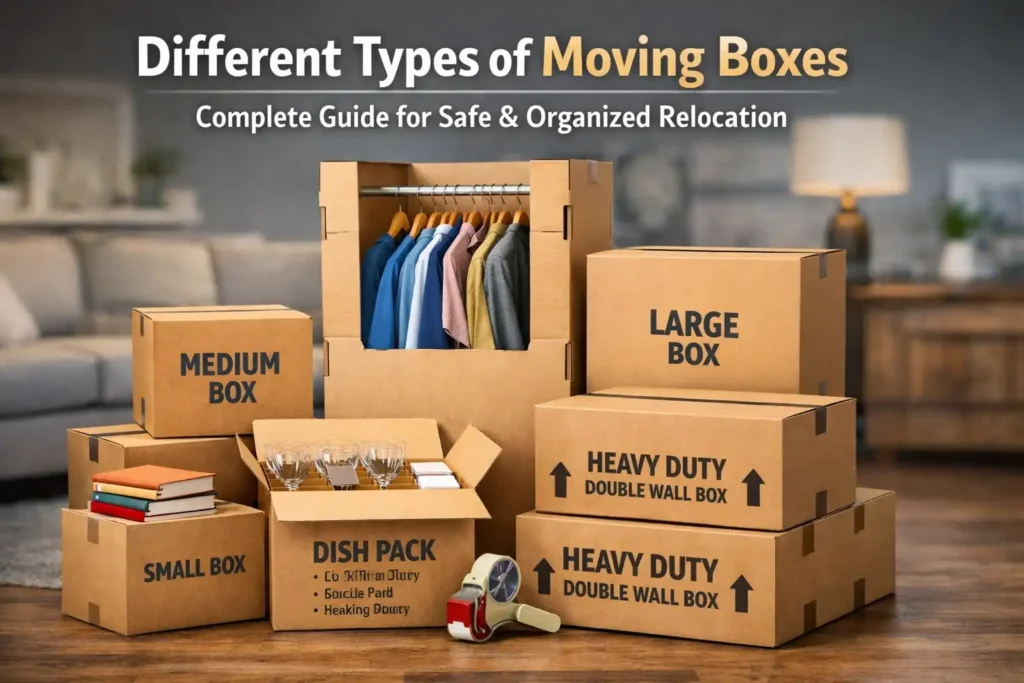
Different types of moving boxes are designed for specific items to ensure safe and organized relocation. Small boxes are used for heavy items like books, medium boxes for general household goods, and large boxes for lightweight items such as clothes and bedding. Dish pack boxes protect glassware, wardrobe boxes keep clothes on hangers, and specialty boxes secure electronics, artwork, and mirrors. Choosing the right box based on item weight and fragility helps reduce damage and improves moving efficiency.
Planning a move involves dozens of decisions, but choosing the right moving boxes is one of the most critical for protecting your belongings and keeping the relocation process organized. Whether you’re shifting locally or moving long-distance, the type, strength, and size of boxes you use directly affect item safety, loading efficiency, stacking stability, and even unpacking speed. Professional packers And Movers plan box usage room-by-room to balance weight, prevent crush damage, and reduce handling risks—especially for fragile and high-value items. In this guide, we break down the different types of moving boxes, their ideal uses, and how selecting the right box for each item can help you avoid common moving mistakes and unnecessary losses.
Key considerations before choosing boxes:
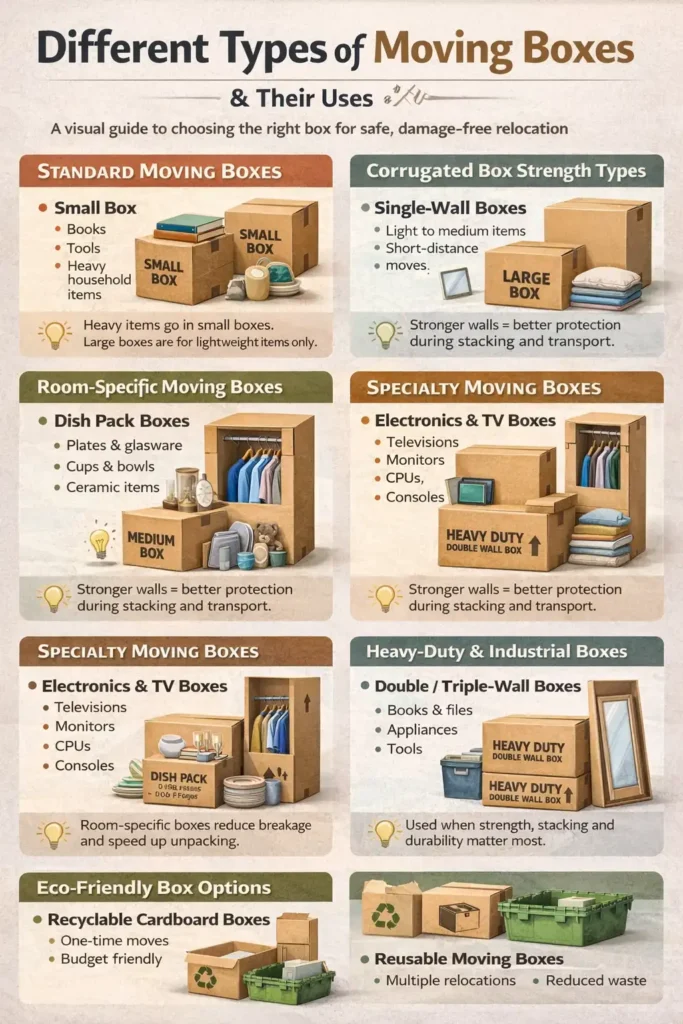
Moving boxes are not one-size-fits-all. Professional packers categorize boxes based on size, construction strength, and intended use to ensure items are packed safely and efficiently. Using the correct box type helps maintain balance during lifting, prevents crushing during stacking, and reduces the risk of damage in transit—especially for long-distance moves.
Below are the most commonly used moving box types in residential and commercial relocations worldwide.
Standard boxes are the backbone of any move. They are designed for everyday household items and are selected based on weight distribution rather than volume alone.
|
Box Size |
Typical Dimensions (inches) |
Ideal For |
Why It Works |
|
Small |
~16 × 12 × 12 |
Books, tools, canned goods |
Prevents overloading heavy items |
|
Medium |
~18 × 18 × 16 |
Kitchen items, toys, décor |
Balanced for mixed-weight packing |
|
Large |
~18 × 18 × 24 |
Linens, pillows, clothes |
Holds bulky but lightweight items |
Why movers prefer standard boxes:
If you’re planning a household move in Coimbatore, professional packers and movers in Coimbatore assess box size and weight distribution before packing begins.
Corrugated Cardboard Boxes (Single-Wall vs Double-Wall)
Corrugated boxes differ in strength based on how many layers (walls) of cardboard they contain. Choosing the right wall type is essential for load-bearing safety and long-distance transport.
Professional Insight:
Using stronger boxes reduces the risk of box failure during loading ramps, truck vibration, and warehouse stacking—common stress points during relocation.
These risks increase during long-distance moves, which is why understanding packers and movers cost factors often includes box strength and packing quality.

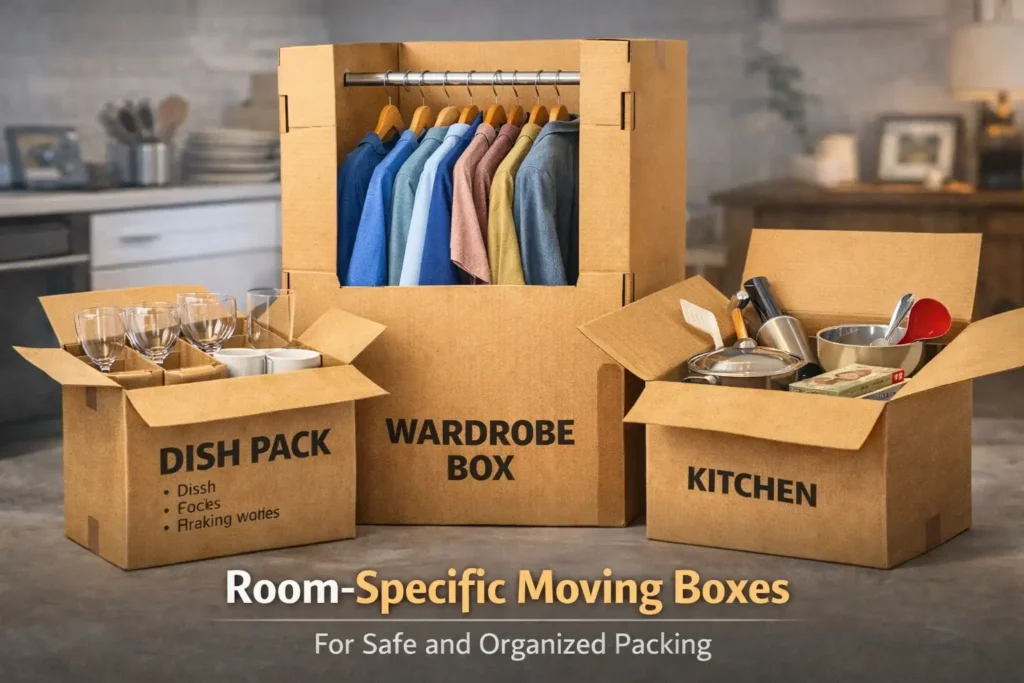
Different rooms contain items with unique shapes, weights, and fragility levels, which is why professional packers rely on room-specific moving boxes instead of generic cartons. Using the right box for each room helps prevent internal movement, reduces breakage, and keeps unpacking organized.
Below are the most commonly used room-specific moving boxes and how they are used in professional relocations.
Dish packs are specially designed for fragile kitchen items such as plates, bowls, glasses, and cups. These boxes are typically double-wall corrugated cartons built to handle weight and stacking pressure.
Wardrobe boxes are tall cartons equipped with a built-in hanging rod, allowing clothes to be moved directly from the closet without folding.
Shoes, handbags, or soft items can be placed at the bottom of the wardrobe box without touching hanging clothes.
Kitchen items vary widely in size and weight, so professionals use a combination of standard, reinforced, and specialty boxes to pack kitchens safely.
Certain household items require extra protection beyond standard cartons due to their shape, material, or value. For these belongings, professional packers rely on specialty moving boxes designed to minimize vibration, prevent internal movement, and protect against impact during loading and transit—especially in long-distance moves.
Electronic items are sensitive to shock, vibration, and static electricity, making proper boxing essential.
Artwork and mirrors are highly prone to cracking and edge damage, even from minor pressure. Adjustable mirror boxes are used to accommodate different sizes securely.
Lamps and décor items often have irregular shapes, making them vulnerable to bending and breakage if packed improperly.
High-value items packed in the right cartons are also better protected under transit insurance during house shifting.
When relocating heavy, dense, or high-value items, standard cartons are often not sufficient. Professional movers use heavy-duty and industrial-grade boxes to handle higher loads, repeated handling, long-distance transport, and extended storage. These boxes are designed to resist crushing, tearing, and moisture exposure, making them ideal for demanding moves.
These boxes are constructed with multiple layers of corrugated fluting, significantly increasing their strength and stacking capacity.
Plastic moving crates are increasingly used in premium and corporate relocations due to their durability and sustainability.
Feature | Double/Triple-Wall Boxes | Plastic Moving Crates |
Load Strength | High | Very High |
Moisture Resistance | Moderate | Excellent |
Reusability | Limited | Multiple uses |
Stack Stability | Good | Excellent |
Environmental Impact | Recyclable | Reusable |

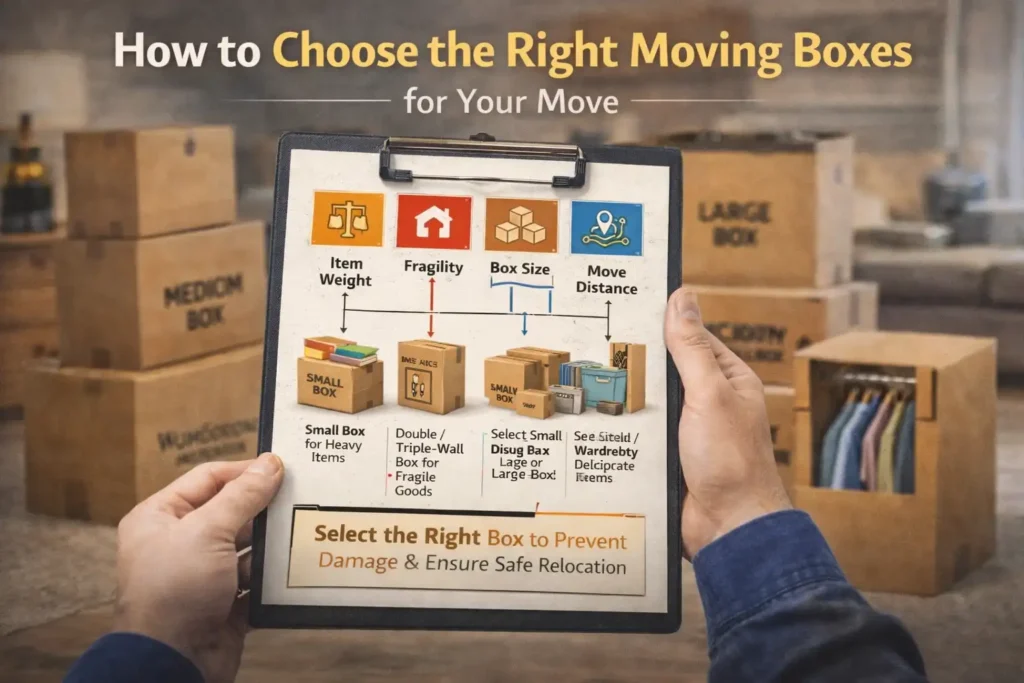
Selecting the right moving boxes is a decision-making process, not just a shopping task. Professional packers evaluate item type, weight, distance, storage duration, and handling frequency before finalizing box combinations. Using the correct boxes minimizes damage, improves load balance, and reduces re-handling during transit.
Below is a practical framework used in standard relocation planning.
Different belongings demand different box characteristics.
Guidelines professionals follow:
Distance increases exposure to vibration, stacking pressure, and repeated handling.
|
Move Type |
Recommended Box Strategy |
|
Local move |
Standard single-wall + limited specialty boxes |
|
Intercity / long-distance |
Double-wall & specialty boxes |
|
Storage-involved moves |
Reinforced or reusable boxes |
Longer distances typically require stronger corrugated construction to withstand stacking and transport stress.
If boxes will remain packed for weeks or months, box integrity becomes critical.
Best practices:
Boxes exposed to humidity or stacking pressure for extended periods should have higher resistance to crushing.
Boxes moved multiple times (home → truck → warehouse → truck → home) need higher durability.
High-handling items include:
For these cases, professionals favor reinforced cardboard or reusable crates to avoid deformation.
Using the strongest box for every item is unnecessary and increases costs.
Cost-effective approach used by movers:
This targeted approach improves protection without overpacking.
Even with good-quality packing materials, incorrect box selection can lead to damaged items, injuries during lifting, and delays during unloading. Professional movers regularly see avoidable issues caused by overloading, poor box strength, and improper item grouping. Avoiding these mistakes helps ensure a safer and smoother relocation.
One of the most common packing mistakes is filling large boxes with heavy items.
Why this causes problems:
Correct approach:
Boxes not designed for moving often lack structural strength.
Common examples to avoid:
Why professionals avoid them:
Combining different item types in one box increases breakage risk.
What goes wrong:
Best practice:
Not all boxes are built to handle the same loads.
Common oversight:
Professional correction:
Unfilled space allows items to move during transit.
Consequences:
Correct method:
Even well-packed boxes can cause problems if not labeled properly.
Issues caused by poor labeling:
Professional labeling approach:
Most of these mistakes can be avoided by following a professional packer selection checklist before finalizing your moving company.
Experienced packers and movers follow a systematic box-allocation strategy to reduce damage, speed up handling, and maintain load balance throughout the move. Rather than packing randomly, professionals assign box types based on item characteristics, handling risk, and transport conditions.
This approach is one of the key reasons professionally packed moves experience fewer breakages and smoother unloading.
Before packing begins, movers typically:
This planning ensures that each item is placed in a box that can support its weight and protect it during transit.
Item Category | Recommended Box Type | Reason |
Books & files | Small, double-wall boxes | Prevents overloading |
Clothes on hangers | Wardrobe boxes | Avoids folding & creasing |
Dishes & glassware | Dish packs with dividers | Reduces contact & breakage |
Electronics | Specialty electronics boxes | Protects from shock |
Artwork & mirrors | Adjustable mirror boxes | Maintains upright position |
Linens & pillows | Large standard boxes | Lightweight & bulky items |
Professional movers often avoid mixing box grades within the same stack to maintain even load distribution.
Improper box selection is a common reason for disputes during damage assessments.
Professional insight:
This workflow minimizes rehandling and ensures boxes arrive intact and organized.
A typical home move requires a combination of box types, not just one.
Most relocations use:
Using multiple box types helps distribute weight properly and reduces damage during transit.
Yes, reusing boxes is safe if they are in good condition.
Before reuse, boxes should be checked for:
Boxes that have lost rigidity may fail under stacking pressure and should not be used for heavy or fragile items.
Heavy items such as books should always be packed in small, reinforced boxes.
Why this works:
Large boxes filled with books are one of the most common causes of packing-related damage.
Yes, wardrobe boxes are designed for multiple uses if kept dry and undamaged.
They are commonly reused for:
The hanging rod can usually be removed and reused with replacement boxes if needed.
Professional packers typically bring their own moving-grade boxes as part of the packing service.
Benefits include:
For DIY packing, boxes can be purchased or rented separately, but selecting the right type becomes the responsibility of the mover.
Plastic moving crates offer advantages in certain situations but are not always necessary.
Plastic crates are better when:
Cardboard boxes are better when:
Yes. Using incorrect boxes is a major contributor to breakage during relocation.
Common causes include:
Matching box type to item weight and fragility significantly lowers damage risk.
Choosing the right moving boxes is only half the job — professional packing makes the real difference. Incorrect box selection, overloading, or weak cartons are among the top causes of damage during relocation. Following expert Moving Tips can help you avoid these common mistakes, which is why thousands of households rely on trained packers who use the right box for every item.
With 6 Packers And Movers, you get:
Get stress-free packing and moving support today