
Top Mistakes People Make When Hiring Packers & Movers (And How to Avoid Them)

Hiring a reliable moving company is one of the most important decisions you make during a relocation, yet many people still fall into common traps that lead to delays, damage, or unexpected expenses. Whether you are shifting within the city or planning an intercity move, Whether you are shifting within the city or planning an intercity move, choosing the right packers and movers services plays a major role in ensuring a smooth, stress-free transition.. Most issues during house shifting arise not because movers are unprofessional, but because homeowners often overlook critical steps—such as verifying company credentials, comparing quotations carefully, checking insurance coverage, and asking about packing quality. Several moving guides also highlight the importance of conducting a proper pre-move survey and avoiding extremely low quotes that typically lead to hidden charges. At the same time, expert recommendations emphasize preparing your home, securing valuables, planning labeling systems, and clarifying manpower details well before the moving day.
This comprehensive guide explores the top mistakes people commonly make when hiring packers and movers and offers practical ways to avoid them. Each section breaks down what can go wrong, why it happens, and what steps you can take to protect your belongings, your time, and your budget. The goal is to help you make informed decisions—based on verified facts, documented processes, and widely accepted best practices—to ensure a safe and hassle-free move.
1. Not Researching the Company’s Background & Reviews
Most problems during relocation start with choosing a mover without adequate research. Many people rely only on a website or a single phone call, overlooking essential checks such as company reviews, local reputation, office verification, and customer feedback. It is advisable to look beyond promotional content and examine third-party reviews, ratings, and consistent customer experiences across multiple platforms. Many industry checklists note that a lack of reviews—or overly polished, repetitive reviews—may indicate fabricated feedback rather than genuine customer experiences.
Why Company Reputation Matters in a High-Risk Industry
Hiring a moving company involves trust—they handle valuable, fragile, and often irreplaceable belongings. A reputable mover usually maintains transparent processes, clear pricing, and trained manpower. Researching their past work, customer interactions, and consistency of positive feedback helps ensure you’re choosing a reliable service provider.
How to Spot Fake Reviews vs. Genuine Reviews
Fake reviews often appear in clusters, sound overly generic, or lack details about the actual moving experience. Genuine reviews typically include specifics: size of the move, how the team handled items, punctuality, and issues faced. Identifying patterns helps filter out misleading information.
Checking Local Listings, Google Maps & Community Feedback
Local listings and Google Maps provide updated ratings, recent photos, and real customer inputs. Community groups or local forums also help confirm whether a mover is active in your area and provides consistent service quality.
Verifying the Company’s Physical Office & Online Presence
A professional moving company maintains a functioning office, updated website, active customer support, and clear service descriptions. Visiting their office or verifying their location online adds an extra layer of safety.
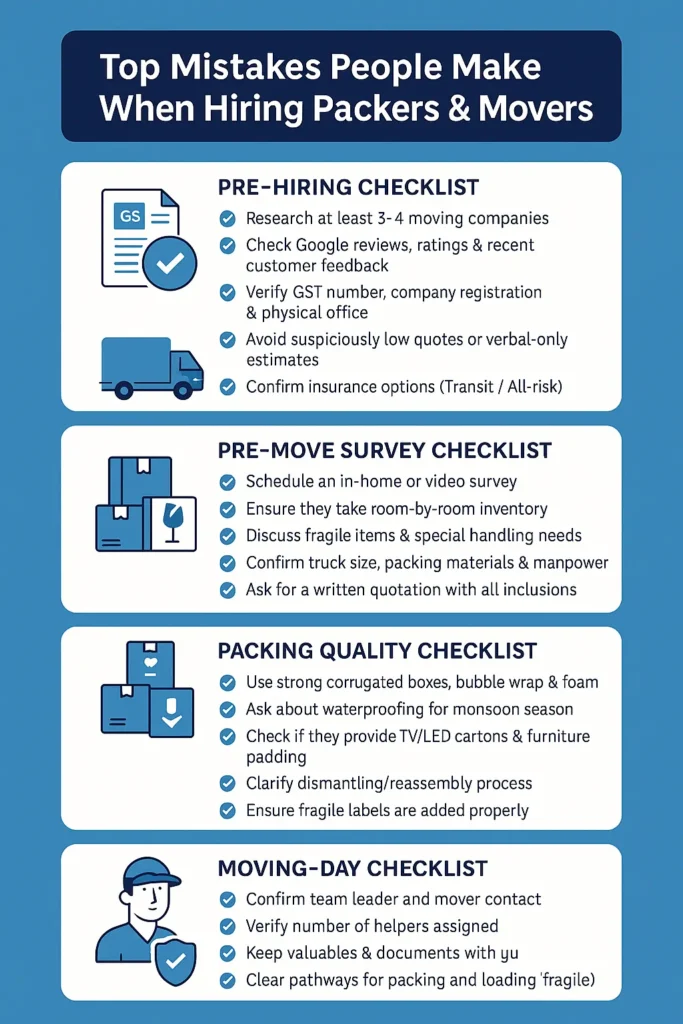
Following a structured checklist for choosing packers and movers helps avoid unreliable companies and common hiring mistakes.
2. Choosing Movers Based Only on the Lowest Price
One of the most common mistakes people make is selecting packers and movers solely based on the lowest quote. While saving money is important, extremely low estimates often come with hidden costs, poor service quality, or inexperienced manpower. Many moving guides note that lowball pricing is a common tactic used to secure customers initially, only to add unexpected charges later during packing, loading, or unloading. It is advisable to compare quotes from at least three companies and evaluate what each one offers—materials used, experience level, insurance coverage, manpower, and vehicle type—before deciding solely on price.
Before finalizing any quotation, it’s important to understand how packers and movers costs are calculated, including what is included and what may be charged separately.
How Lowball Quotes Lead to Hidden Charges Later
Low quotes may not include essential elements such as packing materials, loading labor, insurance, fuel, or GST. Movers may later add these charges once your goods are packed and you have limited room to negotiate. Many users report being asked to pay extra for stairs, additional manpower, long distances between the truck and home, or last-minute packing additions.
Understanding Price vs. Quality in Moving Services
A slightly higher-priced mover often offers better-quality cartons, professional wrapping, trained staff, and safer vehicles. Selecting a mover only on cost may compromise the safety of fragile, premium, or large household items. It is generally recommended to evaluate the value provided rather than the lowest number.
Why Extremely Low Quotes Usually Signal Inexperienced Movers
Companies offering suspiciously low prices may use temporary laborers, unpadded trucks, or minimal packaging. This often leads to damages or delayed deliveries. Established movers typically maintain consistent pricing because they use better materials and experienced teams.
Comparing 3–4 Quotes for Fair Pricing
Requesting multiple quotations helps identify market-standard pricing. Comparisons should include material lists, manpower count, truck type, insurance options, and any exclusions. This prevents falling for misleading or incomplete cost estimates.
3. Skipping the In-Home or Video Pre-Move Survey
Many customers accept phone-based quotations without allowing movers to inspect the household items. This is one of the main reasons for price disputes, inaccurate estimates, or last-minute changes on moving day. A pre-move survey—whether conducted in person or via video call—helps movers assess the volume of goods, the type of furniture, the number of fragile items, and any access challenges such as narrow staircases or limited parking. Several industry verification guides recommend always insisting on a proper survey because it allows movers to plan material quantity, manpower, and vehicle size accurately.
When a survey is skipped, movers often underestimate or overestimate the volume, leading to extra charges, more trips, or the need for a larger vehicle at the last minute. For homeowners, this can create unnecessary delays and stress. Allowing a survey also helps you understand the mover’s professionalism—whether they take proper notes, ask relevant questions, and inspect delicate items like TVs, appliances, and glass furniture. This simple step significantly reduces the risk of miscommunication and ensures a smoother moving-day experience.
Importance of Accurate Volume Assessment
Assessing the exact number of cartons, furniture pieces, and household items helps movers decide on the right truck size, packing materials, and timeline. Accurate volume calculation also prevents surprises such as additional vehicle charges or multiple trips that were not discussed earlier.
How Phone-Based Quotes Lead to Disputes on Moving Day
Phone estimates usually lack clarity about fragile items, heavy appliances, or large furniture. This often results in increased costs once movers see the actual volume. Many checklists highlight that verbal or phone quotations tend to change after physical inspection.
When a Virtual Survey Works Better Than an In-Person One
Video surveys are convenient for busy schedules, gated communities, or when the mover’s office is far away. They still offer sufficient visibility for estimating goods volume and planning the move. Video assessments are especially useful for outstation relocations where movers cannot visit physically.
4. Not Verifying Licensing, GST Registration & Insurance Coverage
Another common mistake is finalizing a moving company without checking its legal registration, GST details, and insurance options. Many homeowners assume the mover is legitimate simply because they have a website or advertise locally, but reliable movers maintain proper documentation that proves their operational authenticity. Industry checklists consistently recommend asking for GSTIN, company registration certificates, trade licenses, or address proof to confirm whether the mover is legally compliant. Verifying these details protects you from fraudulent operators who often disappear after collecting advance payments or cause damage without offering proper support.
Insurance is equally important. Transit insurance covers your belongings against accidental damage during transportation, while comprehensive coverage is generally recommended for long-distance shifts or fragile, high-value items. Several guides emphasise the need to ask whether the mover provides direct insurance options or works with a third-party insurance partner, as this affects claim processing and documentation. Proper verification ensures that you’re working with a responsible company and helps avoid disputes if an unexpected incident occurs during transit.
How to Check GSTIN & Registration Documents
You can request the company’s GST number and verify it through publicly available government portals. Checking whether the company name, address, and active status match the provided GST details helps confirm authenticity. Business registration numbers, PAN, or trade license copies offer additional verification.
Types of Moving Insurance You Should Ask For
Movers generally offer:
- Transit Insurance – Covers damage due to accidents during vehicle transit.
- Comprehensive or All-Risk Insurance – Covers a wider range of risks but may require item valuation.
Understanding these types helps you choose the right protection based on the items you are shifting.
To reduce financial risk, homeowners should clearly understand what transit insurance covers during house shifting before confirming a mover.
What Documents a Legitimate Mover Will Always Provide
A genuine packer and mover typically offers:
- Written quotation
- Service agreement
- GST invoice
- Itemized bill
- Insurance form
These documents help maintain transparency and serve as proof in case of disputes.
5. Ignoring the Fine Print in the Quotation & Service Agreement
Many customers focus only on the total price and overlook the fine print in the quotation or service contract. This often leads to hidden charges, misunderstandings, or disputes during and after the move. It is advisable to carefully read the quotation to understand what is included—such as packing materials, manpower, transportation, taxes, insurance, dismantling and reassembly—and what is excluded. Industry checklists emphasize that transparent movers clearly outline these details, while unreliable ones keep terms vague to add charges later.
A proper service agreement also defines the responsibilities of both parties: handling of fragile items, timelines, payment terms, and liability during damage or delay. Several moving guides recommend avoiding companies that refuse to provide written documentation or ask you to sign incomplete papers, as these are common red flags in the moving industry. Reviewing all clauses beforehand helps you stay informed, prevents last-minute surprises, and ensures a smoother relocation experience.
Hidden Charges to Watch Out For (Stairs, Long Carry, Dismantling)
Many movers charge extra for carrying goods up multiple floors, long walking distances between the truck and home, or dismantling furniture and appliances. Clarifying these additional fees beforehand avoids unexpected increases in the final bill.
Payment Terms—What’s Normal and What’s Risky
A reasonable payment structure typically involves a partial advance and the remaining amount after delivery. Large, full advance payments may indicate risk. Asking for digital or official payment receipts provides further security.
Cancellation & Rescheduling Policies
Understanding the cancellation policy helps avoid disputes if you need to change the moving date. Standard practices include partial deductions or full refunds based on how early the cancellation is made. Movers with flexible policies are generally easier to work with.
What Should Be Included in a Transparent Quotation
A clear quotation should mention:
- Total estimated cost
- Packing materials and quantity
- Manpower count
- Truck size and type
- Insurance charges
- Loading/unloading fees
- Any exclusions
These details ensure price transparency and reduce the risk of disputes.
Why a Written Agreement Protects You From Disputes
A written agreement serves as proof of commitments and makes it easier to address issues if delays, damages, or unexpected charges arise. It documents what the mover has promised and provides a clear reference point if problems occur.
6. Not Checking the Company’s Fleet, Manpower & Equipment Quality
Many customers assume that all packers and movers use the same type of vehicles and manpower, but this varies significantly across companies. The quality of the fleet, skill level of the staff, and availability of proper moving equipment directly impact the safety and efficiency of your relocation. Industry guides highlight that professional movers generally use covered, well-maintained trucks equipped with proper lashing belts, flooring protection, and padding to secure goods during transit. Additionally, experienced movers rely on trained personnel rather than temporary laborers, ensuring better handling of fragile, bulky, or expensive items.
Evaluating a mover’s operational capacity also helps ensure they are capable of managing your specific type of shift—local, intercity, or interstate. A company with a small or outdated fleet may struggle to handle long-distance relocations or multiple bookings, while a well-equipped mover will have standard operating procedures, proper loading techniques, and adequate resources to prevent delays.
Why a Branded, Covered Truck Reduces Transit Damage
Covered trucks provide better protection against weather conditions, dust, and accidental bumps. Trucks with internal padding, proper partitions, and tie-down points minimize shifting of items during transit, which is crucial for long-distance moves.
Importance of Skilled Labor Over Temporary Workers
Trained movers understand correct lifting techniques, packing sequences, labeling systems, and how to handle delicate items. Temporary or untrained helpers may mishandle goods, leading to scratches, dents, or breakage. Skilled labor ensures smoother coordination during loading and unloading.
Tools & Equipment Professionals Use (Dollies, Ramps, Belts)
Reputable movers typically use equipment such as trolleys, dollies, lifting straps, ramps, and furniture sliders. These tools make the process safer, faster, and more organized. Equipment also reduces the physical strain on workers, minimizing the chance of mishaps.
How Poor Equipment Increases Risk of Damage
Lack of proper tools may lead to improper lifting, dragging furniture, or forcing items through tight spaces. This can result in damaged flooring, broken items, or injuries. Proper equipment ensures efficient handling without unnecessary force.
Checking Fleet Size for Outstation Moves
For intercity or interstate relocations, fleet size matters. A company with multiple trucks can offer backup support if a vehicle breaks down or scheduling adjustments are needed. It also indicates the mover’s capability to manage long routes, overnight travel, and timely delivery.
7. Forgetting to Clarify the Moving Day Plan & Team Details
A successful relocation depends heavily on clear communication and planning before the moving day. Many customers assume that movers will automatically know what to do, but failing to clarify team details, timelines, special instructions, and labeling methods can lead to confusion, delays, or mishandling of items. Industry checklists recommend discussing the complete moving-day plan in advance, including the number of helpers, the supervisor’s contact information, the sequence of packing, and how items will be labeled and segregated.
This discussion also helps identify whether the mover has a structured workflow. Some movers assign an on-site supervisor who coordinates the team, manages fragile items, and ensures boxes are loaded in the correct order. Clarifying these roles beforehand makes the moving process smoother and reduces the chance of errors. When the team knows exactly what to expect, they can bring the right materials, equipment, and manpower, ensuring a faster and more organized move.
Confirming the Supervisor or Team Leader Details
It is advisable to ask for the name and contact number of the team leader who will handle the packing and loading. This ensures direct communication and helps address issues promptly during the move.
Number of Helpers Assigned & Their Expertise
Clarifying how many helpers will be present—and whether they are trained employees—helps you understand if the manpower is sufficient for your home size. Understaffed teams often rush the process, increasing the risk of damage.
Expected Timeline for Packing, Loading & Unloading
Discussing the estimated time required for each stage helps you plan your day. Most movers provide a tentative schedule based on the volume of goods. Aligning expectations reduces stress and avoids last-minute delays.
Labelling Method & Item Segregation Process
A clear labeling system is essential, especially for fragile or room-specific items. Movers may use color codes, room tags, or “fragile” stickers. Organized labeling ensures smoother unpacking and reduces the risk of items getting misplaced or mishandled.
Communication Protocols During the Move
Clarifying who to contact during the process—team leader, driver, or office coordinator—ensures smooth communication. This helps track the truck’s status, resolve small issues, and prevent misunderstandings.
8. Hiring Last Minute Without Comparing Options
One of the most avoidable mistakes during relocation is hiring packers and movers at the last minute. When the move is booked in a rush, customers often end up choosing the first available company without checking credentials, insurance, manpower strength, vehicle quality, or customer reviews. Several moving guides highlight that last-minute booking often leads to limited availability, higher prices, and less flexibility in scheduling.
Early planning gives you enough time to compare multiple quotations, verify licenses, inspect the company’s packing standards, and arrange pre-move surveys. Booking at least three to four weeks in advance is advisable, especially during peak seasons, weekends, or month-end dates when demand is high. A well-planned booking ensures you can choose a reliable mover offering quality materials, trained manpower, and transparent pricing.
Many hiring mistakes can be avoided by learning how to verify genuine packers and movers before booking.
Why Last-Minute Bookings Lead to High Costs
During busy periods—such as weekends, holidays, or the end of the month—movers often charge higher rates due to increased demand. Last-minute customers may have no room for negotiation or selection and might end up accepting inflated quotes.
Limited Truck & Manpower Availability During Peak Dates
Professional movers usually allocate manpower and trucks in advance. Late bookings may result in receiving an undersized truck, insufficient helpers, or a poorly scheduled team—leading to delays or inefficient packing.
Comparing Movers Early for Better Pricing
Early comparison allows you to evaluate insurance options, packing materials, truck quality, and additional services. Multiple quotations help identify market-standard pricing, reducing the chance of overpaying.
Planning Timeline for Local vs. Outstation Shifts
Local moves may require 3–5 days of planning, while outstation moves often need 1–2 weeks for surveys, packing, and documentation. Planning ahead ensures smoother coordination for long-distance relocations.
Early Booking Benefits (Priority Service, Discounted Rates)
Movers often provide early-bird benefits such as priority service slots, assured manpower, and better pricing. Early planning also helps avoid last-minute stress and ensures a relaxed, well-organized moving experience.
Hiring packers and movers is a major decision that directly affects the safety of your belongings, the efficiency of your relocation, and your overall moving experience. Most problems—such as hidden charges, delays, damaged items, or poor coordination—stem from avoidable mistakes made during the selection and planning process. By conducting proper research, verifying documentation, comparing quotations, and asking the right questions about packing materials, manpower, insurance, and moving-day workflows, you significantly reduce the chances of any unpleasant surprises.
Industry checklists consistently highlight the importance of prioritizing reliability over the lowest price, insisting on a pre-move survey, confirming GST and registration details, and understanding the claims procedure before finalizing a mover. Preparing your home, managing valuables, and coordinating the moving day plan also contribute to a smooth, stress-free relocation. Whether you are planning a local shift or a long-distance interstate relocation, choosing a mover with the right experience, fleet strength, and operational capabilities ensures a safe and well-organized move.
By following the strategies outlined in this guide, you can make informed decisions, avoid common pitfalls, and ensure that your shifting experience is efficient, transparent, and free from unnecessary stress.
Make your move smooth, safe, and completely stress-free with 6 Packers And Movers. Our trained professionals use high-quality packing materials, secure loading methods, and verified processes to ensure your belongings stay protected throughout the journey. Whether you’re shifting locally or relocating to another city, we provide transparent pricing, GST-registered documentation, and reliable end-to-end support. Don’t take chances with inexperienced movers—choose a trusted team that values your time and safety.
If you’re relocating in Bangalore, working with reliable packers and movers in Agra ensures proper documentation, trained manpower, and safer handling of household goods.