
Common Problems During Relocation & How Professional Movers Handle Them
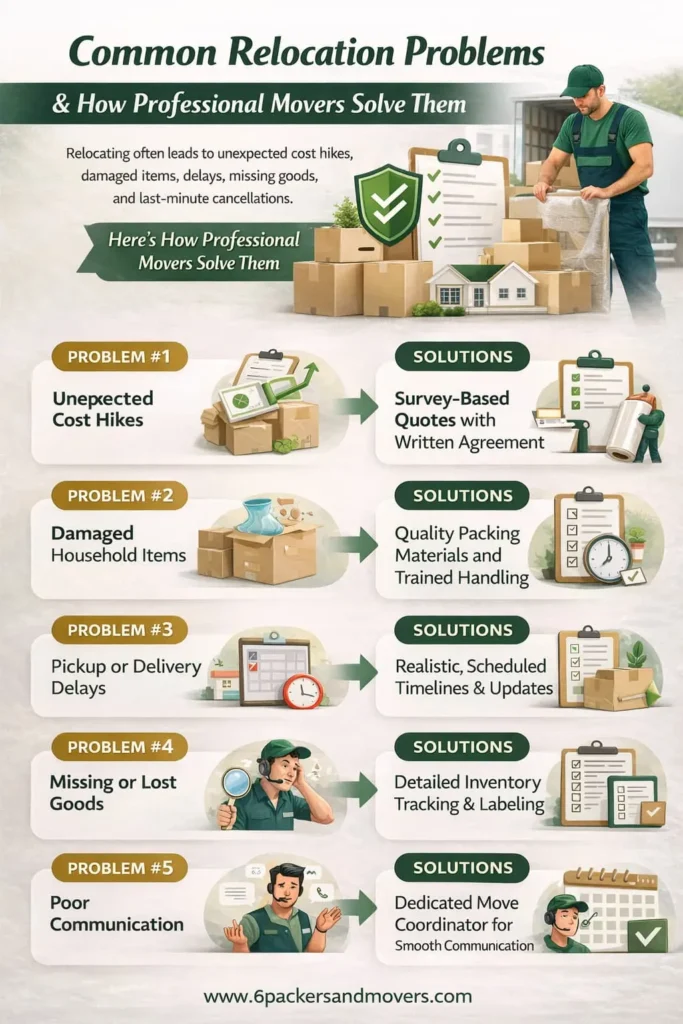
Common problems during relocation include unexpected price hikes, damage to household goods, delivery delays, missing items, poor communication, documentation issues, and last-minute cancellations.
Professional movers handle these challenges by conducting pre-move surveys, using quality packing materials, maintaining inventory lists, planning realistic timelines, assigning dedicated coordinators, ensuring proper documentation, and confirming bookings through written agreements. These structured processes reduce risk, improve transparency, and make relocation safer and more predictable.

Relocation is a complex process that involves careful coordination, physical handling, time management, and documentation. Whether it is a local house shift or an intercity move, even small planning gaps can lead to serious problems such as unexpected cost increases, damaged belongings, delivery delays, or missing items. Many of these issues arise when individuals attempt to manage the move on their own or hire movers without proper systems in place. Choosing Experienced Packers And Movers plays a critical role in reducing these risks by bringing structure, accountability, and professional handling to the entire relocation process.
From inaccurate cost estimates to last-minute service cancellations, relocation-related problems are among the most common consumer complaints in the moving industry. Studies and consumer protection agencies consistently highlight that disputes often occur due to verbal pricing, lack of written documentation, poor communication, and untrained labor. Without clear processes such as pre-move surveys, inventory tracking, proper packing standards, and defined delivery timelines, customers are left vulnerable to stress, financial loss, and damage to valuable household goods.
Professional movers address these challenges by following standardized relocation practices that focus on transparency, safety, and planning. This includes conducting pre-move assessments, using appropriate packing materials, maintaining inventory lists, assigning move coordinators, and ensuring legal compliance throughout the move. When executed correctly, these measures significantly reduce relocation risks and provide customers with greater control and peace of mind during the transition.
we break down the most common problems faced during relocation and explain how professional movers handle each issue through proven processes and operational discipline. Understanding these problem areas will help you make informed decisions, avoid common moving pitfalls, and recognize the value of structured, professional relocation services.
Inaccurate Cost Estimates & Sudden Price Hikes During Relocation
One of the most common and frustrating problems during relocation is receiving a low initial quote and then facing sudden price increases on moving day or at delivery. This usually happens when cost estimates are provided without a proper assessment of the household goods, access conditions, or special handling requirements. Verbal quotes or online form-based estimates often fail to account for factors such as staircases, long carry distances, bulky furniture, fragile items, or additional packing needs, which later become grounds for extra charges.
Understanding how moving charges are calculated can help avoid disputes—refer to this packers and movers cost guide for a detailed breakdown.
Professional movers reduce this risk by following a structured estimation process. Instead of relying solely on rough inputs, they assess the total volume of goods, packing requirements, and logistical constraints before finalizing the price. This approach helps align expectations on both sides and minimizes disputes related to billing.
Why Moving Cost Estimates Often Go Wrong
- Estimates given without a physical or video survey of the household
- Items added at the last minute that were not part of the original quote
- Access-related challenges such as no lift, narrow staircases, or long carrying distances
- Lack of written documentation clearly defining inclusions and exclusions
How professional movers handle cost transparency
- Conduct pre-move surveys to evaluate inventory and site conditions
- Share written, itemized estimates instead of verbal commitments
- Clearly define chargeable variables such as packing type, manpower, and distance
- Explain scenarios that may lead to revised pricing before the move begins
Before finalizing any service provider, it’s essential to follow a proper hiring checklist for packers and movers to avoid hidden charges.
Cost estimation comparison: casual movers vs professional movers
Aspect | Casual / Unstructured Movers | Professional Movers |
Survey method | Phone call or online form only | Physical or video pre-move survey |
Estimate format | Verbal or informal message | Written, itemized estimate |
Scope clarity | Often unclear or incomplete | Clearly defined services and conditions |
Risk of price hike | High | Significantly reduced |
Dispute handling | Reactive | Preventive through documentation |
By insisting on a documented estimate and survey-based pricing, professional movers help customers avoid last-minute financial shocks. This structured approach not only protects the customer’s budget but also builds accountability into the relocation process.
Damage to Household Goods During Packing or Transit
Damage to household items is one of the biggest concerns during relocation, especially for fragile goods, electronics, and large furniture. Breakage, scratches, dents, and internal damage usually occur due to improper packing methods, low-quality materials, or incorrect loading inside the moving vehicle. When items are packed loosely or stacked without considering weight distribution, they become vulnerable to shocks, vibrations, and sudden movements during transit.
Professional movers minimize the risk of damage by following standardized packing and handling procedures. Instead of using random cartons or improvised wrapping, they rely on material-specific packing techniques and systematic loading practices. This structured approach significantly reduces transit-related damage and post-move claims.
Common Reasons Household Items Get Damaged
- Use of weak or reused cartons that cannot bear weight
- Inadequate cushioning for fragile and electronic items
- Mixing heavy and delicate items in the same boxes
- Improper stacking and load imbalance inside the truck
- Manual handling without protective equipment
Knowing exactly what transit insurance covers during house shifting helps protect against financial loss in case of damage.
How professional movers prevent damage
- Use of sturdy corrugated cartons, bubble wrap, stretch film, and cushioning layers
- Separate packing for fragile, heavy, and high-value items
- Furniture protection using padding, corner guards, and shrink wrapping
- Systematic loading with proper weight distribution inside vehicles
- Trained handling techniques during lifting and placement
Packing and handling approach comparison
Area | Unstructured Packing | Professional Packing |
Packing materials | Basic or reused materials | Quality-grade cartons and cushioning |
Fragile item handling | Minimal protection | Multi-layer, item-specific protection |
Furniture safety | Often uncovered | Fully padded and wrapped |
Vehicle loading | Random stacking | Balanced and secured loading |
Damage risk | High | Significantly reduced |
By using the right packing materials and trained handling practices, professional movers reduce the likelihood of damage during both packing and transit. This not only protects valuable household goods but also ensures a smoother and more reliable relocation experience.
Delays in Pickup or Delivery Timelines
Delays in pickup or final delivery are another common relocation problem that can disrupt work schedules, housing arrangements, and daily routines. Such delays usually occur due to poor route planning, unrealistic delivery commitments, vehicle unavailability, permit checks, weather conditions, or inefficient coordination in shared transportation. When timelines are promised without accounting for these variables, customers often face extended waiting periods without clear updates.
Professional movers manage delivery timelines by planning logistics in advance and communicating realistic expectations. Instead of offering guaranteed dates without assessment, they factor in distance, route conditions, transit regulations, and buffer time to reduce uncertainty. This structured planning helps minimize delays and ensures smoother coordination throughout the move.
Why pickup and delivery delays happen
- Overcommitment without proper route or capacity planning
- Traffic congestion, weather disruptions, or regulatory checks
- Poor coordination in shared or consolidated transportation
- Lack of contingency planning for unexpected disruptions
How professional movers manage timelines
- Advance route planning with buffer time for delays
- Clear distinction between estimated and guaranteed delivery windows
- Scheduled pickup slots and dispatch coordination
- Regular status updates during transit
Timeline management comparison
Factor | Poorly Planned Moves | Professionally Managed Moves |
Delivery promise | Unrealistic or vague | Clearly defined delivery window |
Route planning | Minimal or reactive | Pre-planned with contingencies |
Shared transport handling | Disorganized | Coordinated and tracked |
Customer updates | Rare or unclear | Periodic and structured |
Delay risk | High | Significantly reduced |
Understanding how packers and movers work helps set realistic expectations for pickup and delivery timelines.
By adopting realistic scheduling and proactive communication, professional movers help customers plan their relocation with confidence. This approach reduces uncertainty, avoids last-minute disruptions, and creates a more predictable moving experience.
Missing, Lost, or Misplaced Items During Moving
Missing or misplaced items are a serious concern during relocation, especially when households involve multiple cartons, dismantled furniture, and separate packing stages. This problem usually arises when there is no systematic inventory process, poor labeling of boxes, or multiple loading and unloading points during transit. Without proper tracking, small but valuable items can easily go unnoticed until after delivery.
Professional movers reduce the risk of missing items by implementing inventory control and verification procedures. Instead of relying on memory or informal checks, they document each packed item and carton, ensuring accountability at every stage of the move. This structured tracking system helps maintain visibility of goods from origin to destination.
Common causes of missing items during relocation
- Absence of a written or digital inventory list
- Unlabeled or poorly labeled cartons
- Multiple handling points during loading and unloading
- No cross-verification at delivery
How professional movers control inventory
- Preparation of detailed inventory lists with carton numbering
- Labeling cartons by room and content category
- Cross-checking inventory at both pickup and delivery locations
- Maintaining documentation for dispute resolution
Inventory management comparison
Aspect | Unorganized Moves | Professional Movers |
Inventory list | Not maintained | Detailed and documented |
Carton labeling | Inconsistent | Clear and systematic |
Item tracking | Manual or none | Verified at each stage |
Loss detection | After delivery | During loading/unloading |
Accountability | Low | Clearly defined |
Maintaining a proper inventory list is critical—here’s how inventory documentation protects customers during relocation.
By maintaining a clear inventory trail, professional movers significantly reduce the risk of lost or misplaced items. This approach not only protects the customer’s belongings but also builds trust and transparency throughout the relocation process.
Poor Communication & Lack of Accountability from Movers
Poor communication is a major reason why relocation experiences turn stressful. Customers often face issues such as unanswered calls, unclear pickup timelines, last-minute changes without notice, or confusion about who is responsible at different stages of the move. When there is no clear point of contact or documented communication, even small issues can quickly escalate into major disputes.
Professional movers address this problem by establishing clear communication structures before the move begins. Instead of fragmented coordination, they assign responsibility and define communication checkpoints throughout the relocation process. This helps ensure that customers remain informed and know exactly whom to contact at every stage of the move.
Common communication failures during relocation
- No single person responsible for coordinating the move
- Lack of updates during packing, loading, or transit
- Verbal commitments without written confirmation
- Delayed responses to customer queries or concerns
Poor communication is also a warning sign—learn how to identify red flags when hiring moving companies.
How professional movers ensure accountability
- Assign a dedicated move coordinator as a single point of contact
- Share written confirmations for pickup, delivery, and services included
- Provide scheduled updates during transit
- Maintain documented communication for reference and dispute resolution
Communication structure comparison
Area | Poorly Managed Moves | Professional Movers |
Point of contact | Multiple or unclear | Dedicated move coordinator |
Updates | Irregular or absent | Scheduled and proactive |
Commitments | Mostly verbal | Written and documented |
Issue resolution | Reactive | Structured and accountable |
Customer confidence | Low | High |
Clear communication and defined accountability reduce uncertainty and help customers stay informed throughout the relocation process. By maintaining transparency and structured coordination, professional movers create a more reliable and controlled moving experience.
Legal, Documentation & Compliance Issues During Relocation
Legal and documentation-related problems are often overlooked during relocation but can lead to serious complications if not handled properly. These issues usually arise when movers fail to provide written contracts, proper invoices, or necessary transport documents. In some cases, customers only realize the importance of documentation when disputes occur, claims need to be raised, or goods are held up during transit due to compliance checks.
Professional movers reduce these risks by ensuring that all required paperwork is prepared and shared before the move begins. Proper documentation not only protects the customer legally but also establishes accountability and clarity regarding the scope of services, pricing, and responsibilities during relocation.
Common documentation problems during relocation
- Absence of written agreements or service contracts
- Missing or unclear invoices and billing details
- Lack of transit-related documentation
- No formal record of services agreed upon
How professional movers handle compliance
- Issue written contracts outlining services, pricing, and terms
- Provide proper invoices for transparency and record-keeping
- Ensure required transport and transit documents are in place
- Maintain documentation for claims, disputes, and post-move support
Documentation handling comparison
Aspect | Non-Compliant Moves | Professional Movers |
Service agreement | Verbal or informal | Written and documented |
Billing records | Inconsistent or missing | Clear and itemized |
Transit paperwork | Often unavailable | Prepared in advance |
Legal protection | Limited | Clearly defined |
Dispute resolution | Difficult | Structured and traceable |
By maintaining proper documentation and compliance practices, professional movers help safeguard both the customer and the relocation process. This reduces legal risks, prevents misunderstandings, and ensures a smoother move from start to finish.
Stress, Fatigue & Poor Move Planning
Relocation is widely recognized as a high-stress life event, especially when planning, packing, coordination, and physical movement are handled without a clear structure. Stress and fatigue often build up when timelines are rushed, tasks overlap, or responsibilities are unclear. Poor move planning can lead to last-minute packing, missed deadlines, physical exhaustion, and decision fatigue, all of which increase the risk of errors and dissatisfaction during the move.
Professional movers help reduce relocation-related stress by introducing structure, planning, and task distribution into the process. Instead of leaving customers to manage everything on their own, they break the move into manageable phases and follow a predefined workflow. This reduces mental and physical strain while improving overall move efficiency.
Why stress and fatigue increase during relocation
- Last-minute packing and rushed timelines
- Managing multiple tasks without a clear plan
- Physical strain from lifting and repetitive movements
- Uncertainty about pickup, delivery, and completion
How professional movers support better planning
- Create structured move schedules with defined timelines
- Handle packing, loading, and transportation in phases
- Reduce physical workload through trained manpower
- Provide clarity on what happens before, during, and after the move
Planning and stress management comparison
Factor | Self-Managed or Poorly Planned Moves | Professionally Planned Moves |
Task organization | Unstructured | Clearly phased |
Physical fatigue | High | Significantly reduced |
Mental stress | Elevated | Controlled and predictable |
Timeline clarity | Often unclear | Defined in advance |
Overall experience | Overwhelming | More manageable |
By applying structured planning and dividing responsibilities effectively, professional movers help make relocation less exhausting and more organized. This allows customers to focus on settling into their new space rather than struggling with move-related stress.
Untrained Labor & Mishandling of Goods
Untrained labor is a major cause of both physical damage to household goods and personal injury during relocation. Improper lifting techniques, lack of experience with bulky or heavy items, and absence of handling equipment can result in dropped furniture, damaged appliances, and scratched surfaces. Mishandling is especially common when movers are hired on a daily-wage basis without formal training or standardized procedures.
Professional movers address this issue by deploying trained manpower and using proper handling techniques for different types of household goods. Instead of relying solely on physical strength, they follow safe lifting practices and use equipment designed to move heavy or awkward items efficiently. This reduces damage risks and ensures safer handling throughout the move.
Common risks caused by untrained labor
- Incorrect lifting methods leading to item damage
- Mishandling of heavy or oversized furniture
- Lack of coordination during loading and unloading
- Absence of safety tools or handling equipment
How professional movers ensure safe handling
- Use trained personnel familiar with lifting and carrying techniques
- Deploy equipment such as dollies, straps, sliders, and padding
- Follow step-by-step loading and unloading procedures
- Assign team roles to maintain coordination during handling
Labor handling comparison
Area | Untrained Labor | Professional Movers |
Handling technique | Improvised | Standardized and trained |
Safety equipment | Rarely used | Used as required |
Damage likelihood | High | Significantly reduced |
Injury risk | Elevated | Minimized through practice |
Handling efficiency | Inconsistent | Systematic and controlled |
By relying on trained labor and proper handling methods, professional movers significantly reduce the chances of damage and injury. This structured approach improves safety, efficiency, and overall relocation reliability.
Last-Minute Cancellations or Service Refusals by Movers
Last-minute cancellations or service refusals can severely disrupt relocation plans, especially when households have already vacated their premises or arranged travel around a fixed moving date. These issues often occur due to overbooking, unrealistic pricing commitments, lack of capacity planning, or informal agreements without written confirmation. In some cases, movers may refuse to proceed unless additional payments are made, leaving customers with limited options at a critical moment.
Professional movers minimize this risk by confirming bookings through documented agreements and maintaining disciplined scheduling practices. Instead of relying on informal commitments, they align manpower, vehicles, and timelines before accepting a move. This structured approach reduces the likelihood of sudden cancellations and ensures service continuity.
Common reasons for last-minute cancellations
- Overbooking without adequate resource planning
- Unclear or verbal service agreements
- Underquoted prices that become unsustainable
- Lack of confirmed vehicle or manpower allocation
How professional movers prevent service refusals
- Confirm bookings with written contracts and schedules
- Allocate vehicles and manpower in advance
- Clearly define payment terms and service scope
- Maintain backup planning for operational disruptions
Service reliability comparison
Aspect | Unreliable Movers | Professional Movers |
Booking confirmation | Informal or verbal | Written and documented |
Resource planning | Minimal | Pre-allocated |
Cancellation risk | High | Significantly reduced |
Payment clarity | Unclear | Defined in advance |
Move-day certainty | Low | High |
By following structured booking and scheduling practices, professional movers protect customers from last-minute disruptions. This ensures that relocation plans proceed as expected and reduces the stress associated with sudden service failures.
Planning a move and want to avoid cost surprises, damage, or delays?
Choose 6 Packers And Movers for a structured, transparent, and stress-free relocation experience.
- Survey-based pricing with no hidden charges
- Professional packing & trained handling
- Timely pickup and delivery planning
- Inventory tracking & clear documentation
- Dedicated move coordination from start to finish
Get your free moving estimate today and relocate with confidence using 6 Packers And Movers.
If you’re planning a move in Visakhapatnam, choose reliable packers and movers in Visakhapatnam for a safe and well-managed relocation.
Your belongings deserve professional care—make the smart move now.