
Common Moving Company Scams and How To Protect Yourself

Relocating to a new home should be a fresh start, but for many people in India, the experience turns stressful due to fraudulent packers and movers. Complaints related to fake movers, sudden price hikes, delayed deliveries, and missing household items have increased in recent years, especially during intercity relocations. Choosing the wrong service provider not only leads to financial loss but can also put your belongings at serious risk. If you’re searching for reliable packers and movers, choosing verified professionals like packers and movers in Amritsar is the first step toward avoiding relocation scams.
Moving scams typically occur because customers are under time pressure, lack pricing clarity, or trust unverified online listings. Fraudulent operators often exploit this urgency by offering attractive quotes, demanding advance payments, or promising services like insurance that don’t actually exist. Once goods are loaded, customers may face unexpected charges, delivery delays, or complete loss of contact with the mover.
Common issues reported by affected customers include:
- Movers increasing charges after loading household goods
- Companies refusing delivery until extra money is paid
- Insurance claims being rejected due to missing or fake documents
- Fake packers and movers operating without any physical office
These problems are not isolated incidents and follow recurring patterns across cities, making awareness and verification critical before booking any relocation service.
Why Moving Scams Are Common in India
Moving scams are widespread in India mainly because the packers and movers industry operates with very low entry barriers and limited standardization. Unlike regulated sectors, relocation services do not require a central license or approval, making it easy for unverified operators to enter the market and pose as legitimate moving companies.
Understanding how professional relocation services actually operate helps customers avoid misleading claims.
A major reason scams succeed is the information gap faced by customers. Most people relocate only a few times in their lifetime and are unfamiliar with pricing structures, documentation, or standard moving procedures. Fraudulent movers exploit this lack of awareness by using confusing estimates, verbal promises, and last-minute charges.
Another contributing factor is the dependence on online searches and aggregator platforms. Many scam operators list themselves online using fake addresses, copied GST numbers, or misleading company names that closely resemble genuine movers. Customers often finalize bookings based on phone calls and WhatsApp conversations without verifying physical offices or legal documents.
Common conditions that increase the risk of moving scams include:
- Urgent relocation timelines (job transfer, lease expiry, emergencies)
- Choosing movers based only on the lowest quotation
- Lack of written contracts or signed inventories
- Paying advance amounts without verification
In addition, interstate relocations involve multiple handling points, warehouses, and transport delays. This complexity makes it harder for customers to track their goods, giving dishonest movers opportunities to demand extra payments or delay deliveries intentionally.
These structural and behavioral gaps explain why moving scams continue to surface across cities, despite growing awareness among consumers.
Most Common Moving Company Scams You Should Know
Moving scams in India usually follow a predictable pattern. While the tactics may vary, most fraudulent packers and movers rely on misleading pricing, false promises, and the customer’s lack of documentation to trap them during the relocation process. Understanding these common scam types helps you identify risks early—before your household goods are loaded onto a truck.
In most cases, the scam begins at the quotation stage and escalates once your belongings are already in the mover’s control. Fraudulent operators often appear professional during initial conversations but avoid written commitments or detailed estimates.
The most frequently reported moving scams include:
- Fake packers and movers operating without a physical office
- Extremely low quotations that increase sharply on moving day
- Demands for advance or full payment before service completion
- Holding goods hostage to demand additional money
- Charging for insurance that does not actually exist
- Adding hidden charges after loading goods
- Refusing responsibility for damaged or missing items
To avoid price manipulation, customers should understand how packers and movers calculate charges before finalizing any quotation.
These scams are not isolated incidents; they repeat across cities and relocation types—local, intercity, and interstate. Many complaints show that customers only realize something is wrong after their goods are already packed or in transit, which significantly weakens their bargaining power.
Being familiar with these scam categories allows you to ask the right questions, demand proper documentation, and avoid making decisions based solely on price or urgency.
Fake Packers and Movers With No Physical Office
One of the most common moving scams in India involves fake packers and movers who operate without any real office, warehouse, or registered business setup. These operators usually function through mobile numbers, WhatsApp chats, and temporary websites, creating the illusion of a professional moving company.
Such fraud movers often share fake office addresses, copied registration details, or locations that turn out to be residential buildings or empty plots when checked. In many reported cases, customers discover the truth only after payment has been made or goods have already been loaded.
Typical characteristics of fake movers with no physical office include:
- No verifiable office address or refusal to allow an office visit
- Business operations limited to phone calls and WhatsApp messages
- Websites with no company history, legal details, or team information
- Reuse of brand names similar to well-known movers to mislead customers
These operators rely on quick conversions. They push customers to book immediately using low prices and avoid sharing written estimates or company documents. Once the move begins, they may increase charges, delay delivery, or disappear entirely.
To reduce the risk of falling for such scams, customers are advised to verify the company’s physical presence and legal details before confirming any booking.
Low Quotation Scam That Explodes on Moving Day
The low quotation scam is one of the most reported tricks used by fraudulent packers and movers in India. In this scam, movers attract customers by offering an unusually cheap estimate during the initial enquiry, often without conducting a proper pre-move survey or understanding the actual volume of goods.
These low quotes are designed to secure the booking. Once the moving team arrives on moving day and household items are partially packed or loaded, the mover suddenly revises the price. Customers are told that the earlier quote did not include factors such as packing material, weight, number of cartons, stairs, or vehicle size.
Common tactics used in this scam include:
- Giving price estimates over phone or WhatsApp without inspection
- Claiming “minimum charges” after loading begins
- Threatening to stop unloading or cancel transport unless extra money is paid
- Refusing to deliver goods until the revised amount is cleared
At this stage, customers often feel forced to pay because their belongings are already on the truck, leaving them with little bargaining power. Many complaints show that the final cost can be significantly higher than the original quote.
This scam highlights the importance of written estimates and clear pricing breakdowns before moving day.
Advance Payment & Token Amount Scams
Advance payment scams occur when packers and movers demand a large upfront payment—sometimes the full moving cost—before providing any service. Fraudulent operators often insist on immediate payment using UPI or bank transfer, claiming it is required to “block the vehicle” or “confirm the booking.”
In many reported cases, once the advance is transferred, the mover either becomes unreachable or provides excuses to delay the move indefinitely. Some operators show up on moving day but continue demanding additional payments before loading begins.
Common warning signs associated with advance payment scams include:
- Asking for 100% payment before packing or loading
- Refusing to issue any written receipt or invoice
- Insisting on payment only through personal UPI IDs
- Pressuring customers with time-bound payment demands
Knowing how and when to pay packers and movers helps reduce the risk of advance payment fraud.
Genuine moving companies usually follow structured payment terms and provide documentation for any amount collected. Large advance payments without paperwork significantly increase the risk of financial loss.
Customers are advised to be cautious of movers who prioritize payment over documentation or service clarity.
Hostage Goods & Delayed Delivery Scam
The hostage goods scam is one of the most distressing relocation frauds faced by customers. In this scam, packers and movers load household items and then deliberately delay delivery or refuse unloading unless additional money is paid. This tactic is commonly used during intercity or interstate moves, where tracking goods becomes difficult for customers.
After goods are loaded, fraudulent movers may claim unexpected expenses such as increased weight, route changes, or storage charges. Customers are informed that their belongings will not be delivered until the revised amount is cleared. In some cases, delivery is delayed for days or weeks to pressure the customer into paying extra.
Typical signs of a hostage goods scam include:
- Movers refusing delivery until extra charges are paid
- Sudden demand for storage or detention charges mid-transit
- Poor communication or unreachable contact numbers after loading
- Delivery timelines changing without valid explanations
Because household goods are already in the mover’s possession, customers often feel compelled to pay under pressure. Complaints show that this scam frequently follows low-quotation or advance-payment tactics.
Clear written contracts and documented delivery timelines are essential safeguards during intercity moves.
Clear contracts, written delivery timelines, and proper documentation play a crucial role in reducing the risk of such scams.
Insurance Scam and Fake Claim Promises
Insurance-related scams occur when packers and movers charge customers for “insurance coverage” but fail to provide any valid insurance policy or claim support. In many cases, customers are told that their goods are fully insured, only to discover later that no actual insurance was taken or the coverage was invalid.
Fraudulent movers may issue handwritten notes or vague assurances instead of a proper insurance policy document. When goods are damaged or lost, customers are informed that claims cannot be processed due to missing paperwork, exclusions, or incorrect valuation of items.
Common insurance-related issues reported by customers include:
- Being charged for insurance without receiving a policy copy
- Insurance mentioned verbally but not documented
- Claims rejected due to lack of inventory or invoice
- Confusion between “self-insurance” and transit insurance
Customers should clearly understand what transit insurance covers during house shifting to avoid fake claim promises.
In legitimate relocation services, insurance involves a separate policy with defined coverage, terms, and conditions. Without proper documentation, customers have no legal basis to claim compensation for damaged or lost goods.
Verifying insurance details before moving day is critical to avoid financial losses caused by fake claim promises.
Hidden Charges Added After Loading
Hidden charge scams occur when packers and movers introduce additional costs after household goods have already been packed or loaded. These charges are often not disclosed during the quotation stage and are presented as unavoidable expenses once the move is in progress.
Customers commonly report being asked to pay extra for packing materials, labor, stairs, long carrying distance, or vehicle changes. In some cases, movers demand cash payments on the spot, stating that services will be halted if the additional amount is not paid immediately.
Common hidden charges imposed during relocation include:
- Packing material charges not mentioned in the estimate
- Staircase or lift usage fees
- Extra labor or handling charges
- Sudden GST or “tax adjustment” amounts
A detailed estimate that clearly lists inclusions and exclusions helps prevent hidden charges after loading.
Since goods are already in transit, customers feel pressured to comply. Many complaints show that these charges significantly increase the final moving cost beyond the original quote.
This type of scam highlights the importance of written estimates that clearly list inclusions, exclusions, and conditional charges before moving day.
Damaged or Missing Items With No Accountability
Damage or loss of household items is a frequent complaint against fraudulent packers and movers. In such cases, customers report broken furniture, missing boxes, or stolen valuables, followed by the mover denying responsibility or refusing compensation.
This issue commonly arises when movers do not provide a signed inventory list or fail to document the condition of items before packing. Without proper records, customers struggle to prove what was handed over and in what condition. Some movers also avoid giving receipts or bills, further weakening the customer’s ability to raise a formal complaint.
Typical problems faced by customers include:
- Items missing after delivery with no acknowledgment from the mover
- Damage to furniture, appliances, or fragile goods
- Movers blaming poor packing or transit conditions
- Refusal to accept liability due to lack of documentation
Consumer dispute cases show that claims related to damage or loss are difficult to resolve without written proof such as inventories, bills, or insurance policies. This makes documentation a critical safeguard during relocation.
Ensuring accountability through proper paperwork significantly reduces the risk of disputes after delivery.
Broker-Driven Aggregator Scams (Fake Leads, Fake Reviews)
Broker-driven aggregator scams occur when intermediaries pose as packers and movers or list multiple fake companies online to generate leads. These brokers do not own vehicles, warehouses, or staff. Instead, they sell customer enquiries to unknown local operators, often without disclosing their role as middlemen.
In many reported cases, customers believe they are booking a reputed moving company, but the actual service is outsourced at the last moment to an unverified mover. This leads to poor service quality, sudden price changes, and lack of accountability when problems arise.
Common tactics used in broker-driven scams include:
- Creating multiple listings with similar company names
- Using fake or copied customer reviews to build trust
- Displaying GST numbers or licenses belonging to other companies
- Avoiding direct responsibility by blaming “partner movers”
Because brokers are not directly involved in the move, they often refuse to intervene when disputes occur. Customers are left dealing with unknown movers who were never properly vetted.
Understanding the difference between a direct service provider and a lead-generation broker is essential to avoid these scams.
How to Verify a Genuine Moving Company Before Booking
Verifying a moving company before booking is the most effective way to avoid relocation scams. Genuine packers and movers follow basic business practices such as maintaining a physical office, issuing proper documents, and sharing verifiable registration details. Fraudulent operators usually fail at one or more of these checks.
Customers are advised to conduct verification before making any payment or confirming the booking, especially for intercity or interstate moves.
Customers can follow a structured verification process to ensure they are dealing with legitimate service providers.
Key steps to verify a genuine moving company include:
- Check physical office presence
Visit the office address or confirm it through maps and local verification. Companies that avoid office visits or provide vague locations should be treated with caution. - Verify GST registration details
Genuine movers provide a valid GST number that matches the company name and address. - Ask for a written estimate after survey
Reliable movers conduct a physical or video survey and share a detailed written quotation instead of giving random prices over phone or WhatsApp. - Review business history and customer feedback
Consistent business details, long-term presence, and traceable contact information reduce the risk of fraud. - Confirm ownership of vehicles and workforce
Direct service providers usually own or officially manage their transport and labor instead of outsourcing everything to unknown third parties.
Verification Checklist
Verification Point | Why It Matters |
Physical office address | Confirms real business existence |
GST number matching company name | Prevents misuse of fake or copied registrations |
Written quotation | Protects against price manipulation |
Clear contact details | Ensures accountability |
Transparent service scope | Reduces hidden charges |
Skipping these checks significantly increases the chances of falling into pricing, delivery, or insurance-related scams.
Documents and Proof You Must Collect Before Moving Day
Collecting the right documents before moving day is critical for protecting yourself against disputes, hidden charges, and claim rejections. Many relocation complaints arise because customers do not receive written proof of services, payments, or item handovers.
Genuine packers and movers provide proper documentation at each stage of the relocation process. These documents act as legal evidence in case of service deficiencies, damage, or fraud.
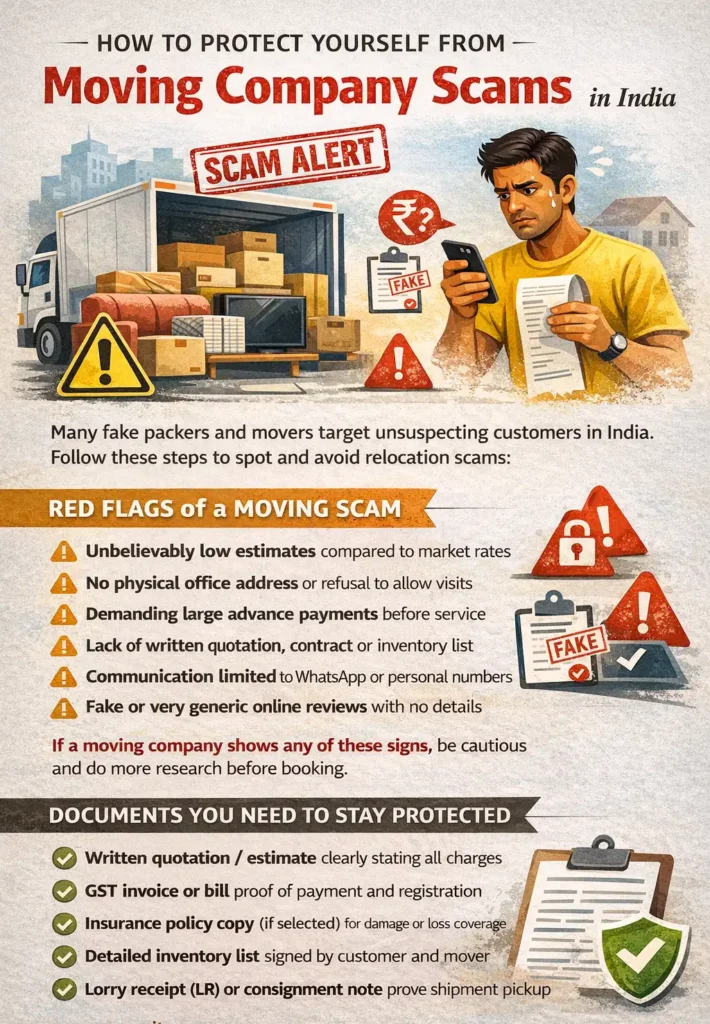
Essential documents to collect before and during the move:
- Written quotation / estimate
Should clearly mention services included, charges, and payment terms. - GST invoice or bill
Confirms that the company is legally registered and provides proof of payment. - Insurance policy copy (if opted)
Must clearly state coverage amount, policy number, and insured items. - Detailed inventory list
Itemized list of all household goods, signed by both customer and mover. - Lorry Receipt (LR) or consignment note
Acts as transport proof for intercity or interstate moves.
Why these documents matter
Document | Purpose |
Quotation | Prevents sudden price hikes |
GST invoice | Enables formal complaints and claims |
Insurance policy | Required for damage or loss claims |
Inventory list | Proof of items handed over |
LR / Consignment note | Tracks shipment during transit |
Without these documents, customers may find it difficult to prove negligence, file insurance claims, or approach consumer forums.
Red Flags That Indicate a Moving Scam
Spotting early warning signs can help you avoid fraudulent packers and movers before any damage is done. Many relocation scams follow similar patterns, making them easier to identify if you know what to look for.
Customers who reported moving frauds often ignored one or more of these red flags during the booking process.
Common red flags you should not ignore:
- Extremely low quotations compared to market rates
- No physical office address or refusal to allow office visits
- Asking for full or large advance payments before service
- No written estimate, contract, or inventory list
- Communication limited to WhatsApp or personal mobile numbers
- Vague answers about insurance, GST, or delivery timelines
- Fake or overly generic online reviews
Quick Red Flag Checklist
Red Flag | Risk Level |
Lowest price without survey | High |
No documents or invoices | High |
Pressure to pay immediately | High |
No office verification | High |
Verbal promises only | Medium–High |
Ignoring these signs increases the likelihood of facing price hikes, delivery delays, or loss of goods. Being cautious during the initial interaction stage is the simplest way to prevent most moving scams.
What to Do If You’ve Been Scammed by a Moving Company
If you believe you’ve been scammed by a packers and movers company, taking timely and structured action can improve your chances of recovery. Indian consumers have multiple official channels to report relocation frauds, especially when proper documents and payment proofs are available.
The first step is to document everything—payment receipts, call records, WhatsApp chats, quotations, invoices, inventory lists, and delivery timelines. These records are essential for any formal complaint or legal action.
Immediate steps you should take:
- Raise a written complaint with the moving company
Send a formal complaint via email or registered post, clearly stating the issue and expected resolution within a defined timeline. - Register a complaint with the National Consumer Helpline (NCH)
Consumers can file complaints online or via toll-free numbers for services-related disputes, including packers and movers.
Approach the Consumer Commission (Consumer Court)
Relocation services fall under “services” covered by consumer protection laws. You can file a case through online consumer grievance portals if the issue remains unresolved. - File a police complaint or FIR in case of fraud or cheating
If the scam involves intentional cheating, non-delivery, or disappearance after payment, a police complaint may be lodged at the local police station. - Report online payment fraud to the Cyber Crime Portal
For UPI or digital payment scams, complaints can be filed on the national cybercrime portal or by calling the dedicated helpline number.
Hiring verified professionals in the first place significantly reduces the risk of facing such disputes.
Where to escalate based on the issue
Issue Type | Recommended Action |
Price hike / service deficiency | Consumer Helpline / Consumer Commission |
Non-delivery of goods | Police complaint + Consumer Forum |
Online payment fraud | Cyber Crime Portal |
Consumer Forum (with documents) |
Acting quickly and using the right channel improves the chances of resolution and prevents further losses.
FAQs on Moving Company Scams
Yes, relocation-related scams are frequently reported across Indian cities. Complaints commonly involve fake movers, sudden price hikes, delivery delays, and missing or damaged household goods.
Paying a small token amount after verification is common, but paying the full amount in advance significantly increases the risk of fraud. Many scam cases involve movers disappearing after receiving large advance payments.
Genuine movers generally collect a limited advance to confirm bookings, with the remaining payment due after loading or delivery. Full upfront payment without documentation is a warning sign.
You should verify the company’s physical office address, GST registration, written quotation, and documentation before booking. Avoid companies that rely only on phone calls and WhatsApp communication.
Key documents include a written quotation, GST invoice, insurance policy (if opted), detailed inventory list, and lorry receipt for intercity moves. These documents are essential for complaints and claims.
If goods are being held or delivery is delayed intentionally, document all communication and raise a formal complaint. You can approach consumer forums or file a police complaint depending on the severity of the issue.
Don’t risk fake movers, hidden charges, or delayed delivery. Book your move through 6 Packers And Movers in Bangalore and connect with verified, document-checked relocation professionals. Don’t risk fake movers, hidden charges, or delayed delivery. Book your move through 6 Packers And Movers and connect with verified, document-checked relocation professionals.